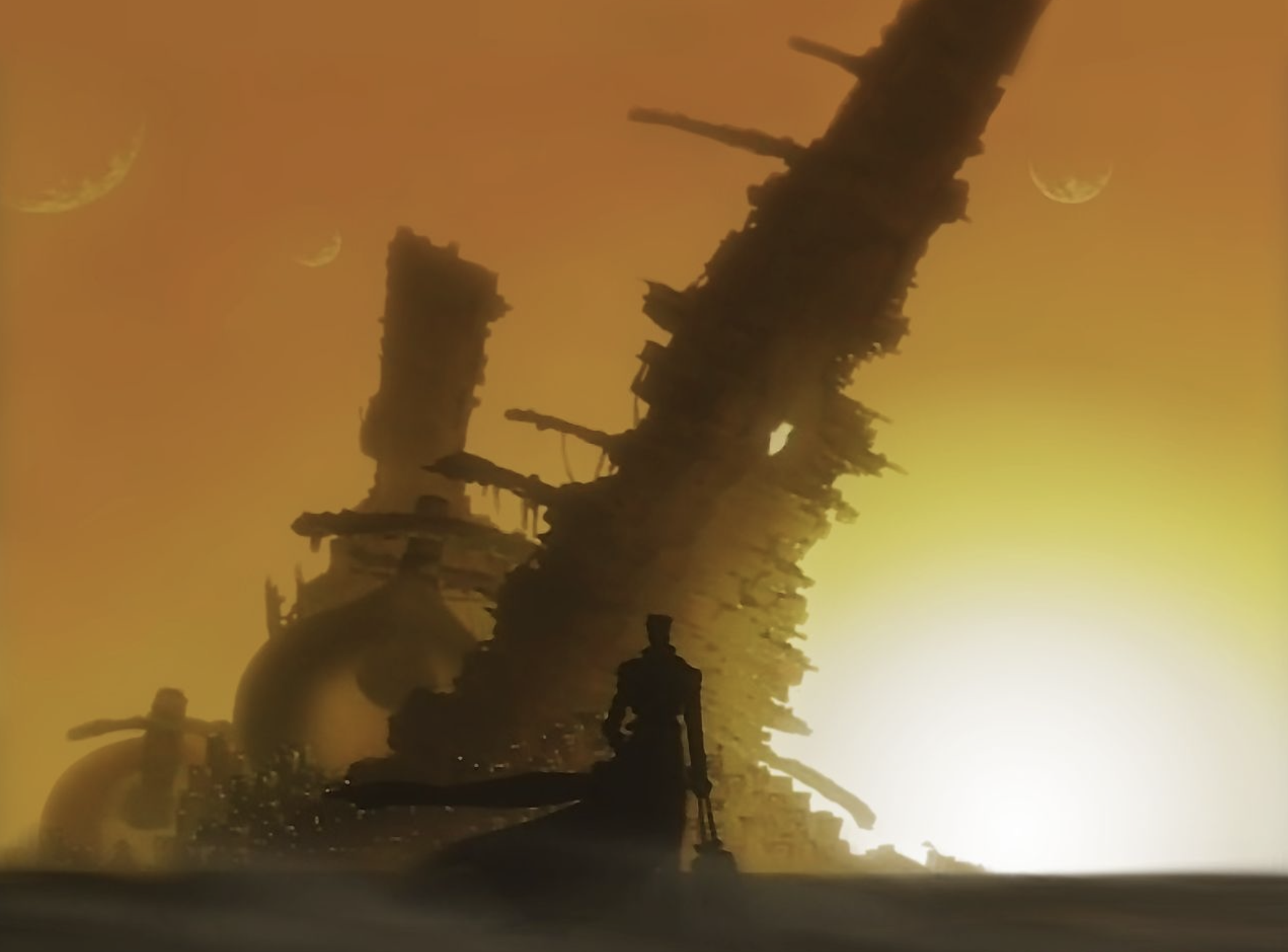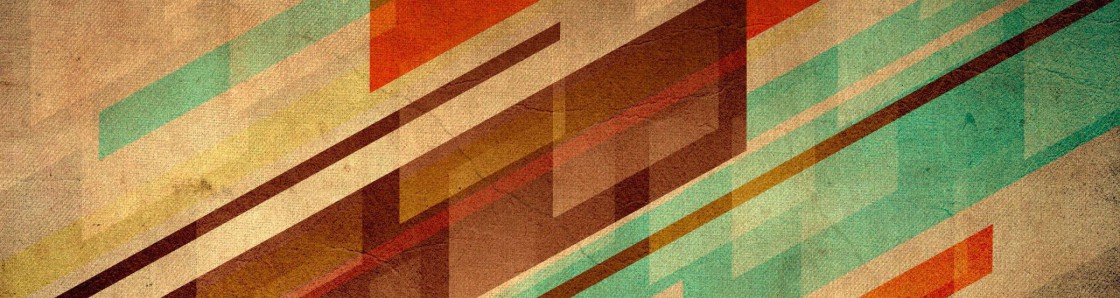
Princess Mononoke forest art background by Nico Yamamoto

“The Forest Within Japanese Hearts”: A Guide to Understanding the Ghibli Greenwood


“. . . I think trees represent something I inherited from far, far in the past. There is something psychological here, for I obviously feel that a landscape with trees is preferable to scenes without them . . . There is also a big difference between realizing and not realizing that the trees alive today have been living on this earth far longer than we humans can even imagine.” 

(Hayao Miyazaki, Starting Point: 1979–1996, p. 163)


I’ve Been Lost in the Woods

My 2023 summer screening experience of Nausicaä of the Valley of the Wind (1984) was perhaps one of the most probing watches of a Studio Ghibli film ever. This was not my first go-round with Nausicaä (my family has owned a DVD copy of it since my childhood), but I’m willing to call it the viewing where I actually understood more of what was happening than not. 

Nausicaä is neither a convoluted film nor a particularly difficult one to understand. Anyone who watches it generally takes note of themes like compassion for the other, exploitation of natural resources, and struggles for ecological balance to name a few. And many, many viewers become sucked in by the gravity of Nausicaä’s glowing forestscape, which is exactly where I’ve been wandering since that 2023 theatrical showing. At some point, I felt compelled to order a dinged up yet discounted copy of the Nausicaä manga courtesy of VIZ and RightStuf (R.I.P.), yet I shelved it upon arrival for future me to explore.

Flash forward to the following summer and I find myself this time at a showing of Princess Mononoke (1997). Now, GKIDS has been graciously offering “Ghibli Fest” screenings for several years. What brought me to see this Miyazaki masterpiece specifically one year after the previous? I’m blaming it on the trees, for when I walked out of the theater and warmly beheld the setting summer sun, I felt a burning resolve to learn more about forests in Japan. As soon as I returned home, I ordered books, cleared off my table, and let the stacks grow until they toppled over. 

It’s now January 2025, and after procrastinating on writing something blog-worthy to encapsulate “where” I’ve been the past year and a half, I’ve decided that I’m ready to turn the leaf and confront the forest head-on. Here is how I learned more about the history and geography of Japanese forests through Hayao Miyazaki and Studio Ghibli.

Why a “Guide” Instead of an Analysis?

In an age where we have access to anything we could ever want to know, right at our fingertips, we have become consumers who seek only the answers to surface-level questions and some of life’s greatest dilemmas alike, and we have neglected the vital process of learning through experience and reading. By my handpicking these films, essays, and excerpts and organizing them in a methodical and practical way for you yourself to learn what these works are doing and how they are doing it, you will walk away with an immensely richer and profoundly deeper understanding of forests in Ghibli works—that, I promise you. Hard work offers fulfillment. Miyazaki himself says it best: “To want to work is to want to live” (Turning Point: 1997–2008, p. 240). If you truly want to get in the weeds of this topic like I did, then it’s time to roll up your sleeves.

The subject of this post is not what I learned, but how I learned. There are countless reviews, both formal analyses and informal reflections, written posts and published videos, that cover what we can learn from Ghibli works. I might contribute to that discussion, but that’s for a different post. My intent here is to show you how I stumbled into this topic, hence this diary of an opener. I want to document how I became lost in the forest’s vastness and offer you a guide to staying above the treetops (or more of a thread to trace) should you find yourself also wanting an invitation to this little party in the woods. (No weird stuff, unless you count the clattering kodama.) Just know, though, that life starts on the forest floor—down in the weeds, the burrows, and the soil itself. It’s a little more fun there, anyhow.

If you know of other supplemental materials to this broad topic of “Ghibli forests,” leave a comment below. If it’s knowledge you’re willing to share, I welcome your recommendations.

So, Where to Start?

I’m no forest ranger (nor much of an outdoors person, really), but I do know that most if not all forests have multiple entrances. Naturally, so do we, too, have many options for embarking on our journey. Of course, whenever “starting” is concerned, I will never fault one for defaulting to theatrical release order. Much insight can be gained by tracking how a writer or director progresses through their career. However, given the universality of Ghibli these days, chances are high that you’ve seen one of their films already; you already have memories and visitations with one or more of these titles, and a truly “ blind chronological viewing” may seem less attainable. 

To me, it’s more fruitful to consider the scope of each major Studio Ghibli film that centers “the forest” as its setting. Three major films come to mind: Nausicaä of the Valley of the Wind (1984), My Neighbor Totoro (1988), and Princess Mononoke (1997). While most materials I fold under each major film are directly related to said film, some works are ancillary. So, I want you to consider this method of organization as well: 

  • To humanity, from the past
  • To humanity, from the future
  • To humanity, living in the present

As I’ve read more essays and speeches by Miyazaki, I’ve come to see him as a man of many contradictions. Publicly, we perceive him as a genius who gripes endlessly about how miserable life in present-day society is—whether in the 80s, 2000s, or now—which consistently leads to further disgruntlement with matters concerning our bleakening future. At the same time, he remains optimistic about children, their innocence, and their ability to make positive impacts. (I wonder how much this has changed since his interviews in the early 2000s . . .) In private, Miyazaki has devoted much time to unraveling the mysteries of Japan’s ancient past. And, while a childlike fascination pokes through his musings on what life must’ve been like during the Jōmon, Heian, or Muromachi periods, he openly confesses that life “back then” also had its abundant misfortunes. Wherever there are people, there are problems, it seems.

What I’m trying to get at is that Miyazaki’s intentions with communicating timely issues are also informed by the genre types his works resemble: historical fantasy (period drama, specifically jidaigeki style), post-apocalyptic fantasy, and rural fantasy. This is where I derive the aforementioned past-future-present structure from. 

Thus, let me then offer you the roots, bark, and branches for this method of attack, starting with what can only be described as one of anime’s most compelling and cinematic experiences to date. That’s right. We first head off to industrial Irontown where the fierce Lady Eboshi wages a one-sided war with the creatures of the forest—and the forest itself. 

Forest of Historical Fantasy

“There is a religious feeling that remains to this day in many Japanese. It is a belief that there is a very pure place deep within our country where people are not to enter. In that place clear water flows and nourishes the deep forests . . . The forest that is the setting for Princess Mononoke is not drawn from an actual forest. Rather, it is a depiction of the forest that has existed within the hearts of Japanese from ancient times.” 

(Hayao Miyazaki, Turning Point: 1997–2008, p. 88)


WATCH: Princess Mononoke (1997)

I fancy beginning with a watch of Princess Mononoke because it packs a whole lot into its 133 minutes while feeling complete on its own. You are introduced to conflicts that form the epicenter of the whole reason why we feel this disconnect with nature to begin with: nature vs. industry, humanity vs. spirit, tradition vs. change. With its sweeping visuals and epic scale, the film invites the viewer to explore what it means not only for one person “to live” but for tribes of people, races of creatures, and forces of nature to all “live” within the same world, even if they exist so in cyclical conflict. 

SUPPLEMENT: The Art of Princess Mononoke (VIZ Media)*

After enjoying such an incredible film, re-experience the magic of the forest with its art book! Notice the contrast in surroundings between Emishi Village and the Tatara Ironworking Clan. Most of those lush forest backgrounds can be found in the “Forest of the Deer God” section (pp. 83-115). VIZ has released English editions of these art books for each Ghibli film by Miyazaki, so check out the art books for the other films mentioned in this guide too.  

*At some point before or after the film, be sure to read the director’s statement “The Battle Between Humans and Ferocious Gods” dated April 19, 1995. You can find it online or printed in various locations: The Art of Princess Mononoke (p. 12), Starting Point: 1979–1996 (p. 272; slight differences due to being a planning memo), Turning Point: 1997–2008 (p. 15), and the GKIDS Blu-ray release insert (p. 5). I always enjoy reading statements like these prior to watching a film, but I can respect wanting a 100% blind experience for first-time viewers. 

READ: Starting Point: 1979–1996 (VIZ Media)

The two essay and interview collections by Hayao Miyazaki are DENSE but fascinating to read, whether by section as needed or straight through like I did. I recommend the entire publication, but relevant passages and starting pages are as follows:

  • Princess Mononoke Planning Memo (p. 272)
  • About Period Dramas (p. 132)
  • The Power of the Single Shot (p. 158)

READ: Turning Point: 1997–2008 (VIZ Media)

Unlike Starting Point, which describes many of the early ventures leading up to some of Miyazaki’s biggest works of the 2000s era, Turning Point goes all-in on five distinct and classic titles. Princess Mononoke starts the ball of this 450-page book rolling with nearly 200 pages dedicated to it and other social happenings as the film was being made. Really, it’s all insightful knowledge, but the following excerpts especially set a solid groundwork for the next leg of our forest journey.

  • The Battle Between Humans and Ferocious Gods—The Goal of This Film (p. 15)
  • The People Who Were Lost (p. 20; poem)
  • Kodama Tree Spirits (p. 24; poem)
  • The Forest of the Deer God (Forest Spirit) (p. 26; poem)
  • The Elemental Power of the Forest Also Lives Within the Hearts of Human Beings (p. 27)
  • Those Who Live in the Natural World All Have the Same Values (p. 38)
  • You Cannot Depict the Wild Without Showing Its Brutality and Cruelty: A Dialogue with Tadao Satō (p. 42; comments on the tagline “Live” on p. 54)
  • Princess Mononoke and the Attraction of Medieval Times: A Dialogue with Yoshihiko Amino (p. 60)
  • Forty-four Questions on Princess Mononoke for Director Hayao Miyazaki from International Journalists at the Berlin International Film Festival (p. 79; comments on how “The kodama came from the eeriness and mysteriousness of the forest” on p. 82; comments on the “depiction of the forest that has existed within the hearts of Japanese from ancient times” on p. 88; comments alluding to biocentrism vs. anthropocentrism debate on p. 90) 
  • Animation and Animism: Thoughts on the Living “Forest” (p. 94)
  • We Should Each Start Doing What We Can (p. 276)

WATCH: The Man Who Planted Trees (1987)

This 30-minute animated short film directed by Frédéric Back (based on Jean Giono’s 1953 short story) is a source of personal inspiration for countless animators, Hayao Miyazaki and Isao Takahata included. At its core is the simple ethos of “paying kindness forward by hard, consistent work,” yet the film’s animation of plants is constantly vibrant and full of motion. Back was a master of the craft, no doubt, and while viewing it online in 480p is far from ideal, you can watch his work HERE on YouTube for free. 

After watching this, return to Starting Point: 1979–1996 and read “Having Seen The Man Who Planted Trees (p. 143) for brief comments by Miyazaki himself. Ghibli director Isao Takahata’s love for the film is mentioned in other documentaries as well, namely Journey of the Heart: Conversations With The Man Who Planted Trees. Traveler: Isao Takahata (1998). 

And now, to get to the heart of these matters concerning the forest, we actually head out to a valley. A valley of the wind. 

Forest of Post-Apocalyptic Fantasy

“I’m sometimes asked what it is about trees that I find so attractive. But it seems to me that even the question represents the height of irreverence. After all, our lives depend on trees, and we exist at their mercy. For example, I believe that we will one day pay a terrible price if people arrogantly and indiscriminately destroy forests, simply because they want ‘a more profitable use of the land.’ In fact, we’re already paying the price.” 

(Hayao Miyazaki, Turning Point: 1997–2008, p. 276)


WATCH: Nausicaä of the Valley of the Wind (1984)*

For people unacquainted with Nausicaä in any form, I will almost always fight for a film watch prior to reading the manga. Hear me out. The film is a good one. It has spellbound literally generations of aspiring artists, animators, and anime fans, and you will never regret being able to say “The manga was better” over “The movie was terrible.” Because it’s not, and now you know. 

Personal opinions aside, a watch of the film before a read of the manga might also be wise since the manga didn’t conclude until 1994 with over 12 years in the making. Miyazaki’s editor paused the manga’s serialization several times to allow the writer/director/artist to clear his head by working on films. (Or maybe it was the other way around; Starting Point provides the full picture.) Although the final theatrical product reflects characters, ideas, and setting details from only the first part of the manga, it remains historical in its effect of inspiring all who witness the flurry of forest life bursting forth from the Sea of Corruption. 

*Don’t forget to read the statements from Toshio Suzuki (2010), Hayao Miyazaki (1983), and Isao Takahata (1983) before OR after watching the film. The only format I presently own these in is the GKIDS Blu-ray release insert, though I’m sure they can be found online or in print elsewhere. 

READ: Starting Point: 1979–1996 (VIZ Media)

We’re back to reinforce our film watching with essays, interviews, and other tangents from the director himself. Because this is the only Miyazaki film with a manga adaptation penned by the director, the dual perspective is fascinating to read up on from a creation standpoint. Read any of this before, while, or after reading the manga. Then, focus on the forests, which I’ve done for you by selecting these particular passages:

  • On the Banks of the Sea of Decay (p. 165)
  • About Ryōtarō Shiba-san (p. 211)
  • On Nausicaä (p. 283)
  • On Completing Nausicaä of the Valley of the Wind (p. 390; about the manga)
  • Earth’s Environment as Metaphor (p. 414)

READ: Nausicaä of the Valley of the Wind (VIZ Media)

Of course, if you start with the film, you’re more likely to appreciate what the animated story has going for it. If you’re in the manga-first camp (a rare breed), then you probably don’t bat an eye at the film, and that’s ok. The Nausicaä manga is one of the most significant achievements in comics, but I probably didn’t need to tell you that. As someone who only finished reading it for the first time at the end of 2024, I was stunned by the piece. Through the Daikosho, we see how reclamation of forest land can be both a natural process and one that’s artificially engineered. And with the theatrical tagline of Princess Mononoke sharing the same word as the final line of the Nausicaä manga—that we must “live”—I surrender to the hope that no matter how much of the forest we take, the forest will find a way to live on—to outgrow us, even. 

Forests of Rural and Urban Fantasy

“We Japanese have changed our environment so much that we must either change ourselves or, clinging to our memories of the past, try to regenerate the trees that once functioned as our mother. That doesn’t mean, of course, that we should think of protecting the environment to the exclusion of all else, because we do ride in automobiles. We must live with contradictions . . . [A]s with films about trees, I hope I can maintain the perspective that the midges in the ditch near my house are just as important as the prized sweetfish in the clean waters of the Shimanto River.”

(Hayao Miyazaki, Starting Point: 1979–1996, p. 163-64)


WATCH: My Neighbor Totoro (1988)*

By this point, we’ve relived the violent past and taken a glimpse into the war-torn future. What is left of the forest in the present? Well, one could definitely say it’s facing a “quickening end” of sorts. As we continue to permit rapid urbanization, expanding cityscapes, and reckless waste, we trade off forest life for our own proliferation. After Nausicaä learns the truth of the Daikosho, who’s to say what the real virus is: a biological toxin born of natural processes and synthetic manipulation, or unchecked human greed. Both stink, that’s for sure. At least we still have Totoro, right?

Although My Neighbor Totoro was released almost a decade before Princess Mononoke, I find its optimistic spirit a far more pleasant cushion for facing the end times. Part of this motivation circles back to Miyazaki’s own fondness for the children growing up in society. Even when we grumble at a weed poking through the pavement, children can still find beauty in the bramble. The forest trees loom large over Mei and Satsuki’s heads, and their joyous wonder is both amusing and contagious. In a way, the forest and its Totoro give the girls energy and awe out in Japan’s quiet countryside. 

*Don’t forget to read the statements from Toshio Suzuki (2012) and Hayao Miyazaki (1986) before OR after watching the film. The only format I presently own these in is the GKIDS Blu-ray release insert, though the director’s statement can also be found in Starting Point: 1979–1996 (p. 255; project plan with more details) and The Art of My Neighbor Totoro (VIZ Media). 

READ: Starting Point: 1979–1996 (VIZ Media)

You saw this coming. Flip open your mangled, marked-up, sticky-noted copy of Starting Point and get to readin’! Oh, does only mine look like that? Huh. 

  • Project Plan for My Neighbor Totoro (p. 255)
  • The Type of Film I’d Like to Create (p. 148)
  • Things That Live in a Tree (p. 162)
  • Totoro Was Not Made as a Nostalgia Piece (p. 350; there are also comments on Kazuo Oga’s artwork)

WATCH: Pom Poko (1994)*

Remember when I said that several Ghibli works approach themes of nature and environmentalism? Pom Poko (1994) is Isao Takahata’s highly beloved crack at the topic, and he does more than snap a few branches. Takahata’s tale of tanuki going “over the hedge” is a landmark in showcasing the modern plight of Japanese forest conservationists. Through depictions across changing seasons in Japan, the film paints over pastoral forest life as urbanity creeps over the canopies one concrete apartment complex at a time. “The forest is magical” is oft cited by Ghibli fans. Between whimsical Totoro, whispering kodama, and wild tanuki, perhaps the forest’s denizens possess equal ability to charm us. 

*Don’t forget to read the statements from Toshio Suzuki (2013) and Isao Takahata (1994) before OR after watching the film. The only format I presently own these in is the GKIDS Blu-ray release insert, though I’m sure they can be found online or in print elsewhere. 

SUPPLEMENT: Kazuo Oga Art Collection I & II (Tokuma Shoten)

We’ve spent so much time admiring the forest through text and animation, but we’ve labored little in studying the foliage up close. Kazuo Oga is not only a famed background artist but also a brilliant art director. His art directorship notably includes My Neighbor Totoro, Only Yesterday, Pom Poko, Princess Mononoke, and The Tale of Princess Kaguya—all Ghibli works where nature plays a star role. Oga’s background art spreads across too many masterful canvases to name here: Panda! Go, Panda!, Kiki’s Delivery Service, Porco Rosso, Whisper of the Heart, Spirited Away—You get the picture. He’s one of a powerhouse team that has fueled the  “Studio Ghibli aesthetic” for decades. And for Princess Mononoke, he traveled far out to the Shirakami-Sanchi mountains to draw inspiration for the Emishi village.

Kazuo Oga’s art collections aren’t available under a U.S. license, but if you can get your hands on at least one of them, you’ll have a friend for life. Let’s spend some time soaking in his legendary forestscapes. If you’re not sure what to “look” for, consider starting with this note, a reflection from Kazuo Oga himself when Miyazaki first critiqued his forest artwork (p. 53):

“I gradually came to understand that I would not be able to achieve the picture that Miyazaki was looking for unless I paid more attention to the relationship between light and subdued colors. Until then, I had drawn trees rather symbolically . . . But I began to feel that I needed to carefully incorporate the many other trees and plants that we don’t usually notice, and the colors of the walls and pillars inside a room . . . The color of the pillars also changes depending on how the light hits them . . .”  

Isao Takahata on Oga’s art direction (p. 88):

“Each plant and object is modest, neither standing out nor blending in, but each one exists properly, alive and well. And how charming it is to see them all blend together in a modest way.” 

(Quotes are rough translations from Art Collection I via Google Lens.)

Other Ghibli Works to Support Your Forest Expedition


“Even though we [Japanese] have become a modern people, we still feel that there is a place where, if we go deep into the mountains, we can find a forest full of beautiful greenery and pure running water that is like a dreamscape . . . Deep in the forest there is something sacred that exists without a perceptible function. That is the central core, the navel, of the world, and we want to return in time to that pure place.”

(Hayao Miyazaki, Turning Point: 1997–2008, p. 36)


WATCH: Castle in the Sky (1986)

The woes of unchecked technological achievement displacing natural biomes forms a fictional historical backdrop in Laputa. Forests aren’t the center attraction per se, but once you consider the resource tradeoffs an ancient civilization made to create high-flying machines and castles . . . Plus, the overgrowth on Laputa is positively wild, almost as if the trees are reclaiming the castle itself.

WATCH: Kiki’s Delivery Service (1989)

Have you ever felt the urge to escape into the woods, to lose yourself in a place of quiet and sort out all of life’s troubles? Kiki’s retreat to Ursula’s cabin is perhaps one of the most convincing scenes of nature (particularly the forest) offering sanctuary for someone who’s lost their motivation AND rediscovered their creativity—their drive, their spirit—through nature. And I’d fight to keep the film on this “forest guide” if only for an illustrative moment like this. 

WATCH: Only Yesterday (1991)

Taeko takes Kiki’s night journey to another level when she decides to revisit her relatives in the countryside. Nature and nostalgia weave together unexpectedly, and past memories bubble forth as Taeko reconnects with the mundane joys of outdoor living. There are many, many flourishing fields and flowers (in no small part thanks to Kazuo Oga), but it’s those majestic mountain forests that give Only Yesterday its sense that love can be expansive, at times arresting, yet always on the horizon.

READ: Shuna’s Journey (1983)

Miyazaki’s only standalone emonogatari (illustrated story) book is a moving work on its own, and it’s an even stronger thematic supplement to Nausicaä and Princess Mononoke especially where nature is visualized. The forest center as a mysterious paradise or “heart” which is home to the collective pulse of all ancient life is a frequently revisited motif in Miyazaki’s works. Given Shuna’s early 1983 publication date, it’s no wonder that the story sowed the creative seeds for many other recurring images, themes, and setting details.  

SUPPLEMENT: Hayao Miyazaki (Academy Museum)

Such a dense archival book (both for information and artwork) is worth looking into for forest matters if only because the publication itself highlights Miyazaki’s forests in specific sections. These bits are of special note for us:

  • Creating Worlds (p. 121)
  • Totoro and the Mother Tree (p. 151)
  • The Forest, Kodama, and the Deer God (p. 157)
  • Nature and Nostalgia (p. 200)
  • Magical Forest (p. 250)

SUPPLEMENT: Studio Ghibli: Architecture in Animation (VIZ Media)

Wait, what does architecture have to do with nature? If you’ve watched any Ghibli film, then you’d know that the two come hand-in-hand. Architectural historian Terunobu Fujimori has put together a way to absorb and analyze Ghibli backgrounds that transcends the traditional art book experience of awe and admiration. His commentaries on the “Point of Contact Between Nature and Artifice” and “Forestry Society” (p. 25) are especially insightful. 

Towards Greener Pastures: Ghibli-Adjacent Works


“The major characteristic of Studio Ghibli—not just myself—is the way we depict nature. We don’t subordinate the natural setting to the characters. Our way of thinking is that nature exists and human beings exist within it.” 

(Hayao Miyazaki, Turning Point: 1997–2008, p. 90)


READ: The Easy Life in Kamusari (Shion Miura)

This slow-going, slice-of-life novel follows Yuki Hirano, a fresh-out-of-high-school bum who is sent out to the remote mountain village of Kamusari to earn some income through a forestry training program. Although he’s distanced from technology, friends, and popular society itself, Yuki eventually takes on the natural and practical challenges the mountain poses and comes to appreciate the forest for the trees. Shion Miura (The Great Passage, Run with the Wind) pens a teenage boy’s point-of-view with all its growing pains, even referencing a certain Ghibli film to describe the reverential movement of snow-like spores floating above the forest range. 

READ: Sweet Bean Paste (Durian Sukegawa)

An international bestseller, Sweet Bean Paste might not have anything to do with forests, but it does discuss the misery, stigma, and effects of a certain disease outbreak and Japan’s historical mistreatment of those affected. I offer it here because, while Miyazaki was working on Princess Mononoke, he would frequently visit the sanatorium grounds (which is next to its museum) and ponder deeply and sincerely about those who suffered. This became part of the inspiration for the infected Prince Ashitaka who henceforth embarks through dense forests to find himself a cure. Sukegawa’s book is also flat-out remarkable for its equally endearing, admirable characters. 

READ: Once and Forever: The Tales of Kenji Miyazawa

I haven’t actually read this particular collection of Miyazawa’s classic, fablesque short story writing, but I do know two things: 1) the late philosopher Takeshi Umehara (in an interview with Hayao Miyazaki) cites Kenji Miyazawa as one of “two poets of the forest,” the other being Kumagusu Minakata (Turning Point: 1997–2008, pg. 103); and 2) the NYRB publication of Miyazawa’s collected tales features giant trees on the cover. As a follow-up to this forest journey, this book will be one of my next immediate reads. 

WATCH: Mushi-Shi (2005)

There are probably a hundred excellent anime out there that make intellectual, philosophical, and spiritual commentary on the forest like Studio Ghibli works do, but few are more patient than Mushi-Shi. You follow Ginko, an investigator of sorts with the rare ability “to peer into the places where the mushi hide in plain sight,” the mushi being the unexplainable, unseen creatures of nature which have silently attached themselves to our lives. For Ginko, exploring dark forest depths is par for the course, and how he conducts himself in nature is a philosophy in itself. 

SUPPLEMENT: Kawase Hasui Artworks – Enlarged Revised Edition (Tokyo Bijutsu)

For this recommendation, any Kawase Hasui art book would do, but I really like this one. A printmaker of the shin-hanga “new prints” movement, Hasui combines the ukiyo-e “floating world” style while incorporating Western atmospheric effects and natural lighting (two attributes which Kazuo Oga strove for in his backgrounds for Ghibli). Since Hasui specialized in landscapes, you will find lots of 20th century (or older) architecture and nature depictions across all seasons and weather types. Studying the shift from traditional two-dimensional ukiyo-e to Hasui’s blended Eastern-Western style and all the way up to Oga’s Western style with Eastern subjects is rewarding on its own. The forest has been a world of inspiration for artists of all forms—and of all generations. 

SUPPLEMENT: Art Books by Nizo Yamamoto (Various)

I wanted to squeeze one final recommendation that’s not pictured anywhere in this post. Nizo Yamamoto was an art director and background artist like Kazuo Oga who produced nature art for several Studio Ghibli projects (including the background used in this post’s header graphic). Sadly, he passed away in 2023, but his style is timeless. You can find various art books by the late artist still in print.  

Planting a Seed (i.e., What’s Next?)


At just over 5,000 words, this is a project that I’m happy to finally see through to completion. I’ve had reference materials, sticky notes, and midnight movie viewings filling up my creative space for some time, and it’s satisfying to return them each to their respective home on my shelves. One thing you may have noticed is that there’s not much for video or online article sources cited here. That was intentional. With so many materials physically published and Blu-rays released, I wanted to revel in the analog for this project. A quick YouTube search on this topic or adjacent ones will likely spit out what you want, anyhow; this was a purely personal journey, and I simply wanted to share my close-reading methods with you. 

That said, with the popularity of the video guide format, I might make a video version of this post for my YouTube channel. It could prove equally fun to hop behind the camera and thumb through the pages for y’all, but no promises. As for other Ghibli posts, Hayao Miyazaki made the forest a real character through his films, yet one could argue he’s even more famous for his films depicting aviation and other magical worlds. Until I find a new topic to obsess over, we’ll leave it at the trees for now.

To completely pivot, I’ve got a smaller project on the complete opposite topic currently in the works. Did you guess sci-fi cityscapes in anime? Hah! Think of it as a direct response to this post about life on the forest floor. Throughout fall 2024, I was able to escape into both of these vastly diverse settings. I can’t wait to show you that other half which calls out to me. 

Also, I haven’t forgotten about the Makoto Shinkai “revisit” project I started last year! It got shelved for a bit due to other intervening interests, but I do plan to produce something worth reading. Lastly, as February draws nearer, my annual “V-Day Special” anime marathon awaits. More TBA soon. 

If you made it to the end, I hope this guide will prove OR has proven helpful to your own understanding of Ghibli forests and nature more broadly. Thank you for your time, and happy reading! 

– Takuto 

Sailor Moon “Black Moon Arc” Themes, Motifs, & Symbols

This is PART II of the Sailor Moon analysis series. Click here for PART I “Dark Kingdom Arc.”


Welcome to the long-awaited continuation of this Sailor Moon light analysis series! Like I did in my overview of themes, motifs, and symbols in Sailor Moon‘s “Dark Kingdom Arc,” I want to try veering off the traditional review path and instead focus on some of the thematic devices and elements in my favorite manga or anime series. These posts will not aim to critically analyze elements of the work but rather provide a leaping-off point to prompt your own discussions. I encourage readers to use this post as they see fit (just be sure to tag me and link this page), and I hope you will find it useful!

The themes, motifs, and symbols discussed here pertain specifically to the “Black Moon Arc” of Naoko Takeuchi’s Sailor Moon manga and the Sailor Moon Crystal anime series. Other themes, motifs, and symbols may also apply, though I plan to save those devices for future posts where they are more relevant in other parts of the franchise (like the use of dreams inSuperS). At the same time, I’ll avoid repeating any items from previous posts because, like most series, Sailor Moon tends to build off of existing groundwork as the story progresses. As such, this listing is by no means exhaustive, but it should help anyone trying to understand how some of the thematic devices function within the narrative. SPOILERS AHEAD!

Themes


Desire as a Slippery Slope to Possession

It’s no coincidence that the classic anime refigures the “Black Moon Arc” as Sailor Moon R, an R which is commonly believed to signify “Romance,” “Return,” or “Rose.” Plights of desire and envy ignite every moment with new layers of meaning to the word “romance.” Prince Demande’s overwhelming desire to capture Neo Queen Serenity and demonstrate his mastery is a clear twisting of the romance shared between the Queen and her King Endymion. Endymion stands behind Serenity as an act of giving love, while Demande, well, demands that possessing Serenity and her Silver Crystal is the only way to effectively communicate his desires. In truth, Demande likely felt “bewitched” by her superiority, and so he tries to place a bell jar over his love out of an unwillingness to accept that her strength—her capacity to love—is greater than his own.

Duplicity Is Deception

Doppelgängers or mirror personalities loom in the shadows of many characters, reflecting both a semblance of repressed desires and a gross exaggeration of said truth. Tiny Chibiusa has bold Black Lady, the Queen of Nemesis cloaked with power AND the man of her dreams at her beck and call. Little does she realize that a more earnest sense of self awaits around the corner in the form of Sailor Chibi Moon. Sailor Moon (or Neo Queen Serenity) has the submissive, altered version that exists in Prince Demande’s evil eye(s). All of the Black Moon members bear desires original to them that are buried beneath Wiseman’s hypnotic effects. And even Wiseman himself masks his true form as Death Phantom, shedding his layers of deception only as the Senshi are able to wipe away each one.

Distance Breeds Love and Hate

They say that the farther we are from the ones we cherish most, the stronger our passion for them—and despise for others—can grow. Sailor Pluto, known for residing at the forbidden corridor between space and time, is living proof that experiencing distance from our loved ones can reinforce that same fondness for them. She views the dedication to her task as a positive way to deepen her bonds with the royal family’s members. In a way, she is a foil to Wiseman, who instead of safeguarding space-time hides within its folds, his hatred for Serenity heavy in his heart. On the other hand, both Usagi and Chibiusa view their rotating separation from Mamoru with frustration and jealousy towards the other girl. When one has her moment with Mamoru, the other is often caught up in worry and vexation, however needless it all seems in hindsight. It’s astonishing how a little separation can so drastically affect us.

Isolation Creates an Echo Chamber

For a series about love and romance, many characters across the “Black Moon Arc” experience aching loneliness and anxious ideation from their isolation. On Planet Nemesis, Wiseman stews in his own depravity and torment as a rebel forever banished from humanity on Earth. Rather than use the imprisonment cast by Neo Queen Serenity to reflect on the error of his ways, he mines Planet Nemesis for the Beguiling Black Crystal, a gem which only furthers his corruption. It’s not just the bad guys damaged by isolation, though. In the 30th century, Chibiusa is ostracized by her classmates for being the Queen’s daughter; her mother has much grander ordeals to attend to than child-rearing, and the Inner Senshi often accompany their Queen. The echo chamber of her perceived isolation is exploited when Chibiusa flees to the shadowy edges of space-time and Wiseman lures out these anxieties within her. Of course, there’s also Sailor Pluto whose sole guardianship over space-time leads her to ever wondering if her work and dedication were truly enough to please her Queen and, in ways unrequited, her King.

The Futility of Changing History

After becoming disillusioned by the supposed unaffecting ways of Crystal Tokyo’s monarchal rule, the Black Moon Clan joins forces with Wiseman, a terrorist exiled to the far reaches of space, to travel back to the past and erase the possibility of a new Silver Millennium being created in the 30th century. As the Sailor Guardians thwart every one of the Black Moon Clan’s missions, however, it becomes apparent that history is a fixed constant, one that is futile to change. Even if the Inner Senshi become detained or incapacitated, the lone Guardian of Space-Time can be called upon in their darkest hour.

Critiques of Monarchy and Singular Authority

When the Sailor Guardians make their way to 30th century Crystal Tokyo, they find that Neo Queen Serenity had bricked herself up in the Crystal Palace as a final act of self-preservation. Granted, this decision safeguarded the one hope that could be used against the Black Moon, but it’s this same singular dependance on one figure to constantly save the day that landed Crystal Tokyo in so much trouble when the Black Moon first invaded. According to their account, Neo Queen Serenity only graced the public to protect her people against rare acts of terrorism. She was, to the renegade Black Moon (who were once citizens of Crystal Tokyo themselves) a leader in name only—a concept, even. With all vestiges of celestial power sealed within the slumbering Neo Queen Serenity, it almost begs the same question that the Black Moon propose: Why does a superior 30th-century human race still rely on the crown, and why can’t the radiance of the Silver Crystal—the symbol of monarchal authority—be shared by more than one individual?

Motifs


Blackness

Black Moon. Black Lady. Beguiling Black Crystal, black as the abyss of space. The “Dark Kingdom Arc” introduces a similarly vague word to express the forces of evil, but whereas darkness exists on a spectrum of light, black connotes just that: stark, opaque, dense, and without dimension. The evil present in the second arc of Sailor Moon is far more sinister in scale, and its shadows are twice as black. Interestingly, the notes in the manga describe that the Black Moon Clan members Crimson Rubeus, Verdant Esmeraude, and Azure Saphir unite under Prince Demande as the primary colors found in light (red + green + blue = white). When they are removed from the picture, the light is gone; in their stead, “Black Lady” reigns supreme.

The Future

Anxieties about what the future will bring swirl in the hearts of many. For the girls living in the present, it’s mostly concerns with studies, extracurriculars, and friendships. For all of the “aliens,” this worry is retrograde. Having lived to see 30th century Earth, the Black Moon looks to the past to weed out their future enemies. Likewise, Chibiusa fears the reality that the legendary Sailor Moon of the past may be unable to protect her family in the future. After weighing her future against humanity’s, Sailor Pluto makes the desperate call to stop time in the ultimate showdown against Demande. The future is always at risk, ever slipping between characters’ grasps. Simultaneously, it is that which everyone is living through—a stage of possibility that fluctuates on every whim, breath, and pulse shared by the actors. Regardless of the consequences, it’s Mamoru’s comment that closes out this clash for romance, dominance, and the future: “It wasn’t a dream. It was the story of a future that will be here before we know it.”

Acts of Motherhood

This arc, which is devoted to exploring love and its many different forms, does not neglect the mother-daughter relationship in the slightest. Usagi and Chibiusa’s relationship starts out rough, but the edges start to smooth once the two develop a routine: waking up, going to school, playing at the arcade with friends, fighting over Mamoru’s attention, combatting the forces of evil, and then returning home to sleep and start all over again the next day. In particular, it’s moments when Mamoru is present that Usagi feels the conflict of love, for his caring gaze seems split between the two girls. When Usagi heads to Crystal Tokyo and learns more of Neo Queen Serenity, she starts to adopt a more motherly tone with her future daughter. Furthermore, Usagi’s mother begins to feel the gravity of the cosmos pulling her daughter away from their little home in the Juban District. Even Luna must accept that her daughter Diana knows more about the future and what’s best for everyone than she does (which is a RARE occurrence indeed). It’s the willingness of mothers—Usagi, Ikuko, Luna—to relinquish their daughters and let them experience the world that allows trust to strengthen on both sides.

Spectre and the Supernatural

Between fortune tellings gone awry, UFO sightings on the rise, and urban legends spiraling out of control, the Sailor Guardians do their best to combat the bizarre. The iconically named “Spectre Sisters” adorn the first half of the narrative with poltergeist-level misdemeanors and serial phantom kidnappings. It’s not until a literal “Death Phantom” (AKA Wiseman) conjures stranger images that the whole of space-time becomes at risk of collapse. Even with the anime-original “Doom Tree Arc” included at the start of season two, Sailor Moon R‘s expanded exploration to the dark corners of the solar system are entirely connected under the motif of supernatural happenings. There are some forces out there that simply can’t be explained . . . apparently . . .

Exiles, Outcasts, and Alien Invaders

Along with alien energies and antagonists, there’s a fair amount of invasion occurring on just about every level of human interaction. The obvious one is the Black Moon Clan appearing in strange, UFO-shaped discs of light to abduct people for their schemes. Wiseman is an exile of the gravest kind, a terrorist who led a rebellion against the Silver Millennium and is imprisoned on Planet Nemesis for his crimes. Chibiusa, too, is an invader upon not only the temporal past (and the Door of Space and Time protected by Pluto) but also Mamoru and Usagi’s relationship. Additionally, she regards herself as a kind of outcast from her class and family’s affection back home. Finally, there’s Sailor Pluto whose solitary role lends itself to the outward appearance of being outcast from the other Senshi. Despite their respective distances, the narratives of these exiles, outcasts, and invaders will intermingle and cause ripples of unimagined proportion.

Planet Power

We don’t often regard our planet as possessing its own kind of power, but in 30th century Crystal Tokyo, Earth shines as a jewel across the cosmos. Planet Nemesis, which apparently went undetected for centuries due to the *rare* gravitational phenomonen surrounding it, emerges as a planet of rival energy due to it possessing its own crystal power. This battle between Planet Earth and Planet Nemesis, Mythical Silver Crystal and Beguiling Black Crystal, centers itself as the arc’s grand climax. In response, the Sailor Guardians are granted “Planet Power” for the first time by Neo Queen Serenity. With Earth’s prosperity secured across 20th and 30th centuries, the stage becomes reset for the next arc to begin.

Doors and Keys

The “Black Moon Arc” begins with Chibiusa’s opening of the doors to space-time, and it ends in the same way. Doors represent barriers to forces which we might not be ready to take on . . . yet, anyway. The Door of Space and Time offers entrance to the unfathomable realm of causality. Hence, it is only discussed in hushed whispers, locked by special spatial keys, and watched by a lone protector. Still, Chibiusa hears the rumors, steals the keys, and befriends the solitary Sailor Guardian. She opens doors left and right, willing to cause trouble at every turn if it offers a new chance for her to find strength—and a savior—for the ones she loves. To Chibiusa, behind every door resides new possibilities; one only needs the right key to open them up.

Symbols


Beguiling Black Crystal

Unlike the Mythical Silver Crystal, which is limited to one (“1”) body and wielded by the Silver Millenium, the Beguiling (or Malefic/Evil, depending on translation) Black Crystal is mined and crafted into different shapes and sizes. High-ranking Clan members are bestowed Beguiling Black Crystal Earrings which can channel the power of the main crystal housed within the Black Moon Castle. Asteroid-sized Black Crystals have been used to decimate and weaken Crystal Tokyo with a nuclear power that is instantly reminiscent of the atom bomb. If the Silver Crystal persists in its namesake mercurial nature, slipping in and out of various grasps yet unable to be controlled, the Beguiling Black Crystal beckons each of its many holders forward. Not like quicksilver in the slightest, the Beguiling Black Crystal is ironically clear in its presentation. The Mythical Silver Crystal is an endless fountain of radiant power; the Beguiling Black Crystal, its one true rival force, draws and drains power from its surrounding in wicked supply. As Wiseman states, “The negative energy of the Beguiling Black Crystal that consumes all things, returning them to nothingness. And the infinite positive energy of the Mythical Silver Crystal that grants power to all things, amplifying it beyond measure . . .” Like their respective users, the two crystals symbolize the way we can love others: by giving and showering love, or by stealing it away.

UFOs

The preferred method of travel by the Black Moon invaders resembles (by little coincidence) the primary vehicle of stereotypical alien travel. UFO sightings have been a superstitious craze for decades, centuries even, and Naoko Takeuchi’s decision to incorporate their iconic shape into the story takes the girls’ fascination for urban legends to the next level. In reality, these light-shaped discs are not machines but portals created in the vacuum of space-time. While the Senshi are led to believe the invaders are from outer space, the Black Moon members cleverly withhold a second layer of truth: they are travelers from the distant future.

Luna-P

This gift given by Sailor Pluto to Chibiusa means all the world to the budding Sailor Guardian in pink. The way Chibiusa bounces Luna-P around and performs prankish tricks resembles a child playing with a temari, a Japanese handball used for games. Luna-P seems to house many hidden abilities, but one shouldn’t read too much into it as a sophisticated weapon. Rather, the cat-faced ball is a symbol of youthful mischief, joyful innocence, bountiful luck, divine protection, and above all, the bond between two friends.

Crystal Palace

The attempted siege against the Crystal Palace of 30th century Earth began with Wiseman’s acts of terrorism. Following his mission, the Black Moon became consumed with rage against the crown and its opulence. The Crystal Palace still stands after the carnage, a symbol of the royal family’s resilience to change in more ways than one. Until Sailor Moon can save Crystal Tokyo, the palace acts as a safe house for the slumbering Sailor Guardians and the royal family. After all, only the inheritors of Silver Millennium may draw on the power of the Mythical Silver Crystal. The fallout of Crystal Tokyo is still blatant in its chaotic implications, though; the royal family sleeps safely in the palace while civilian bodies lie strewn along ruined streets. Even Usagi herself contemplates the matter of a “divine right to rule” pounding in her soul: “Is it really the Silver Crystal that plants evil in people’s hearts and makes them fight each other? If the Silver Crystal never existed . . . would history never run off course? Should the Mythical Silver Crystal . . . should I . . . have never existed?”

Evil Eye and Bestial Hands

Beauty is in the eye of the beholder, yet don’t confuse Demande’s bewitching gaze as a mere sign of affection. This power to control and subjugate, along with the Bestial Hands, are bequeathed to Wiseman’s most loyal pawns. The Evil Eye, red with irritation, matches the savage cruelty of the Bestial Hands that go with them. While it’s easy to dismiss them as classic features of fantasy antagonists, one will remember that Wiseman draws his power from the Beguiling Black Crystal on top of years of practicing dark arts. Given Naoko Takeuchi’s background studying science, this could be a dramatization of the mutation caused by the Black Crystal’s radiation and a direct allusion to Japan’s own history with radiation poisoning.

Planet Nemesis

Rumors and theories about a distant 10th planet in the solar system were rampant decades before the dawn of superior-powered telescopes. Nemesis is an extension of this astronomical urban legend given nightmarish form. Comprised of Black Crystal, which was capable of absorbing light and energy much like a black hole, the phantom planet would appear and disappear from Crystal Tokyo’s sensors. As followers of Death Phantom also fled to Nemesis, its powers grew, and the planet began to emit large amounts of negative energy. The planet became synonymous with Death Phantom himself, as symbolized by the loss of his physical body and the binding of his will to Nemesis. For all that was righteous, luminous, and pure about the bygone era of Silver Millennium on the Moon, Nemesis offers the opposite—an all-consuming abyss that feeds off its prisoners.

Usagi’s “Reverie” Dress

Naoko Takeuchi is famous for her fashion tributes and passion for haute couture. When Prince Demande kidnaps Sailor Moon, she awakens to find herself dressed in an unfamiliar white gown. The design of the dress is inspired from Alphonse Mucha’s poster for the F. Champenois company, an art piece that was later given the title “Reverie.” The foreign white dress becomes emblematic of Sailor Moon’s current situation, her subjugation, and (after being topped with an unwanted kiss from Demande) the complete invasion of her body. The aliens had succeeded in capturing the enemy queen. While the whole display is gross to watch, there’s no denying the gorgeousness of the dress. Attached to the back of the dress are four wings fashioned from a translucent fabric. Given that Usagi is royalty, the scene may allude to the Amazonian Queen Hippolyta’s forced capture and wed by Theseus who, in Shakespeare’s A Midsummer Night’s Dream (“reverie” meaning daydream, by the way), infamously “wooed thee with [his] sword/ And won thy love doing thee injuries” (i.e., bested her in combat, which is how Sailor Moon also lost). In the play, which is inspired by Greek mythology, the fairy king Oberon commits similar dehumanizing acts against Titania, the fairy queen, in a parallel plot. With white wedding dress adorning her front and fairy wings strapped to her back, the stage almost appears set for Sailor Moon (or Hippolyta, or Titania) to plan her unprecedented comeback.

Moon Rod

A celestial weapon created from the love between Sailor Moon and Tuxedo Mask, the Moon Rod is the manifestation of their partnership. If Sailor Moon’s previous primary weapon, the Moon Stick, represents her destiny as the Moon Princess, the Moon Rod illuminates her future as a wife, a Queen, and a mother. In that way, the Rod could be likened to a royal scepter. When Tuxedo Mask is brainwashed and uses the Rod to hit Usagi, the scene resembles an instance of domestic violence. Sailor Moon internalizes the attack as such: “That rod was born of our combined powers. And he’s using it . . . against me.” Whether wielded with pure or ill intent, the Rod has always represented the unity of their love. Like the Moon Stick, instead of outright “killing” enemies, the Moon Rod specializes in purifying evil. Of course, bodies completely consumed by darkness are likely to disintegrate entirely. As the story evolves across arcs and seasons, so too will the Mood Rod upgrade in its healing magnanimity, physical stature, and legendary light.


Got any themes, motifs, or symbols you think should be on this list? Drop your suggestions down in the comments for all of us to see. Thanks for reading, and ‘til next time! 

– Takuto
Tumbling Over TRIGUN: Exploding Frontierism and the Wilder West


“All of life’s journeys come with meetings, partings, and reunions.”

– Meryl Stryfe


Upon finishing Trigun (1998), Trigun: Badlands Rumble (2010), and Trigun Stampede (2023) for the first time this past February, I surprised myself when I hopped over to the keyboard and realized I had nothing to say. The words simply wouldn’t come. It’s not like I was blown away from witnessing a masterpiece. If anything, my experience felt mostly lukewarm, save for the tingle of relief that came from having cleared out another series in my watch stack. 

So, rather than force myself (and any readers) through a more traditional review or reflection post, I figured I’d tug a bit on the unique setting elements that stood out to me either for their sheer creativity or potential historical allusions. Note that this is NOT a formal analysis, nor am I suggesting any authorial intent. Instead, I aim to connect Trigun with a separate history that precedes its creation, that which is bottled within my incredibly limited understanding of the U.S. Wild West, its motifs, and a few themes. Unfortunately for Stampede fans, this means I’ll mainly be sticking to the classic series. Mild spoiler warnings for the entire Trigun animated franchise!

Ready? Steady? Let’s roll!!

No-Man’s Land, an Ever-Expanding Frontier

When it comes to Trigun, the biggest draw for me isn’t its flashy characters or high-octane entertainment value. Rather, it’s the world that this sci-fi Western is set within. Some call the desert planet Vash and crew roam “Gunsmoke,” while others refer to it by the equally loving moniker “No-Man’s Land.” (There’s literally a Reddit thread dedicated to fans disputing the planet’s name, I’m not joking.) 

However you stack the deck, this barren wasteland offers few sympathies towards the unwary. Although water is as precious as gold out in the dusty field, one can count on the occasional small-town saloon to have its shelves stocked with the goods. The liquor is cold, the women are tough, and everyone owns a gun. By the way, these towns or “Plants” apparently formed out of the husks of massive spaceships that crash-landed on the red planet long ago. This is the world of Trigun

. . . And call me crazy, but doesn’t it kind of sound like America’s own Wild West?

Historians peg the start of this period being 1800 with Frederick Jackson Turner’s Frontier Thesis declaring the frontier “closed” in 1890. When we think of cowboy Westerns, our minds are pulling on Hollywood portrayals of the peak of this period, around 1865. Given the relatively large span of time, one can interpret the frontier as an idea, a metaphor of process that is not only physical but also political, even psychological. Famously, Turner coined America’s Frontier as “the outer edge of the wave—the meeting point between savagery and civilization.” As adventurers, armies, and settlers pushed toward the Pacific, exploration, struggle, confrontation, and compromise each came to describe this psychological and social expansion. Hence, the frontiersman proved his Americanness by taming this savage Western landscape. Sadly, it was humanity that became (and technically already was) a part of this landscape. 


“We are searching for a place where we can live our lives in peaceful days. No wars, no stealing; a place that isn’t run by fear; a place where people can live, and actually trust other human beings.”

– Vash the Stampede


Whether cattle-driving cowboys and pioneers or refugees and migrant families from faraway lands, settlers of the frontier have traversed its rough terrain for centuries. Understandably, travel and setting play crucial roles in Western-inspired stories just like Trigun. More common than not is it to encounter characters in frontier stories moving from one plot to another in the search of a place to call home. (This is arguably the entire plot of Trigun Stampede . . .) Some ventures involve transcontinental travel or a plight from interplanetary worlds; other movements occur in intimate spaces as private as the bedroom or even the human mind. We see this mirrored in the way Vash strips down when he’s alone in his various busted motel rooms. The outlaw’s bright personality grows markedly dismal when he pensively reminisces on his travels, his fears, and his past. Across both anime adaptations, he manages to mask the truth of his identity beneath obnoxious smiles and booze, but it is traveling the frontier with Meryl and friends that slowly starts to wear down his bravado. 

The Transcontinental Railroad Sandsteamer

As a child, I used to be a train-kid. Trains occupied such a huge part of my life, so much so that I thought I’d grow up to be a train conductor one day. Oh, if younger me were to find out that passenger cars would become obsolete by the time he became a teenager, he’d probably have lost his faith in humanity much sooner. Thankfully, traveling by train is the best way to cross Trigun‘s seamless deserts, and Stampede made sure not to abandon faith either—even if the redesigns look more like clothes irons than locomotives! 

Wait a sec. Sandsteamer. Steam irons. Maybe Stampede is onto something after all. 

By connecting the already existing eastern U.S. rail networks to the west coast, the Transcontinental Railroad became the first continuous railroad line across the country. It was constructed between 1863 and 1869, which according to our earlier history lesson matches right up with the height of the Wild West era. No wonder so many Westerns featured precarious showdowns on the roofs of zooming train cars. Trigun pays homage to this combat motif in two drastically different episodic plots depending on the series. The thrilling two-parter arc in the classic version gave us a particularly in-depth look at the sand steamer’s inner schematics, and I’m eternally thankful for it. 

Wherever the journey goes, motion accompanies the landscape. Whether traveling by boot, cruising via sandsteamer, or hitching a ride on the back of Meryl’s bird/ostrich thing (or sports utility vehicle in the remake), the travel motif connects us to themes of personal growth, reflections of identity, and the cultivation of the agricultural frontier (for not everyone takes on the desert with pistol in hand). 

The Big Electrical Boom

Despite the analogies I’ve made to frontiers and railroads, Trigun isn’t technically a Western; it’s a science-fiction series, one that sometimes toys with elements of cyberpunk through its action-packed set pieces and leather-bound character designs. So, the third connection I make here might seem like I’m reaching (because I am, I always am), but hear me out!

Trigun‘s representations of electrical power “Plants” echo the advent of electricity and the West’s increasing dependence on it for survival.

In studying the fate of the Wild West, three major factors contributed to its end: barbed wire fencing, privatized land, and the railroad. Now, electricity wasn’t commercially available in the U.S. until the LATE 1800s, and western settlers wouldn’t get a taste of it until well into the 1900s, some places as late as the 1950s. (Shocking!) However, what seemed a pleasant commodity at the start eventually turned into a necessity in rural areas. During the Great Depression of the 1930s, communities banded together to bring electricity to America’s farmland. With electricity, farmers could produce greater quantities of food and other resources. 

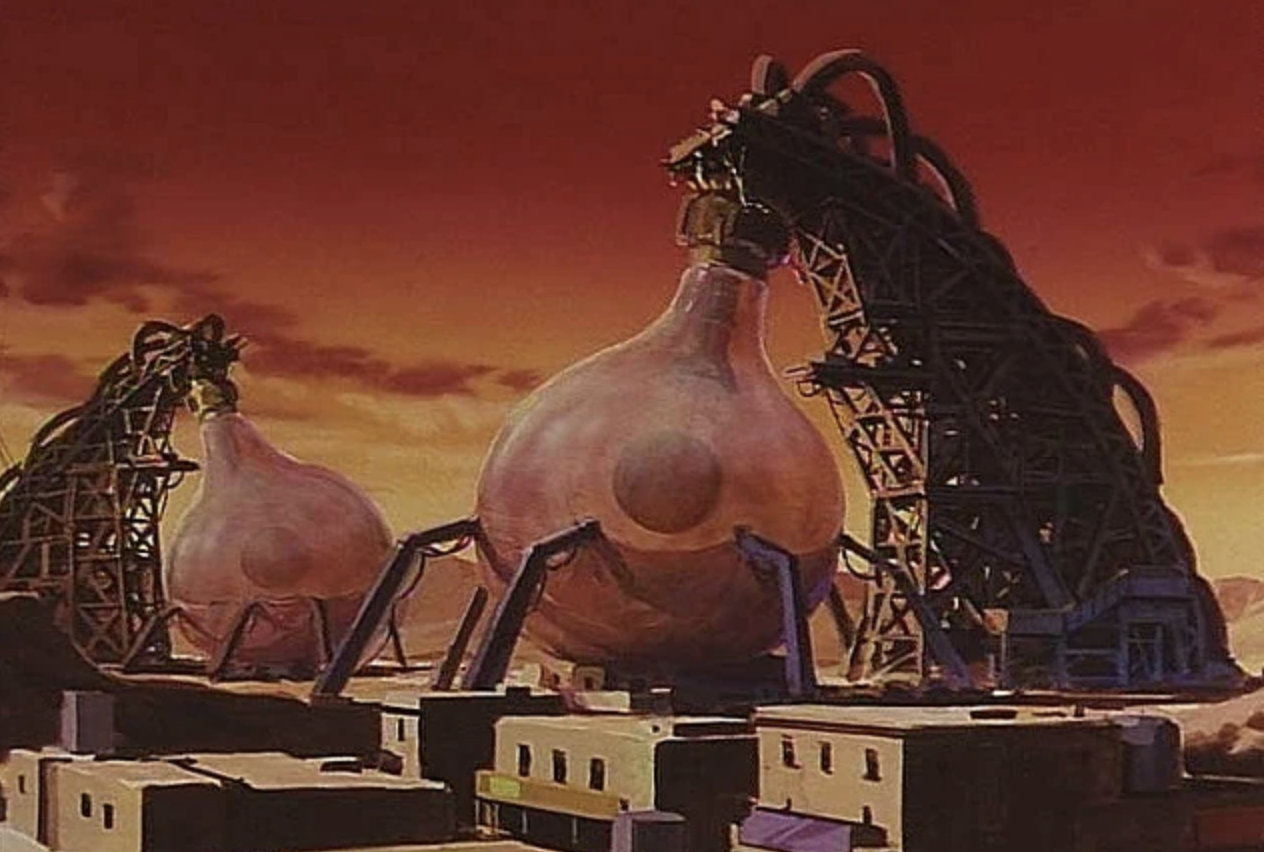
Taken together, I find it most intriguing how the Plants or spaceship remnants that form the heart of each dinky town scattered across No-Man’s Land (AKA Gunsmoke) resemble giant freakin’ lightbulbs. These Plants can generate energy and food/water-based on environmental conditions, which makes them ideal as colonizing vessels. (Remember that point about “taming the land” from earlier?) Not only that, but most residents that Vash and co. run into are doubly sure to cite half of their worries lie with the inevitability that their Plant is DYING and that not a soul knows how to fix them. Except Vash, of course. Family secret and all that, y’know? 

Like the dawn of electrical power and the final days of the Wild West, when faced with barren land, humanity had to turn to manufacturing artificial energy to eke out a living. This is the part where I add that my favorite moment in the entire Trigun anime franchise is when a comedically large lightbulb goes rolling down a hill and lands securely in the back of an equally large tank Lupin the Third style. Badlands Rumble, you are a gift to God’s green earth. 

Ballad Repetition and Saloon-Style Swing

If you’ve ever watched an old Western, you’d find that, like Trigun, ballads and bars just go hand-in-hand with one another. Across each iteration of this story, Vash, Meryl, Wolfwood, and crew frequent a lot of bars. Like, a Cowboy Bebop number of bars. In fact, the 1998 series opens the first episode inside of one. This, too, would’ve been common for real outlaws both then and now, but I didn’t need to tell you that. Stamped on the cover of my Trigun Funimation DVD set is the iconic yellow subtitle “The Ballad of Vash the Stampede,” a lasting reminder that the series is just that, a ballad: a recount of this pseudo-mythical heroic figure and the dramatic past that immortalized him. (Or permanently labeled him as an outlaw in every town and territory on this side of July City, take your pick.)

The point is, the ballad is the story of an adventure, of a hero, his tragic gifts, and his triumphant deeds. And like any song, it garners strength through repetition. If any story is going to get remade again and again, it’s one in a similar disposition to Trigun where having an evolving audience opens itself up to new variations on the same theme. Even as a standalone ’90s anime, the series uses its episodic escapades to drive the notorious character of the “Humanoid Typhoon” into the viewer’s skull time and time again until the outlaw FINALLY meets his fated showdown against ruthless rival Millions Knives. If Trigun is remembered for anything, it’s without a doubt for being the ballad of one irritating pacifist with blond hair, round shades, and a crimson coat. 

As an aside, music is as equally important as giant lightbulbs and steam trains for creating a setting reminiscent of vintage Westerns. Composer and guitarist Tsuneo Imahori brings jazz, folk, electronic, and orchestral genres into the 1998 and film OSTs that I can only call “electrified Western.” One moment the folk-style swing guitar is jamming’ out with the drums, the next moment it’s a storm of freestyle heavy metal. Or steady, sexy tango with bongos. Or smooth sax with jazz-style piano, saloon-style piano, ballad-style piano—look, if you can play it on a keyboard, Trigun has it. Stampede even dusts off its version of a “pipe organ.” Different composer (nothing but respect to my guy Tatsuya Katou), but still.

Whether ballad or blues, Western landscapes and their depiction entail a degree of imagination to create a complete vision of some kind. This is why I position the classic series over the remake; the classic carries charm in all that it does while the remake tries so hard to be “cool” that it feels like any sci-fi CG series with overly wrought apocalyptic tones and a lack of love for its crew. Still, there is motion in each landscape, and how that kinetic energy is directed will convey the magnitude—and the struggle—of the trying journey the frontier vehemently demands from us. And Trigun kicks that frontierism up a notch in every way. It’s not just the Wild West being re-envisioned—it is one wilder yet.


“I meditate diligently every morning. The subject is Life and Love. I quit after three seconds.”

– Vash the Stampede

Afterword: A 25-Year Retrospective Ramble

I’ll finish by addressing my lateness on two accounts.

The first is that this post comes over two months after my announcement that I’d be marathoning Trigun for my blog’s annual Valentine’s Day Special. I don’t really have any excuses aside from that I finished and didn’t really have too much to say on Trigun at the time . . . Now we’re here 2,000+ words later . . . However, this tardiness does not compare to the second offense: my being 25 years late to watching this much beloved sci-fi anime. Granted, it was released before I was born, but I’ve had Funimation’s Anime Classics DVD set collecting dust on my shelf for several years. I’m not sure why I waited so long to start Trigun, but in a way, I’m glad I watched it when I did. Any past iteration of myself would’ve found it annoyingly quirky. Now, after the release of its hotly anticipated remake series, I get to say it’s annoyingly quirky YET better than the original story it was based on. (Sorry, but when one has gung-ho gunslinger Milly Thompson and the other doesn’t, the decision is obvious!)

Trigun was a unique experience for me because it failed astonishingly at making me care about the epic sci-fi plot and the MC redemption arc it was working towards and said, “Hey, check out these lamp cities instead! We have trains, too!” Damn. Looking back, the whole marathon feels like a dream. Glad I dreamt it, but I’m happier to be awake. 

Ok, I think I’m done with the ballad of Vash the Stampede and its lovely calamities for a bit. Someone take it away from me so we can queue up a different tune. 

‘Til next time! 

– Takuto
Sailor Moon “Dark Kingdom Arc” Themes, Motifs, & Symbols

Welcome to the start of a new series on my blog! I want to try veering off the traditional review path and instead focus on some of the themes, motifs, and symbols in my favorite manga or anime series. These posts will not aim to critically analyze elements of the work, but rather provide a leaping-off point to prompt your own discussions. I encourage readers to use this post as they see fit (just be sure to tag me and link this page), and I hope you will find it useful!

The themes, motifs, and symbols discussed here pertain specifically to the “Dark Kingdom Arc” of Naoko Takeuchi’s Sailor Moon manga and the Sailor Moon Crystal anime series. Other themes, motifs, and symbols may also apply, though I plan to save those devices for future posts where they are more relevant in other parts of the franchise (like the use of dreams in SuperS). As such, this listing is by no means exhaustive, but it should help anyone trying to understand how some of the thematic devices function within the narrative. SPOILERS AHEAD!

Themes


Love and Fate Are Intertwined

Usagi and Mamoru’s relationship is written in the stars. Across time, they share many fated moments together, both on and off the battlefield. Whether as Usagi and Mamoru, Sailor Moon and Tuxedo Mask, or Princess Serenity and Prince Endymion, our star-crossed (or moonlit) lovers are fated to meet again and again. Their romance is the anchor for cruel fate to tear them apart at every possible junction. But, of course, love always wins, especially if it’s destined.

Destiny Is Circular

Fate, cycles, and chance meetings in the night create a circular storytelling pattern in the Dark Kingdom Arc. Just as the girls form unbreakable bonds with each other, they remember that they all used to be friends many moons ago—and that destiny, as it happens, has brought them together once more. The reuniting of the Sailor Guardians this time around is for the same purpose, too: the vanquishing of evil Queen Metalia once and for all. (In the classic Sailor Moon anime, the Sailor Guardians also lose their memories after defeating Queen Beryl—only for Usagi to have to once again become Sailor Moon in the second season—thus enhancing the circular nature of destiny.)

Light Conquers the Darkness

A story of magical girls invoking celestial powers to fight the forces of evil would not be complete without the popular saying “light conquers the dark.” It’s a cliche theme, but again, Sailor Moon makes it work because of its contrast between the heavenly moonlight of Silver Millennium (the force of good) and the subterranean Dark Kingdom (the force of evil). Quite literally, Serenity’s moonlight shines down from on high, establishing a visual hierarchy of morality as well as signaling a powerful allusion to heaven and hell itself.

Loyalty Accompanies Royalty

Every princess has her entourage of ladies-in-waiting, and Princess Serenity is no different. Although it takes the Sailor Guardians considerable time to realize that one of their own is in fact the Princess of the Moon Kingdom, they all naturally look to Sailor Moon anyway for guidance. Perhaps this is attest to her innate charm or the nature of destiny, but Usagi nevertheless finds herself surrounded by a circle of amazing female friendships. Similarly, Queen Beryl has her four Dark Generals carry out every waking task she can come up with. To the bitter end, they follow the will of their supreme ruler.

Acceptance of the Past

Finding out that you once stabbed yourself with a sword out of love several millennia ago and then were reborn in modern Tokyo would be a bitter pill for anyone to swallow. Yet, this is Usagi’s destiny, and it’s the past she has to accept if she wants to save her friends and the world in the present. Likewise, Mamoru must overcome any doubts of who he may have been as a young child due to his amnesia. All he knows now is that he needs the Silver Crystal to reaffirm something unknown to him in his own past. On the flip side, Beryl is forced to recall her feelings for Prince Endymion (and acknowledge her use of Metalia’s dark magic) if she is to take what she believes she rightfully deserves.

Justice Against the Usurper

Queen Beryl, as we find, was not always the monarch she claims to be. At most, she was a peasant girl whose infatuation, obsession, and jealousy over Prince Endymion’s love caused her to sign a dark contract. As Beryl led the rebellion against Earth and eventually the Moon, she only destroyed innocent lives in her path. When she finds the Dark Kingdom in the present age and establishes herself as its queen, she even starts scheming to overcome her ruler’s power, the darkness of Queen Metalia. Once Sailor Moon gets a complete grasp of the situation, it quickly becomes apparent what she must do: avenge her mother, her people, and her own past self by killing Beryl. Only Beryl’s (and Metalia’s) death will claim the justice Sailor Moon needs to validate her dual existence as Princess Serenity.

With Power Comes Responsibility

The staple character pattern of all superhero works is watching the protagonist grow into their newfound powers, only for them to realize that their actions have consequences, regardless of severity. Magic can be a blessing or a curse, and this dilemma stresses Usagi out. In the early chapters, she admits several times that she hates being a Sailor Guardian—that she hates being in pain and likewise inflicting it upon others. Being the guardian of love and justice certainly has its costs, yet Usagi’s destiny that only she can be Sailor Moon—as well as the Moon Princess—will be something she struggles with realizing time and time again. Gone are the days of innocent, youthful school life, and dawning now is the coming-of-age story for the future queen of the galaxy.

Motifs


Friendship

Perhaps what the entire Sailor Moon franchise is most beloved for is the endearing and genuine friendship between the girls. In the Dark Kingdom Arc, five girls who once adored each other and their peaceful life on the Moon are separated by fate, only to find themselves falling back into each others’ lives one chapter at a time. From their shared compassion, the Sailor Guardians are able to conquer any obstacles that come their way, whether the forces of evil Queen Beryl or the stress of classroom exams.

Magical Girl Transformation

Sailor Moon is one of the most influential works in creating the popular image of the “magical girl” as we know it today. From Sailor Moon, the magical girl has gone on to spiral into its own genre, wherein the themes of love, light, and justice often reoccur. While it may not be the first work of its kind, we can still understand how magical girls come across as admirable in the way that Usagi idolizes Sailor V. To Usagi Tsukino, Sailor V represents everything she aspires to become. Being a “tough and beautiful ally of justice” would be a dream—until Usagi becomes Sailor Moon, the soon-to-be-strongest magical girl in all existence, and realizes that her previous mundane reality wasn’t so bad after all. Each time the Sailor Guardians transform, we are reminded of their legendary powers, as well as how they are responsible for safeguarding humanity from the darkness.

Disguises & Misrecognition

People wear all kinds of disguises in Sailor Moon. Some moments of misrecognition are comic, like when Usagi transforms into a nurse to rescue Ami. Other times it is more tragic, like how Endou appears to Usagi with the face of Mamoru. The most famous disguise we know is Mamoru Chiba donning his suit and hat for Tuxedo Mask. With this disguise, he navigates through the night undetected to uncover more about the Silver Crystal’s whereabouts, as well as understand his own amnesiac past. As for the girls, they have their second identities as Sailor Guardians, and although they don’t look too different from their normal selves, the powers of magic prevent onlookers from seeing past the guise. Jadeite, Nephrite, Zoisite, and Kunzite also all use the bodies of innocent citizens to hide their monstrous demons. Finally, Usagi and Mamoru have their dual (tertiary?) identities as Princess Serenity and Prince Endymion. The fact that no one is able to figure out the princess’s identity until she is standing before them is attest to misrecognition’s role in protecting destiny itself.

Roundtable Meetings

Like King Arthur’s Knights of the Round or any other kind of strategizing scene in a superhero or spy movie, the Sailor Guardians are always assessing and evaluating new information as a group. Typically, their meetings take place at someone’s home, a local park, the arcade, or their secret base beneath the arcade. These meetings primarily serve to debrief recently acquired information and establish a plan of attack for the group, but they also provide insight into the girls’ individual personalities as they react to the developing situation. For example, Ami responds with tactical reasoning, Makoto just wants to fight the enemy, and Usagi usually sleeps through the whole thing. Meetings add moments of levity where the suspense of lingering battle can reset and transition back to daily life, reinforcing the themes of responsibility and loyalty to their noble cause.

Darkness & Light

Throughout this first arc, darkness always looms at bay. Whether the monsters of the Dark Generals, Beryl’s witchcraft, or Metalia’s overwhelming presence, darkness pervades in Sailor Moon. The radiant Moon and the Mythical Silver Crystal symbolize pure light, and although Metalia is a being born of the Sun, her existence only casts shadows—a kind of darkness which twists her and any who interact with her. It’s no coincidence that the Sailor Guardians are always “fighting evil by moonlight,” for the night is when the darkness can creep out. Likewise, their “winning love by daylight” lets us know that daytime is more or less a safe space. Any colorations of light and dark are further emphasized in the manga, wherein Naoko Takeuchi uses stark panels of all-black to heighten the spectacle of Sailor Moon’s glittering light.

Death & Rebirth

Cycles of life and death occur for both the heroes and the villains of the Dark Kingdom Arc. In the war on the Moon, the Sailor Guardians are defeated, Prince Endymion is martyred, and Usagi commits suicide. Likewise, Beryl is slain in her revolt, and her master, Metalia, is sealed away. The death of the antagonists and the preservation of the protagonists are commandeered by Queen Serenity, who uses the last of her strength to give the Sailor Guardians a second chance at life on Earth. Even after all Serenity had done, however, Mamoru again martyrs himself for Usagi, and Usagi—drawn to her wits end—surrenders to their circular fate and draws the fatal sword to her chest once again.

Monarchy

Castles and royalty are central to the early story of Sailor Moon and her legend. Queen Serenity ruled the Moon Kingdom. Prince Endymion ruled the kingdoms of Earth. Now, Queen Beryl rules the Dark Kingdom, and in order to reclaim what was lost from her mother, Usagi will have to awaken as Princess Serenity and end Beryl’s terrible reign. As the series progresses (across this arc and subsequent ones), we follow Usagi as she slowly starts equipping herself with the powers that once belonged to Queen Serenity. In this arc, the climax is Sailor Moon wielding the destructive force of the Silver Crystal to vanquish her foes. The passing of the jewel from mother to daughter is a significant rite of royal passage, one which marks Usagi as the next heir to the Silver Millennium.

Slumber & Awakening

Moments of sleep and wakefulness are apparent throughout the story. When not fighting the forces of evil, Usagi and the Sailor Guardians earn their rest. In fact, much of the motivated drama in the story is enhanced by Usagi and Mamoru’s conflicting dreams. Both sense their fate, yet they can’t quite grasp what it means. In the same sense, Queen Metalia “slumbers” deep beneath the Dark Kingdom as Beryl’s Four Dark Generals amass energy for their great ruler’s return. Likewise, both Queen Serenity on the Moon and the essence of Princess Serenity within Usagi’s heart lie dormant until the Silver Crystal can unleash their fated awakenings.

The Moonlight Legend Reborn

This signature phrase is borrowed from Viz Media’s marketing of the Sailor Moon Crystal anime, and it’s quite a fitting phrase considering how many times various adaptations have revisited this timeless story’s opening act. From manga to animation, stage plays to musicals, and likely countless drama CDs, Sailor Moon Crystal marks yet another retelling of the Moon Princess’ origin story. The moonlight legend is reborn, and we are once again given a chance for one of these adaptations to tell the manga’s story as Naoko Takeuchi originally intended. Thankfully, if the Crystal anime gets one thing right, it’s the conviction to that cause.

Symbols


Jewelry & Gemstones

Across literary and cinematic history, jewelry and gemstones have become associated with wealth, power, greed, and an obsession with vanity. Their sparkling allure attracts the gaze of many—it’s no wonder Beryl is so drawn to the Mythical Silver Crystal. Along with Beryl, the Four Heavenly Princes are characterized after actual gemstones. Naoko Takeuchi is able to flex her background in chemistry and gemology by tying many of the characters and plot points in the series to her personal fascination with minerals and gemstones.

Mythical Silver Crystal

The famous and sacred MacGuffin of Sailor Moon. Whether translated as legendary, imperium, or mythical (as the English localization of the manga went with), one thing’s certain—the crystal is silver, and its powers are unrivaled. One could argue that the Silver Crystal symbolizes the ugly struggle for power itself, as Beryl and Queen Metalia stop at nothing to obtain it. When wielded by an emotional Sailor Moon, however, the Silver Crystal only serves to protect her allies, heal their wounds, and carve a destructive path toward justice. The Silver Crystal also represents the legacy of the Moon Kingdom left in Usagi’s hands by Queen Serenity, which makes sense why it was hidden away from everyone—including loyal Luna—in Usagi’s own heart. What seems to matter most is that in the hands of evil, the legendary crystal is nothing but another pretty rock.

Transformation Pens

The obvious connotation here is that the pens aid in the transformation and disguise of the Sailor Guardians. Each pen is uniquely colored, denoting individual ownership over them. Thus, they become symbols of responsibility for the Sailor Guardians. While Usagi has her own assortment of magical items, the Sailor Guardians only have their pens. Holding their pens close to their chest when they shout out their transformation mantras, the transformation pens represent the timeless duty of the Sailor Guardians.

Stone Sword

The sword is a unique artifact in the continuity in that it is the only traditional weapon found in the battle against Beryl and Queen Metalia. A blade compounded over time by countless rocks and minerals, the sword is durable enough to cut through diamonds. It’s also heavy and denotes leadership, as shown in the way Sailor Jupiter helps Sailor Venus wield its power. Moreover, the sword was used in the previous war on the Moon to banish Queen Metalia. Back then it was shining, but its stone-cold appearance now reinforces the fact that Metalia’s power is turning things to stone. Additionally, Usagi wields this sword twice in the act of suicide, forever tying the blade to her suffering and legend. Thus, the stone sword needs to be the item that ends this story once again, for it symbolizes the destruction of ancient evil and leaving antiquity behind, once and for all.

The Moon & Silver Millennium

Floating high above and adorned on just about everything pertaining to the Sailor Guardians and their princess, the Moon carries the ambitious task of symbolizing everything the titular heroine stands for: tranquility, ephemerality, and serenity. Although Usagi may not embody those traits perfectly at first, the Moon is a constant reminder of where she’s come from—and where she needs to go next. We can almost attribute the crescent moon to Sailor Moon herself, while the full moon represents Queen Serenity. The moon’s white glow often warms the characters, and as they lose their way, they look up to its light for guidance. Of course, Earth’s silver satellite is also home to the Moon Kingdom, Silver Millennium, which means it bears an ancient history as the civilization that once orbited the blue planet below.

Rose

Red roses are the romantic mark of Tuxedo Mask. Since the flower is almost exclusively found on Earth, we can also associate plant life and nature with Prince Endymion. A red rose symbolizes true love, respect, and courage, qualities which are all tried and exemplified by all the good-natured characters in the story. Most of all, the flash of a red rose on the battlefield reaffirms Sailor Moon that she is not alone, for Tuxedo Mask is always watching her back.

Rabbit

Based on the pun of Usagi’s name and the Japanese word for rabbit, the animal is associated with Usagi Tsukino herself, as it is patterned on all her stationary and personalized items. The cute bunny ears and light colors also represent innocence, and we tend to associate them with Usagi as a middle-school girl as opposed to future queen of the Moon. In English, one could almost see the word “bunny” more closely relating to Usagi’s modern self, whereas the more sophisticated “rabbit” would befit Serenity (even though they are the same person and refer to the same animal).

Pocket Watch

Mamoru’s star-shaped pocket watch is the memento Usagi holds onto until she is able to see her beloved again. The watch symbolizes time, but specifically in relation to the temporal distance which separates the two lovers. When the pocket watch is cracked, the lovers struggle to find one another. The fact that the watch protects Usagi from her suicidal blow with the stone sword shows that time is on their side, and that they will eventually claim their happiness once they defeat Queen Metalia. Usagi mending the watch and returning it to Mamoru tells us that she has accepted her identity as the Moon Princess, and that she no longer needs to rely on borrowed time to understand her cosmic role.

Handkerchief

Like Mamoru’s pocket watch, the handkerchief is a classic symbol of lovesickness. Mamoru’s longing to be with Usagi is indicated by his delicate handling of her pink-laced handkerchief. The personalized cloth is also a mark of championship, almost as if Usagi has (unbeknownst to her) already chosen Mamoru to be her knight. We find this relationship twofold when Tuxedo Mask admits his admiration for the guardian of love and justice, Sailor Moon.

Sailor Moon’s Compact

The transformation brooch given to Usagi by Luna at the story’s beginning is the device which allows her to become the titular guardian of love and justice. It fashions nicely with both her sailor-suited outfits for school life and heroine life. As the franchise progresses, the compact itself transforms and receives new powers—blessings from the moon and Queen Serenity. After Beryl and Metalia’s defeat in the “Dark Kingdom Arc,” Usagi’s receiving of a new compact from her mother is symbolic of her divine right to rule. Its star-encrusted pattern and colored gems represent the unity of Sailor Moon and her Sailor Guardians as they are bound to Silver Millennium’s fate. This new compact houses the Mythical Silver Crystal, and its light will continue to guide Usagi as they both transform together.


Got any themes, motifs, or symbols you think should be on this list? Drop your suggestions down in the comments for all of us to see. Thanks for reading, and ‘til next time!

– Takuto
Shirobako: A Creative’s Guide to Happiness || OWLS “Hope”

Chances are that if you were linked here from another blogger pal, then you might be new. To those first-timers, “Hi, I’m Takuto, welcome to my anime cafe!” For the OWLS blog tour’s fourth monthly topic of 2020, “Hope,” I wanted to put aside my more elaborate thoughts on the entertaining and endearing Shirobako and just kinda ramble about creativity and the future. (Worry not, I’ll have more to say in a series review forthcoming!)

We are in the midst of a pandemic which has led people to live in fear and anxiety over the coronavirus. For this month, rather than seeing the dark side of the situation we are living in, we will be exploring anime and other pop culture mediums that bring hope for humanity and why they have such a positive impact on us.

This is such a wonderful topic, and yet I feel so unprepared for it. I hope you guys will enjoy what I’ve got to share. Thanks Lyn for the prompt!

miyamori shocked


A brief discussion of the 24-episode fall 2014 anime “Shirobako,” animated by P.A. Works, directed by Tsutomu Mizushima, and based on the original story by Michiko Yokote. 

Being Creative is Tough

Five high school girls had dreams of creating an anime together after showing off the labors of their club’s hard work in a school festival. Skip forward a couple years and we see that while Aoi and Ema made it into a reputable studio in the industry, all five of them are struggling to find a greater purpose behind the work. It would seem that the path to one’s dream job is littered with all kinds of trials and unexpected turns. 

At Musashino Animation, Aoi Miyamori has it pretty decent as a production assistant compared to her animator friend Ema. Miyamori’s job entails coordinating emails between departments and outside sources, scheduling meetings, running errands, maintaining public relations, and generally keeping everyone on task—including a notoriously nervous director and a whole crew of constantly tired animators, key artists, and the like. Half the battle, as one can imagine, is not with the work itself, but the people behind it.

But where Ema’s sights are clearly set on becoming one of the best animators the industry’s ever known, Miyamori often finds herself asking why she even joined the animation world in the first place. Despite the job suiting her better than she realizes, Miyamori feels adrift in an industry that’s been chewing people up and spitting them out for years. While the road to success is rough now, it’s only bound to get rockier—not to mention veer off the path more than once. Still, this is the world that Miyamori dreams of working in, and dreams—as she realizes—can still be achieved through unyielding perseverance and a splash of creativity. 

miyamori sleepy

A Future Unknown

Office stress, annoying coworkers, late nights, instant meals—oh Miyamori, how I feel for you. As a young twenty-something myself, it can seem near impossible to try exploring other potential avenues of interest when all our time and energy is drained just by living day to day. In struggles like this where future seems unclear, we want simple work, mechanical work. Even if it’s repetitive and dull, it is stable, and reliably puts food on the table each night. Because she does not yet know what she truly wants to do in life, Miyamori continues to slave away, giving her current job everything she’s got despite its tedium. 

On the other hand, when we have something to look forward to—a goal or a higher purpose in mind—we find ourselves more willing to take risks, and risk is always a scary thing. This isn’t just as a feeling of general optimism, but a yearning for something more in life. It’s a feeling of being destined for greatness, even if the path to that future lies completely unpaved. Miyamori knows deep down that she’s just as creative and visionary as her friends are—now she’s just got to figure out what niche she belongs in. As we see for her, others will help pave this path, and brick by brick, slowly, everything will come together in the end.

It sounds easier to just coast the less pleasurable route out, but that’s the trap. Before you know it, more time has passed by, and seldom do second, let alone third, fourth, or fifth, chances come along. Through her interactions with some of the big wigs who have been in the industry for decades, Miyamori finds that they all had specific goals to strive for. With this realization comes aspiration, and soon it dawns on her what she must do: Once one’s goal in life has been found, you should take time to figure out how you can achieve it. If you’ve done everything right, you’ll probably end up having to make a critical decision: Will you play things safe, or risk it for the chance to dream big?

crossroads

At the Crossroads of Happiness & Hope

Life is full of choices we have to make, crossroads we have to pass. But it’s because crossroads exist that people can get a true start on their lives and do the things they’ve always wanted to, whether that is explicitly known to them in the moment or not. Crossroads are a curse, but they also provide hope—the hope that people can choose their own path in life and make something fantastic out of their time on earth. They’re a necessary evil, the riskiest kind of choice, but once you know deep down that you made the right choice, there truly is no better feeling.

As Miyamori’s friends start to see the crossroads lay out before them, they decide to chase down the path of their dreams. In the end, Ema, Shizuka, Misa, and Midori each chose the riskier path—the hopeful path—over the one guaranteeing security. All at once, everything starts to look a lot brighter for them. Sure, there will be rough days and hard nights ahead, but at least they can sleep knowing that this is indeed the path for them.

Suddenly—as if all the clouds parted at once—tomorrow seems a heck of a lot brighter than the day before for these ladies. The air is lighter, the sky looks clearer, and all because they realized what they really wanted to do in life. Doesn’t that sound like a wonderful feeling? That is what gives people hope—pursuing passion and happiness even if the future seems uncertain. I wonder what path Miyamori will choose . . .

happy miyamori


There is no occupation that doesn’t have its difficulties. That’s why the rest is how much you’re able to endure after all of the humiliation you face. — Rinko Ogasawara


Afterword

Shirobako spoke to me with all kinds of wisdom, I love it so much. Again, I’ll have a full series review out for Shirobako here in a bit, hopefully, so please look forward to that! I’ve really enjoyed watching Shirobako, and I’m so glad I held off on it until now. The series is full of pathos that I’m sure any creative can relate to. Sorrows and frustrations blend perfectly yet realistically with the joys and satisfaction of being involved with the arts, and the whole experience has been absolutely healing for a soul like mine. Thus, I hope you enjoyed some of my takeaways from the series here today!

This concludes my April 11th entry in the OWLS “Hope” blog tour. My dear friend Lita (LitaKino Anime Corner) went right before me with a sweet post on Cells At Work that you really shouldn’t miss! Now, look out for my buddy Matt (Matt in the Hat) with a post on one of his favorite superhero icons, Spiderman, this coming Monday, April 13th! Thank you so much for reading, and until next time!

– Takuto
Yumeiro Patisserie: The Strong, the Savory, & the Sweet || OWLS “Failure”

Chances are that if you were linked here from another blogger pal, then you might be new. To those first-timers, “Hi, I’m Takuto, welcome to my anime cafe!” For the OWLS blog tour’s eleventh monthly topic of 2019, “Failure,” I wanted to dabble just a bit into the sweetest little show that’s been on my plate as of late. We’re talking about Yumeiro Patissiere and a young girl’s road to becoming a pastry chef—and don’t worry, I’m not gonna sugarcoat any part of her great struggles!

One of the best ways we can learn is through failure. This month we will be talking about the failures of our favorite characters in pop culture media and what we can learn from them. We will also reflect on our own mistakes and failures and how those experiences have allowed us to grow as human beings.

I’m gonna keep this sweet and simple, just as the show would serve it to you, so thanks Lyn for the prompt!

strawberry crepe cake.PNG


A brief discussion of the 50-episode fall 2009 anime “Yumeiro Patissiere,” stylized as “Yumeiro Pâtissière,” animated by Studio Pierrot and Studio Hibari, directed by Suzuki Iku, and based on the manga by Natsumi Matsumoto. Minor spoilers for the first 12 episodes will be present. 

Thrown Into the Culinary World

Ichigo Amano may just be a middle schooler, but she’s nothing when compared to her piano prodigy of a kid sister. In fact, Ichigo hasn’t ever been successful at anything, but she does have a passion for eating cakes. This unique tongue of hers leads Ichigo to Henri Lucas, a famous patissier who not only recognizes Ichigo’s tasting talents, but points her towards St. Marie Academy. This prestigious culinary school specializes in the art of desserts, and just so happens to be her late grandma’s alma mater, who was an accomplished confectioner in her own right.

Despite being a beginner lacking all of the essential skills for the craft (and thanks to being recommended by THE Henri sensei), Ichigo is placed in the elite A Group with the “Sweets Princes.” Famous throughout the school for their enchanting treats (and charming good looks), the trio is composed of Andou, an analytical, traditional Japanese sweets specialist; Hanabusa, a delicate boy who crafts elegant candied flowers; and Kashino, a gifted chocolatier with an attitude that’s not afraid to bite back.

While they’d likely fair well on their own (save for poor Ichigo), each of the kids in A Group are accompanied by their “Sweets Spirits,” fairies from a distant land who make patissiers’ dreams come true by aiding them in the kitchen with tips and tricks. Together, they all work towards their unique goals in the competitive world of sweets, and pray each day that their combined efforts will pay off in the future.

ichigo sweets

The Strong Must Protect the Sweet

The culinary world will always be a scary one to me, so it’s no wonder that Ichigo is freaking out when she’s placed among the school’s elite from the get-go. Easily the kind of girl to mistake the salt for sugar, Ichigo is a total klutz—and this doesn’t take too long for her new classmates to figure out. Every minute Ichigo spends with the esteemed Sweets Princes soils their perfect reputation.

However, as she works her saccharine magic on their hearts and they bond together through late night practice sessions in the kitchen, the Sweets Princes slowly start to care less about what their peers think and more about what their savory sweets mean to those that fall for their confectionery. By bouncing their knowledge and creativity off one another, the members of A Group learn most of all that love is just as essential an ingredient as flour, eggs, or sugar are.

sweets princes.PNG

Criticism & Self-Destruction in Academia

Japan has this thing about letting us know how exploited and overworked students can sometimes feel in elite academic settings. The tiniest compliments can give such students the greatest confidence boost, but the slightest criticism can be absolutely devastating. It’s a fine line us students pressured by high standards find ourselves tight-roping across, and that’s exactly where Ichigo finds herself at St. Marie.

At its earliest low in the series’ first twelve episodes, Ichigo almost quits school entirely. The moment before she left her dorm for home, she got ahead of herself and thought she’d do well in the upcoming cake-baking tournament without having had more experience behind her. Of course, she was just joking around with the Sweets Princes, boasting because they had recently served up something incredible as a team, but Andou and Hanabusa, who are normally very kind and supportive, snapped back and told her how wrong she was—that the competitive world of a pastry chef is much more arduous and complicated than baking a cake for some kids.

sweets princes practicing.PNG

This revelation—and it coming from the nicest people in her class—throws Ichigo from the top of the summit to the bottom of the ravine. One minute she felt like she could joke around and laugh at her successes and failures alike with her esteemed peers, the next she couldn’t feel more distant from them. Here, we have a middle school girl voicing the concerns of every struggling honor student in academia:


I got into the school fine, but it was just screw up after screw up, day after day. And once in a while, when someone complimented me, I got way too carried away. I think I’m just not cut out for that place. — Ichigo Amano


Inspiration Lies In Our Humble Beginnings

It takes going back to her creative roots—to her grandma’s old sweets shop, and the source of her inspiration—to jump-start that confidence and motivate Ichigo to get back on her feet. Ichigo even gets the chance to flex in front of her incredibly talented younger sister, showing off all the skills she learned at her fancy academy. It turns out, when she has to fend for herself, Ichigo knows a lot more than she gives herself credit for

When she asks her uncle to make the house special strawberry tart, only she—not even her talented sister—notices that her grandma’s recipe was changed. It is at that very moment that Ichigo realizes she is qualified for this career, and she becomes even more deeply connected with her grandma’s unique style as a patissier.

grandma amano.PNG

Having turned a new leaf, Ichigo feels ready to get back to baking. Of course, kind hearts attract good company, as Ichigo’s mom had her packed bags ready to go in the trunk the whole time. Imparting precious wisdom, Kyouko Amano drops her clumsy yet dedicated daughter back off at the academy. Honestly, that’s #familygoals, but she also wouldn’t be coming back were it not for her friends in A Group who covered for her abrupt absence.

When the going gets tough, sometimes we have to take life one chocolate cake roll at a time. We should take chances, and even if we suck, we should never give up. We should polish our dreams like jewels, and even when we want to cry, if we try smiling while doing something we love, we just might be able to change our whole day around all on our own. Sometimes, all it takes is going back to our humble beginnings to realize just how far we’ve traveled. There are more takeaways one could make, but hey, sometimes the shortest explanations are the sweetest ones. 

ichigo baking.PNG


It’s ok to get depressed sometimes. But what’s important is to get back on our feet when we’re ready. — Kyouko Amano


Afterword

Just like the opening says, Yumeiro Patissiere is “Light and soft and fluffy! Melt-in-your-mouth sweet! It’ll bring you so much unbridled happiness.” So on and so forth. Yumeiro Patisserie is a gem, a certified “Cake” like you’ve never had it, and one that has a fun flavor you’ll never forget! I doubt anyone’s ever heard of this anime (I hadn’t, until the Blu-ray was recommended to me in a sale so I snatched it up), but don’t sleep on this shit—it’s GOOD. The young hardworking patissieres, the beautiful string music, the decadent, delectable desserts—this show is so friggin’ charming, and I’m so excited to see where it goes. After all, there are 50 episodes in the first season alone!

This concludes my November 28th entry in the OWLS “Failure” blog tour. My friend Crimson (Read At Night) went right before me with a post over the heartbreaking geisha drama novel Snow Country that you can read right here! Now, look out for my blogger buddy Scott (Mechanical Anime Reviews) as he rounds out the month with his crack at Haikyu!! and what failure means to the Karasuno Team (so excited to read!) this Saturday, November 30th! Thank you so much for reading, and until next time, this has been

– Takuto, your host

To the Top of the Tower: How Alicization Encodes its Lore || OWLS “Fantasy”

Chances are that if you were linked here from another blogger pal, then you might be new. To those first-timers, “Hi, I’m Takuto, welcome to my anime cafe!” For the OWLS blog tour’s tenth monthly topic of 2019, “Fantasy,” I decided to head down a less conventional route for portraying this genre with none other than the (in)famous Sword Art Online. But fear not, for in my most humblest opinion, the Alicization story is not only the franchise’s most competent arc, but most fantasy-heavy one as well.

In the month of October, we will be exploring the world of fantasy in pop culture. The genre of fantasy focuses on telling stories about our external and internal environments. There are many ways we can interpret the word fantasy. For example, we can talk about how a fantastical place could glorify what reality should be, or the dangers of ideal expectations. Fantasy could also be seen as taking a “wild journey” or a “hallucination,” and how that can affect our psyche and well-being. Additionally, fantasy can focus on our personal dreams and expectations, and how those expectations do not align with our reality. Overall, our posts will reflect on how we view the fantasy genre and what we can learn about these pop culture mediums.

Since I’ve got a review of the series coming in a couple days, it’ll be nice to focus exclusively on the cool story elements at play here. SPOILERS will be present. Thanks Lyn and Aria for the prompt!

kirito luminous element.PNG


A brief discussion of the 24-episode fall 2018 anime “Sword Art Online: Alicization” as well as the original novel series, animated by A-1 Pictures, directed by Manabu Ono, and based on the light novel by Reki Kawahara. MAJOR SPOILERS WILL BE PRESENT. 

How SAO Blends Magic & Science Fiction

Reki Kawahara’s Sword Art Online has amassed into a franchise that sets its stories in a variety of fantasy worlds, but with a caveat: They are gaming worlds, virtual lands created by programming, and code is the law of the land. My favorite aspect of each season is watching how they seamlessly blends the two genres I love most—fantasy and sci-fi—with one another to create some of the coolest adventure stories out there. SAO is cool, yeah, I said it.

stay cool kirito.PNG

Every magical attack, legendary item, or floor boss is portrayed through a fantasy lens, but can be broken down scientifically by sword skills and hit-points, system stats, and in-game features. SAO, GGO, ALO, and the latest VR world “Underworld” all operate on systems that actively try to rationalize even their most fantastical of elements. Often, yet most especially with this third season, the series isn’t afraid to dive into weapon lore and in-game backstory whenever permissible to explain certain mechanics and unique properties. As such, SAO is a universe structured around duality: the relationship between code (the outside world) and lore (the inside world)

In this community, however, it is rare for people to call parts—let alone entire story arcs—of SAO “good” or even “great” like I do, which kinda sucks as a fan. But the coming of Alicization changed the game, truly, and imparted with us a story of epic proportions unlike anything the series has tackled before. And with the grand War of Underworld on the horizon, there’s no better time than now to sit down and take a look at the inner mechanisms of this latest world our hero finds himself trapped in.

underworld human realm.PNG

System Call: Underworld’s Unique Features

As with previous seasons, Kirito is forced into another virtual world due to circumstances far out of his control. What immediately draws his eyes to this virtual reality, unlike others have done before, however, is that “Underworld” looks and feels very real. And it should—it’s based on a network of real human memories, after all. By highlighting the neural pathways of the brain—the “Fluctlight”—and flooding them with visual imagery that stimulates one’s haptic, echoic, and visual senses, a person hooked up to the “Soul Translator” can essentially experience life in an entirely different world, detailed down to the tiniest speck of dirt.

While the mind is in some far off world full of swords and dragons, the physical body remains intact on the outside. You could almost view Kirito’s wild journey through the fantastical unknown as one big hallucination, as every memory made in the game world is erased upon awakening (due to a contractual agreement made between the Rath Scientists and the subject). This allows Kirito’s mind to continue operating and maintain the neural connections that would otherwise be lost due to his fatal encounter at the third season’s beginning.

And so here we are, in this world that looks just like ours on the surface, but operates under an entirely different set of encoded gimmicks and laws. Instead of chemical properties and physics, everything in Underworld has life and experience points. Rocks, trees, food, weapons, and of course people are all bound to a numerical HP. Can’t seem to lift a heavy blade or open a particular door? Perhaps it’s not your own strength at fault, but the fact that such “objects” may be assigned a higher priority number than your own level can currently interact with. And you don’t “make” fires—you “Generate Thermal Elements.” Such cool coding lingo.

stacia window.PNG

The system gets even more interesting when it comes to the Integrity Knights’ Divine Object-class weapons, one-of-a-kind arms they wield to protect the human realm. Each with their own unique origin, such legendary swords or bows can unleash unimaginable powers beyond their prescribed damage set, especially if the weapon’s memory is triggered via the “Enhance Armament” system command, followed by “Release Recollection.”

For instance, Kirito’s Night Sky Sword, made from the highest branch of the once-infellable Gigas Cedar, can summon all of the darkness amassed through years of gazing at the stars in one incredible blast when its memory is released. Eugeo’s Blue Rose Sword, born from a lonely rose which blossomed in the snow and ice of the End Mountains, freezes all in its user’s path, encasing foes in icy vines and frost.

Eugeo enhance armament.PNG

For the Integrity Knights, the lore embedded within their Divine Objects runs even deeper due to their creator’s self-assigned calling as Ruler of Underworld. The titular Alice Synthesis Thirty’s golden-petaled Osmanthus Blade was originally the first tree programmed in Underworld, and thus the oldest creation in the land. Fanatio Synthesis Two’s Heaven Piercing Sword was a physics experiment of Administrator’s in which the concentrated the light of a thousand mirrors was forged into a single blade in an attempt to mimmick the great Solus itself.

And get this: the great Bercouli Synthesis One’s Time Piercing Sword was crafted from the needle on the first village’s clock tower—Underworld’s own system clock. I just love the way Kawahara marries gaming mechanics and programming with story lore to form not just creative weapon origin stories, but an entire world full of intrigue and wonder to be fascinated with.

Osmanthus tree.PNG

Cracking open the Central Cathedral

When a story presents you with a tower, you climb it. Whether you’re adventurous or not, that’s just what you do. Kirito seeks out the towering Central Cathedral at the center of the human realm in hopes that somewhere waiting for him on the very top lies a console in which he can log himself out through. While he’s not technically wrong, the costs of getting to the 100th floor far outweigh the prize he seeks.

The very act of ascending Central Cathedral floor by floor feeds us with hope that whatever lies at the top will scratch that itch we’ve had since Kirito first woke up in Underworld. Little did any of us realize how truly unprepared we were for the rich irony awaiting our poor characters, as well as the truth behind the horrific secrets holding the fabric of their world together. 

quinella is god.PNG

As the Pontifex of the church, Administrator, imparts her devious and wicked plots to Kirito and his friend Eugeo, we finally come to understand that some truths are in fact better not knowing. The holy order that’s been maintaining peace in the realm, the legend of the three goddesses who blessed the land, the very truth behind the coming cataclysmic invasion by the forces of the Dark Territory—

Of course, it’s all fake. Yup. Fantasy often leaves us spellbound, instilling within us a feeling that something holds deeper meaning than it really does. Perhaps that’s because we want fantasies to entertain us, to dress up the real world, even if the characters may be desperately trying to tear it all down. Like Administrator’s Integrity Knights, which have been brutally brainwashed into fighting on the behalf of some made-up higher power than themselves, we want to believe there is deeper meaning to what we do, and that we’re not just vehicles for someone else’s success or failure.

To trust in that illusion is to fall for deception, and that’s exactly what Administrator did. She deceived people. She built up several lifetimes worth of fraud, lies, and corruption, which are manifested by the imposing, all-seeing tower of Central Cathedral itself. As Kirito remarks toward Administrator, toward Quinella: she’s no god or ruler, but a thief. Quinella preached unconditional love to her followers, but all she really desired was absolute control. So she stole what she wanted from the humans of Underworld, and fabricated layers of mythos to protect her frail ego from the mere thought of losing her power, her authority, and her control over others.

quinella looks down

Imagination Holds the Power to Change Everything

Central Cathedral and the Integrity Knights—“born” to fight for the good of the human realm yet unknowingly bow to Administrator’s whim—represent just how a land of honor, bravery, and magic can glorify these noble concepts: People should be born with the freedom to love and protect as they wish to, not as someone else pleases. Kirito and Eugeo’s quest to right the wrongs of this land’s all-powerful Ruler present the dangers of ideal expectations in the form Quinella’s knights that were led astray by her lust. But most of all, we experience firsthand how human morals can be easily twisted when the right bait is dangled in front of our faces.

The power of using imagination to change the world—or in this case create one—is the philosophy that lies at the core of the fantasy genre. If we can dream it, it shall be, and SAO is no exception to this principle. Fantasies can conjure forth one’s greatest mystical musings about how the world can be, and Quinella took this power in her own hands to create a reality where the world bows to her wishes, not the other way around. When Kirito forces his way to her chambers on the 100th floor, her expectations of the fantasy world she created are called into question.

As a VRMMORPG fanatic, I guess you could say Kirito’s ideas of a truly enjoyable fantasy world overpowered even the Ruler’s imagination of such a world, and thus he manages to slay Administrator in combat, single-handed. By then, it was not a battle of strength, but a clash of two individual wills—and an exchange for the truth that resulted in the shattering of over 300 years worth of painstakingly crafted illusions, and the destruction of a young greedy girl’s entire fantasy.

IMG_7084


The only proof of my existence is the control I exert. That desire is the one thing that motives me and gives me life! These legs of mine are meant only to trample over others. They are not for bending at the knees! — Administrator


Afterword

Lots of foreshadowing there at the end, I know! It’s not THE Quinella post I wanted to write, but it’ll do for now. This post probably made no sense whatsoever to non-SAO fans, and perhaps even to people who watched and even enjoyed Alicization‘s first half. I often ramble in these posts, but man, someone really should’ve cut me off with this one! A full series review of Alicization is in the works, so I’ll save any kind of rating for then. In the meantime, if you, too, liked the first half of this epic third season, I encourage you to share your favorite aspects about the series in the comments!

This concludes my October 29th entry in the OWLS “Fantasy” blog tour. Scott (Mechanical Anime Reviews) went right before me with a much more pleasant post over the light-hearted Flying Witch that you can read right here! Now, look out for Naja (Blerdy Otome) with an excellent post about the portrayal of romance in her favorite otome games tomorrow, October 30th! Thank you so much for reading, and until next time, this has been

– Takuto, your host