Parasyte -the maxim- Review

I kid you not, as I was following this show during the fall season, I found myself acting in this more “unemotional or robotic” way. I didn’t really talk to people, I only ate and slept for energy, and I even recognized all of the unnecessary and disgusting things some of my friends do. Upon finishing my simulcasts as of late, I noticed what was manipulating me – possibly one of the most influential anime I’ve seen to date – Parasyte -the maxim-.

They called themselves alien beings, but we know them better as Parasites . . .

Izumi Shinichi is a lanky and awkward 17-year-old high school boy who lives peacefully with his mom and dad. One night, tiny aliens silently rained from the sky, burrowing themselves into humans and taking over their brains. As one of the worms tries to crawl into Shinichi’s ear, the headphones he wore while sleeping blocked the entrance. It tries to drill itself into his right hand, but Shinichi rips off the ear buds and ties them around his arm, preventing the bug from entering his brain.

Forced to coexist with “Migi,” the two form a close bond (literally!). And while the separately conscious pair stumble into other Parasites on the streets, the two form strategies and acquire new skills to ensure their survival.

Though I don’t care much for this survival of the fittest concept, Parasyte at the very least deserves the award for one of the most well-paced anime I’ve ever seen – and it keeps this effort up until about episode 18/24, after which it dramatically slows down to introduce the core villain, but picks back up again in the last couple episodes for a satisfying conclusion. The only con to this ending is the still-unknown origin of the Parasites, but hey, I really didn’t care about that by the end.

So an impressively-paced anime must include some interesting characters, right? Absolutely, and Izumi Shinichi’s dynamic yet gradual change from absolute human to slightly less than machine couldn’t have been more fleshed out than this! The struggles, externally and internally, of what it truly means to be “human” that Shinichi overcome are seriously scary – Do you think you could kill another (or several) human(s), one bearing a child at that? Sure, his foes are technically Parasites, but it’s damned hard to tell in some cases! Great developing character; an ideal lead for the “did nothing wrong” trope.

Representing the cold, harsh truth is Migi, Shinichi’s newly named right hand after the Parasite took over it. Because he is attached to his body, he receives nutrients from the food Shinichi eats, meaning that he has no need to kill humans for food. He doesn’t understand humans. The rational Migi values his own life over all others, threating to kill anyone whom Shinichi leaks the news to. As the series progresses, however, Migi slowly reveals a human side, and as it happens, Shinichi is absorbed more into the monstrous nature; the Parasite lifestyle. It’s a brilliant concept that is executed without flaw.

Shinichi and Migi deserve another round of applause for their superb voice actor and actress, Nobunaga Shimazaki and Aya Hirano, respectively. Shinichi’s confusion, transformation, and choking on blood sounds convincingly realistic, and Migi’s emotionless yet matter-of-fact speech is one of this show’s charms. Migi is so gosh darn cute – especially when he/it detaches from the arm and waddles around :3

The only other interest is Tamura Reiko, Shinichi’s substitute math teacher who is actually a Parasite. I won’t spoil the crimes that she commits, but she almost outdoes Shinichi in the transforming humanism aspect. She is a key character because, though she does kill to survive, Tamura is among the few that question their own origin by “experimenting” on other Parasites and humans. Let’s just say that when she’s taken out of the picture, the story as a whole loses some drive and fundamental curiosity.

Shinichi’s friend/love interest Satomi Murano is an annoying piece of sh*t.

If you enjoy more realistic animation, then you’ll enjoy what Madhouse has to offer. With the exception of the “anime eyes,” everything is pretty proportional. To me, the flesh-colored tones and dull colors are boring, but despite that the animation is indeed solid. The UNSENCORED BLOODY Parasite fights nice; intense and fluid in motion, using bright colors during quick and deadly execution. In contrast, emotional or romantic scenes feature cool/rich colors to mellow out the mood and add a sense of hearth.

And while Migi had some personality, all of the other Parasites were just the same monster; variety is not prominent in this anime.

I am torn when it comes to the OST. Parasyte is infamous for its use of dubstep BGM, even though there are killer monstrosities on the run. That, I can understand, makes for some lackluster encounters. On the other hand, there’s a music box-sounding track that plays during parts where you’re like, “Oh man, something really bad is going to happen any minute now.” The soundtrack is very enjoyable when it plays the right song, but otherwise it can draw away from the mood.

The first part of the strong opening (verse) “Let Me Hear” by fear, and Loathing in Las Vegas is really freakin’ cool, however, from the chorus and on the opening is just a screamo song. My thoughts aside, it fit the show quite well. The ending, “IT’S THE RIGHT TIME” by Daichi Miura beautifully wraps up each episode with melancholy and a longing to just go home. Though I absolutely love the song, it doesn’t fit well when some episodes end on the world’s largest cliffhanger. 😀

Parasyte -the maxim- succeeds at appealing to all levels of relationship: maternal, paternal, friendship, mutuality, comradery, and by distant acquaintance. Its address on the qualities of humanity attacks your very soul, challenging and questioning you as to what it truly means to be “human.” This anime does lack notable supporting and antagonistic roles, but it’s nevertheless an exciting story of power struggle. Because of its uncensored, slasher gore, the horror that is Parasyte is not for young or soft viewers. But for those who can handle the gripping thrill ride, do yourself a favor and check it out!

“I might be about to commit an irredeemable sin as a human being, but can I say that an organism has no right to live just because it’s harmful? Even if it is not beneficial to humans, to Earth, it may actually be . . .” – Izumi Shinichi

Parasyte -the maxim- has been licensed by Sentai Filmworks, so we can expect an English dub soon, fingers crossed – this is Sentai, after all. For legal streaming, the whole series is out there on Crunchyroll for FREE! Did you like this anime? Feel free to like and comment! Until next time, this has been

-Takuto, your host

ALDNOAH.ZERO 2nd Season

One of the most controversial anime to come out these past couple of seasons finally comes to a close. But who comes out on top? Slaine fans get “Slained” and you Inaho dogs, just sit there and don’t smile. Nah, I’m just kidding! Caution: Spoilers for both seasons are present!

Picking up from the first half’s suspenseful ending, silent protagonist Inaho undergoes a surgery that connects some sort of calculating machine into his shot eye. No. He’s not dead, but the thing’s pretty cool. The Deucalion suits up for battle, and while the Terrans celebrate their temporary “victory” / prepare for any Martian activity, the Martians step up their game.

As Slaine, the Terran-born Vers soldier accompanies Count Saazbaum, who seeks revenge on Earth, an “accident” occurs and Saazbaum is killed. In an attempt to restore the Vers Empire and reclaim the blue planet, Slaine ascends to Count status and primitively the throne with a new gal who literally came out of NOWHERE, wheel-chair-bound, lavender-haired Princess Lemrina.

Rather than stand by twiddling their thumbs, the Terrans take the fight to the Martians, and an all-out space war rages! But the fate of the two races ultimately resides in Princess Asseylum Vers Allusia, whose preserved body in Martian Custody slowly reawakens . . . a bullet to the brain and she didn’t die either. Damn.

I’ll admit – I really enjoyed the first season, especially the end. Sure the plot and characters went downhill after the first 6 or so episodes, but it kept me thrilled to see what would happen next.

Season two is a bit different, however. First the pros. The show starts stronger than ever before with the inclusion of Asseylum’s sister Lemrina was probably one of the series’ best moves. While my favorite moments in the first season were obviously the glamorous, high-energy robot battles, season two’s were the drama talks among the Martian hierarchy. The manipulative Lemrina is an essential part of Slaine’s motive for justice, for she can change her appearance to mirror Seylum’s, masking any idea that Seylum had died. In turn, she is a thorn in his side, desiring his affection and secretly wishing that she could replace her comatose sister for good. Though these additions couldn’t save the series in the end, the spicy and dramatic relationships really turned up the emotional dial for this sequel – I only wish I could’ve see more of Lemrina.

Now the cons. The plot is an obvious wreck. Poor pacing, bad balance of characters, and a much different (lesser) tone than the first half resulted in a LACKLUSTER ENDING. Seriously, after two seasons of killer alien robots and explosive combat and emotions – no one died. Not even any of Inaho’s friends took the fall. I’m not saying that death is a good thing in anime; it’s simply that ALDNOAH.ZERO went through a lot of trouble and no one bit the bullet.

Overall, season two values a softer and more emotional approach to a very different story. While the franchise still retains its innumerable plot holes, lacks proper character attention, and frankly sh*ts on its own design, A.Z is still passes as a decent tragedy.

Characters, what’s to say? The sequel drops any supporting Terrans, so you can all forget about Inaho’s friends. Well, maybe besides Inko and his sis. That Marito guy doesn’t even get any follow up to his problems, whatever they were. Just poor balance of characters.

More of the Martian counts are introduced as distinct personalities, which ties back to one of the greater things this sinking ship of a show offered. Their intense qualms regarding loyalty to the almighty dick Slaine made for more interesting views.

Inaho is still pretty meh. He still swoops in to take out the Counts, calibrating all of their weaknesses and eliminating them in the last second. His eye causes him suffering, but he endures the pain for the computer’s benefits. One part of the show really startled me, and that was the smooth transition from Inaho to the eye “talking” to Seylum. Supposedly, the eye grew a consciousness of its own or something cause it carried out Inaho’s last words to the Princess. Just goes to confirm Inaho is nearly no different than a robot, cause I hardly noticed the shift in dialogue – and they even stated it.

It felt really weird when Asseylum woke up from her coma, as if Lemrina’s whole world came crashing down on her – and it kinda did. Too bad Asseylum wasn’t as near as complex as Lemrina, for she remained the same old boring, dutiful Princess. However, she grew some balls in the end and surprised everyone. When that happened, A.Z woke up from its nightmare and ended things right then and there.

Slaine was by far the most developed, but that wasn’t necessarily a good thing. He went from being an obedient servant of the Vers monarchy to a stubborn, stuck up b*tch. I guess it proves once again the power is greed trope. I can distinctly recall him saying that he had pretty much started down the road to hell, and that there was no turning back. His decisions make absolutely no sense; he does retarded stuff, and in the end gets blamed for everything that happened. Humanity will remember that the whole war was because of him. Like . . . wut?

A-1 Pictures’ animation didn’t drop in quality whatsoever. It’s still pretty solid, so if you’re one for the Kataphrakt CGI fights, then you’ll be satisfied. Characters are colored in lighter tints to contrast the black nothingness of space. I love the characters and their expressions! Also, the Martian Kataphrakts are freakin’ cool, even if their design makes little to no sense.

The OP “&Z” by SawanoHiroyuki[nZk]:mizuki mirrors the softer appeal the anime presents while the ED “GENESIS” by Eir Aoi, to me, captures the downfall of Slaine and the ultimate tragedy of the show. Beautiful.

Hiroyuki Sawano continues to impress with touching, somber piano solos and full orchestra tracks. Though the small OST is repeated over and over again to where you can predict what song will play next, the tracks are still great, supporting the mood admirably. His attempt to milk what he could out of A.Z wasn’t in vain; there are several touching moments centered around Slaine, Asseylum, Inaho and Lemrina that were particularly beautiful despite their relevance to the plot.

If you watched ALDNOAH.ZERO’s first season, then go ahead if you haven’t already and finish this thing off. To others, I would avoid this franchise in general for its inconsistent plot, poor distribution of character development, and at times nonsensical scheming. The show is not bad, it’s just messy, and I would only watch it if you are searching for high-energy, well-animated, robot space combat or political drama, though do realize that that part eventually goes down the drain. I’m glad ALDNOAH.ZERO is over. It’s just a shame that the writers couldn’t learn from their mistakes – the show had A LOT of potential.

I guess that’s it. THE ANIME DOESN’T END HORRIBLY WHATSOEVER. If you watched A.Z, please leave a comment below with any of your thoughts. I’m a bit lost when it comes to this show. If you had similar musings, hit the like button for more anime reviews. Until next time, this has been

– Takuto, your host

Yona of the Dawn Review

Late into the simulcast season I decided to pick this one up and boy did I make the right decision! Today, let’s dive into the soft and beautiful world of “Akatsuki no Yona: The Girl Standing in The Blush of Dawn.”

Sheltered yet joyful Princess Yona was having a great day. Her birthday was right around the corner, and the love of her life, the charming Soo-won, was visiting the Kohka Kingdom. Before she could tell her gentle father the king of her unrequited love, however, she witnesses the man she loves sinking a knife into the king’s chest – her father was assassinated. Confused, upset, and torn apart by the dreadful betrayal, the red-haired Princess Yona flees the palace with her loyal servant Hak.

On her journey to renew the kingdom by befriending the four dragons, AKA beautiful boys, she realizes that while the late king prohibited violence, there were many who were suffering during this time. Yona finds the determination to protect her people, taking up the sword and bow with unwavering spirit.

Here’s the interesting bit though: While the cunning Soo-won brutally killed Yona’s father, he did so to protect the kingdom. Sure he is labeled as the “antagonist,” but his motives might be more pure than we think, as he pops in and out of the story curing the problems of villagers and rekindling the kingdom’s faith . . .

Yona of the Dawn follows a simple premise. Find the four dragons, stop the new king, and save the world. Fans of Avatar: The Last Airbender or Tales of Symphonia might enjoy Yona for its traditional journey setting, though it’s not as near as grand.

Other than its somewhat boring and overused plot, another beef I have with this show was the unsatisfactory ending. If a season two is confirmed, then I immediately withdraw this complaint. Otherwise, it’s ultimately a prologue for something magnificent. “As the heroes, now all assembled, stand by the cliff’s edge with weapons in hand, the king’s army appears on the horizon” – kind of ending. Seriously, the last dragon boy is introduced in the final episode . . . there better be a sequel.

Princess Yona is a beautifully dynamic character. She starts off as the typical fragile, pampered princess but gradually develops into a fierce and brave fighter – one to be feared! I thought Yona would be plain at first, but heck no – she’s on FIRE! Such a great independent girl woman.

Her smartass companion Hak is a badass, too. Swingin’ his glaive around, knocking down enemies left and right, he also harbors a very intimate side with Yona . . . it’s almost as if he can’t hold it back . . . but that’s more to follow up with in the hopeful second season.

Young “protector” of the clumsy oracle is Yun, one of the more invest-worthy characters in the series. Standing as a child who grew up during the late King II’s weak reign, Yun was hit the hardest during these poor times. Flash forward to the present and the acclaimed “bishonen” speaks with sass and a quick-temper. His growth continues as he crosses paths with royalty in the form of the Princess, whom he despises at first, but grows to love more than anyone else. :3

The charming dragon boys + Hak and Yun remind me so much of the Host Club from Ouran High School Host Club. Their conversations with each other are quirky and comical, yet they also have fantastic solo moments and tragic stories. Though these lovable dudes don’t live up to Ouran’s standards, they’re still pretty fun to watch! Heads up that the jokes are pretty stale. Just saying.

The art is pretty decent. Combat scenes are done smoothly and character designs are ornate. Specifically speaking, the animation used for Yona’s flowing red hair contrasts brilliantly with the background. Add that with her angry violet eyes and you literally have the dawn striking your heart.

The OST supports the theme of the anime immensely. The first opening and main theme “Akatsuki no Yona” by Ryo Kunihiko is SOOOOO TRADITIONAL AND GORGEOUS. Second OP, “Akatsuki no Hana” by Cyntia is a bit spunkier, complimenting the action and twists driving the show. To calm down is “Akatsuki” by Akiko Shikata (one of my fav artists), reflects the oriental atmosphere. Great songs!

Yona of the Dawn starts off a bit slow, but grows into an adventurous drama about a girl reclaiming her torn-apart kingdom. The varying characters help to lighten the mood, but sometimes their constant antics ruin serious moments. It’s a give-and-take gimmick, but otherwise, they make you chuckle. 😀

Yona of the Dawn offers enjoyable characters and a heartwarming story. I only wish the adventure would continue, and I have a strong feeling it will. This anime is a hidden pleasure, giving you all kinds of feels and wrapping up everything nicely; no noticeable plot holes besides a necessary continuation of this goddamn beauty! Shojo or reverse harem fans, go Yona of the Dawn. It takes a bit to get its motor started, but after that it’s pure satisfaction. Even if you don’t care for the more shojo bits, there are plenty of great sword fights and a very original second half in store!

“I am the proud princess of Kouka Kingdom, so I should not complain but do something about it myself.” – Yona

This review was a bit shorter than my usual ones, but there’s not much else to say! I can’t wait for a home video release by FUNimation. Thanks for reading and slice that like button to pieces if you liked my review (LOL)! Until next time, this has been

– Takuto, your host

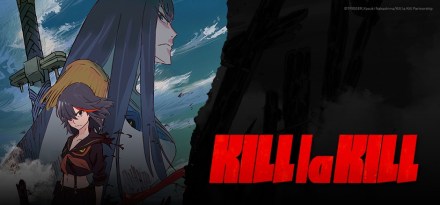
Kill la Kill Review

It’s been a while since I have been wowed like this. Mocha-quality Kill la Kill strips down a basic yet stupid idea, over sexualizes women, showcases butt-naked men, and gets rough, rowdy and ridiculous all for the sake of boldly venturing where not many anime go. The burning question at hand: “Why do humans wear clothing?”

Hot-blooded high school girl Ryuko Matoi is in search for “the girl with the scissor blade;” the same girl who killed her father. Her clue hunt has led her to Honnouji Academy, a militaristic school structured by the “Goku uniforms,” uniquely ranked suits that grant students superpowers. As such, there is a fine line drawn between the mighty and the weak. Law and order is maintained through the school’s “Elite Four” and their supreme student council president, Satsuki Kiryuin, who rules over the domain with unquestionable judgment and absolute authority.

As the unwavering Lady Satsuki and fierce Ryuko meet face-to-face on the bloodstained battlefield that is Honnouji Academy, the threads of fate begin to unravel, and the whole school – as well as the world itself – is at risk of destruction.

Starred uniforms that give students unimaginable power? Yep, it sounds stupid. Very stupid. But through countless fights against a variety of opponents, Kill la Kill makes it work. Why they were made, how they were made, and what they actually are made of are all concepts that the anime explores thoroughly. Don’t try to wrap your head around things – Kill la Kill is NOT a “concentration-necessary” show.

Though fast-paced, the show never seemed rushed. Starting from the fateful encounter, the series gradually builds up to about the ¾ point, after which like any other 26-ish episode anime, it becomes a dramatic and serious blaze to the finish! The anime never seems convoluted in plot and serves as a great storyteller.

Ryuko Matoi is our main heroine. She will do anything to uncover the truth about the powerful Scissor Blade and to avenge her father, including “sacrificing” her body to Senketsu, one of the most powerful sailor suits in existence. While she’s hot-blooded and eager to fight aggressively, Ryuko always seems have issues with Senketsu; the two struggle to agree on matters and as a result have bonding troubles. “Losing her way” would be the proper term to explain her conundrum.

But Ryuko undergoes numerous transformations that make her easily likable and somewhat old-fashioned. Her character reminds me of the typical heroine, yet one embodying the resolve of the classic male hero, too. Because we get to see both sides to her, feminine and masculine, Ryuko becomes a relatable and rather enjoyable lead female – one of the best I’ve seen!

On the other side of the coin is Satsuki Kiryuin, the commanding figurehead and rival to Matoi. A Machiavellian leader, Lady Satsuki is calculating, observant, influential, and above all, sexy. Her iron rule comes from her infamous tagline, which I’ll put in quotes at the end of the review.

In a very similar style to Ryuko, Satsuki exemplifies the feminine and masculine qualities of the archetypical hero. While I can’t leak too much for spoiler’s sake, I can say that she carries a softer side as well. Satsuki is brilliant and inspirational – a rare beauty and one of my favorite characters in general! “HAIL SATSUKI-SAMA!!”

The supporting cast can be broken down by simple goals and stereotypes. The Elite Four consists of 3-star fighters who serve and protect their Satsuki at all costs: the guardian, the fighter, the brains, and the little girl you should probably be terrified of. “Nudist Beach,” the organization opposed to the Goku Uniforms also resembles the usual resistance team.

One other character to point out is Mako Mankanshoku, a goofy, hyperactive student at Honnouji Academy. After literally diving into Ryuko’s life, the two become best friends. Even though she is the moe girl, Mako and her wild family stand as a constant reminder to Ryuko as to what a good family is. Mako is a bit too much at times, leaping in at the last minute to save Ryuko from inescapable doom, but beyond that she is entertaining, friendly, and loving.

Animation by Trigger – hate it or love it. The style is rough, extreme, and lacking in detail. It’s a great change of pace compared to the typical class room setting, however, the obnoxious bold lines sketched all over the place occasionally take things too far. Tension, comedy, and impact are perfectly-balanced strengths, shown best through the very first 10 minutes of the show. Sometimes the animation is very expressive and does the show justice, but other times it’s indistinguishable. The best things about the animation are the communicative facial expressions and high-energy fights. Trigger clearly wasn’t scared to show anger and explosive rage, as they hit that ball out of the park!

For the OST, this is by far Hiroyuki Sawano’s best work. Superior tracks such as “Blumenkranz” are pure evil (fitting for the f*ck-tastic villain Ragyo, might I add), while Satsuki Kiryuin’s theme or Jakuzure’s anthem match their character PERFECTLY. And as much as I hate Nui Harime, even her theme gave off this bizarre feeling of creepy. I NEVER got sick of Kill la Kill’s over-the-top, epic soundtrack! 😀 (PS: 2nd OP “ambiguous” by GARNiDELiA is really awesome)

The only possible turn-off is the surplus of fanservice. Naked men from Nudist Beach and Kamui crop-tops with miniscule panties are overbearing. The director probably wanted to attract as much attention as possible, and hey it worked; thin straps covering well-endowed breasts and sword-wielding beauties? Yep, that’ll stop traffic. But also consider this: the show rebels against clothing, so doesn’t the nudity in a sense support the main message . . . ?

Kill la Kill is great because it is not afraid to show some skin and express itself boldly, however brash it seems at times. It doesn’t hold back when it comes to furiousness, fiery combat, or majestic speeches – it let’s all hell loose, and it’s fantastic. I full-heartedly recommend Kill la Kill for an awesome story, memorable protagonists, and the best rainbow-haired, purely evil antagonist IN EXISTENCE – just get past the nudity first and you’re golden! If you like action and overwhelming emotions please do yourself a favor and check it out. Its nearly mindless-fun approach to storytelling might intrigue you.

“Fear is freedom! Subjugation is liberation! Contradiction is truth! Those are the facts of this world! And you will all surrender to them, you pigs in human clothing!” – One of the greatest leaders to live, Satsuki Kiryuin

Thanks so much for checking out my thoughts on Kill la Kill! I love this anime so much it’s crazy! IT HAS A VERY SATISFYING ENDING. If you enjoyed the review, hit that like button – I’d really appreciate it. Feel free to drop a comment below, too! Until next time, this has been

– Takuto, your host

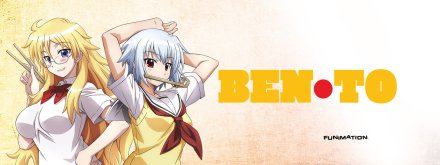
Ben-To Review

While ramen bowls and instant rice make for a quick, cheap meal, the premade bento box featured in grocery stores is the dinner for kings – some say it’s even to die for. Today, an anime centered on retrieving that ultimate dish not only for the driving guts, but for the incomparable glory.

Yo Sato, a high school pervert who revels in playing old SEGA games, decides to purchase a bento box from his local grocery store when he realizes that was his first mistake. Waking up from his unconscious state, he sees that all of the bento are gone. “Wolves,” intense brawlers who live thrive for the taste of a half-priced bento fight in the store until only the mighty survive. Yarizui, the “Ice Witch,” is the head of the Half-Pricer Club at his school, and upon his cold knockout, forces Sato to join the club and to enter the battle of the bento!

Taking an unnecessarily serious approach to the art of low-budget dining, Ben-To is hilarious. There really isn’t much more to say. It is a pure comedy, lacking any dark history or overly dramatic plot twists. The show is perfect for “rinsing your anime palette,” especially after watching something really intense.

The characters are also light-hearted. They each have their own unique names they are coined for: “Ice Witch,” “Lady of the Lake,” “Wizard,” so on and so forth. Over the course of the show, you begin to realize how they got their name, their concentrated strategies and styles, but most important, their motive and willingness to fight – the honor of the bento. None of the characters come from a distorted past, meaning that they are pure enjoyment! That’s not to say that “what you see is what you get,” however; you’ll be surprised by the interesting personas provided by each character.

It’s also amusing to watch the stereotypical archetypes duke it out in what? A grocery store. The quiet girl, the perverted girl, the ordinary high schooler, the “older sister,” the twins, the leader type – it all works, and it’s fascinating! J

I’ve never seen animation by Production David, but they did a fine job with the dramatic brawls that unfold in the store. And while the characters look really beautiful up close, specifically the eyes, even a couple feet away from the viewer the characters’ eyes appear really spaced out/messed up. It becomes distracting after a while, and during a few of the softer moments it kinda trashes the overall appeal.

Interestingly enough, the OST for Ben-To features many brass instrumentals, which is a cool change in music compared to other anime. For those who’ve seen it, it’s reminiscent of C: The Money of Soul and Possibility Control.

The saucy opening “LIVE for LIFE” by Aimi matches perfectly as far as lyrics and context. The in-depth views of characters in the supermarket make the scene look very busy, and in the anime, it most certainly is! In contrast, each day concludes peacefully with the ending, “Egao no Housoku” by Mariya Ise, featuring a soliloquy-esque spotlight by the cerulean-haired red-eyed babe Yarizui.

There is plenty of ecchi scenes and fanservice, and while I’d like to say it’s for the girls, for a change it’s actually for Sato. Oshiroi, the perverted girl and innocent classmate, never stops shipping Sato with the other boys and older men in the series. She reminds me of Rikka from Haganai. Characters such as the student council president or the head of the judo club also have a bolt to pick with him. As a guy, the natural hatred by the setting followed by the slow growth to fondness is comical. Besides this, there are still plenty of skin-revealing scenes for everyone, so yeah . . . awesome.

There isn’t really much else to add besides the known fact that Ben-To is a must-watch comedy series. The ”shop till you drop” story makes for fantastic hand-to-hand combat, my favorite being Shaga, though I also like Yarizui, and it never loses its touch. Though the show’s not family friendly because of the platefuls of fanservice, it’s definitely a great watch after a really sad/dramatic or intense thriller anime. Ben-To will make you hungry, so why wait? The laurel wreath sticker has been placed, the “Wolves” are ready at their marks, the doors close, finally BAM – it’s time to dine!!

“Say your thanks before you eat.” – Sen Yarizui

Thanks for checkin’ out my rather quick review of Ben-To, a comedy action series booming with fun! I have not seen the dub yet, but I love Trina Nishimura, so yeah, got to check it out. Please give me a like if you enjoyed the review, as it makes my day! Until next time, this has been

– Takuto, your host

Date A Live Review

So I crossed this show when I saw some of its key visuals: a powerful warrior clad in a violet, pink and gold-armored dress, with hair of a rich purple hue. Some know her as Tohka, but she’s also known as the girl who was revoked by her own show. Today, a shambling show of plot, yet a decent display of boobage – Date A Live.

Itsuka Shidou is yes, your average high school student. He lives a normal life with his red-headed little sister Kotori, despite him having bold blue hair (she’s got to be adopted). His life is disrupted, however, when another “spatial quake” explodes in his city, causing mass destruction and panic to spread.

These spatial quakes bring Spirits, mystical and powerful beings of unknown origin, coincidently hot/cute chicks. His sister also just happens to be the commander of an Anti-Spirit Team aboard the Fraxinus. As she and the other crew have analyzed, the only way to seal the powers of the Spirits is by making them fall in love with Shidou – and by giving them a kiss. “Kill or kiss the world,” as they say! Failure to accomplish the mission will be met by deadly firepower from the AST’s flying powered suits – worn by half naked women, might I add.

Date A Live is a harem, romance, action, school, comedy, mecha, sci-fi . . . so on and so forth . . . anime. It poorly jumps around between being absolutely serious, bat-sh*t crazy, and fluffy as daily life can be. I enjoy really dark, thoughtful, and intense anime, with a few slice-of-life scenes splattered during the appropriate times – and there are a couple of crafty surprises packed within the show. But this anime is not organized with its plot whatsoever.

Recall that scene from episode 3, the one where Tohka and Origami face off and she accidentally shoots/kills Shidou? That was easily the best moment of the anime; it was second to Kurumi’s creepy assault on the humans in the woods. Too bad the end of the series was met with just a mech fight (not hating on mecha anime or anything, but seriously). – _ –

Also, I don’t really see how the dating sim system the AST uses is helpful. By the time everyone reads the three weird options, votes on one, and tell it to Shidou through ear piece, the moment is long gone and would be too late to respond to questions. But whatever.

Besides Shidou having a really cute face, he’s just the boring middleman between the Spirits, taking in and returning expressions of “absolute concern,” because you know, he’s the good guy. I suppose he can be comical at times, and he’s not an annoying protagonist too, which are pluses, but yeah, he’s not anything new either.

I could sit here and talk about each of the Spirits and how “different” they all are, but really they can be grouped by stereotypes: Yoshino, the shy and quiet girl, Origami, the secretly-in-love-with-classmate, Kurumi, not gonna lie, a decent villain yet tossed to the side the last couple episodes, Kotori, the little sister, and that just leaves one girl – Tohka. While they are all entertaining, comedic, and cute (with great curves :3) they lack the flushing-out that I enjoy most.

Tohka is the first Spirit we are introduced to. She’s tsundere at first, but develops into waifu for Shidou. It’s similar to Asuna from SAO, though Asuna is a much better fighter and character! Anyway, not only does Tohka have a heart-warming food-consuming personality, she also has a beautiful design. When I think about it, Tohka is just Saber (Fate/Zero) if Saber did not have such strict social contracts binding herself. I love the purples, pinks, light blues and golds on her armor and in her sweet eyes!

Yet the one thing this anime had going for itself was put to the side because WHO THE HELL KNOWS. Tohka is a great fighter and by this point she is the best character, so why dump her? For the other girls I guess, but it ain’t worth it. After episode three, Tohka doesn’t get the spotlight again until the end; that’s +6 episodes of Tohka just eating and sitting on her ass. A shame.

This was the high point for the show – the animation by AIC Plus+. Again worth mentioning are the superb character designs, but additionally the sharp and colorful background scenes. I can’t recall low quality of any kind from this show, so a round of applause to them! The only thing I could complain about are the fight scenes, which rarely happen – and I’m talking all-out fights, not a missile launch here and there. The action sequences featuring the dominant Spirits clashing with the AST units are spectacular, but sadly few and far between.

The soundtrack was a real surprise for me. Not only are the daily life scenes well-supported by casual themes, but the dramatic sections are gorgeous and truly melancholic. Anthems for battle ring with a full on orchestra plowing down the field, and intensity is never lost by the OST.

Infamously known, the opening “Date A Live” by sweet ARMS quickly catches attention as an opener. Its passionate choir vocals along with an addicting melody are a great way to start each episode! The ending second “SAVE THE WORLD” by Iori Nomizu is also so catchy! I’m quite attached to them both!

But great background music and quality detailed animation won’t save the failing date that is Date A Live. The show brings nothing new besides its unique yet unorganized story idea, and if you’ve already waded through several harem anime, then you’ll know all of the ins and outs, getting more and more tired of this show’s determination to be something it’s not. If you are not a critical viewer and are simply looking for time to blow on an action/romance with comedy, impressive fights, and fan service then this is perfect. Otherwise it doesn’t live up to the hype.

“Just killing and killing and killing? You deserve to die and to die and to die.” – Tohka Tatogami

Yeah, bummer, it was disappointing. However, there is a second season, so I will be checking that out soon. Since I watched it in subs, I hear the dub for Kurumi is really awesome, so I might give that a watch too . . . if only I could ever find the time. Thanks for reading – slap that like button if you enjoyed my review and until next time, this has been

– Takuto, your host

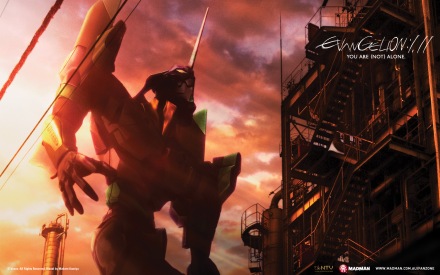
Evangelion: 1.11 You Are (Not) Alone. Review

Hideaki Anno had already captured the minds of millions when his most popular series Neon Genesis Evangelion was produced way back in 1995-1996. In 2007, he started the Rebuild of Evangelion, a series of movies that would reaffirm and branch off of the original series, hence, a rebuild. Today I’ll look at his first film, 1.0 (later to be released as a special edition, 1.11), and see if it meets his grand intent of pleasing fans and drawing in a wider audience with better visuals, music, and hopefully, an improved story.

2015. Tokyo-3 is the only remaining city in Japan after the Second Impact devastates the world. The lone city is not at peace, however, as gigantically scary extraterrestrial life forms known as Angels seek to exterminate the human race. As young boy who has not seen his father for over eight years, Shinji Ikari is called to NERV, an organization assembled to take down the Angels, where he will be piloting Evangelion Unit 01. Ikari’s father, the head of NERV, demands Shinji’s combat against the Angels; choose to not fight, and the already-injured and mysterious pilot 00 Rei Ayanami will be forced to. Getting himself into much more trouble than a robot fight, Evangelion 1.11 features the first three Angel clashes in remastered HD quality.

As far as changes go, this movie is almost an exact adaptation of the first eight or so episodes from the original series. As such you can check out my Neon Genesis Evangelion review here for a more in-depth review. The movie does a great job at recapping the old material, but of course, it drops quite a few scenes for time’s sake. Veterans of Evangelion might be disappointed with this, despite the new, incredibly detailing scenes that were added, but to newcomers it gets straight to the point.

The characters are also the exact same, with the exception of Shinji Ikari receiving less annoying dialogue. He just seems like a troubled 10 year-old instead of some rude brat when he refuses to fight at times.

For pacing, the show is rather rugged. It’s almost always on the edge of its seat, seeming like a string of intensity instead of a smooth-running film.

Another reason fans were let down was because it just didn’t feel like Eva. Everything is clear-cut and dialogue is cleaned up, making for fewer interpretive scenes and lessening the overall enigmatic effect. For unfamiliar people, this is a good thing, but for those who had seen the original, it doesn’t maintain the shady and “distorted” Evangelion quality.

I was pleased to hear that all of the main characters and some of the side were portrayed by the same English and Japanese voice actors. Props to FUNimation for the great dubbing!

The music is top-notch, though most of the tracks are just pulled from NGE. Model examples include “Decisive Battle” and “Angel Attack,” two of the main battle themes of the show. The ending, “Beautiful World” by Utada Hikaru, is simply a beautiful song, no joke. It was a cool way to end the film. I listen to it off and on as one of my alarms – it’s a great way to start the day!

Studio Khara revives the original series with amazingballz visuals! CG for the Angels, specifically the complete makeover of the 6th Angel (blue diamond one), is brilliantly done. Architecture is clean, for when Tokyo-3 goes into Angel alert, the sunrise combined with the colossal rising and falling buildings is a splendor. And of course, the Eva Units’ new computer graphics are glorious!

For a 2007 film, it easily rivals and surpasses most of the animated films of today. Fans will be pleased, as I was for sure. However, since it only encompasses the first quarter of the show, this will raise more questions than answers for newcomers to the franchise. Though it lacks footage and original atmosphere, Evangelion: 1.11 You Are (Not) Alone manages to be a great reaffirmation of the old anime, and masterful edition to the Evangelion series.

I hoped you enjoyed my quick few thoughts over the Rebuild of Evangelion’s first film! Drop a comment below if you had similar or different thoughts, because I love reading them ~ Until next time, this has been

– Takuto, your host

No Game No Life Review

I have this system that allows me to recommend anime even if they have this “read the manga” bull-sh*t ending. After all, it’s usually the ride that counts for me. No Game No Life is a quizzical anime adaptation based on Yuu Kamiya’s light novel series, and its lack of an animated ending hurts the series the more I think about it.

Bro and sis Sora and Shiro are gifted NEETs who form the notorious “blank” across the gaming world. Together they are an unstoppable force: pulling all-nighters, eating junk food, and learning all of the ins and outs of various games just to achieve victory – but they never cheat. They both find the real world to be harsh and even crappy, donning it as just another game. When challenged to a complex game of chess supposedly designed by God himself, Tet emerges upon their triumph, and the two are warped to another world.

In this world, God has outlawed war and violence, so instead of physical brawls, everything is decided by games. Want all the money from a bank? Beat its owner. What about living in a castle? Simply defeat the king – and that is exactly what “blank” does. With the humans or “Imanity” chased to the board’s edge by other races, is it up to Sora and Shiro to save the Imanity and conquer the gaming world – but in real life this time.

No Game No Life’s basic premise can be carried out in many ways, yet “beat the boss, next floor” format doesn’t flow in this anime, and that can be appreciated – to a certain degree. While you know Sora and Shiro will win all of exciting and intriguing games (cause if they lose there wouldn’t be a show), it’s the ride to that final draw that make 12-episode anime worth it. The games are wacky and chalked full of weird rules, however, that makes them so much fun to watch!

On the other hand, the slight lack of explanation in each challenge often results in seemingly impossible feats. The games can be confusing and drawn out to two episodes at a time. As such this show is a binge watch – you’ll lose track if you try to space your viewings out.

Sora overwhelmingly takes the lead as the perverted-older-brother-mad-hatter type of character. He’s clever and brainy, desiring to win a library for knowledge of the world that he and his adorable sister were thrown into. Logging it in their phone, Sora immediately makes it his top priority to challenge the God of this world. Yoshitsugu Matsuoka (Kirito from SAO, Arata from TRINITY SEVEN) performs with such strong lust in his voice acting that makes for quirky dialogue. He certainly plays the role well!

For a female lead, Shiro is not that interesting. She’s cute, quiet, and relies on her onii-san. There is a much more intellectual side to her, unlike her brother, that makes for quick-witted comebacks and in contrast respectful monologues. While Shiro gets a couple of great episodes to herself – literally by herself – there isn’t really much else to say.

The only other mention is Stephanie Dora, an emotional young Imanity girl who is the daughter of the recently dead king. She is stubborn, whiny, and expressive, yet has an intelligent side regarding the Imanity. Because she flips from being a genius to a dimwitted casual – just to make Shiro and Sora seem smarter, might I add – she was poorly treated by the writer(s). Stephanie is easily likable, but only when she has her dignity intact.

NGNL’s animation by Madhouse is rather . . . how’s to say, bright? The effective use of reds, blues and other vibrant colors as outlines instead of the usual black adds to more eye-appeal. Everything else is also energetic in color; these upbeat hues help to bring the world of games alive! It’s fun J and not like your average anime!

Sound-wise, I wasn’t too impressed. There are a few “Aha!” tracks for the intense gaming climaxes, but the more emotional bits are supported, yet without memorability. I can recall the epic challenges that Sora and Shiro surpass, but I can’t remember any of the characters spewing out their passion, and part of that is because the actual-game-sounding music just wasn’t on-par with the anime. Besides “Predawn,” it’s not bad by any means, but could have been more.

The show gives off this foreboding vibe, as if Tet foreshadowing the darkness behind the gaming world is where the series would end, however, we never get down to the heart of things. That disappointed me most. A perfect reflection of my thoughts are in the opening, “This game” by Konomi Suzuki. The piano introduces us to a mysterious and devious land, yet past this rich piano solo, the song turns into your average anime opening, revealing its sense of playful trickery.

I have troubles recommending No Game No Life particularly because it just ends with another game. Upon release of a second season, which is most likely, then I will 100% recommend this anime to anyone, despite the mild nudity. The characters can drag the anime down a little bit with their ecchi playing, but when the boobs are put away, No Game No Life functions as a great piece of entertainment, and I enjoyed its cleverness thoroughly.

“’Checkmate’ doesn’t mean you’ve simply cornered the enemy king. It’s a declaration that the enemy king is yours. That’s why I said it the first time I met you. ‘Checkmate.’” – Sora

The anime has been licensed by Sentai Filmworks, so we can expect a dub release sometime soon hopefully. Thanks so much for reading my review over this fun gaming anime! If you had similar thoughts, hit that like button and follow me for more material like this. Until next time, this has been

– Takuto, your host

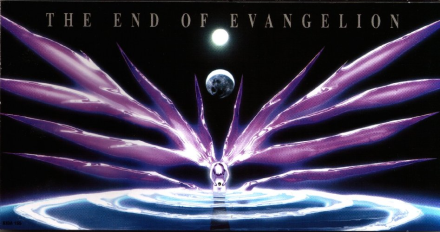
The End of Evangelion Review

Between Neon Genesis Evangelion ending with two episodes of solid ideology talk in Shinji’s mind, and the lack of explanation by SEELE regarding their “Human Instrumentality Project,” how did the series physically end? The End of Evangelion finally gives fans resolution, but does it raise more questions than answers?

First off, the soundtrack for this movie includes many classical pieces that provide an epic feel to the battles. Robots and Angels would be shooting lasers and fighting like crazy, yet all you would hear are the powerful strings and band waltzing around. Really neat touch to the already-unique qualities of Evangelion.

The animation is surreal; especially the spiritual ending the movie is famous for. It’s breathtaking, yet makes you feel strange and without an appetite. Invoking a sense of rejuvenation, the movie’s high quality fight scenes and godly interventions are a splendor. Asuka’s fight against the mass-produced Evas in particular is one of my favorite fights I’ve ever seen in anime – and this film was released in 1997! You can just feel the weight of the colossal metal swords she’s swingin’ around!

There are a few curious shots, however, and particularly when real-life video clips are present for some odd reason –  but it all adds to the feel of the film (WTF) . . . I mean, I guess. . .?

This movie is divided into two 40-ish minute long episodes, which are supposed to break down what actually happens outside of Shinji’s mind in those last two episodes of the series. Making more sense now?

NERV is being attacked by SEELE, which causes pandemonium to break out everywhere. Shinji goes hysterical over the death of Kaworu and spends the first episode confronting the three lead females as to his remaining humanity, each represented by Naoko Akagi’s philosophy of herself: Asuka, the woman, Rei, the mother, and Dr. Akagi, the scientist. Misato embodies a ‘lil bit of each, and continues to act as the free spirit and love, which is why she is one of the last ones Shinji confronts. This is one of Evangelion’s most crucial themes, which is exploited quite thoroughly in this movie. Following Asuka’s last fight and when the three “are rejected by” or reject Shinji himself, they curl up in despair, which is continued in the second half. Shinji then sinks into the next and final phase of his development.

In the second episode and finale, Gendo Ikari attempts to acheive his ultimate goal – the bringing back of his dead wife Yui through the Angel of humanity’s creation – Lilith. Previously, an “accident” during Eva-01’s creation absorbed Yui’s soul and she was absorbed into the Eva as LCL. When Gendo tried to salvage his wife, the first Rei was born instead. This small detail is the cross point of many questions in the series, including why Shinji, Yui’s son, would have been the ideal pilot for Eva-01, and why Gendo was so insistent on Shinji piloting it.

By using the Rei models as clones for his wife, he had planned to unite her with the embryo form of Adam, the First Angel and genetic basis of the Evangelions, to supposedly “bring himself to his wife” or whatever. This fails, however, as Rei grows consciousness (plus a freakin’ personality) and rejects Gendo.

Rei proceeds to unite herself with Lilith, awakening the Second Angel in the process and creating an Anti A.T. Field that turns all humans but Shinji into LCL – the lifeblood of Lilith. The stage is now set for its grandiose climax!

Yui reacts to the rebirth and as a result, Shinji, piloting Eva-01 against Angels, must make a decision:

  1. a) allow instrumentality to succeed, “dissolving” the A.T. fields (ego) of humans so that humanity evolves to become one individual, or
  2. b) reject instrumentality and God knows what happens. . .

At the beginning of Instrumentality, before and during a Shinji’s decision-making,”Komm, süsser Tod” (Come, Sweet Death), an upbeat song plays in the background. I’ve never felt such feels like this with anime ever, and that scene right there was pure bliss. I feel I can just let everything go, that I’ve reached my own salvation with my anime journey.

Because the movie is so intriguing and justly satisfies with a divine ending, I have to take back a comment regarding Neon Genesis Evangelion, in that it is not a “timeless classic.” This movie, however, definitely deserves the title.

Hideaki Anno’s The End of Evangelion does indeed answer the painful questions pondering fans, yet it does so in a very artistic (interpretive) and “spiritual” manner. At its heart, Evangelion is a beautiful story about life. Whether its religious references even make any sense, the movie pulls all of its strings together, ties them in a knot of a balloon called “hope,” and lets it soar into the heavens, so-to-speak. The End of Evangelion is one of the best films to follow an anime ever, and if you haven’t seen it – you’re missing out on a masterpiece. Truly, you are.

“Anywhere can be paradise as long as you have the will to live. After all, you are alive, so you will always have the chance to be happy. As long as the Sun, the Moon, and the Earth exist, everything will be alright.” – Yui Ikari

Whew! What an experience! If you haven’t already seen Neon Genesis Evangelion, go watch it. Like now. I’ve been in such a ponderous mood ever since then it’s not even funny. 🙂 Enjoyed the review? Click the like button below and follow me for more material. Until next time, this has been

– Takuto, your host

PS: Here is a video or two I used to help recap all of the history of the film. If you’re confused about Evangelion, give it a watch – THEY REALLY HELP:

History Explanation – https://www.youtube.com/watch?v=Ho07Ag6lV9g

How Rei is present in the beginning and the end – https://www.youtube.com/watch?v=gNx-wsaEkZ4

Neon Genesis Evangelion Review

As said in my “You Are (Not) Alone” Valentine’s day post, I had a pleasant three-day weekend to binge-watch the infamous robot anime Evangelion, a timeless classic in the anime community. So what do I have to say about it? Well, I can fully appreciate Ender’s Game now.

Fifteen years ago, the Angels, gigantically scary extraterrestrial life forms, caused The Second Impact, a catastrophe which wiped out half of humanity and literally threw Earth of its axis. In present-day 2015, the Angels have returned in Tokyo. To counteract, a secret UN agency by the name of NERV has developed weapons – human fighting machines known as “Evangelion.” Though they can only be piloted by fourteen-year olds, for some odd reason cause its anime, the heroic Evangelion robots hold up against the Angels with ease – most of the time.

Shinji Ikari’s whole world is thrown into chaos when his asshole of a father, the head of NERV, demands that Shinji pilot purple Evangelion 01 during a sudden Angel attack, even though his own son is terrified of the thought. Regardless of what he truly wants, Shinji must courageously force himself head first into intense battles, diving deeper and deeper into despair and insanity to uncover his self-worth.

Shinji is a difficult character to talk about mainly because his life is a double-edged sword; pilot the Eva and win – everyone loves you. Lose, however, and you’re on everyone’s death list. He has a pussy attitude and his constant apologizing gets on many people’s nerves. To top off this train wreck, he specifically says that distancing himself from others is easier than being with someone. As much as I want to say he is a hero, he really isn’t, but rather the child that humanity must pity. That’s not to say that his life is hell, though, because it definitely sucks! I think a distressed youth such as Shinji was the most interesting viewpoint the series could have had.

Misato Katsuragi, the sexy chief of operations officer at NERV, takes timid Shinji under her wing, serving as the motherly figure that was robbed from him as a child. She is pretty messy, as she leaves beer cans and instant-made food containers lying all around the apartment. For most of the show, she serves as the comedy and fan service side of things, but she’s way more than that. In work, she is punctual, intelligent, and a captain, while at home, Misato is relaxed, carefree, and a lover. Misato is a fun and awesome gal, and Allison Keith portrayed her with a quality-matching English dub performance!

Asuka Langley Soryu pilots red Evangelion 02, and as such acts as Shinji’s partner for parts of the show. She serves the plot as Shinji’s opposite with her busty German speaking and ballsy/brash loud mouth. She too suffers from intense mental grief, shown physically through the way she feels the need to conquer everyone else – that she is better and above all others. The two fight a lot and over the course of the show, she opens him up to a more social, sexually-open life. I especially enjoyed Asuka as a character and her English voice actress, Tiffany Grant. She nailed the German, I tell you! 😉 “Wunderbar…” God damn, I can’t even…

The one whom I was disappointed with was Rei Ayanami. Then again, I’m not one for silent characters. With her blue hair and red eyes, you get the impression right away that something about her seems, hmm, fake? She pilots the prototype orange/blue Evangelion 00. To the plot, she is much more in The End of Evangelion. For now, however, she acts as Shinji’s “love interest,” though they don’t get really far between his shyness and Rei’s awkwardness and lack of communication. Rei is the opposite side of the same coin to Asuka: a peaceful, compliant fantasy girl to a demonic, enticing sex counterpart.

So that’s all, right? Nothing else to the characters? Of course not. Neon Genesis Evangelion’s cast is massive; I’d be spending several reviews recapping just the complexity these last four characters if I could. They are all wonderful, intricate, memorable, and most important of all – human.

All of the characters are pretty screwed up though. Towards the second half and end of the series, they all descend into their own personal hell, growing more insane due to the vibe the Evangelion give off until they eventually crack. Even the good doctor Ritsuko crumbles in madness. It makes you feel depressed, shameful, guilty – just all of the things that they feel, really.

And the plot is the same way. What started out as a regular mech series that has fighters cleverly taking down enemies ended up soiling itself in darkness and messed-up plot turns. However, the show’s real antagonist,” Seele,” lacks so much explanation that they are hard to understand. They pull random crap out of nowhere and it can be really confuzzling. Character motives become distorted and you ultimately end up with a show soaked in raw twistedness.

To the animation by low-budget Gainax – IT’S NOT AS BAD AS PEOPLE SAY IT IS. Frankly, I found the animation to give the show a unique feel to it. Yeah, it’s crap during a plentiful amount of scenes; there are freeze frames where nothing is moving for a freakin’ hour; the Evangelion and Angels are not given justice in Gainax’s animation – so what?! It makes you feel eerie; the dull tone and paleness makes the story more mysterious in a sense. Praise to the Rebuild films – ABSOLUTELY – but this anime makes do with its poor studio budget, and I appreciate that.

The soundtrack supports many militaristic themes for the engaging battles, but nothing really stands out. Even more emotional moments lack interesting tracks. I suppose it fits the mood well, but it’s not a brilliant score by any means. One of the main things I took from this experience was the addicting opening, “A Cruel Angel’s Thesis” by Yoko Takahashi. I kid you not; I never skipped this opening once when I watched the series. While the legendary lyrics don’t really match Shinji’s character, the song is still a must-listen! 😀

If you didn’t understand Neon Genesis Evangelion – that’s fine, did anyone? Just to name a few questions: Who can truly say when evolution has gone too far, as well as whether having a God is a good thing for humanity? As long as you grasped your own beliefs from this anime, then you have mastered the Evangelion experience, so-to-speak. Many believe this anime to be symbolic of life; some think Hideaki Anno was simply high when this show came out in 1995, and he probably was. Neon Genesis Evangelion truly masters character relationships, and is intelligent, creative, disturbing, unnerving, and downright weird. But at that, one hell of a ride. “Science has made us gods even before we are worthy of being men.” – Ritsuko Akagi

Thank you so much for reading my review over this timeless anime classic! Leave a comment below with any thoughts or questions you had. Hit the like and/or follow buttons for more content like this and until next time, this has been

– Takuto, your host