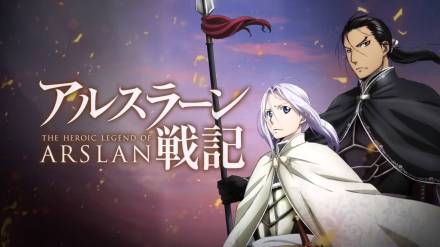
Arslan Senki, When the OP/ED is Better Than the Actual Show

A spoiler-free review of the 25-episode spring 2015 anime “The Heroic Legend of Arslan,” produced by LIDEN FILMS and SANZIGEN, based on the manga (story) by Yoshiki Tanaka.

Undefeated King Andragoras rules over the flourishing kingdom of Pars with a firm grip through his mighty Royal Capital, Ecbatana, a city structured around a slave system that fuels the royal palace. However, the baby-faced prince Arslan, a wide-eyed and curious boy, knows deep down that he does not possess the same iron fist that his father, the King, leads with.

Pars Era, Year 320. At the tender age of 14, Arslan sets out on his maiden battle at Atropatene only for everything to go up in flames. Ecbatana falls to the Holy Lusitanian Empire, an enemy not only smart on the battlefield, but one that follows their all-empowering god “Yaldabaoth.” The youthful Arslan witnesses bloodshed of his people and the capture of his glorious Ecbatana. Arslan quickly flees the war mounted on the steed of his faithful knight, Daryun. It is at this moment that Arslan’s destiny is written in the stars, and through the help of his new followers and friends, he will rise to reclaim his golden capital no matter the cost.


At its core, this anime is about growing up and finding the courage to lead, and it pulls this decently enough. Arslan is faced with countless tasks that he must overcome before he begins his reclamation: Inviting members to join his party, establishing his force, rebuilding his army, seizing a base of operation – those are his main goals. But there are many bumps in the road for the poor blue-eyed prince. He must first find his drive to fight, his charisma to keep others around him, and lastly, his ethical approach to war. All of this ties into leadership, and through the guiding pen of Narsus, the master tactician, Arslan’s ideals become clearer.

Arslan Senki is set in a world based on past historical cultures, and I can proudly say has it done its research quite well. Although I’ve never been out of the country [yet], its portrayal of distant desert lands are captured in such a rich manner that I feel as if I’m actually sitting on a silk cushion in bright banquet room watching minstrels and men get heavily drunk!

You must not forget that Arslan is a fantasy. The magic may only be sneaking in the shadows (receiving no explanation whatsoever), but it’s still there. And since there is a hint of magic, it seems that the anime takes the typical fantasy copout: “It’s magic. I ain’t gotta explain sh*t.” Know that it works in mysterious ways, charming characters in the background, but it’s not the main focus. That’s on our characters.

Wait, what? No. Go home.

We’ve already talked about Arslan; decent kid, fair development, a bit bland, but not a poor character. Following Arslan right by his side – both his sword (javelin-thing) and shield – is Daryun. Daryun’s loyalty to his “prince” is admirable by many and his strength is unmatched – even by those in foreign lands. When he is not speaking to his prince, Daryun chats with Narsus, an old pal of his from back in the day. The two share conversations of strategy and wit, a combo both deadly and humorous. Just don’t bring up Narsus’ side-hobby of painting. Really, don’t.

Hey buddy, that’s what I thought

The other two I enjoyed were also fine warriors in their own rights. Gieve, a whimsical “traveling musician” who can skillfully wield many weapons and the chill Farangis, a muscular yet enchanting cleric and master of the bow which whom Gieve proclaims his love to. Although they are somewhat a gag duo, Gieve neither siding with Narsus nor the enemy half of the time, they receive very little backstory (specifically Farangis) – which is the biggest disappointment. I would have sacrificed ten Arslan balcony-contemplation scenes for one Farangis side story if I could.

That’s right. Slip and slide outta that room Gieve, you perv.

These adventurers along with a couple others compose Arslan’s force against lord “Silver Mask” (oh the cheese, it hurts), an incredibly skillful brute who is after Arslan’s head for some reason . . . Among the challenges that Arslan faces, this is his toughest one yet! This man is what triggers Arslan’s moral conflict. I won’t say much, but it was an intense endeavor for the crew to keep away from this madman.

Too bad NO ONE knows who you are even without the mask

Now, if you’ve thought that up until now Arslan Senki was an A+ for me, you’re incredibly mistaken. The entire show is one sloppy quest, and here’s why:

They say adventures are all about “the getting there,” and that the resolution just happens to tie loose ends. But Arslan Senki doesn’t give us either of these things! Instead it drags on for 25 boring episodes of pointless side plots doing FLIP that take far too long to resolve – Speaking of, IT DOESN’T END. Spoiler alert, but it doesn’t. Instead, we have Arslan and the gang mounted majestically, waiting to take back the kingdom until blah blah blah “here’s a season two B.S. announcement because we couldn’t get our crap together in the first.” Seriously, WHAT!?

Yuck

More yuck

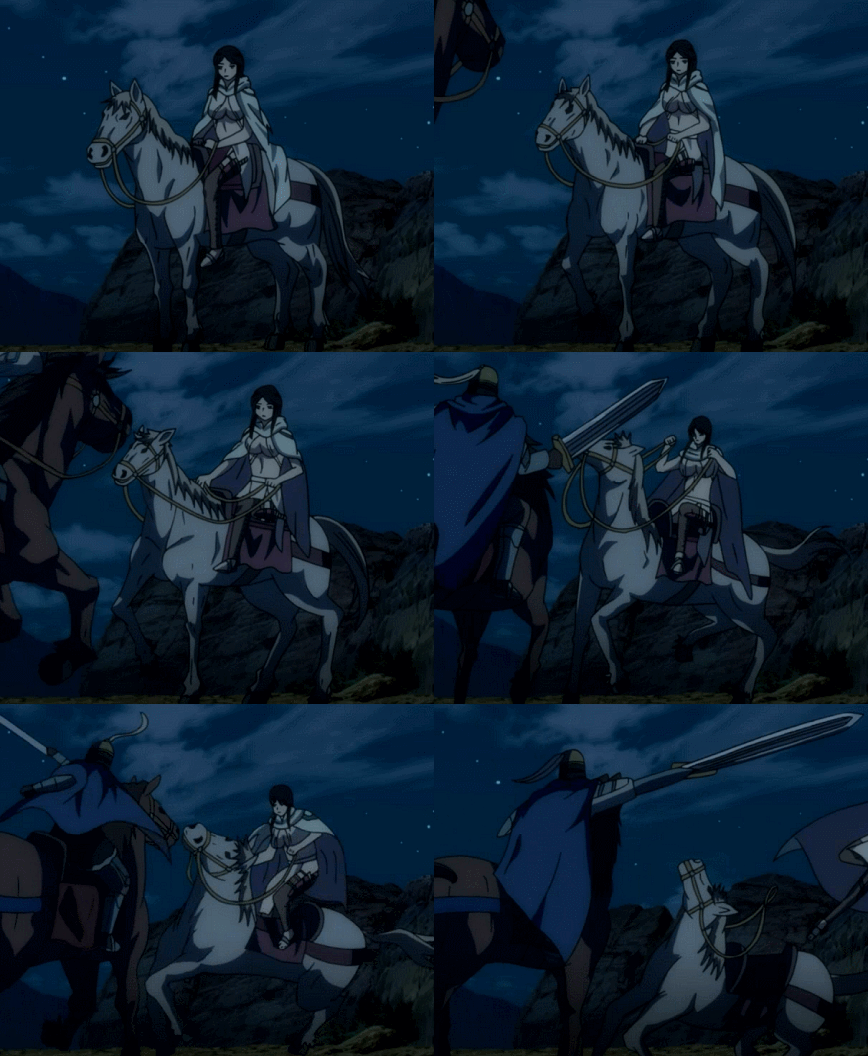
Don’t even get me started with this anime’s production value. It’s TERRIBLE. I’ve had enough of CG-gummy army men, retarded-angry horses, and derpy Arslan faces to last me enough time to figure out the secrets of “Silver Mask” and overthrow Pars THREE times over. The animation is extremely inconsistent, relying on its few high-budget fight scenes and opening animation alone, and it really drags the show in the mud. You know it’s bad when you can tell where the money went in each episode. Art may look pretty, but for the love of Yaldabaoth DO NOT get this show in motion!! It’s so IRRITATING.

Heavens, I find that very hard to believe
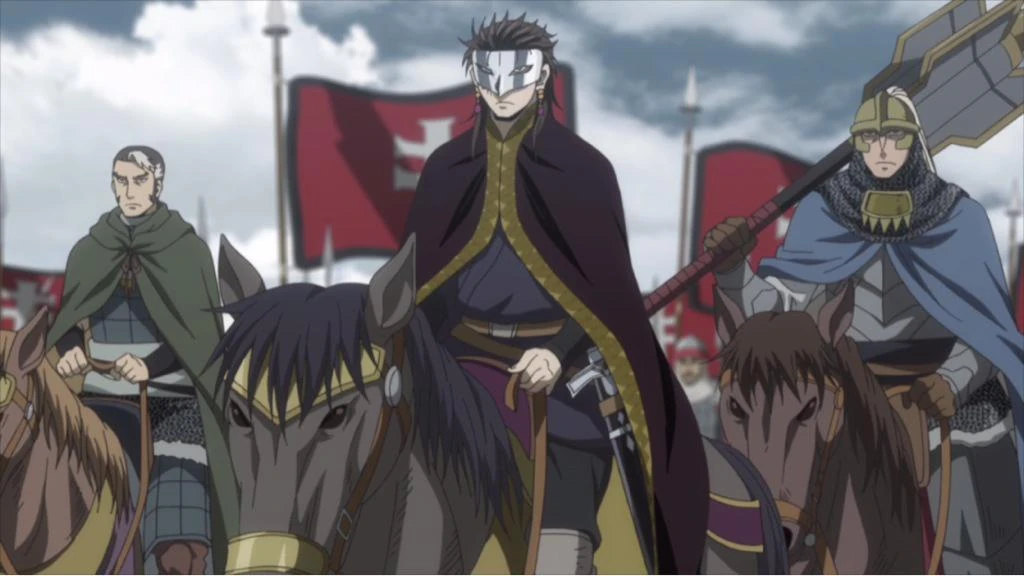
Why do those horses look so . . . evil?

why do they go to the dark side

No seriously, what the hell IS that??
23WCsqc

“Yes, he’s supposed to be killing that horse.”

And now for the music. Does it fail epically like its visuals? Well, slap UVERworld, Eir Aoi, and Kalafina in the same anime and you tell me. The first opening “Boku no Kotoba de wa Nai, Kore wa Bokutachi no Kotoba” by UVERworld is pretty darn solid, and the second, “Uzu to Uzu” by NICO Touches the Walls has that quality “second half” feel to it. Once you hit Eir Aoi’s ending “Lapis Lazuli,” however, you’ve entered my top 5 endings. If Arslan is remembered for one thing, it’s gonna be this song (that moment when the OP/ED is better than the show). Lastly, Kalafina brings all under their graceful wings with “One Light,” the second ending, giving us some air of conclusion to grasp onto.

I’ll give Taro Iwashiro’s soundtrack props to filling out the fantasy-adventure tone enough to immerse me in the setting. No tracks in specific to highlight, but being supportive is all I could ask for with this shambling show.

So whoopty-freakin’-doo, there are my thoughts on The Heroic Legend of Arslan, or more accurately titled, The Heroic Legend of Asslan, pardon my French. Unless you are an absolute diehard fan of the fantasy-adventure/war drama genre, then throw this one out with yesterday’s garbage. We don’t need it, and certainly not a flippin’ sequel. That’s bullticky. Now if you’ll excuse me, I’m going to go find Farangis’ cult and burn crosses in Lusitanian yards.

“The throne itself does not have a will of its own. Depending on who sits in it, it can be the seat of justice or it can be the seat of inhuman cruelty. As long as it is a man, and not a god, doing the governing, he can never be perfect. But should he neglect to make efforts to reach for perfection, a king will surely tumble down the slippery slope towards evil with no one around to stop him.” – Farangis, and amen at that

+ Arslan’s main troupe, though a bit lacking in development, comes across as a pleasant party

+ All openings and endings were the only features keeping me attached to this show

– IN-CONS.ISTENT. ANIMATI-ON.

– Sloppy execution of story, not enough character spotlight, specifically for Farangis and Arslan

– So much wasted potential in all categories, ending was unsatisfactory

For the café rating, it’s average even during its best moments. Did anyone else feel disappointed with this anime? If you had other thoughts, I’d be very interested to read them, but otherwise charge into the like button if you found my “spittin’ fire” on Arslan at all amusing. “Yashasuiin!” I won’t lie, if felt darn good to hate on something since all I do is spread cheer about shows. And right as I return, I must bid you all farewell again, so until next time, this has been

– Takuto, your host
Sword Art Online Novel 02 Mini-Review & Chance to Win $50

Evening all,

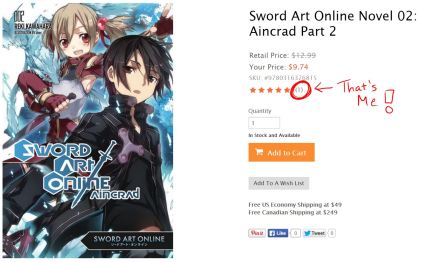
For those who get the RightStuf.com emails, you would know that recently (or at least I noticed recently) that each month they apparently raffle off $50 as a giveaway incentive to those that write a review for a product in their store. All you need is an account (FREE and easy to make), but if you shop there regularly, then you probably already have one! All you have to do is follow their instructions that I’ve listed below. Be wary that there is a character limit – That bit me in the rump. Anyone can enter. Simple as that!

rightstuf50

I make this announcement because their system just caught wind of my Sword Art Online Novel 02: Aincrad Part 2 mini-review, and I had just double-checked to see if it was posted in their store. IT WAS! I can’t believe that I’ve just embedded myself into the RightStuf system, but I’ve done it, and there’s no going back – It’ll be there FOREVER muahahaha! If you’d like to check out my mini-review over the product, CLICK HERE. Maybe it’ll inspire you to pick it up yourself! I’d be overjoyed ^.^

But that’s all I’ve got for now. Stay tuned for a review of The Heroic Legend of Arslan or Sound of the Sky, whichever comes first! Who knows, maybe something else random will pop up and I’ll have to brag about it XD. Have a wonderful Friday tomorrow, and until next time, this has been

– Takuto, your host

Want a FOODGASM? Enter the Food Wars!

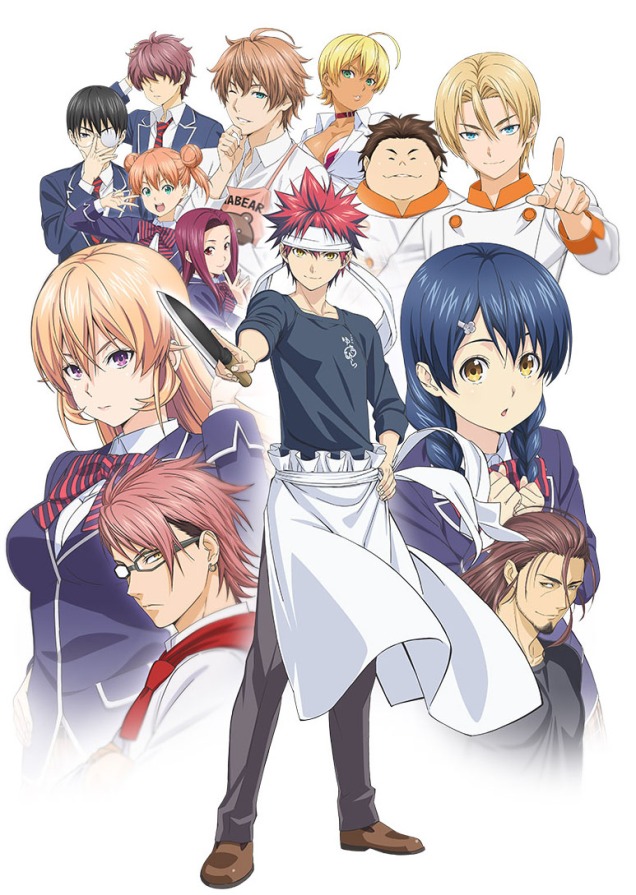
A spoiler-free review of the spring 2015 anime “Food Wars! Shokugeki no Souma,” produced by J.C. Staff, based on the manga by Yuuto Tsukuda and contributor Yuki Morisaki.

I like to cook. Granted, I’m no master chef, nor do I really know what I am doing half of the time, but I find enjoyment in starting the rice cooker and chopping up some lettuce. Lather on some soy sauce and you’ve got yourself some tasty stuff. In fact, I’ll be right back . . .

*with mouth full of food* Now wheh wur we? Oh, wat’s wight. Food Wars!, baby! PREPARE YOUR ANUS FOR ALL THIS ‘FOOD PORN.’

Shokugeki no Soma centers on Yukihira Souma, a 15-year-old practically raised in his father’s local Japanese restaurant so that he’ll one day take over the family business. That’s no fuss for Souma because he loves cooking and dreams that nothing will ever change. But when his sly father suddenly closes down shop for a bit to play chef in America, Souma is challenged by his old man to attend Toutsuki Culinary Academy, which considering its incredibly slim 10% graduation rate, is basically hell itself! As Souma dives into delicious, daily tests and mouthwatering missions, he makes new friends and even more enemies, but will his father’s teachings be enough to pull him through the first semester? As long as he wins the Shokugeki!

So what is a Shokugeki? It’s a famous Toutsuki tradition that has withstood the test of time. Essentially, it’s a cooking duel initiated when two persons need to settle a dispute. They are judged by an unbiased panel and all the clashing chefs have to do is muster their culinary expertise to best their opponent AKA a game of whose food tastes better. This is where the anime gets its fire. The acclaimed battle-roulette shounen is fueled by these steamy competitions of trial-and-error and sheer willpower!

Aw yeah, here we go!

Aw yeah, here we go!

Shokugeki proves that resolution and “courage” are not enough to win one’s case, however, and that’s what makes this anime excel from other shounen with the same stunts. An incredible amount of cooking skill, familiarity in the kitchen, and knowledge of spices that I’ve honestly never even heard of are necessary to simply blend in with the crowd, let alone actually surprise one of the scary judges! I mean, it’s still a school, so I would hope that they are learning to grill my steaks properly.

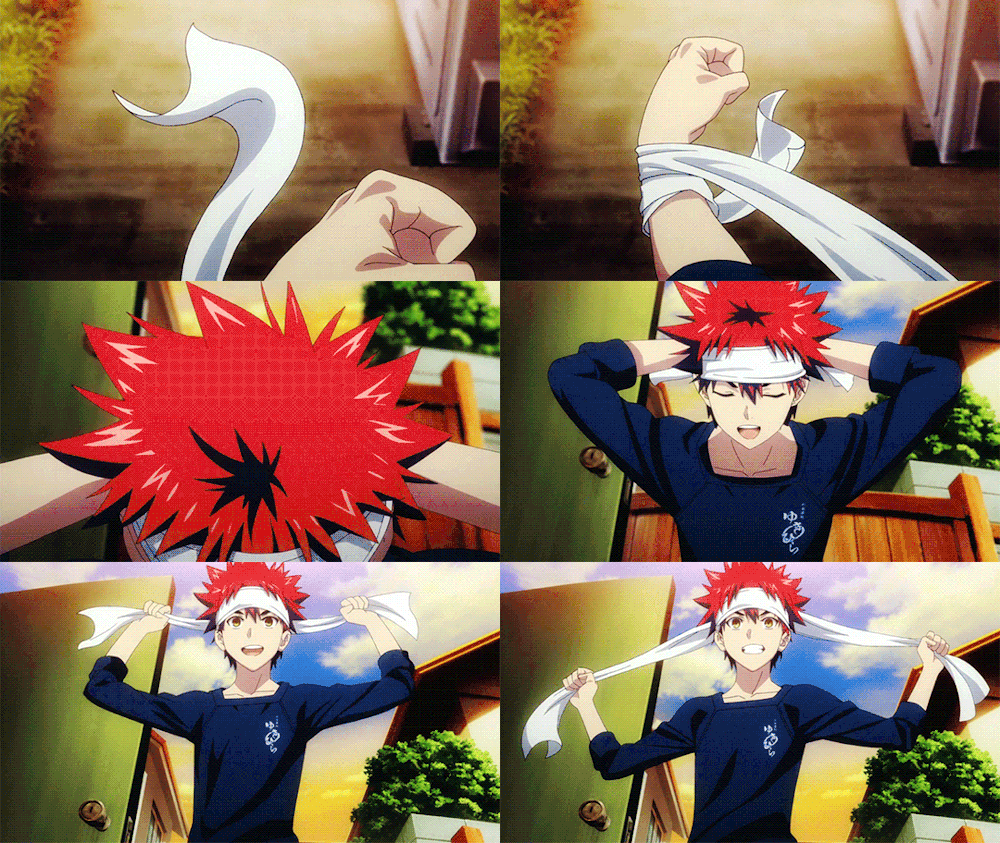
Souma thinks he’s a wise guy, taking after his son-of-a-buck father. He’s pretty damn smug during his entrance speech, proclaiming that he doesn’t plan on losing to “some bunch that has never stood in front of clients” – That’ll earn you a rep no doubt, because now the entire student body wants to slit your throat! Cocky as he seems, Souma’s got one thing that none of the others have. Passion? Nope. Talent? Not that. A hot body? For this spiky redhead, hardly. Souma wants to support others, and when your egg omelet determines your fate, that’s a rare treat in a guy. Even though he’s a dumb fool, ‘he helps others find their feet so that they learn to stand up on their own’ (as one reviewer sorta put it), specifically speaking, the clumsy yet sweet Tadokoro Megumi.

The rest of the characters are pretty much store-bought stereotypes, but in the case of Shokugeki, that’s not a bad thing at all! There’s the tsundere “God Tongue” Erina Nakiri, the critical queen of Toutsuki who seriously needs a new nickname; Nikumi the “Meat Master,” a busty servant of Erina who trust me, knows her way around meat; Tadokoro Megumi, the already-mentioned endearing ‘freshmeat’ of the pack who, at first clings to Souma’s apron like a stain, builds her own uniqueness and learns to fight on her own turf like a pro; Lastly Takumi Aldini (the Italian stallion) who remains Souma’s poke-fun-of rival in this shounen.

Better start learning how to shine shoes because she’s several feet over our heads

unnamed

tumblr_np5qu2utOR1tda6puo5_500

Aww, what’s wrong? You’re looking a bit flushed there, Mr. Aldini

I didn’t even get to mention the cool Polar Star Dormitory pals, but there are so many other exaggerated and outrageous cutouts that benefit this particular story genre. If you know shounen anime enough, then none of these characters are necessarily fresh. That doesn’t stop these chefs from being entertaining and downright amazing in their own right, though. Their uniqueness often adds an extra layer of hilarity!

Oh yeah, there’s this woman, too . . .

So the story is nothing new and the characters aren’t original, either. How’s the animation fair? SWEET MOTHER OF EGGS! J.C. Staff has taken food to a whole new level and MY GOD things are so juicy! Now why do people keep calling it “food porn?” It’s the way the characters revel, squirm, and orgasm on their own taste buds. Apparently one of the key animators worked with hentai, so that’s probably where the show gets its inherent sex drive. Besides being ridiculously over-the top, I found the sensual reactions to be another one of Shokugeki’s winning attributes. The exploding articles of clothing and intense moaning reveal what an A+ dish can truly do to your body – make it foodgasm. The science of good food is also thoroughly explored, so by entering with an engaged mind, you might learn a thing or two.

This one’s actually not a foodgasm. He just gets this way . . . sometimes . . .

Composer Tatsuya Kato is a genius, simply put. I especially loved the way he incorporated Western-inspired tracks to this show; the soundtrack only makes it more flavorful (awesome trumpet and strings)! Disappointment, rage, awkwardness, celebration, competition, grandeur – it’s all here, and expressed with such invigorating fervor. While watching, I wanted to stop and scream just how incredible this OST is, but then I’d be missing out on another bite of excitement.

Check out “01. Towards the Horizon of Cuisine,” “06. The Texture of a Decisive Battle,” “07. Go Study Both Sour and Sweet!,” “08. God Tongue,” “09. Disgusting!,” “18. The Heat of Confrontation,” and “25. The Secret Ingredient Named Victory” to get a lick of Souma’s world!

And all of these delightful features are carried by tasty openings and endings. My two favorites were the first two, opening “Kibou no Uta” by Ultra Tower and ending “Spice” by Tokyo Karankoron. Watching this anime each Saturday morning as a simulcast, this opening was such a great “good morning” call that I had to download it as an alarm. My sweet little “Spice” also charmed me early on, and I loved the dinner table scene at the end.

With incredible amounts of five-star food, unnecessarily high degrees of tension, and FAN SERVICE OUT THE WAZOO, Shokugeki constantly delivers fun and flavor! At the end of the day, it’s all about a boy who practices to surpass his father. So rather than blindly recommending this fantastic treat with two open thumbs up, I instead refer Food Wars! to those who want fun, but don’t want change.  The outrageous reactions to the food, the bouncy animation, the blazing competition – It’s all to delight in! But the story of the Shokugeki is much more than that; it was the incalculable trial and error – blood, sweat, and tears – over and over again that made this anime shine above the rest. “…repeating trial and error and failing many times…it’s that process which makes the dishes shine.”

While characters know hardships, the show never lowers its light to become a negative influence. Take it like a nice, home-cooked meal: The food is ever-changing, but the heart never falters. I also learned some neat kitchen tricks! If you’re looking for some grilled competition and true comedy, yet ecchi fan-service doesn’t bother you too much, then try dipping into Food Wars! You’ll find that it doesn’t need any extra salt. The flavor is just right.

“Don’t think of unnecessary things, just make a dish that suits you!” – Souma to Tadokoro

+ Yukihira Souma is a character that you’ll naturally want to cheer on, which is the goal for any shounen anime

+ Entertainment value is through the roof, so long as you don’t mind ecchi, umm, ‘plot’

+ Animation quality is absolutely incredible! The food will make your mouth drool and characters will make you giggle so hard you vomit

+ A soundtrack so fitting that it elevates the stakes on every front, yet knows when to be playful, witty, or heartwarming

Thanks for reading my review, and I hope you liked it! “Happy to serve!” You can let me know your thoughts by dropping a comment below and/or sautéing that like button! The café rates this anime with a gratifying 9/10, so if you’re interested in Food Wars!, the entire show can be viewed on Crunchyroll for FREE! Now you’ve got nothing to lose but your appetite! Until next time everyone, this has been

– Takuto, your host

I Can’t Believe My Light Novel Is This Ambitious

Give this a read if you have the time. There are some very realistic points made, some that you might have been wondering about yourself. Enjoy!

Kai's avatardeluscar

Shakugan no Shana, one of the most unique series ever. Shakugan no Shana, one of the most “unique” series ever…

Back when I first watched Shakugan no Shana, I thought it’s an unique anime, but now not so much-this was also at a time where I didn’t even realize the series is based from light novels. I also love the Index series a lot when I first stumbled upon it. Fast forward to the present, I had begun to feel that it’s harder to appreciate these types of light novels-in particular, these types of action/supernatural-themed light novels and their over-ambitious natures.

View original post 728 more words

Hyouka: Fifty Lazy, Dull, Grey Shades of Curiosity (FEAT. Sherlock Houtarou)

A spoiler-free review of the spring 2012 anime “Hyouka,” produced by Kyoto Animation, based on the “Koten-bu Series” novels by Honobu Yonezawa.

Do you read the newspaper anymore? You know, that compilation of local and global updates printed on cheap, ink-rich, pulpy paper that would arrive every Sunday morning (delivery date varying on location)? Yeah, me neither. Between bright news channels on TV and the instant convenience of the Internet, I have no right reason to order such a monochrome, drab publication (unless you do it for the ink odor, to which I reckon you meet with a psychiatrist ASAP).

But despite my preferences, there are still those who cling to this plain method, which is completely fine, by all means. My only question: Who would want to pay for boring when digital brilliance is free with the click of a button?

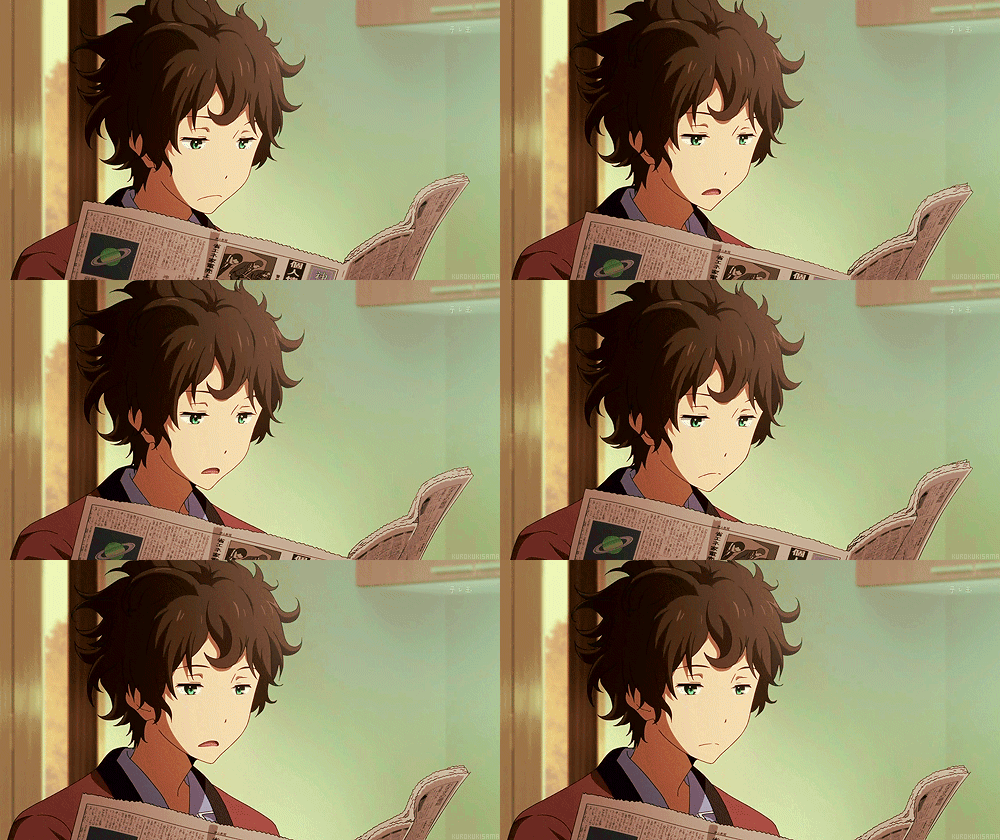
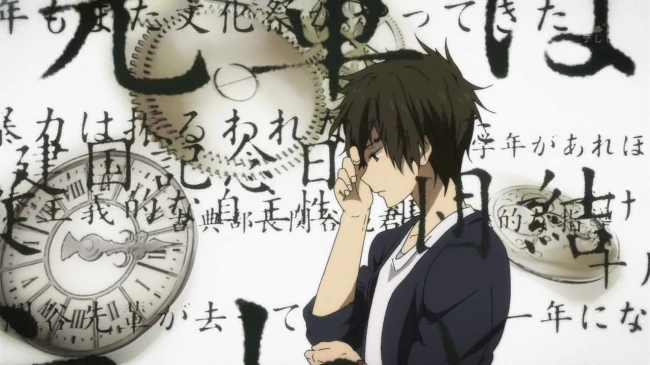
This bum. Nice Hair.

This bum. Nice Hair.

Enter Oreki Houtarou, our mundane, dispassionate, high-school culprit who would indeed prefer this simple format. Why? A newspaper is neither flashy nor motivational. Additionally, it comes to you rather than you going to it, which though might not sound like a good enough excuse for us, works fantastically in Houtarou’s favor.

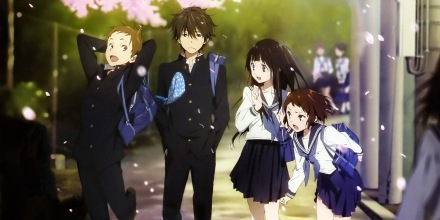
To save his elder sister’s club from disbandment/comply with orders, Houtarou reluctantly joins the Classic Literature Club. There, he reunites with his lively buddy, Fukube Satoshi, and adversary/manga addict, Ibara Mayaka, a couple too energetic for him to be around. That’s not all lurking in the clubroom, however. Violet-eyed Chitanda Eru, a proper, lovely girl, transforms into the quintessential curiosity bomb when something interesting and mysterious catches her eye, or rather, tongue (“Curiosity killed the cat,” or “Cat got your tongue,” anyone?). Anyway, the story follows the Classics Club and their investigations surrounding their beloved Kamiyama High, for the more they unravel mysteries, the more they get tangled up with each other’s personal lives.

And that’s all these kids do. Solve mysteries for the mere sake of solving mysteries – all while satisfying Chitanda’s raging curiosity, of course! The development of the setting and characters comes from each of these case arcs that divide the series. That’s where problems can arise, you see. With the way the anime is set, beginning strongly and upholding that entertainment through the middle, the end pulls the characters out of the thrilling school festival setting to further polish the two relationships. What that creates is a most lackluster ending – as if we ended on just another episode – which is a real shame considering that the suspense from the two previous potent mystery arcs was driving up to this ‘finale.’

Ah, friendship ~

Despite my need to rearrange the story arcs, Hyouka’s characters are at least one-of-a-kind. As you know, Houtarou is and was my site’s mascot prior to my watching this anime, and you might be glad to hear that he’s sticking around! “If I don’t have to do it, I won’t. If I have to do it, I’ll make it quick.” Bent on avoiding a “rose-colored high school life,” that is his faithful motto. But he gradually breaks away from this eternal LAZINESS the more he quells Chitanda’s curiosity. The consequent result of his efforts – He develops a driving curiosity for himself!

“I’m not stupid. I’m just too lazy to show how smart I am.”

This is how I look when people ask to see my notes.

SAME

Houtarou is also incredibly relatable (my bedhead twin). I found his nonchalant way of dealing with the day-to-day schemes of his rather gray life not only amusing but realistic. Besides his dull “oohs” and “ahs,” provided by the charming actor Yuuichi Nakamura, he also has very little to say. Most of Houtarou’s ‘dialogue’ is composed of complex thoughts in that brown bushy head of his (indicated by the tugging of his bangs), while what he actually spouts is concise and to the point.

If Chitanda’s energy combats Houtarou’s laziness, then Satoshi’s spunk grinds with Mayaka’s bluntness. Claiming to be a “database” that can store info but not make conclusions, Fuku-chan supports Oreki regardless of his high expectations for him. All the while, Mayaka tries desperately to win Fuku-chan’s heart and Chi-chan fires questions in Oreki’s direction. Ladies and gents, here you have the musings of the Classics Club!

Calling the animation simply “beautiful” would be the easy way out. The cinematography here makes other KyoAni works look elementary. The dull world around Houtarou is coated in pale browns and yellows to reflect his boring view. In contrast, when he becomes shocked or surprised, lighting plays a key effect, as everything sparkles and brightens the eyes! When it comes to the mystery aspects of the show, each time a new case is introduced, the run-down of the information carries its own unique and quirky animated sequence. It’s as if Shaft and KyoAni birthed a gorgeous, brilliant, and eccentric child!

Kids actually utilizing their public libraries – and it’s cool!

I want to bring up the OST not because it’s necessarily the greatest thing ever, but because it fits the mystery atmosphere so perfectly! For the majority of the tracks, irritated strings, peculiar xylophones, and romantic choirs/pianos/harps pave the way for intense thinking and detective work. Sleuthy, eerie, dramatic, or flat out rambunctious, the music remains an engaging feature of Hyouka. The exciting inclusion of classical music, be it the reoccurring Beethoven, Bach, or Faure adds a, and imagine this, “classy” feel to the whole shebang. I simply can’t get enough of “Sicilienne” and Bach’s “Cello Suite!” *Cue reading letter from Oreki’s sis*

Before we leave the OST department, I’d like to highlight “Yasashisa no Riyuu” by ChouCho, the first opening. This song just oozes with good feels and astonishing visuals, so it was naturally a shame to lose it after the first half! Similarly, the first ending “Mikansei Stride” by Saori Kodama was also a pleasant touch.

tumblr_m4qozdj3ue1r6ksv2o1_r1_500

Hyouka’s best feature was its ability to juggle the genres of mystery, drama, romance, and slice-of-life, and do it phenomenally! To parody, it was like “Fifty lazy, dull, Grey Shades” of freakin’ curiosity. Seriously, if I was having the crappiest day ever and was wanting to be cheered up, or if I wanted something fairly heavy to dip my emotions into, then this is one of the bests. Even if the mysteries are lacking towards the end, there are plenty of other great qualities the story has to offer. So why don’t you throw down that dusty newspaper of yours and hop online with Hyouka!? It’s not like you were reading it, anyway.

“People who are confident in themselves never talk about expectations. “Expectation” is a word rooted in giving up. It leaves you with no other choice. It makes it obvious that you’re powerless.” – philosophy of Fukube Satoshi

+ One-of-a-kind characters (especially Oreki, Fukube, and Irisu) with different viewpoints and philosophies on expectation. Great vocal performances for characters

+ Mystery arc “Why Didn’t She Ask EBA”

+ Sensational cinematography of Oreki’s drab world and its contrast, captivating art and animation

– “Just another episode” ending; no satisfying conclusion

I can’t believe I finally got to watch Hyouka! Uf, and what a splendor it was. For the café, Hyouka is a solid 8/10 with a superior caffe mocha rating! It’s a real bummer that, at this point, there is no English localization of the anime (WHY HASN’T ANYONE PICKED THIS UP). While I encourage you to watch it if you have a hankering-for-a-tinkering with some mystery drama, the only way to find it is through fansubs, meaning not-so-legal streaming. Only watch it if that kinda thing doesn’t bother you. To those who have, what did you think of Hyouka? “Watashi KININARIMASU!” *Oreki: . . . shit.* Thanks for reading, keep an eye out for thieves hangin’ around your club room, huehuehue, and until next time, this has been

– Takuto, your host

Nagi-Asu: Proving that Life is Simply Better Down Where It’s Wetter

A spoiler-free review of the 2013-2014 anime “Nagi no Asukara” or “Nagi-Asu: A Lull in the Sea,” produced by P.A. Works.

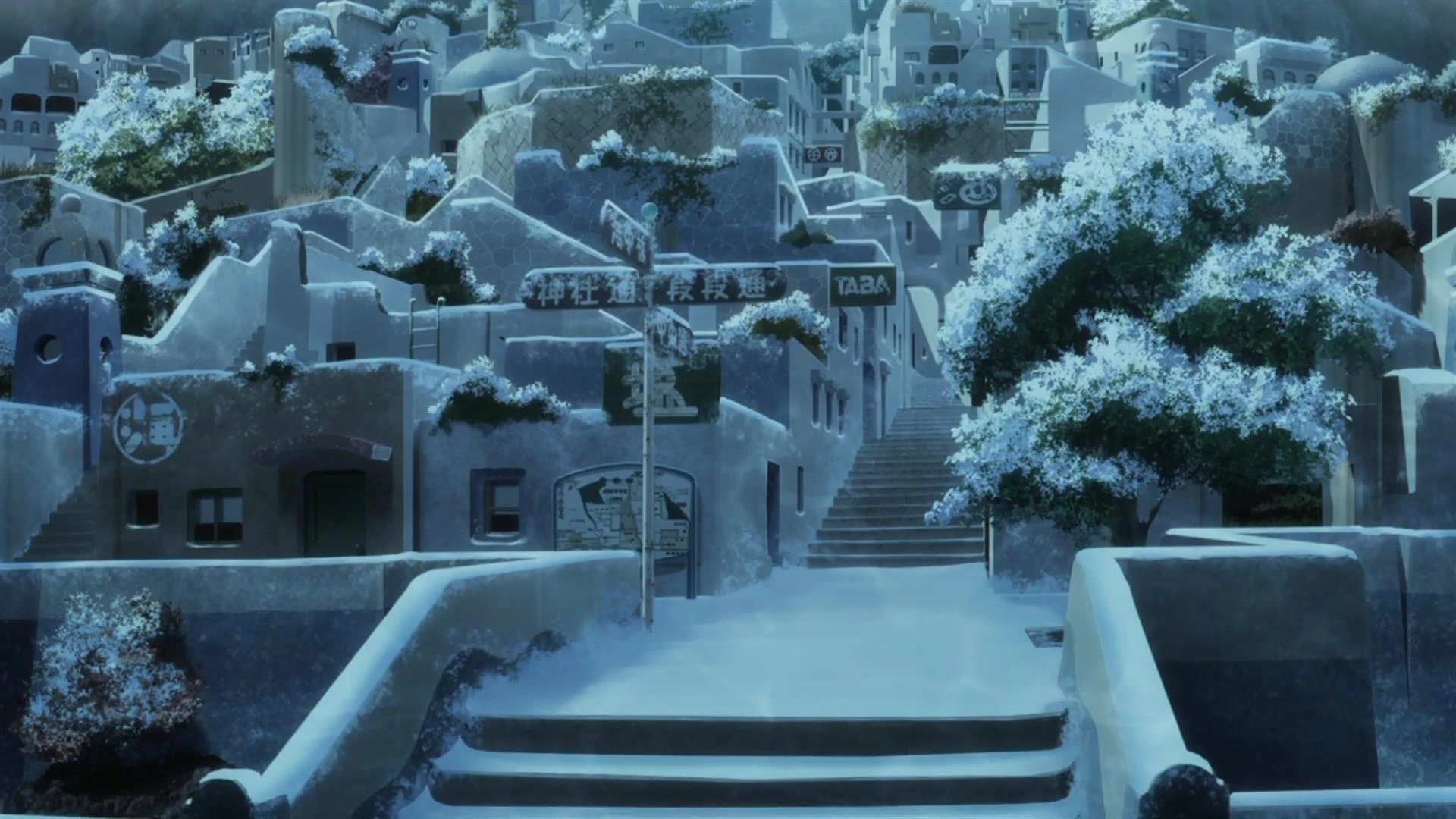
I will sacrifice all of my worldly possessions if I could live in Shioshishio for a year. In fact, Umigami, just take my soul. I’ll even be the Ojoshi-sama if it means visiting this dreamlike underwater village. Please, give me Ena ~

Shioshishio, the enchanting undersea village

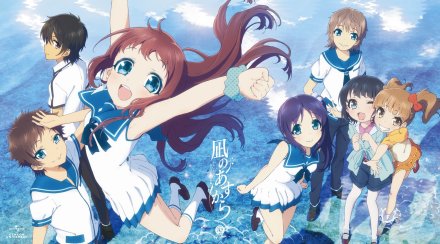
Since the dawn of humanity, civilization had lived on the ocean floor. As curiosity tugged at their legs (or fins), however, several humans migrated to the land, which caused a huge splintering in lifestyles. Upon their undersea school closing, Hikari, Manaka, Chisaki, and Kaname – four 14-year-old middle school kiddos – are forced to eke out education on land and adapt to the unfamiliar environment. They aren’t alone in terms of emotional struggle, though. Three surface kids – Tsumugu, Miyuna, and Sayu – must also confront their feelings before the whole lot grows older, and the rift between the sea and the land, old and young, tears the two parties apart.

It should become clear right off the bat that we’re dealing with seven individuals, which means in terms of coupling someone will be left out. As dramatic as that sounds, Nagi-Asu manages to keep a level head, never allowing said drama to grow out of hand nor become overbearing. That’s not to say that the show is lighthearted, though! Uh, no, it’s got just the right amount of spice, but in that way, has its own way of plucking your heart strings, and thankfully it doesn’t ever snap them. The anime incorporates themes of love by using slice-of-life tactics, and it overwhelmingly succeeds on this front.

See, love – it’s easy as Hikari loves Manaka, but Manaka falls in love with Tsumugu, though Chisaki might have a crush on Hikari, but Kaname is already in love with Chisaki, and . . .

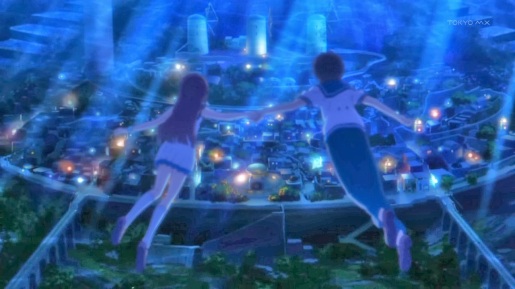
Oh the water physics – don’t try to wrap your head around it. Just admire its subtle beauty and convenience . . . writing on paper, running around, boiling food on the ocean floor . . . What is this, SpongeBob!?

tumblr_mxsgh10THD1sax5fho4_500

But moreover, once the drama wave sinks back into the ocean, we are left with a story about innocent crab children crawling out of their shells to deliver their unrequited love to one another. Because the characters are so unexperienced with the notion, and have even grown up together in the local village, it’s vital to pay attention to each of their reactions to the sudden emotional turns taken in the series. Thankfully, the animation directors have a very keen eye for these delicate matters, and display facial expressions with such passion! Props to the VAs, too, for putting up equally impressive vocal performances, especially Hanae Natsuki’s youthful role as Hikari and Kana Hanazawa’s adorable Manaka!

Let’s talk about those characters now. I’ll admit, they’re a great, well-developed bunch, but the only one whom particularly snatched my attention was the main character himself, Hikari Sakishima. Born ‘n raised in the deep blue, he harbors a distinct hate towards the land people. Specifically speaking, he loathes the silent but strong Tsumugu for him loving his little Manaka – or rather, Manaka sneaking a peak at this dark-tanned land dweller. Underneath his layers of stubbornness, Hikari prematurely believed that he and Manaka were an assumed pairing. Manaka has other plans. Throughout the series, Hikari struggles with his passive relationship with his other friend, Chisaki, and we witness him grow from a boy to a man (kinda sorta, not physically at least :3)!

I have much to say about the art and animation, but it’d do you justice to simply marvel at the “environmental porn” surrounding the sea village itself and its sister harbor above. The animators always use the color blue. In fact, it’s in every frame of the series. Sharply contrasting the magnificent hue is orange, blue’s complementary color. Whether it be the rust on the boats moored at the dock or the land school’s uniforms, orange manages to cancel out blue’s magic. Not only is it smart cinematography, but the most effective. Nagi-Asu is truly is the prettiest anime series I have ever seen!

There’s only one word to describe this OST: Heart. It has a lot of heart. While lively guitar strums out the cheerful opening tone, fitting for the youthful boasts of Hikari, a bittersweet piano slides in to caress the emotional moments featured in the series. “Cry for the Moon,” “Tears of the Sea,” “Prayer,” “Solitude,” and “The Ofunehiki Song” are the best examples of this mood. I could listen to this soundtrack for hours on end, but then only feel depressed that I spent so much time out of the water’s embrace 🙂

To add to the praise, I must admit that both of Ray’s openings, “lull ~Soshite Bokura wa~” and “ebb and flow” are so incredibly fitting for the undersea atmosphere! They make me want to swim around in cool, clear waters with all of my friends. But we can’t forget “Aqua Terrarium” by Nagi Yanagi, the first ending, which depicts the cold, deep blue ocean floor with a frozen Manaka.

It would be a crime to not watch Nagi-Asu. The art is divine and animation of this quality is rare to come by! Always, the story kept me intrigued, and the romance between the characters tied the package all together! But I can’t help but regret the switch to the above ground in the second half, especially when they had so much going for them down where it was wetter. So much life; carefree days of youth. The surface is a bitter cold. Adults struggle to make a living, and kids don’t have as near wide of smiles as the Shioshishio squad. Growing up and realizing your feelings, whether they are for others or nature, was a deeply felt theme in the anime. However much I disliked the change, the two halves of the series were the twin tides that brought the message in the bottle to the salty shore; truthfully, both were needed.

“Having feelings for someone just brings sorrow to someone else. Someone always gets sacrificed and suffers. If this is what it means to fall in love . . . then falling in love is terrible.” – Hikari Sakishima

+ Story felt fresh; romance and drama were never too overbearing, but enough to convey true feelings of love

+ Characters were very well-developed and entertaining, notably Hikari and maybe Chisaki

+ Themes of old vs. young, love of people vs. nature were demonstrated with a content satisfaction

+ UNDER THE FREAKIN’ SEA, absolutely stellar art and consistent superior animation quality

+ A rich OST full of heart, appropriate instruments to enhance the mood

– Switch from underwater to above land was somewhat disappointing

– A few interfering elements to the story were ‘too’ supernatural

I have returned to anime reviews! Do you prefer this new format over the previous one? It’s a work in progress, but I’m trying to find a style I’m completely satisfied with. Did you have similar thoughts about this under-the-sea fantasy drama/rom-com? Different? For the café menu, Nagi-Asu receives a solid 9/10, and I strongly recommend you watch this show on Crunchyroll – and it’s free of all things, so no excuses! If you enjoyed the review, feel free to caress that like button like a red-bellied sea slug, as that’ll let me know if you like my content! Ah, how grand it feels to be back to these reviews ~ Until next time everyone, this has been

– Takuto, your host

Code Geass: A Masterful Rebellion To Be Remembered

A review of the 2006-2007 anime “Code Geass: Lelouch of the Rebellion” and its 2008 sequel, “R2”

***Beware of slight spoilers, though everyone should have seen this show by now***

Before I start writing, we must travel back in time to December of last year – my amateur Guilty Crown review *shudders*. In it, I accused GC of “stealing something precious from every solid robot/action anime prior to its own existence,” and that it was “just a messy conglomeration of past sci-fi anime.” I actually confess to being the one guilty here, as prior to that review I was honestly just venting others’ thoughts rather than speaking my own. I knew nothing about the mecha genre of anime! So now, I apologize and atone for my sins by witnessing the very chaos where Guilty Crown got its roots – And it all rises with a single rebellious command.

Secondly, my god, how I love smart characters. Enjoy ~

By 2010, the totalitarian Holy Britannian Empire, which already claims a third of the world, captures and strips the honorable Japan down to petty people. Now renamed to Area 11, the “Elevens” no longer enjoy a life of freedom and pride, but slave away while the Britannian aristocracy stands over them with overwhelming wealth and authority, wine glasses in hand.

Lelouch vi Britannia, a banished royal youth has been taking refuge in the prestigious Ashford Academy with his blind and wheelchair-bound little sister Nunnally. Going by the last name Lamperouge to escape execution, the two became members of the spirited student council. All goes fairly well for the two, but Lelouch can hardly even call hiding in secret day by day living! So when a Japanese terrorist operation results in a horrific highway wreck, the witness Lelouch runs to check on their safety, but instead uncovers a classified Britannian “weapon” of sorts. Her name is C.C. (pronounced C2), and she bestows the near-omnipotent power of Geass upon him – the power of absolute control over another, which merely requires direct eye contact and a command to activate.

It’s at this exact moment that the scheming Lelouch ZERO begins his awe-inspiring rebellion to destroy Britannia and recreate the world anew, all for the safety of his crippled sister and to uncover the mysteries surrounding his mother’s death. Zero rallies his Black Knights, the Japanese terrorists, and sets his sights on liberation, but by donning the mask of a criminal mastermind and wielding his King’s Power mercilessly, he shall pave his own path of solitude and shoulder all of the world’s evil.

Code Geass is a complex anime to watch. Half of the show is following Lelouch as he scrambles identities from school boy to the anarchist Zero, while the other half is political mumbo jumbo. Between constant Geass brainwashing, royal court betrayals, and countless bickering, national figureheads, each complete with an ideology of their own, it’s quite easy to get lost. The plot also relies on very meticulously placed characters to show you what you need to see, when you should see it. I don’t think this overly convenient placement is considered plot armor for Lelouch, for he is quite the intelligent badass, it’s just that there is an inhuman amount of info to keep track of, considering that each character’s current knowledge, prior history and point of view is equally important toward the end result. One easy slip-up early on and his whole uprising would have fallen flat -_-

As a viewer, I was very stressed to find no answers to any of my several hundred questions after the first season, but in due time, everything became clear. Often, explanations arrive too late in the series, however, which only adds to the long-standing confusion. My episode one qualms no longer seemed relevant to what was going on.

About the mechs. While the first season valued tactics, ahem errr, strategy on the battlefield, the second season’s combat was structured on “my gun is bigger than your gun,” of which the sexy Rakshata or ridiculously quirky “Earl of Pudding” would steal the other’s ideas to invent a better one. These scientific discoveries were pointless compared to the supernatural Geass, though they were at least entertaining. The second season’s use of flight capabilities also took out the thrill that came from ground combat. All in all, I really enjoyed the solidly strategized Knightmare Frame battles, but I could have gone without the boring aerial stuff.

As for characters, we have the aforementioned Lelouch Lamperouge, the brilliant chess master who is justly one of the BEST anime characters EVER, like do I even need to explain? Always several steps ahead of the game, using whomever he needs like pawns to create a new world. One character who constantly bumps heads with him is childhood friend Suzaku Kururugi, a knight of justice who in contrast to Lelouch believes that the means are more important than the end result. Due to “Spinzaku” being Japanese, his righteousness brings punishment from leaders on the both sides, however, and his stubborn will causes never-ending interference with the Britannian nobles and Lelouch. A fine character nevertheless.

And of course, the rest of the cast is extraordinary! Nobles like Prince Schneizel and Cornelia li Britannia (BEST GIRL) continually throw in spicy curveballs. A rebel like Kallen challenges her very existence because of her being half Britannian and half Japanese. Lovers like Lulu’s sister Nunnally, Rolo, Jeremiah, Shirley, Villetta, and eventually C.C. heighten the levels of drama. There are also the Black Knights, Ashford’s student council, and other royals that play their part exceptionally well! Granted some of the characters are incredibly dumb, and in the second season there are a lot of bipolar decisions, I was pretty damn impressed with what we got. Lastly, Code Geass never forgets about a single character; each one is gradually touched on throughout the entirety of the franchise, and that is not an easy feat to pull off!

Animation was done by Sunrise, and since I have not watched many mecha anime, it was a huge change for me to see robots that were all drawn. Unlike most CG, I was never taken out of the world thanks to the drawn appearance, so that’s a plus! Another nice factor was the character designs done up by Clamp. There’s just something so incredibly sexy about those elongated chests and limbs tagged along with bold, charming, unique faces that made me go mmmm. I especially love the eye and hair designs (Leads, Euphemia, Cornelia), so rich and fierce 😉

Ahh, the OST by Kotaro Nakagawa and Hitomi Kuroishi, much like the animation, a strong point. It’s an epic, classical, string based soundtrack, which are my favorite kinds, but occasionally there are soft, Celtic-esque tracks that play during the most depressing moments, milking all that they can out of a scene. Some of the best songs include “Black Knights,” “Beautiful Emperor,” “Lullaby of M,” “All-out Attack,” and the famous “Madder Sky.” But the one that tops them all, possibly my favorite track from an OST, is the bittersweet “Continued Story” by Hitomi Kuroishi, which played in the final episode. From YouTube, this is the song that got me into the show, and literally tears run down every time . . .

The very first and last ending themes, both Ali Project songs, also added fuel to the fire of the rebellion! Check out “Yuukyou Seishunka” and “Waga Routashi Aku no Hana,” as they are both eerie and insane!

I can now easily understand why Code Geass receives so much conversation and the title of classic. I was always trying to guess what Zero would do next, but little did I know that he had everything in the bag from the start, or so I believe. The show excels in all categories and provides the genre with ONE OF THE BEST (TRAGIC) ENDINGS IN ANIME HISTORY. Code Geass is a battle of wit, a competition for science, a war of mechs, a struggle for royal power, a strife for family, and above all, a rebellion to be remembered. By accepting Geass and becoming the world’s greatest antihero, Lelouch vi Britannia dug his own grave, and once he reaches the pits of hell itself, he shall take all of the world’s hatred with him.

“Suppose there is an evil that justice cannot bring down. What would you do? Would you taint your hands with evil to destroy evil? Or would you carry out your own justice and succumb to that evil?” – Lelouch Lamperouge

+ One of the best main characters to hit anime, supporting cast also brilliant

+ Masterful varying portrayals of justice and other ideological themes

+ Excellent English dub (especially Lelouch, Suzaku, Kallen, Cornelia), strong soundtrack

+ Gripping, curious, and intense story to the finale, one of anime’s greatest endings

– Plotline involving Geass history/Emperor’s grand plan could have used more combing through

– Several moments were a bit too conventional for Lelouch, some bipolar actions made to keep story moving

– 2 seasons; 50 episodes can be very extensive for some

This was definitely a difficult review to write, as I was pretty much just fanboying the entire time 😀 I did have a few complaints, though. But after considering the clever ride from start to finish, it deserves the Caffé Mocha award without a doubt! 9/10 for both seasons to those following my MyAnimeList. Action, romance, drama, great characters and story – EVERY anime fan must watch this show! The varying genres of school, mecha, war, comedy, sci-fi and more also make this show interesting. I feel I have the room to judge anime a little better now that I’ve seen this classic (and that cart scene, I see what you did there). My god, I’ve never been so entertained by one character in such a long time ahaha AHAHAH MUAHAHA – ALL HAIL LELOUCH!! Now, I command you to like, comment and follow my blog, and until next time, this has been

– Takuto, your emperor

Triumph! Sound the Euphonium!

A review of the 2015 spring anime “Sound! Euphonium”

I’ve been joined at the hip with music since a young age, and, having been a first-chair orchestra member for seven years and counting, I have not only the right but the responsibility to announce that this series exemplifies the hearts and minds of every concert band and orchestra member to T. Putting KyoAni’s ideal cuteness aside, Sound! Euphonium accurately depicts how rigorous classroom music can be when kids become critical of themselves.

Talented euphonium player  Kumiko Oumae enters Kitauji High School’s brass band club during her first year (‘Euph’: a “good sounding” small tenor-pitched tuba, sometimes referred to as a baritone). There, she encounters her old classmate Reina, and memories of a previous junior high incident flood back, causing Kumiko to be hesitant. As Kumiko remains strong buddies with other girls, though, Reina slowly opens up and the two become very close friends. Looming in the darkness is the national contest, which their meticulous new teacher, Taki-sensei, proposes to have the students decide for themselves whether or not they should pursue the gold.

Much like in real life, hours of practicing, enduring hardships, insanely challenging musical passages, kids who have talent that start to waver, competition among new and old recruits, wanting to drop out to focus on education and countless other issues bring a shining realism to the table – a characteristic that I haven’t sampled for a while now. From start to finish, the show knows exactly where it wants to go, and as much as I want to say it was the practical setting to thank, it’s because of the characters that this drive was so truthful.

Euphonium‘s cast does not rely on one or two characters, but rather the entire ensemble. Kumiko herself is strong-willed, though sometimes acts a little empty-headed, and her budding romance with the silent yet brilliant Reina is certainly our sweetest relationship. But there are several other duos that bring the issues listed earlier to light. The vigilant Asuka and occasionally sheepish Haruka tackle youth leadership with unsurety. The lackadaisical yet easy-going Nakagawa manages to keep Kumiko on her toes in terms of skill. Sub characters like the hot-headed Yuuko and gentle Kaori pose a nagging trouble to the professional Reina when they all duke it out for the trumpet solo. Seeing as how I play a string instrument, I was dying to hear more dilemmas from the only string player in the band: On the oversized contrabass everyone, Midori “Sapphire-chan” Kawashima! Too bad she only existed to cheer on the other girls 😦

I was overly pleased with what the anime had in terms of cast, as nearly each member of the band, major and minor, received standout character designs and individual thoughts and scenes. Having Taki-sensei  as a rather disoriented teacher also made situations more ambiguous. For instance, he’d ask “Are you having trouble with that?” Then instead of following up, Taki would declare, “Please have that ready by next week.” There were just certain aspects to his character that made me want to cuss, but then he would return on scene with a heartwarming smile and encouraging speech, kinda how a real director would.

If I had to pick something about the plot that seemed off, it would be the sudden love interest and misplaced drama. In the first few episodes, we clearly see that things between Reina and Kumiko are really awkward. After climbing a mountain trail path in a certain middle episode, however, POOF! The two become super intense friends – for some, too close for comfort. It’s not really yuri, but you could ship the two by just looking at the poster art now.

The non-music drama stems from a miniscule love triangle between Kumiko, an energetic girl pal Hazuki and Tsukamoto, Kumiko’s childhood friend. Seeing how Tsukamoto only cares for Kumiko, who feels indifferent, Hazuki becomes a forced trope just to milk some sort of depressing drama out of the whole shebang, not that the show already played perfectly fine without it. But like the sudden love, it’s all only one episode, so it can easily be overlooked.

I KID YOU NOT when I claim that Kyoto Animation performs their finest job I’ve ever seen from them in terms of animation!! All of the shining brass instrumets, the natural movement of people breathing during practice, the beautiful people themselves, and that side-of-the-river bridge where Kumiko always goes to chat and play the euphonium – it’s all so soooo gorgeous; a true crime not to watch the opening at least once to get a glimpse of BREATHTAKING EVERYTHING!!

The OST is also remarkable! Orchestra tagged along with a piano for melody hits up feels from slice of life to cliff sunsets to tension in the classroom . “Flow of Destiny,” the simplest variation of the main theme can be elegantly heard throughout the series. Real classical music is also pulled into the soundtrack for during performances and practices. Especially noted is Reina’s ditty of the “From the New World Symphony’s 2nd Movement,” which everyone stopped to listen to. 🙂

Hitting off each note is the exciting opening “DREAM SOLISTER” by TRUE! I love the inclusion of the brass instruments – it makes the song coherent to a show about a brass club, ya know? The ending “Tutti” by the Kitauji Quartet is also tons of foot-tappin’ fun!

In terms of character interaction, the featuring of the entire class as a whole and as individuals, stunning animation, topnotch voice acting, realistic musical presentation and content, Sound! Euphonium did several things right and executes everything with near perfection! The ending is also standing ovation-worthy for including the uncut concert performance rather than just cutting that out to view the results. Concert band and orchestra kids were given the best representation in anime – for most, more than what we could ever ask for. 5/5 stars, a triumphant “Caffé Mocha!” Congrats, Kitauji High School Band – You most definitely deserve the Gold in my eyes!!

+ Relatable and realistic anime for high school band and orchestra classes (or at least some); best representation anime has given us students

+ Themes of hard work VS raw talent are executed quite well

+ Absolutely breathtaking visuals, instruments look excellent, actual music is awesome, too

+ Story knows exactly where it’s headed, and delivers with a triumphant, satisfying end

– Sudden romantic relationship drama unnecessarily threw plot off course, though only for an episode

Thank you for reading my review over the wonderful Sound! Euphonium! It was definitely one of the most fun and fulfilling shows to follow this past spring. Did you have similar thoughts on this show? Were you as impacted as I was? Leave your comments below so that we can chat! Now while the inspiration is hot, I’m gonna go work hard myself and practice my cello! Haha, until next time, this has been

– Takuto, your host
Plastic Memories: Sadly and Ironically Unmemorable

A review of the 2015 spring anime “Plastic Memories”

In the near future, androids that possess human emotions called “Giftia” can be seen all over the place. Produced and managed by the SAI Corporation, these Giftia practically blend in with society, the only catch being that they cannot live to be older than nine years, after which their memory needs to be wiped clean to prevent further contamination.

Upon bombing college entrance exams, Tsukasa Mizugaki is offered a position (through his father’s unknown relations) at one of SAI’s Terminal Service Department. Their job –  to retrieve nearly-expired Giftia and delete their memories.

Tsukasa descends into madness as he begins to take away the precious memories of his friends one by one, discovering that they are Giftia. Teaming up with a rebellious organization to stop SAI from creating more false hopes and plastic memories, Tsukasa and his sexy female companion Isla arm themselves to spill blood and delete data in hopes of a brighter future. But can a future be salvaged from these lost, crushed dreams?

Naw, I’m just kidding. It deceptively feels this way at first, though we could only wish it continued. Plastic Memories is actually a love story. Yep, one unmemorable love story at that.

Tsukasa is partnered up with Isla, a petit Giftia whose only practice and profession is serving tea to her co-workers. She’s a bit of a klutz and quite shy around him, but after a few retrieval cases, the two fall for each other and become more than office co-workers. Little does Tsukasa know, Isla only has a few months remaining before she herself is to be turned in.

Built in a sci-fi setting centered on a broken concept, this anime could have gone in several more interesting directions. Had I known that it was a love story from the beginning, then maybe I could have appreciated it more. Thing is, the anime also tried to be more than romantic. Slice-of-life, comedy, and sexual teasing are all tossed in to hinder the true development of the couple. You’d have a truly touching scene at the apartment, then someone waltzes in naked, Tsukasa freaks, and the whole moment is lost; “Plastic Memories,” more like plastic emotions –  Quit toying with my feelings and cue the tender skits, please!

Also, for sacrificing the whole potential plot towards this absentminded relationship, the romance isn’t even that great! I didn’t feel any pull between Tsukasa and Isla until the end, which is obviously too late. Plastic Memories was ultimately too distracted with other elements, and thus couldn’t keep my absolute focus – But right as I decide to close out of another wasted episode, the show manages to hook me back on with a heartwarming event.

When it comes to romance, or whatever this anime decides to sport, it’s up to the characters to convey the feelings out of my heart, and very few times do they actually achieve this goal. Determined Tsukasa and shaky Isla kindly function as one and manage to keep things as genuine as possible, but the supporting cast really likes to bump heads with our leads. They’re the typical office cast: the sideline tsundere drama, the loud spoken honest boy, the soft spoken kind boy, the grungy pervert man, the boss too kind for anyone to handle, the supervisor with a stick up their ass, so on and so forth. Had the directors not spent so many episodes of Isla and Tsukasa bumbling around in stupid antics with said cast, then they could have received actual depth rather than cheap one-liners. I really wanted to like this cast, but I couldn’t get into them because anytime deep fondness was expressed, someone had to jiggle their boobs or put another in a headlock. So frustrating!

The only character I’d like to highlight is Michiru (Eva’s Asuka lookalike), a well-developed tsundere who, like the series, could have taken a very different route. It’s obvious that she harbors feelings for Tsukasa, which could have made Plamemo a stereotypical love triangle, but Michiru is not there to makes things worse. She sticks up for Isla and even tutors the two, guiding them down the love path she wishes she could walk. Thanks Michiru for not fitting the mold and being delightful all by yourself! 🙂

Previously I had not seen any anime by studio Doga Kobo, so this was joyfully new for me. Characters and their expressions are cutely designed. Architecture of this futuristic setting was handled well, too, and the colors are always bright. There are a few awkward inconsistencies when it comes to facial details, and sometimes the action transitions choppy, but none of it was particularly bad; nothing spectacular, either.

Going back and listening to it now, the OST contains several upbeat string and vocal songs, usually featuring a guitar as well. For the softer scenes, tracks like “again & again” in the first half set the mood with beautiful piano. The opening “Ring of Fortune” by Eri Sasaki also accents this beauty. Overall the OST is not standout, but sweet and supportive.

Plamemo‘s biggest problem is the fact that it starts out with several heartbreaking retrieval cases that are honestly so depressing you can’t help but shed a little water from your eyes. This exposition starts you off thinking, “Oh god, I’m going to have my heart torn to pieces by the end.” But then when the show shifts to the romance, it distracts itself with dumb antics that don’t feel they should belong in this kind of show. It was only by the final Ferris wheel scene where I could actually feel the connection.

But I couldn’t feel sad either, for after all of this nonsense in the office and quiet days at home, it was time for the show to end, which it did so happily and without regret. It’s sad and ironic to say that I won’t remember Plastic Memories all because of its misplaced foolery and nonsensical direction, but it was the one that decided to poke fun at itself, not me.

“Having happy and beautiful memories won’t always bring you salvation. The more beautiful a memory is, the more painful it can become. Both for the one who’s leaving . . . and for the one left behind.” – Isla

+ Heartbreaking first four episodes are so powerful; compelling end on par with beginning

+ Michiru’s character added depth where there was none

– Continuous, overused antics stop this anime from being memorable

– Interesting premise with varying direction, route chosen was somewhat disappointing

– Side characters lack dimension

And that concludes my thoughts on an anime that tried to juggle it all, but dropped the pins. For cafe awarding, it can be found under the “Coffee” menu. Did you have other thoughts on Plastic Memories? Leave your comments below, “like” if you enjoyed this review and until next time, this has been

– Takuto, your host