Sailor Moon “Black Moon Arc” Themes, Motifs, & Symbols

This is PART II of the Sailor Moon analysis series. Click here for PART I “Dark Kingdom Arc.”


Welcome to the long-awaited continuation of this Sailor Moon light analysis series! Like I did in my overview of themes, motifs, and symbols in Sailor Moon‘s “Dark Kingdom Arc,” I want to try veering off the traditional review path and instead focus on some of the thematic devices and elements in my favorite manga or anime series. These posts will not aim to critically analyze elements of the work but rather provide a leaping-off point to prompt your own discussions. I encourage readers to use this post as they see fit (just be sure to tag me and link this page), and I hope you will find it useful!

The themes, motifs, and symbols discussed here pertain specifically to the “Black Moon Arc” of Naoko Takeuchi’s Sailor Moon manga and the Sailor Moon Crystal anime series. Other themes, motifs, and symbols may also apply, though I plan to save those devices for future posts where they are more relevant in other parts of the franchise (like the use of dreams inSuperS). At the same time, I’ll avoid repeating any items from previous posts because, like most series, Sailor Moon tends to build off of existing groundwork as the story progresses. As such, this listing is by no means exhaustive, but it should help anyone trying to understand how some of the thematic devices function within the narrative. SPOILERS AHEAD!

Themes


Desire as a Slippery Slope to Possession

It’s no coincidence that the classic anime refigures the “Black Moon Arc” as Sailor Moon R, an R which is commonly believed to signify “Romance,” “Return,” or “Rose.” Plights of desire and envy ignite every moment with new layers of meaning to the word “romance.” Prince Demande’s overwhelming desire to capture Neo Queen Serenity and demonstrate his mastery is a clear twisting of the romance shared between the Queen and her King Endymion. Endymion stands behind Serenity as an act of giving love, while Demande, well, demands that possessing Serenity and her Silver Crystal is the only way to effectively communicate his desires. In truth, Demande likely felt “bewitched” by her superiority, and so he tries to place a bell jar over his love out of an unwillingness to accept that her strength—her capacity to love—is greater than his own.

Duplicity Is Deception

Doppelgängers or mirror personalities loom in the shadows of many characters, reflecting both a semblance of repressed desires and a gross exaggeration of said truth. Tiny Chibiusa has bold Black Lady, the Queen of Nemesis cloaked with power AND the man of her dreams at her beck and call. Little does she realize that a more earnest sense of self awaits around the corner in the form of Sailor Chibi Moon. Sailor Moon (or Neo Queen Serenity) has the submissive, altered version that exists in Prince Demande’s evil eye(s). All of the Black Moon members bear desires original to them that are buried beneath Wiseman’s hypnotic effects. And even Wiseman himself masks his true form as Death Phantom, shedding his layers of deception only as the Senshi are able to wipe away each one.

Distance Breeds Love and Hate

They say that the farther we are from the ones we cherish most, the stronger our passion for them—and despise for others—can grow. Sailor Pluto, known for residing at the forbidden corridor between space and time, is living proof that experiencing distance from our loved ones can reinforce that same fondness for them. She views the dedication to her task as a positive way to deepen her bonds with the royal family’s members. In a way, she is a foil to Wiseman, who instead of safeguarding space-time hides within its folds, his hatred for Serenity heavy in his heart. On the other hand, both Usagi and Chibiusa view their rotating separation from Mamoru with frustration and jealousy towards the other girl. When one has her moment with Mamoru, the other is often caught up in worry and vexation, however needless it all seems in hindsight. It’s astonishing how a little separation can so drastically affect us.

Isolation Creates an Echo Chamber

For a series about love and romance, many characters across the “Black Moon Arc” experience aching loneliness and anxious ideation from their isolation. On Planet Nemesis, Wiseman stews in his own depravity and torment as a rebel forever banished from humanity on Earth. Rather than use the imprisonment cast by Neo Queen Serenity to reflect on the error of his ways, he mines Planet Nemesis for the Beguiling Black Crystal, a gem which only furthers his corruption. It’s not just the bad guys damaged by isolation, though. In the 30th century, Chibiusa is ostracized by her classmates for being the Queen’s daughter; her mother has much grander ordeals to attend to than child-rearing, and the Inner Senshi often accompany their Queen. The echo chamber of her perceived isolation is exploited when Chibiusa flees to the shadowy edges of space-time and Wiseman lures out these anxieties within her. Of course, there’s also Sailor Pluto whose sole guardianship over space-time leads her to ever wondering if her work and dedication were truly enough to please her Queen and, in ways unrequited, her King.

The Futility of Changing History

After becoming disillusioned by the supposed unaffecting ways of Crystal Tokyo’s monarchal rule, the Black Moon Clan joins forces with Wiseman, a terrorist exiled to the far reaches of space, to travel back to the past and erase the possibility of a new Silver Millennium being created in the 30th century. As the Sailor Guardians thwart every one of the Black Moon Clan’s missions, however, it becomes apparent that history is a fixed constant, one that is futile to change. Even if the Inner Senshi become detained or incapacitated, the lone Guardian of Space-Time can be called upon in their darkest hour.

Critiques of Monarchy and Singular Authority

When the Sailor Guardians make their way to 30th century Crystal Tokyo, they find that Neo Queen Serenity had bricked herself up in the Crystal Palace as a final act of self-preservation. Granted, this decision safeguarded the one hope that could be used against the Black Moon, but it’s this same singular dependance on one figure to constantly save the day that landed Crystal Tokyo in so much trouble when the Black Moon first invaded. According to their account, Neo Queen Serenity only graced the public to protect her people against rare acts of terrorism. She was, to the renegade Black Moon (who were once citizens of Crystal Tokyo themselves) a leader in name only—a concept, even. With all vestiges of celestial power sealed within the slumbering Neo Queen Serenity, it almost begs the same question that the Black Moon propose: Why does a superior 30th-century human race still rely on the crown, and why can’t the radiance of the Silver Crystal—the symbol of monarchal authority—be shared by more than one individual?

Motifs


Blackness

Black Moon. Black Lady. Beguiling Black Crystal, black as the abyss of space. The “Dark Kingdom Arc” introduces a similarly vague word to express the forces of evil, but whereas darkness exists on a spectrum of light, black connotes just that: stark, opaque, dense, and without dimension. The evil present in the second arc of Sailor Moon is far more sinister in scale, and its shadows are twice as black. Interestingly, the notes in the manga describe that the Black Moon Clan members Crimson Rubeus, Verdant Esmeraude, and Azure Saphir unite under Prince Demande as the primary colors found in light (red + green + blue = white). When they are removed from the picture, the light is gone; in their stead, “Black Lady” reigns supreme.

The Future

Anxieties about what the future will bring swirl in the hearts of many. For the girls living in the present, it’s mostly concerns with studies, extracurriculars, and friendships. For all of the “aliens,” this worry is retrograde. Having lived to see 30th century Earth, the Black Moon looks to the past to weed out their future enemies. Likewise, Chibiusa fears the reality that the legendary Sailor Moon of the past may be unable to protect her family in the future. After weighing her future against humanity’s, Sailor Pluto makes the desperate call to stop time in the ultimate showdown against Demande. The future is always at risk, ever slipping between characters’ grasps. Simultaneously, it is that which everyone is living through—a stage of possibility that fluctuates on every whim, breath, and pulse shared by the actors. Regardless of the consequences, it’s Mamoru’s comment that closes out this clash for romance, dominance, and the future: “It wasn’t a dream. It was the story of a future that will be here before we know it.”

Acts of Motherhood

This arc, which is devoted to exploring love and its many different forms, does not neglect the mother-daughter relationship in the slightest. Usagi and Chibiusa’s relationship starts out rough, but the edges start to smooth once the two develop a routine: waking up, going to school, playing at the arcade with friends, fighting over Mamoru’s attention, combatting the forces of evil, and then returning home to sleep and start all over again the next day. In particular, it’s moments when Mamoru is present that Usagi feels the conflict of love, for his caring gaze seems split between the two girls. When Usagi heads to Crystal Tokyo and learns more of Neo Queen Serenity, she starts to adopt a more motherly tone with her future daughter. Furthermore, Usagi’s mother begins to feel the gravity of the cosmos pulling her daughter away from their little home in the Juban District. Even Luna must accept that her daughter Diana knows more about the future and what’s best for everyone than she does (which is a RARE occurrence indeed). It’s the willingness of mothers—Usagi, Ikuko, Luna—to relinquish their daughters and let them experience the world that allows trust to strengthen on both sides.

Spectre and the Supernatural

Between fortune tellings gone awry, UFO sightings on the rise, and urban legends spiraling out of control, the Sailor Guardians do their best to combat the bizarre. The iconically named “Spectre Sisters” adorn the first half of the narrative with poltergeist-level misdemeanors and serial phantom kidnappings. It’s not until a literal “Death Phantom” (AKA Wiseman) conjures stranger images that the whole of space-time becomes at risk of collapse. Even with the anime-original “Doom Tree Arc” included at the start of season two, Sailor Moon R‘s expanded exploration to the dark corners of the solar system are entirely connected under the motif of supernatural happenings. There are some forces out there that simply can’t be explained . . . apparently . . .

Exiles, Outcasts, and Alien Invaders

Along with alien energies and antagonists, there’s a fair amount of invasion occurring on just about every level of human interaction. The obvious one is the Black Moon Clan appearing in strange, UFO-shaped discs of light to abduct people for their schemes. Wiseman is an exile of the gravest kind, a terrorist who led a rebellion against the Silver Millennium and is imprisoned on Planet Nemesis for his crimes. Chibiusa, too, is an invader upon not only the temporal past (and the Door of Space and Time protected by Pluto) but also Mamoru and Usagi’s relationship. Additionally, she regards herself as a kind of outcast from her class and family’s affection back home. Finally, there’s Sailor Pluto whose solitary role lends itself to the outward appearance of being outcast from the other Senshi. Despite their respective distances, the narratives of these exiles, outcasts, and invaders will intermingle and cause ripples of unimagined proportion.

Planet Power

We don’t often regard our planet as possessing its own kind of power, but in 30th century Crystal Tokyo, Earth shines as a jewel across the cosmos. Planet Nemesis, which apparently went undetected for centuries due to the *rare* gravitational phenomonen surrounding it, emerges as a planet of rival energy due to it possessing its own crystal power. This battle between Planet Earth and Planet Nemesis, Mythical Silver Crystal and Beguiling Black Crystal, centers itself as the arc’s grand climax. In response, the Sailor Guardians are granted “Planet Power” for the first time by Neo Queen Serenity. With Earth’s prosperity secured across 20th and 30th centuries, the stage becomes reset for the next arc to begin.

Doors and Keys

The “Black Moon Arc” begins with Chibiusa’s opening of the doors to space-time, and it ends in the same way. Doors represent barriers to forces which we might not be ready to take on . . . yet, anyway. The Door of Space and Time offers entrance to the unfathomable realm of causality. Hence, it is only discussed in hushed whispers, locked by special spatial keys, and watched by a lone protector. Still, Chibiusa hears the rumors, steals the keys, and befriends the solitary Sailor Guardian. She opens doors left and right, willing to cause trouble at every turn if it offers a new chance for her to find strength—and a savior—for the ones she loves. To Chibiusa, behind every door resides new possibilities; one only needs the right key to open them up.

Symbols


Beguiling Black Crystal

Unlike the Mythical Silver Crystal, which is limited to one (“1”) body and wielded by the Silver Millenium, the Beguiling (or Malefic/Evil, depending on translation) Black Crystal is mined and crafted into different shapes and sizes. High-ranking Clan members are bestowed Beguiling Black Crystal Earrings which can channel the power of the main crystal housed within the Black Moon Castle. Asteroid-sized Black Crystals have been used to decimate and weaken Crystal Tokyo with a nuclear power that is instantly reminiscent of the atom bomb. If the Silver Crystal persists in its namesake mercurial nature, slipping in and out of various grasps yet unable to be controlled, the Beguiling Black Crystal beckons each of its many holders forward. Not like quicksilver in the slightest, the Beguiling Black Crystal is ironically clear in its presentation. The Mythical Silver Crystal is an endless fountain of radiant power; the Beguiling Black Crystal, its one true rival force, draws and drains power from its surrounding in wicked supply. As Wiseman states, “The negative energy of the Beguiling Black Crystal that consumes all things, returning them to nothingness. And the infinite positive energy of the Mythical Silver Crystal that grants power to all things, amplifying it beyond measure . . .” Like their respective users, the two crystals symbolize the way we can love others: by giving and showering love, or by stealing it away.

UFOs

The preferred method of travel by the Black Moon invaders resembles (by little coincidence) the primary vehicle of stereotypical alien travel. UFO sightings have been a superstitious craze for decades, centuries even, and Naoko Takeuchi’s decision to incorporate their iconic shape into the story takes the girls’ fascination for urban legends to the next level. In reality, these light-shaped discs are not machines but portals created in the vacuum of space-time. While the Senshi are led to believe the invaders are from outer space, the Black Moon members cleverly withhold a second layer of truth: they are travelers from the distant future.

Luna-P

This gift given by Sailor Pluto to Chibiusa means all the world to the budding Sailor Guardian in pink. The way Chibiusa bounces Luna-P around and performs prankish tricks resembles a child playing with a temari, a Japanese handball used for games. Luna-P seems to house many hidden abilities, but one shouldn’t read too much into it as a sophisticated weapon. Rather, the cat-faced ball is a symbol of youthful mischief, joyful innocence, bountiful luck, divine protection, and above all, the bond between two friends.

Crystal Palace

The attempted siege against the Crystal Palace of 30th century Earth began with Wiseman’s acts of terrorism. Following his mission, the Black Moon became consumed with rage against the crown and its opulence. The Crystal Palace still stands after the carnage, a symbol of the royal family’s resilience to change in more ways than one. Until Sailor Moon can save Crystal Tokyo, the palace acts as a safe house for the slumbering Sailor Guardians and the royal family. After all, only the inheritors of Silver Millennium may draw on the power of the Mythical Silver Crystal. The fallout of Crystal Tokyo is still blatant in its chaotic implications, though; the royal family sleeps safely in the palace while civilian bodies lie strewn along ruined streets. Even Usagi herself contemplates the matter of a “divine right to rule” pounding in her soul: “Is it really the Silver Crystal that plants evil in people’s hearts and makes them fight each other? If the Silver Crystal never existed . . . would history never run off course? Should the Mythical Silver Crystal . . . should I . . . have never existed?”

Evil Eye and Bestial Hands

Beauty is in the eye of the beholder, yet don’t confuse Demande’s bewitching gaze as a mere sign of affection. This power to control and subjugate, along with the Bestial Hands, are bequeathed to Wiseman’s most loyal pawns. The Evil Eye, red with irritation, matches the savage cruelty of the Bestial Hands that go with them. While it’s easy to dismiss them as classic features of fantasy antagonists, one will remember that Wiseman draws his power from the Beguiling Black Crystal on top of years of practicing dark arts. Given Naoko Takeuchi’s background studying science, this could be a dramatization of the mutation caused by the Black Crystal’s radiation and a direct allusion to Japan’s own history with radiation poisoning.

Planet Nemesis

Rumors and theories about a distant 10th planet in the solar system were rampant decades before the dawn of superior-powered telescopes. Nemesis is an extension of this astronomical urban legend given nightmarish form. Comprised of Black Crystal, which was capable of absorbing light and energy much like a black hole, the phantom planet would appear and disappear from Crystal Tokyo’s sensors. As followers of Death Phantom also fled to Nemesis, its powers grew, and the planet began to emit large amounts of negative energy. The planet became synonymous with Death Phantom himself, as symbolized by the loss of his physical body and the binding of his will to Nemesis. For all that was righteous, luminous, and pure about the bygone era of Silver Millennium on the Moon, Nemesis offers the opposite—an all-consuming abyss that feeds off its prisoners.

Usagi’s “Reverie” Dress

Naoko Takeuchi is famous for her fashion tributes and passion for haute couture. When Prince Demande kidnaps Sailor Moon, she awakens to find herself dressed in an unfamiliar white gown. The design of the dress is inspired from Alphonse Mucha’s poster for the F. Champenois company, an art piece that was later given the title “Reverie.” The foreign white dress becomes emblematic of Sailor Moon’s current situation, her subjugation, and (after being topped with an unwanted kiss from Demande) the complete invasion of her body. The aliens had succeeded in capturing the enemy queen. While the whole display is gross to watch, there’s no denying the gorgeousness of the dress. Attached to the back of the dress are four wings fashioned from a translucent fabric. Given that Usagi is royalty, the scene may allude to the Amazonian Queen Hippolyta’s forced capture and wed by Theseus who, in Shakespeare’s A Midsummer Night’s Dream (“reverie” meaning daydream, by the way), infamously “wooed thee with [his] sword/ And won thy love doing thee injuries” (i.e., bested her in combat, which is how Sailor Moon also lost). In the play, which is inspired by Greek mythology, the fairy king Oberon commits similar dehumanizing acts against Titania, the fairy queen, in a parallel plot. With white wedding dress adorning her front and fairy wings strapped to her back, the stage almost appears set for Sailor Moon (or Hippolyta, or Titania) to plan her unprecedented comeback.

Moon Rod

A celestial weapon created from the love between Sailor Moon and Tuxedo Mask, the Moon Rod is the manifestation of their partnership. If Sailor Moon’s previous primary weapon, the Moon Stick, represents her destiny as the Moon Princess, the Moon Rod illuminates her future as a wife, a Queen, and a mother. In that way, the Rod could be likened to a royal scepter. When Tuxedo Mask is brainwashed and uses the Rod to hit Usagi, the scene resembles an instance of domestic violence. Sailor Moon internalizes the attack as such: “That rod was born of our combined powers. And he’s using it . . . against me.” Whether wielded with pure or ill intent, the Rod has always represented the unity of their love. Like the Moon Stick, instead of outright “killing” enemies, the Moon Rod specializes in purifying evil. Of course, bodies completely consumed by darkness are likely to disintegrate entirely. As the story evolves across arcs and seasons, so too will the Mood Rod upgrade in its healing magnanimity, physical stature, and legendary light.


Got any themes, motifs, or symbols you think should be on this list? Drop your suggestions down in the comments for all of us to see. Thanks for reading, and ‘til next time! 

– Takuto

First Manga Haul of 2022! 🐯 | +MXTX, SAO Novels

FIRST HAUL OF THE NEW YEAR! 🐯

I already uploaded my first manga haul of 2022 back in January, but here is the video for my blog followers! Lots of updates for several of my favorite ongoing series. Plus, I’ve got a few holiday gifts and Seven Seas’ new danmei releases to unpack. It’s a fun haul for sure, so let me know if you are reading any of these titles!

Interested in more anime, manga, or K-pop content? Subscribe to stick around 🙏

Thanks for watching~!

– Takuto

Evangelion Manga Reading Vlog!

TODAY WE GET IN THE ROBOT

Hey guys! With the theatrical release of Evangelion 3.0+1.0, I couldn’t think of a better time to bust out Yoshiyuki Sadamoto’s Evangelion manga than now! Plus, I found myself with a free weekend to just chill and read for a bit :3

Did you enjoy this manga read-with-me vlog style video? Share your thoughts about the vid or your love for Eva down in the comments!

Interested in more anime, manga, or K-pop content? Subscribe to stick around!

Thanks for watching~!

– Takuto

WE’RE BACK on the Trail: Yona of the Dawn Volumes 4-6

After several months, we return to the story of the girl whose blazing hair boldly paints the dawn crimson red.

Loose thoughts on volumes 4-6 of Mizuho Kusanagi’s manga series “Yona of the Dawn,” initially published in 2016 by VIZ Media. Spoilers will be present.

CLICK HERE TO READ MY THOUGHTS ON VOLUMES 1-3


Finding the Blue Dragon

It’s been FOREVER since I last talked about Yona and the crew (or blogged in general, yikes)! But fear not, we’re back on track with the manga volume “reviews.” I wanted to count volumes 7-9 of Yona as part of my 25 Days of Manga reads, only to realize that I never covered 4-6 here on the blog! It’s been a minute, but I hope you’ll enjoy reading these loose thoughts.

Alright, so volume 4 basically serves as our transition volume from the Gija story to the introduction of the Blue Dragon. Gija proves his worth to the team with his ability to sense the presence of other dragons. This will be useful, especially in the start, as Yona and Hak (and Yun) have essentially NO clue where the other dragons are residing. Unlike Gija, the others seem to have deserted the typical ways of the tradition, which make them particularly tricky to find in the vast countryside.

But obviously, Gija manages to find a way. We enter the Blue Dragon’s village, which is interestingly imbedded in a series of mountain caverns. (Seems like a difficult way of life to me, but hey, I know many cultures have done it in the past.) Shunned for his cursed eyes that supposedly turn people to stone, the Blue Dragon lives with the other villagers, although away from them at the same time. His story is a sad one, filled with drama, loss, and curses from his previous master. The villagers don’t like him much (which is their loss, seeing as how the Blue Dragon is my fave), but they want to protect him all the same. Weird. But it will all work out in the end, right?

A Name is Given

I love volume 5 of this series so much. Yona moves at a decent pace, quickly assimilating the Blue Dragon into the party and moving on to find the Green Dragon. Of course, this comes after escaping collapsing tunnels, gaining the trust of an entire village, and earning respects from the Blue Dragon himself. Speaking of, we finally have a name for him–Sinha! It was Yona’s idea, that lovely girl. With his silent charm and fluffy quirks, Sinha is right at home with Yona’s crew. It’s almost as if they were destined to be together . . .

After overcoming a bizarre little sick moment, Gija sniffs out the location of the Green Dragon. The good news? He’s relatively close. The bad news: His position changes frequently, almost as if he’s flying around like a madman. Though not far from that truth, the hunt for the Green Dragon comes to a hault when Hak causes trouble in the port town of the Green Dragon. His wanted poster goes up, and now it’s incognito mode for Yona’s bodyguard. It’s a good thing that Gija can still detect the Green Dragon’s position–their encounter is one of the funniest moments in the series yet!

The fault doesn’t like completely with Hak, however; unbeknownst to the party, the Green Dragon himself also joined Hak in taking down a few local hothead officials belonging to Lord Yang Kum-Ji. They are in many ways the same, both driven recklessly by their sense of justice. Heavy taxes imposed by Kum-Ji alone make him a pretty terrible guy, but the moment we find out that Kum-Ji is the leader of a human-trafficking ring, I immediately want him taken out. Thankfully, Jaeha, the Green Dragon, and his Captain, a local pirate woman, see eye-to-eye on this, and they form a crew–and a plan–to take Kum-Ji down.

A Test of Courage

Jaeha’s captain, Gi-Gan only agrees to accepting Yona’s help if the girl can prove herself in a challenge. Yona’s test involves scaling an imposing cliffside to retrieve a healing root which only grows in the cliff. Determined (as our girl always is), Yona takes on the challenge. Though Jaeha has to come to her rescue, Yona obtains the root and returns safely, thus passing the Captain’s test. The Captain sees a rare strength in Yona–the same fire in herself–and it’s these guts which convince the Captain that Yona would never betray her friends.

During Yona’s sidequest, Jaeha starts to feel the pull of the Red Dragon residing within Yona’s blood. He resists completely joining her quest of uniting the kingdom, but now he’s at least interested (both in these sudden feelings of loyalty and the young maiden herself). Romantic tensions between Hak and Yona also increase. We find that Hak has the HOTS for our beloved red-head princess, and that he’s been holding himself back for as long as he can remember. WOW Hak, way to reign it in. At the same time, I don’t think licking Yona’s wounds is convincing to anyone that you don’t love the princess. >.<

At last, a plan to take down Kum-Ji is drafted. It will involve all of the Captain’s noble pirate crew and everyone in Team Yona. (Lady Yun returns!) Before we move on, I just wanted to say that I actually really like the Captain’s crew. Gi-Gan herself, aged and stubborn, is a rare kind of admirable elder in shoujo manga. She’s the mother Yona never had, a role model that will no doubt influence how Yona views comradeship and hardship in this difficult world. Hopefully, the Captain has taught Yona enough in this short of time to be able to pull off the hardest role in this entire operation–being taken hostage by Kum-Ji himself!


SHE GREW UP SHIELDED FROM THE WORLD’S HORRORS, BUT SOMETIMES, SHE HAS THE LOOK OF THE SOLDIER ON THE BATTLEFIELD. SHE’S LEAVING ME SPEECHLESS. — CAPTAIN GI-GAN


Afterword

Forgive me if my blogging is a bit rusty, it’s been too long. I should have taken a formal break, but instead I let the nagging pressure of eventually needing to return agonize me for weeks. I’ll try to notify you guys next time I decide to take a break. Yona’s adventures are only beginning. I’ll start reading the next three volumes tonight, and will hopefully have the next post up soon. I’m glad to be back, and I’m thankful for your continued readership. ‘Till next time!

– Takuto

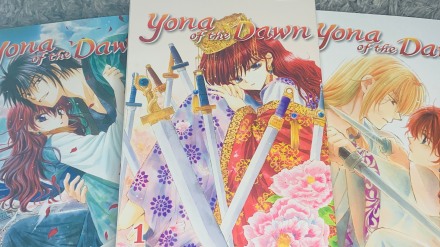
The Start of a Long Journey: Yona of the Dawn Manga Volumes 1-3 || First Impressions

First impressions and loose thoughts on volumes 1-3 of Mizuho Kusanagi’s manga series “Yona of the Dawn,” initially published in 2016 by VIZ Media. Spoilers will be present.


A Terrible, Terrible Birthday

I’m no stranger to the beautiful and cruel world of Yona of the Dawn. I followed the anime when it first aired many years ago. Loved it. Since then, I decided to pick up the first NINE volumes of the manga to hopefully quench my thirst for a sequel we’ll probably never get. Wellll, you know how I do these things—the manga sat on my shelf for a good couple years, untouched, and the dust started to collect.

Until now! My rekindled love for manga has motivated me to tackle my shelves before buying new titles, which naturally placed volume one of this long-awaited read in my hands. And guys, what can I say that hasn’t been said already? Yona is a wonderful shoujo fantasy series with a compelling cast of characters living in an interesting Asian-inspired world. BANG. What more could you want?

But in case you know nothing about Yona, the shoujo manga follows the titular Princess Yona, whose bright red hair makes her the crown jewel of the Kohka Kingdom. After her doting father, the king, is murdered in cold blood by her childhood friend and lover, Su-won, Yona flees for her life with her faithful guard Hak. Now, Yona sets out on a journey to reclaim her country with hak, which includes tracking down the four dragon warriors of ancient lore.

Out on the Run

Right off the bat, I think the most striking thing about Yona’s world is the choice to use Korean-inspired names instead of the typical Japanese names. In fact, the series draws more inspiration from Korean culture than it does Japanese, making it an intriguing blend of both cultures. The series carries with it a heavy traditional feel, but also contains a surprising amount of fun and comedic moments despite the tragic start.

Following their flee, Hak seeks out his home village of Fuuga to avoid further pursuit from Su-won’s soldiers. The village’s chief (and Hak’s foster grandfather), Mundeok, is an admirable figure who I’m sure could’ve taken in Yona and raised her very well—but that wouldn’t be much of a story then, would it?

No, instead, Yona puts her foot down and decides to leave the village herself, demanding Hak continue to stay at her side. (The audacity, I know!!) Shortly after, Yona and Hak confront their pursers, and we get the powerful scene where Yona slashes her own hair—which she is adored for—to free herself from Kang Tae-Jun’s captivity. If that’s not symbolic of a woman choosing strength and independence over frailty and vanity, I’m not sure what is. The passing of Yona’s cut lock to Su-won leads him to believing that Yona has truly perished, which deeply hits him, interestingly enough. Like, Su-won isn’t a good guy, but, is he truly bad . . . ?

She with the Crimson Hair

Volume 3 is where we finally start to get a glimpse of the overall plot Yona is about to take up. Now that we’ve become acquainted with Yona’s rare fiery side as well as Hak’s reliability and loyalty on and off the battlefield, we are introduced to Ik-su, a lackadaisical priest who fled the capital when the regime changed years ago, and Yun, a haughty young pretty boy whose talents in cooking, fashion, and herbal remedies will prove incredibly useful on their journey going forward.

Ik-su tells Yona (and the reader) a great deal about the world, the legend of the dragon warriors, and Yona’s role in all of it. He prophesizes the assembly of the four dragon warriors, and how their coming together will awaken the monarch and resurrect the red dragon of dawn. The spirit of the dragons is passed down through four individual bloodlines, each of which still bear fealty to their beloved crimson dragon even to this day.

After a sad parting, we leave behind Ik-su, and Yun joins us in traveling to the White Dragon Village. There, in the land of the wind, we meet the first dragon warrior, a beautiful young man named Gija who possesses the “arm of a dragon,” scales and all. Although Gija bumps heads with Hak, the pain in Gija’s arm makes him realize that joining Yona is his life’s calling—and the destiny that has been passed down his family for generations. Another bittersweet parting between Gija and his grandmother sets us on the long quest to finding the other dragon warriors.

A Fantastic Historical Fiction Drama

Mizuho Kusanagi’s art style is the stuff of legends. Almost flawlessly, she recreates an era in time that dates back to the Three Kingdoms period of Korea. Mind you, it’s all historical fiction, so none of the setting is real, but Kusanagi reimagines this period from architecture and fashion style to customs traditional of this period. It’s such, SUCH, a gorgeous manga.

All of Kusanagi’s characters are beautiful (as one might expect in a shoujo manga), but also brazen and fierce. There’s a fire in Yona’s eyes that is unmatched; in Hak’s, a gaze of strength and familiarity; and in Su-won, a dark, melancholic sadness. Each cover piece alone is a work of art, as the coloring is so pretty and vibrant, much like Yona’s captivating red hair.

So, will I be reading more Yona of the Dawn in the future? Well, duh—I already bought the first nine volumes, or did you already forget? Haha! Seriously though, if I didn’t already have them, I would’ve placed an order immediately following the second volume. Yona has a lot of promise, which comes as little surprise given how highly talked about this series is. I’m excited to embark on this long journey with Yona, and I do hope you’ll be tagging along for the ride.


If it were a person . . . if this were a battlefield . . . I’d need my arrow to fly true. Drawing your bow means taking a life—or letting someone take yours.Yona


Afterword

I could talk on end for how much I love Hak, how much I love Yun, and how endearing of a protagonist I find Yona to be growing into. But, I’ll save that for future manga write-ups. After all, this is only the first three volumes, and there are well over 20 volumes available in English! I do hope you’ll continue with my reading of Yona of the Dawn. What are your thoughts on this highly beloved series? Let me know down in the comments! ‘Till next time!

– Takuto

CLICK HERE TO READ MY THOUGHTS ON VOLUMES 4-6

That Blue Sky Feeling: Preciously Queer & Wholeheartedly Delightful || Review

A brief review of the 3-volume manga series “That Blue Sky Feeling,” story by Okura, art by Coma Hashii,, and licensed in English by Viz Media. MINOR SPOILERS for Volume 1 will be present.


Have You Heard the Rumors?

High school transfer student Noshiro may seem like a cool and outgoing guy to his new classmates, but Noshiro’s big, bumbling heart is his best feature. Although he’s inexperienced in love, he finds himself drawn to Sanada, the school outcast, who is rumored to be gay. While most would get squeamish at the thought, the rumor only further fuels Noshiro’s interest and determination to get close to Sanada. Set in motion is a bittersweet tale of self-discovery, friendship, and first love.

Marketed under the shounen demographic, this school romance drew a lot of its appeal from the relatable character drama presented and Coma Hashii’s soft and cute character designs. With only three volumes, the story reads quickly, but methodically guides us through Noshiro and Sanada’s entire first year together as classmates. Showcased are the attempts made by Noshiro to become friends with Sanada, all of the ups and downs of this rocky relationship, the misunderstandings, and the persistent efforts to grow closer.

From the start, this seemingly simple story of exploring a rumor opens up to much larger contexts, including social pressures and the meaning of “being gay” itself. Using Noshiro’s naivete as a lens for self-questioning, Okura has carefully crafted a cast of characters that investigate the notions of sexuality, attraction, and “liking”—and largely without even being aware of it! This is the kind of title that doesn’t break boundaries so much as explore how these boundaries form, why they do, and how people are affected by them.

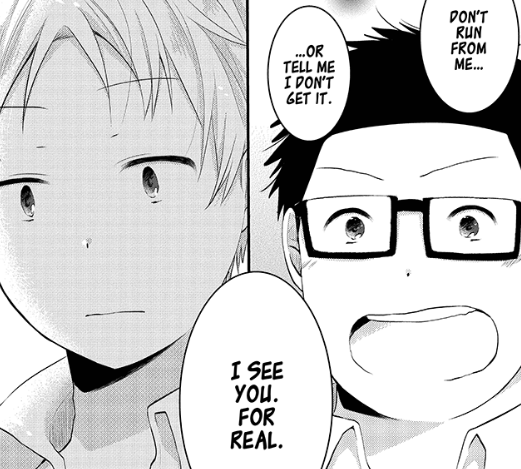
noshiro and sanada

Straight, Gay, and Curious

Dai Noshiro is the open-book kind of character. He’s silly, easily approachable, and loud, which (often to Sanada’s dismay) attracts a huge crowd wherever he goes. It’s refreshing to have a lead character in this type of story who isn’t some tall and skinny bishounen. If anything, being built and a little on the round side (or as Sanada calls him, a “country potato”) is celebrated in That Blue Sky Feeling as a body type that characters like Sanada and energetic underclassman Morinaga actually hold as a preference. This definitely met my approval!

Having a guy like Noshiro who knows virtually nothing about the LGBT community (or relationships for that matter) makes him the perfect voice for Okura’s discussion on what it means to be a closeted gay kid—or being gay in general. Noshiro is new to this kind of thing. He straight . . . or, at least, he thinks so—he hasn’t ever given relationships much thought. But we know he’s uneasy, curious even, and I can’t blame him. This really is a smart move on Okura’s part, as now Noshiro functions both as a likable MC and a subtle proxy for self-exploration. Nothing in That Blue Sky Feeling is forced. Like clouds, these musings come and go, occasionally bringing a little rain or blocking out the sun.

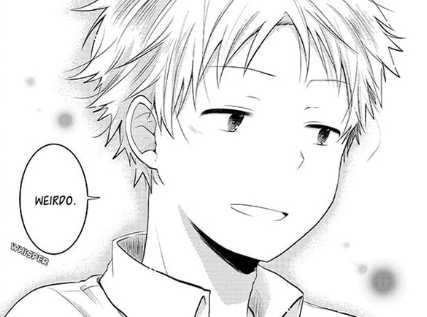
Then there’s Kou Sanada. As the quiet closeted kid, Sanada strays away from anything that would draw attention: sports, clubs, even leisurely activities like swimming. He’s standoffish, dismissive, and get’s irritated easily. Sounds like no one would like him, right? Well, that’s where I was wrong, too. Sanada is just misunderstood. He doesn’t fit in with the other boys because he often can’t relate to any of them without fearing they’d leave him for thinking he’s weird. I mean, how regularly do you see gay people hanging out alone with their straight friends of the same gender? I suppose it’s different for everybody, but I get why Sanada distances himself. (I JUST WANT MY SLEEPY BOY TO BE HAPPY.)

If any part of Sanada will be a mixed bag, it’s his past relationship . . . with a 26-year-old man named Hide. I don’t think Okura is trying to condone pedophilia, but Sanada and Hide really did go out, and Hide’s not afraid to poke fun at their past together. Now, hear me when I say that Hide is genuinely a good guy. He serves as a mentor of sorts to Noshiro when it comes to gay stuff, and he only aims to help, not harm. I was uneasy about Hide at first, but—thankfully—I ended up being wrong about him.

dai pushing chair

Subtlety is Blue Sky‘s Greatest Strength

Okura’s story is wonderful, truly, but the biggest draw to That Blue Sky Feeling would easily be Coma Hashii’s art. The series has this wondrously soft aura to it, which is in no surprise thanks to Hashii’s character designs. Fun fact: The Blue Sky I am able to enjoy now is actually a remake of Okura’s original web comic series. When a book publication was announced, Okura brought on Hashii to redraw the entire series with greater quality art and the gentle touch Blue Sky is now beloved for.

Sanada and his dear childhood friend and classmate, a girl named Ayumi Yamamoto, are drawn with a slimmer build and bigger eyes. (Sanada’s cat-like design really accentuates his sleepy aura.) Other characters like Noshiro and Hide are noticably more rotund but still very cute. Like the story itself, the character expressions are never overdone, and that subtlety works to Okura’s writing immensely. I mean, a character turning away from someone—only to reveal bright blush marks on their cheeks—can speak where words wouldn’t quite do those feelings justice.

kou blushing

Unexpectedly Falling in Love

What does it mean to be normal? What does it mean to be weird? Navigating through the complexities of making friends as a young homosexual in a heteronormative world, That Blue Sky Feeling handles first love and the notion of “inexperience” with surprising delicacy and innocence. Even when things get heated, the characters try to better themselves by digging deep within and honestly asking what it is they want, and how they can present their truest self to others.

Everyone in That Blue Sky Feeling has an unbelievably pure heart. Just as prominent as the exploration into friendship, liking, and being gay is the theme of unrequited feelings. For a series to have such a tangled web of complex feelings, Blue Sky‘s characters hold their heads high and continue to remain friends despite all odds. This kind of content is the exact opposite of “toxic,” and is the reason I fell in love with Noshiro, Sanada, Ayumi, and everyone else.

As the gap between Noshiro and Sanada slowly shrinks, we come to see how two very different high school boys can find themselves unexpectedly falling for one another. Noshiro quickly finds that, perhaps, labels aren’t suited for everything, especially people and relationships. Wishing only for the happiness of these kids, That Blue Sky Feeling is preciously queer and wholeheartedly delightful.

sanada whisper


What does it mean to like someone? Going out. Boyfriends. Girlfriends. I never thought about it, never worried about it. Until I met Kou Sanada — Dai Noshiro


Afterword

Guys, I love this manga with all my heart. ALL MY HEART. If you couldn’t already tell, that means That Blue Sky Feeling is another certified “Cafe Mocha” for me! I can see why people may find Hide and the age gap to be a turn-off, but that kind of stuff happens in real life, too, and we eventually have to move past it. I love Noshiro’s loudness, Ayumi’s sweetness, and grew quite fond of Sanada’s character. (He really is charming when you get to know him!) Viz’s releases of this series are also pretty in pastel colors, I’m so thankful to them for such pleasant publications!

But I’ve talked enough, what did you think of That Blue Sky Feeling? Let me know in the comments. To shake things up, my next Pride Month post will be over the anime Love Stage!!, so please look forward to it! Thanks for reading, and until next time!

– Takuto