
From the New World Review

I always used to think that sci-fi was robots, high-tech cities, and people in black suits shooting guns at other people in black suits. Flying cars, neon lights, and stainless steel, right? Well I’m not all wrong, but I’m certainly not right, as here is Shinsekai Yori (From the New World), a psychological mystery drama that uses themes from the supernatural and the occult to create – yep, you got it – a science fiction anime. Prepare to abandon all sense of worldliness and jump into your traditional Japanese village, where, for some reason, something doesn’t feel quite right . . .

Unknown apocalyptic events have passed which destroyed most of the world. Taking place 1,000 years in the future, we are met with a small Japanese village of humans that have supernatural, psychic Power. Two Committees maintain peace and judgment: Ethics and Education. On the surface, they are the ones maintaining this masterful, humble utopia, but these Committees actually regulate information and manipulate reality in the village. Whether it’s by “banishing” troublesome individuals or even subverting one’s own memories, they will risk any and everything to maintain order.

There’s always this dangerous aura that spurs from the setting, making each and every day in class risky. Adventures outside of the village barrier, which no one is allowed to leave, are hazardous, yes, but exhilarating and unknowing. As far as you know, everything outside the gates is desolate and menacing. Rules upon rules established by the Ethics and Education Committees allow for “thinking in the box only,” and actions that go against these authoritative groups warrant unimaginable punishment. Thus, the theme proven most effective to preserving protection in the village is to use FEAR as a means to influence and control the youth. Well done, From the New World.

Our actual story centers around Saki and her four friends: Satoru, Shun, Mamoru and Maria. We witness the development of their Powers in school (some more than others) and the truths of the real world outside the village. From child to teen to young adult – innocence to rebellion to experienced –  we follow five youths that will inspire the drive for hopeful future of change.

What’s obviously the best part of this anime is the particular care that went into telling a great story. It seems that at all times, we are shown only what we need to be seen for the time being, much like a novel, filling holes and uncovering twists at the end of each chapter. Speaking of, the show was based on “Shinsekai Yori,” a Japanese novel by Yusuke Kishi. That’s right, not a light novel, not manga, a “book” book. That explains why the anime feels like something all teachers would make their kids read. It requires that kind of technical thinking.

But it’s not all smooth sailing – no – because like books, each “chapter” of the characters’ lives begins so painfully slow. Told from Saki as the narrator flashing back on the events, the time skips include life at ages 12, 14, 26, and 36. The pace only picks up towards the end of each arc when they decide to info dump us, a reoccurring problem.

Another issue I had with the show was actually the Powers. To what is their extent?? Levitation (of body and objects including giant rocks), pyrokinesis, the ability to reassemble glass, drawing with the mind, creating reflective surfaces out of nothing – seriously! What can they not do? I understand that each person has some sort of practice unique to them, but still, with all things considered, I feel that they could at least be living in a city with their powers rather than some weird collection of occult shanties (no offense). Also, they cannot kill another human due to the “Death of Shame,” a genetic trait which causes them to die instantaneously if they use their powers to kill another . . . umm, I guess it’s conventional, but that’s it.

The characters are developed well enough to identify definite progression since episode one, especially Saki and Satoru, but that development comes with discovering the events that led up to present-day. Well, that and the Monster Rats, humanoid mutant rats that live in colonies and obey the psychic people like gods.

In fact, the most interesting character in the entire series is a Monster Rat known as Squealer, a helper of Saki and Satoru in their early days outside the barrier. I literally can’t say anything due to spoiler’s sake, but do keep an eye on this creepy fellow – he performs some very very commendable acts as a main character . . . some wicked, Machiavellian acts we’ve all seen sometime before . . .

I found the animation by A1-Pictures to be gorgeous: soft sunrises, intense sunsets, luscious forests, and beautiful character designs. While it contributed to the atmosphere of the show marvelously, including the vast difference between the village and “Tokyo,” it’s not 100% satisfaction.

Apparently there was a change in staff when it came to design work and animation around earlier/mid episodes that fluctuated between two totally unlike styles – neither of which were bad, just noticeably different. Another weak point was the Monster Rat Colony fight scenes. The boulders are so CG and glaringly horrendous that I just laughed the whole time!

Sound-wise, hair-raising tracks boost the suspense and inevitable horror. In contrast, subtle adventurous songs for exploring helped establish various moods. A standing ovation, however, goes to “Ienikaeru (Going Home),” which is actually composed by Dvorak and coincidently, from the 2nd Movement (Largo) of the “From the New World” Symphony. Being a classical nut, this tune as the evening “children, return home” theme that plays over speakers in the village completely through me off. One of my all time favorite classical works, on the verge of tears when this played at the end 😥

Oh yeah, Yuki Kaji’s freaking awesome as always, performing the role of Satoru with such strong conviction and youthful stress. Always great to listen to him!

One of the biggest reasons I love From the New World is because it reminds me sooo much of No.6, another one of my first anime that I hold to heart. Soundtrack, dystopia, youth, romance, suspense, thriller, science fiction – it’s got it all, too, but this anime did what No.6 didn’t, and that was deliver with a fulfilling ending. I never, ever got closure from watching that anime a couple of years back, no matter how much I searched for “anime like No.6.” I can finally rest easy.

Despite being just a science fiction story, this anime feels more scary real than anything else I’ve encountered in a long while, and that could be because of its realistic characters and their actions. Its analysis of the human condition through a dark, manipulative plotline adds so much depth and curiosity that you’ll be guessing until that last episode, but no more than that. Why? Because by the end of the show, From the New World does not get very far at all, but it paves the way to a more hopeful future instead, and after all of the wrong, disturbing, and twisted carnage that I bore witness to, I could not ask for more than that.

“We have to change our way of thinking if we really want to change the future.” – Watanabe Saki

+ Mastered storytelling, made gripping and curious until the very end

+ Incorporation of “Going Home” really made the mood shine

+ Thriller tone so realistic like nothing I’ve seen in a long time; fresh, clean slate after viewing

+ Satisfying ending that delivers justice to the show

– Brief animation issues

– Info dumping in the beginning/middle of each new arc made for rugged understanding

Wow, this anime was so hard to talk about! It’s such a beautiful story that you should defiantly check it out. It’s not for everyone, but for those seeking something completely different than the norm and/or are wanting a clean slate by the end, you can watch the whole thing on Crunchyroll for FREE! Thanks so much for reading my emotional report over From the New World, and in fact, thanks world for the joyous experience! Beware the Trickster Cat, and until next time, this has been

– Takuto, your host

Bakemonogatari Review

So I decided to take up another large anime project and have settled on the Monogatari series. Famous for its dialogue-driven stories full of supernatural phenomenon, I thought “hey, sounds like a blast.” What I got instead, sugar coating scraped off, was a hit-or-miss subtitle-heavy anime that, with all careful decision in mind, I might not explore to its fullest.

“Ghostory” centers on Koyomi Araragi, a high school boy who, after surviving a vampire attack, became half-vampire himself, giving him various powers such as regeneration and heightened vision. To the best of his abilities, Araragi lends a helping hand to five different girls who have also become entangled with ghosts and spirits. His first encounter with the sadist tsundere Ms. Senjougahara Hitagi, however, sets him down the path of frustration yet eventually love.

I came into this anime expecting dark, twisted stories about ghosts and the occult, but instead I got a romance harem. *sighs* The series is divided into five different arcs – one for each girl – and while each one is interesting and rounds out a particular character to a considerable degree, the lack of coherence to each story chops up Senjougahara and Araragi’s overarching relationship. In an anime filled with nothing but dialogue, each arc manages to keep the story fresh, but their relationship suffers heavily.

In terms of character dialogue, there is nothing wittier than this, well, besides Okabe and Makise from Steins;Gate. Crafty wordplay, playful teasing, and intense argumentative banter are so well presented in Bakemonogatari that often times than not, it’s even worth reading in subs. Sure, some of the comical value of the puns is lost, as I sadly do not know Japanese, but the interactions are still super entertaining. A downside to this factor is that these quirky conversations can last the span of half an episode, where the characters are just standing around or sitting on a park bench. AS SUCH, THE SHOW CAN BE EQUALLY BORING.

Another disappointing thing was that arcs would begin mysteriously and uber creepy (YESS!!), but then they sometimes build up to a lackluster finish. For instance, I really liked how “Nadeko Snake” started, but man, it was such a boring finish. This show was good, but not a masterpiece by any means, and I honestly don’t know if I want to watch the second season.

Each of the girls have been “cursed” so-to-speak by an apparition, and as a result carry some sort of deformation that affects their body: Hitagi’s physical weight was stolen from her, Mayoi can’t seem to return home, Suruga’s arm became that of a monkey’s, so on and so forth. In addition to their dilemmas, each girl is a personification of various anime girl stereotypes – but with a twist. Take Hanekawa: class rep, studious, kind, but has parental problems at home. Suruga is the loud athletic girl, but she’s extremely perverted as well as a hardcore lesbian! These additions not only help personalize characters, but they feel more realistic, too.

Watching all of the characters interact with each other is where this anime shines. Because the show has such a small cast, each of the characters are explored and developed quite thoroughly. Even Araragi is hilarious to watch, witnessing his switch from lolicon to pervert, serious man to joker! The comedic skits are fast-paced while the “return fire” in arguments are just as quick-witted! Great voice acting, especially for Araragi and Senjougahara, also helps to bring out the sass talk!

Animation studio Shaft brings it all together with its attractive presentation. Silhouettes, background shadows, geometric lining, extreme symbolism and color balance are all presented with such unity that it’s truly remarkable to watch! Not to mention, varying camera angles and flash frames attempt to keep those long conversation scenes as exhilarating as possible. Also, it’s hilarious to watch the characters anger Araragi; I love all of the cartoon faces that he makes!

About the flash frames, though –  while some shows flash a couple of words that can easily be read, Bakemonogatari seizures us with occasionally paragraphs of plot-important text. I found myself slamming the pause button every five seconds during the episode openings where they are most abundant.

As for OST, the fight scenes are not necessarily well-supported, but the lengthy conversations have several strange and upbeat scores playing in the background. While the OST is not worth mentioning, the fourth opening “Ren’ai Circulation” by Kana Hanazawa and the fifth opening “Sugar Sweet Nightmare” by Yui Horie are both really catchy!

Bakemonogatari is a very surreal anime built around cursed characters that try to fight their own nightmares. They speak cleverly, some a bit smart-assy than most! I strongly recommend walking into this anime with an open mind, as lots of information are thrown at you – and you gotta read fast! Underneath all of the jokes is a memorable cast of colorful and deep characters, each complete with a story of their own no matter how grim, and it’s all about diving into their personal hell and finding the cure so that they can be at peace once again.

“If I kill you, that means I’ll be the one closest to you when you’re on your deathbed. Isn’t it romantic?” – Senjougahara to Araragi

+ Incredibly well-developed characters with entertaining dialogue

+ Sense of “something’s not quite right” establishes great tone

+ Shaft’s unique animation adds to the series quality

– Lots of subtitles to read

– Drastically boring during periods without suspense

Haha, Senjougahara, I’m not sure if that’s romantic, but it’s definitely true (and freakin’ weird)! If you want, you can watch the first 12 episodes of Bakemonogatari on Crunchyroll for free, and you’ll have to find the last three episodes somewhere . . . umm . . . on the web. What did you think of this anime? Does it get better after the first season? Staplers and head tilts!? Let me know in the comments, thanks for reading, and until next time, this has been

– Takuto, your host

Date A Live Review

So I crossed this show when I saw some of its key visuals: a powerful warrior clad in a violet, pink and gold-armored dress, with hair of a rich purple hue. Some know her as Tohka, but she’s also known as the girl who was revoked by her own show. Today, a shambling show of plot, yet a decent display of boobage – Date A Live.

Itsuka Shidou is yes, your average high school student. He lives a normal life with his red-headed little sister Kotori, despite him having bold blue hair (she’s got to be adopted). His life is disrupted, however, when another “spatial quake” explodes in his city, causing mass destruction and panic to spread.

These spatial quakes bring Spirits, mystical and powerful beings of unknown origin, coincidently hot/cute chicks. His sister also just happens to be the commander of an Anti-Spirit Team aboard the Fraxinus. As she and the other crew have analyzed, the only way to seal the powers of the Spirits is by making them fall in love with Shidou – and by giving them a kiss. “Kill or kiss the world,” as they say! Failure to accomplish the mission will be met by deadly firepower from the AST’s flying powered suits – worn by half naked women, might I add.

Date A Live is a harem, romance, action, school, comedy, mecha, sci-fi . . . so on and so forth . . . anime. It poorly jumps around between being absolutely serious, bat-sh*t crazy, and fluffy as daily life can be. I enjoy really dark, thoughtful, and intense anime, with a few slice-of-life scenes splattered during the appropriate times – and there are a couple of crafty surprises packed within the show. But this anime is not organized with its plot whatsoever.

Recall that scene from episode 3, the one where Tohka and Origami face off and she accidentally shoots/kills Shidou? That was easily the best moment of the anime; it was second to Kurumi’s creepy assault on the humans in the woods. Too bad the end of the series was met with just a mech fight (not hating on mecha anime or anything, but seriously). – _ –

Also, I don’t really see how the dating sim system the AST uses is helpful. By the time everyone reads the three weird options, votes on one, and tell it to Shidou through ear piece, the moment is long gone and would be too late to respond to questions. But whatever.

Besides Shidou having a really cute face, he’s just the boring middleman between the Spirits, taking in and returning expressions of “absolute concern,” because you know, he’s the good guy. I suppose he can be comical at times, and he’s not an annoying protagonist too, which are pluses, but yeah, he’s not anything new either.

I could sit here and talk about each of the Spirits and how “different” they all are, but really they can be grouped by stereotypes: Yoshino, the shy and quiet girl, Origami, the secretly-in-love-with-classmate, Kurumi, not gonna lie, a decent villain yet tossed to the side the last couple episodes, Kotori, the little sister, and that just leaves one girl – Tohka. While they are all entertaining, comedic, and cute (with great curves :3) they lack the flushing-out that I enjoy most.

Tohka is the first Spirit we are introduced to. She’s tsundere at first, but develops into waifu for Shidou. It’s similar to Asuna from SAO, though Asuna is a much better fighter and character! Anyway, not only does Tohka have a heart-warming food-consuming personality, she also has a beautiful design. When I think about it, Tohka is just Saber (Fate/Zero) if Saber did not have such strict social contracts binding herself. I love the purples, pinks, light blues and golds on her armor and in her sweet eyes!

Yet the one thing this anime had going for itself was put to the side because WHO THE HELL KNOWS. Tohka is a great fighter and by this point she is the best character, so why dump her? For the other girls I guess, but it ain’t worth it. After episode three, Tohka doesn’t get the spotlight again until the end; that’s +6 episodes of Tohka just eating and sitting on her ass. A shame.

This was the high point for the show – the animation by AIC Plus+. Again worth mentioning are the superb character designs, but additionally the sharp and colorful background scenes. I can’t recall low quality of any kind from this show, so a round of applause to them! The only thing I could complain about are the fight scenes, which rarely happen – and I’m talking all-out fights, not a missile launch here and there. The action sequences featuring the dominant Spirits clashing with the AST units are spectacular, but sadly few and far between.

The soundtrack was a real surprise for me. Not only are the daily life scenes well-supported by casual themes, but the dramatic sections are gorgeous and truly melancholic. Anthems for battle ring with a full on orchestra plowing down the field, and intensity is never lost by the OST.

Infamously known, the opening “Date A Live” by sweet ARMS quickly catches attention as an opener. Its passionate choir vocals along with an addicting melody are a great way to start each episode! The ending second “SAVE THE WORLD” by Iori Nomizu is also so catchy! I’m quite attached to them both!

But great background music and quality detailed animation won’t save the failing date that is Date A Live. The show brings nothing new besides its unique yet unorganized story idea, and if you’ve already waded through several harem anime, then you’ll know all of the ins and outs, getting more and more tired of this show’s determination to be something it’s not. If you are not a critical viewer and are simply looking for time to blow on an action/romance with comedy, impressive fights, and fan service then this is perfect. Otherwise it doesn’t live up to the hype.

“Just killing and killing and killing? You deserve to die and to die and to die.” – Tohka Tatogami

Yeah, bummer, it was disappointing. However, there is a second season, so I will be checking that out soon. Since I watched it in subs, I hear the dub for Kurumi is really awesome, so I might give that a watch too . . . if only I could ever find the time. Thanks for reading – slap that like button if you enjoyed my review and until next time, this has been

– Takuto, your host
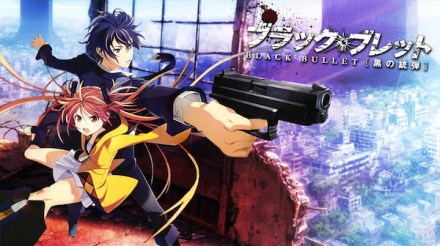
Black Bullet Review

The apocalypse cannot be summed up in thirteen episodes, especially when half of those episodes are pointless loli fights.

In the near future, humans have been defeated by the giant viral insects called the Gastrea. Shortly after, mankind created Varanium, a weakening metal that is immune to the virus and wards off the Gastrea effects. Black Varanium walls were erected around the Tokyo area to keep the insects out, but the real toll has already been taken in the form of the “Cursed Children.” Due to Gastrea infecting the mothers, Cursed Children were born as red-eyed girls with superhuman powers.

Satomi Rentarou lost his family to the Gastrea in an earlier war, and because of his hatred for them ended up joining Tendo Civil Security as a Promoter, one of the many organizations fighting against the Gastrea. Teamed up with his loli partner, Aihara Enju, the two receive requests from Tokyo’s leader, Seitenshi-sama, that involve protecting her from harm’s way, managing public safety and of course, killing off the Gastrea with their black bullets.

I expected this series to be an action rom-com, similar to Aria the Scarlet Ammo, and I got that impression, that is, from the first half of the series only. The first half follows Rentarou and Enju beating up all who oppose Seitenshi-sama. There are comedic scenes, decent character development and yeah – just pretty laid back.

But around episode eight or so, the government gets involved, and we all know what happens then. Our little fights become all-out war and by then the show isn’t even interesting anymore.

And for a show about the Gastrea, they never show up in the city after the first episode, so I don’t really know what genre to classify this series as. Replacing the Seitenshi-sama bits with in-town Gastrea fights would have at least kept the consistency of the overarching plot.

At least the anime does a decent job at defining the discrimination between ordinary citizens and that of the red-eyed Cursed Children. I got really emotional when any of them died, but maybe because they are only little lolis. Still sad stuff though!

The only characters worth mentioning are Enju, Rentarou and his boss, Kisara Tendo. Enju constantly asks to marry Rentarou, but we never really find out why – or at least it’s not memorable. Other than that flaw she’s pretty cute, innocent, and a kick-ass fighter!

Rentarou’s only redeeming quality is the fact that his voice actor is Yuki Kaji (Shu Ouma, Eren Jaeger). He does such a phenomenal job at capturing the youth male in an expressive and active manner. Towards the end, I only watched the series for Kaji’s amazing acting.

Kisara is . . . hmm, Rin Tohsaka? Pretty much, only that Tohsaka’s a billion times cooler. They belong to involved families, aid the protagonist, act somewhat, and I say this lightly, tsundere, and they both look the freakin’ same.

But I still liked Kisara. She and Rentarou actually push the romantic level in this series to a point where I was satisfied, and not overdone. Her end, though, makes me question her bi-polar-ness. “I am evil.” What the hell?

The reason I started this series was for its animation by Kinema Citrus Co. I love the bright colors and matching pallets on the characters. Eyes, hair, clothing, boobs – just everything was nicely done. The only problem was the cheap CGI animation in the Gastrea. They seriously look like dumb indistinguishable blobs.

As far as sound goes, the OST is pretty vivid. A variety of different styles were used to caption the different moments. Techno, choral, orchestral and even Western-inspired tracks were present. Emotional death scenes are well supported by the soundtrack. I can’t really complain.

Now the opening –I love the J-pop band fripSide after hearing them perform the openings for A Certain Scientific Railgun and its sequel, but their new song (the opening) certainly raises the bar. “Black Bullet” (original, I know) amplifies itself with rushing choir chants similar to Attack on Titan’s second opening, and it’s such a catchy beat. CHECK IT OUT!

The ending, “Tokohana” by Nagi Yanagi, also deserves a shout out for its haunting glow. It subtly captions the cries of the Cursed Children. I bow to you, Nagi Yanagi.

At its end, Black Bullet finishes with an epic fight, yet ultimately resolves nothing. I guess the Cursed Children get it good, but Kisara only gets a start to her story. Along the way, the show answers no questions, adds new ones, and just fails to explain anything. Had the last ten minutes specifically been taken out then I could have made an enjoyable experience out of the whole thing, but sadly, no.

I guess Black Bullet falls into the trend of “good animation, unexplained plot,” similar to TRINITY SEVEN that I recently finished. If the anime just answered its own problems before adding new ones – antagonist Kagatane, I’m talking to you – then again, I would have had a lot of fun with this series. And because of its lack in explanation, I can’t really recommend this anime. Perhaps if you enjoy loli combat, colorful animation and fripSide, then go ahead. Black Bullet had something going, but shot too many holes in itself by the end. “The scariest thing about killing people is getting used to it” – Satomi Rentarou

If you had similar or even favorable thoughts on Black Bullet, feel free to leave a comment below! I want to know if it was just me who was unsatisfied. Thanks for reading, have a good one, and until next time, this has been

– Takuto, your host
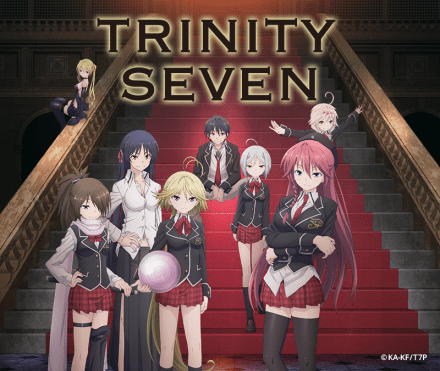
TRINITY SEVEN Review

Harem anime rely on three concepts to succeed, regardless of how stupid the plot might be:

1. A decently likable lead that undergoes some sort of personal growth throughout the show
2. An even more enjoyable and interactive ensemble cast that is attracted to said lead for some odd reason
3. Humorous dialogue and decent amounts of fan service

. . . Or so I thought.

TRINITY SEVEN demonstrates what happens when an anime relies too much on its harem, sidelining any plot explanation, and ultimately pays a heavy price for such unbalanced writing.

Arata Kasuga’s world literally comes crashing down on him when an apocalyptic event known as a “Breakdown Phenomenon” destroys the whole world and throws his cousin Hijiri Kasuga into a different one. Unable to get Hijiri back nor stop the catastrophe, Arata finds himself enrolling in a magic school, Royal Biblia Academy, that houses the great “Trinity Seven,” seven girls who have mastered their own “Thema” and are ace magicians. From here, Arata plans to “learn the magic” of these powerful ladies and control his “demon lord candidate” abilities in order to bring back his beloved cousin, Hijiri.

What caused this untimely “Breakdown Phenomenon?” What did the caster gain from this tragedy? How does one learn the complex system of magic?

These are just a few of the many reasonable questions that get little to no answer. Crucial explanation is tossed out for exploding clothes, bouncing boobies and nude scenes of Arata and the girls. I enjoy my fair share of fan service as much as the next guy, but TRINITY SEVEN has way way too much of it! I grew really tired of it :/

Unnecessarily convoluted plot aside, the show might score a win with its characters.

The lead boy Arata Kasuga appears to be your typical pervert, but he’s surprisingly different. He’s honest about his attractions, never stuttering while apologizing a thousand times; we’ve all seen it, don’t lie, it gets really old. “Thank you for the feast” is one of his quotes to witnessing nudity. Kasuga was a fresh harem lead, and I enjoyed the fact that he doesn’t use the Trinity Seven, but instead fights even stronger alongside them. Plus, his voice actor is Yoshitsugu Matsuoka (Kirito-kun) – you can’t get much better than him!

While a couple of the Trinity Seven are cutout characters, the ones that I found myself drawn to were Lilith Asami, Levi Kazama, and Akio Fudou.

First off, Lilith-sensei is one of the teachers at Royal Biblia Academy, and as such is Arata’s #1 tease. She wields a magical rail rifle weapon and knows how to fire it quite well. I love the concept art of her character, red-braided hair with blue eyes and a monocle on occasion, as well as her hate/love relationship with Arata. The two get along well, and by the end, hold respectful positions with each other. Also, Arata loves her giant jugs – the best out of the Trinity Seven 😉

Levi and Akio act more like supports for Lilith and Mira Yamana (the cute yet stern tsundere leader) respectively, and as such are mainly “power houses.” They both have their own motives, yet go along with Arata’s teasing. Truly a hidden comical duo!

Another one of the show’s better features was the animation by Seven Arcs. While intricate CGI architecture made up the school and its majestic hallways, characters had matching and rich color designs, be it in uniforms, hair color or eyes. The ecchi hot scenes are also a beauty; graceful curves and shining skin really do go a long way :3

OST-wise, the soundtrack contains lovely violin melodies for both combat and relaxation. Sometimes rap-like chanting is sung to help fill the space. It’s unique and adds its own touch to this anime.

The opening “Seven Doors” by ZAQ is freakin’ amazingballz! By using chromatic scales to create a haunting undertone, and mixing that with a sweet, reminiscing melody, you get a super cool song! Check it out – it is a must! BTW, I love Hijiri’s cute face when the verse starts ~

Now back to the rant. TRINITY SEVEN is nothing but boobs, attempted serious magic, exploding clothes, then more boobs. It’s awesome for a while and really could have been so much more, but by episode 6 or so I was utterly lost and just done. To be honest, I can’t believe I stuck it out, but then again, I’m a completionist, so yeah. “Connect to blah blah – Execute Thema!” Or whatever the hell it is.

Thanks for reading! Remember that these are my own thoughts, so feel free to drop a comment with your own. Until next time, this has been

– Takuto, your host

Sword Art Online II (Phantom Bullet) Review

It’s funny that I do this review before the prequel, but it’s been a while since I’ve seen the first season and I didn’t want to half-ass a review. Enjoy ~

It’s been one year since Kirito escaped the deadly game that is Sword Art Online. Meanwhile, ALfheim Online has gained much popularity, for it serves as a peaceful outlet for Kirito and his friends to escape from real world troubles.

Evil doesn’t die so easily, though. Roaming around another famous VRMMORPG by the name of “Gun Gale Online” (GGO) is “Death Gun,” a cloaked man rumored to kill individuals in real life through the game’s avatars. Kirito once again risks life and limb through virtual means to apprehend the mysterious assassin, but he’s not alone – the best sniper in the game, Sinon, with her highly destructive PGM Ultima Ratio Hecate II, proves worthy of battle herself in this world of guns. As the world tournament Bullet of Bullets commences, Sinon, Kirito, saber in hand, and Death Gun enter the arena among many other foes, guns locked and loaded.

After the events of last series, SAO had a little repairing to do, and GGO was the best tool to do so. This arc in the light novel series by Reki Kawahara made up for the lack of action and strength in the first season’s Fairy Dance arc. Phantom Bullet reminds us of the quality characters and themes that the SAO series was famous for; a powerful sequel that matches the strong will and survival feel of the first arc, Aincrad. Sword Art Online II is engaging and thrillingly eerie through to the end of the arc.

Kirito logs into GGO as a . . . girl? Yep, and it’s just great. His particular model possesses long dark hair, and his breastplate, well, yeah, adds emphasis. While he continues his unwavering badass style, he crumbles when he finds out that Death Gun must be a member of the “Laughing Coffin” guild, a player-killing group from SAO. The vibe from the first season returns as Kirito realizes that he could actually die in this harsh, cold, foreign world. He starts to recall haunting memories of the PK-ing he committed himself when fending off the Laughing Coffin members. This new revelation builds on past his one dimensional superb fighting skills.

Asada Shino is weak, quiet, and had shot someone when she was very young, and that terrifies her. She can’t even hold a weapon without trembling and then vomiting. But in GGO – a virtual world, she’s not actually killing anyone, so she masks her fears through Sinon, the cerulean-haired, lime-armored heroine. In the gun world, she’s stronger, faster – better. She doesn’t have to worry anymore, because Sinon protects her and fights for her. Sinon puts a new spin on “the will to fight” that makes her my favorite character. When she meets Kirito, she thinks they are both girls, and acts in a friendly manner, but quickly goes tsundere when she finds out the truth.

Kirito and Sinon balance each other out very well – I couldn’t have asked for better pairing besides maybe Asuna, who supports Kirigaya Kazuto on the other side of the amusphere. Sinon does, however, fall to Kirito’s irresistible charm when she becomes weak, but hey, that’s just her real-world self breaking through, not a whole new and sudden change.

I would tell anyone to watch SAO for the character costume designs alone because holy sh*t this is where it’s at! Match these colorfully crafty armor and weapon designs with fluid visuals pumped with action and A-1 Pictures really has something going on! As mentioned previously, there are many more battle scenes in this sequel, and quality never dipped once. The landscape of GGO is give a desolate color palette to that of a ruined desert city. Graphically and artistically, the anime does take me to the mature and virtual world of GGO.

Yuki Kajiura adds to this unique universe by providing an adventurous soundtrack. There’s not really much to say, as it is still just as amazing as the first season’s. She did, however, take the “Survive the Swordland” track, the epic main theme, put it on flute, and up the tempo to add a new sense of glory to the Kirito and Sinon action. Nice 🙂

While the opening “Ignite” by Eir Aoi was befitting for a show with this quality of animation, the true delight is in the lovely ending, “Startear” by Luna Haruna. It features Asada Shino young and old along with her avatar, Sinon, providing a reminiscent feel of childhood and maturation.

Sword Art Online II is a strong follow up to its first season, as it contains much action, brilliant music along with fluid animation, and reminds us of the themes the very first arc held. I recommend all of the SAO series to young viewers because of its genuine romance and characters. While more mature viewers might get bored of the concept , I still recommend this season for its high quality animation and soundtrack. This second series definitely lives up to the hype, so I’d get aboard the SAO train before it’s long gone.

You can watch all of the anime for free at Crunchyroll! Sword Art Online II continues to cross the bridge between the virtual and real worlds, proving to us that they might not be as different as people think. “The virtual world is just a different form of reality.” – Asada Shino
It has been tons of fun following this thrilling adventure! Till next time ~

– Takuto, your host

Love, Chunibyo & Other Delusions! Review

Ah yes, adolescents at its finest. I too, “suffered” from chunibyo, Japanese term for eight grader syndrome, when I was younger, though I wouldn’t call it suffering by any means. Sure, mine was only from elementary school until sixth grade or so, yet they were some of the most fun, carefree years of my life. Today, we invest ourselves in a girl who claims to “live in the world beyond” – yet she’s an incoming freshmen in high school.

The “Dark Flame Master,” AKA Yuuta Togashi intended to leave behind his embarrassing past when his family moved to a different city. Wanting to start anew with his freshman year in high school, he tries to make a fresh batch of friends. This changes when a mysterious girl appears climbing out of her apartment. That neighbor – that same delusional girl in his class, Rikka Takanashi the “Wicked Eye,” hears him speak of his past when he lets it loose on the school balcony for relief. She becomes fascinated, hooked – drawn in by his cool display of chunibyo. This crazy chick is the full on thing, though – eye patch, umbrella shield, battling with the “priestess” (her sister) and more ridiculousness. Together, the two recruit members for a trivial club and hilarity ensue.

Let’s just face it: the characters in this anime are beyond incredible. Yuuta is a simple boy desiring to leave behind his childishness. He’s awkward when trying to meet people such as Makoto Isshiki, a kid who attempts to rate the girls in his class; however, the two become best of friends. Isshiki’s love, Kumin-senpai, spends the majority of the show sleeping – no joke – but is still adorable.

Another duo is Shinka Nibutani, class representative, cheerleader, popular, yet ex-chunibyo sufferer “Mori Summer,” and the middle school servant of “The Wicked Eye,” Sanae Dekomori. Nibutani is beautiful and regarded as gentle or sympathetic by her classmates, but when playful Dekomori is found carrying around a book written by Shinka from her delusional days, she does everything in her power to protect her image by retrieving the tome.

Dekomori’s extremely long blonde twintails, her preferred weapon, are very original in design. She even loads them with weights when she enters harsh combat against the “fake Mori Summer,” for she doesn’t believe that Nibutani wrote the book. Also, unlike Rikka, Dekomori is the highest in her class – smartest, cutest, and rich. This background gives Nibutani and Dekomori great depth and memorable scenes. I love them both :3

Rikka is the epitome of Yuuta’s past, and thus presents major problems to the guy – well, just comedy for us. She finds pleasure in the smallest of things that we as viewers often forgot ourselves, be it in the form of a calculator lock taped to her door or spinning around an umbrella as a sword. But she’s more than just creative, as the two develop genuine feelings for one another to the point where they start dating. Even Nibutani backs down to kindly support Rikka and her motives, returning as “Mori Summer” when absolutely necessary. They don’t get very far at first due to Takanashi’s delusional state of mind, but that’s the time when we get to enjoy the couple, cause from here on the story sadly loses its touch.

The second half of the series throws in a concept that I absolutely love, yet classically hits the viewer like a bus – drama. Rikka’s family and past are delved into with sudden furiousness that made me go “wut, I thought this show was built upon light-hearted comedy and romance, not overused dramatic clichés.” Sure, the events improve Rikka as a character and explain her motives, but that development throws the rest of the plot down the drain. Takanashi and Togashi spend several episodes apart which made me drop most of the momentum their relationship carried through the first half; they had worked so enchantingly hard to sculpt an unfinished project. The writers took the “Chunibyo & Other Delusions!” out of the show, leaving a failing “love” to support the title.

A better side to the show is its visuals. If I tell you anything, it’s that this show is cute! J Kyoto Animation, as always, does a remarkable job capturing the youthfulness of the characters by using bright colors and outlines. Movements are extremely fluid to the point where any few seconds of the show would make a hilarious gif. Characters are lively and background sceneries stand appealing.

The OST, though nothing fancy, sounds fairly decent. To contrast the energetic or more comedic moments in the show are lovely slow-moving piano pieces played during depressing/relaxing scenes. The opening, “Sparkling Daydream” by Zaq is paired up with fun, fast visuals of the characters doing what matches their personality and Rikka shakin’ her ass, which is just awesome!

So, is Love, Chunibyo & Other Delusions! worth the watch? Yeah, I think it is. I feel younger and older audiences can appeal to the characters equally. The show’s highlights were any of the cute chunibyo-filled scenes and quick-witted character interactions, though they substitute those later on for more, and I put this in double quotes, “”character development.”” Chunibyo is definitely better than most rom-com anime out there, and I enjoyed it a lot; however, I wanted to watch these lovable “kids” goofing around doing stupid stuff and not worrying about real life. It’s a shame we all have to grow up sometime . . . “Reality, be rent. Synapse, break. Banishment, this world!!!”– Rikka Takanashi

You can watch the series to its entirety for free over on Crunchyroll, as it has a really enjoyable Japanese voice cast. Also, it has been licensed by Sentai Filmworks if you wanna pick up a copy. Thanks for reading and hit the like button if you thought this review was somewhat decent! Until next time, this has been

– Takuto, your host

Oreimo 2 (season two) Review

Of course I had to continue with Oreimo 2 because the first season was so eccentric! If you haven’t already, check out my anime review of Oreimo (season one) for a better reinstating of the plot. Also, watch the first season before you read this, as a spoiler or two might be present in this review.

Following Kirino’s departure to America in season one (OVAs), the sequel picks back up on the average life of Kyousuke Kousaka. When the older brother demands his sister’s return, even traveling all the way to America himself to do so, things between the two begin to break apart again. After all of the work in season one Kirino still seems just as tsundere as ever. Drama rears its ugly head, however, when Kuroneko, Ayase, Kirino and the rest reveal their mixed feelings for our bumbling brother. The story goes from otaku culture in society to relationships with siblings and others.

This second season crushes the majority of the characters by turning them on their own heads. Specifically speaking, the hot-headed and sophisticated Ayase is no longer that. Do you recall the moments when she detested Kyousuke, eroge, and everything else that he was involved in? How about the episodes of time where she would yell at Kyousuke and even Kirino just to try to cleanse Kirino of her hobbies? That signature kick that she would deal upon him when he was against Ayase – well, that’s still here, but anyway, the series suddenly turns her into an active yandere without even a second thought. She was one of the few serious characters, now diminished to a lover and a dreamer. A shame.

Kirino remains true to her tsundere influenced setup. In fact, she still gets mad at Kyousuke, yells at him, and then kicks his door. I love Kirino as a character; even in this second season, she realizes the bad things she does and tries to take care of it, though this usually fails and then gets cleared up by Kyousuke. She’s just a teenage girl – she makes mistakes but grows through them. The only difference in her mood is that towards the end, she somewhat realizes her love and dependence on Kyousuke. It’s weird and strays away from the original plot, but touching nonetheless. After watching the strange ending, I now understand Kirino and Kyousuke as characters much more than before.

If you liked Kuroneko, Saori, and Manami, you’ll be pleased to know that they have improved. Kuroneko gets her own little arc with Kyousuke, but I found it less right than him and Kirino. Kuroneko and Kyousuke didn’t go well together; I couldn’t feel the connection between them like I did with his sister, and I know it’s “wrong” to say that. Saori receives a nice embellishment with her sister and her past, which many people skip by, but I found those episodes to be more enjoyable than the entire Kuroneko arc – and that’s saying something!

Enough about characters. The soundtrack is pretty much the same quirky OSTs as last season. Some new tracks are added to the romantic moments, though. The opening, which I can’t even remember, is just another J-pop song. Yeah it’s fine, but nothing I can recall.

Animation has improved. And saying that the quality before was fine, this was even more enjoyable. I like the concept art of Kirino and the other girls’ characters. They are soft, yet gorgeous and just overall well presented.

Oreimo 2 is a very good anime; it just fails to deliver as a sequel to an amazing first season. This season drops most of the otaku acts and focuses on forced cliché relationships. I guess if you love drama, then here you go, but I watch this particular anime for the struggles of otaku life and comedy – Oreimo is not a serious show, so why should it start being so now? For people who followed the first season, feel free to watch the sequel, just know that it’ll break your views of the interesting characters we encouraged for the previous twelve lovely episodes.

And with that, I conclude my overall thoughts Oreimo – My Little Sister Can’t Be This Cute! Currently, though I do not own a copy of the series, you can watch it for free over at Crunchyroll, but you can also slide on over to my place because “The only one I sexually harass is you!” – Kyousuke

Hehe, if you found this review at all helpful or interesting, go ahead and slap dat like button. You know you want to. 😉

– Takuto, your host