Welcome back to EVERYDAY EVA, the blog series where I aim to cover one episode of Evangelion every single day for Mecha March 2022!
This is a weird episode—and it’s only the second one.
This episode is so great because of what it doesn’t immediately provide us with: an explanation of how Shinji “won” his first fight against the Angels. Instead, we get iconic hospital lighting and the “unfamiliar ceiling” motif. SEELE is shown in their goofy rainbow colored lighting and goofier dialogue (this is one instance where I prefer the Rebuild’s take). Then, Misato compliments the achievement that is air conditioning—a woman out for all our hearts, really. Really though, Misato’s optimism here will become pivotal to her character as it develops clear up through the final Rebuild film.
In fact, we see Misato’s influence radiate throughout all parts of this episode. She proposes to take Shinji in as a roommate, which shows her motherly side. Then she takes him to see the skyscrapers of Tokyo-3 rise back to the surface against the dazzling amber sunset. She’s the only one who provides Shinji with info about their world, and we can’t help but respect and sympathize with her. Pen Pen is introduced as the show’s true best character, further cementing Misato’s legitimacy at her trying to provide a welcoming home. Speaking of, I made a post a long time ago about how Misato’s apartment serves as a safe haven against the cruel outside world, and most of my opinions still stand today. Fun fact: The production notes say that no other people live in the apartment complex.
Capping off the end of this episode is a return to the events of the previous, and at last we get to see the fallout of Shinji’s plight and the manifestation of “The Beast.” Misato tries to quell his heart with kind words and a warm bath, but the damage is already done—and the bath only causes bad memories of his father to surface. The flashback narrative structure is not only unique but bold for a sequel episode. Also notice how, as Shinji lies in bed staring at yet another unfamiliar ceiling, we only hear the minutely subtle instrumental music of his SDAT player. It’s the sirens and pounding of the Angel’s lasers that segue us into the flashback sequence. Surely, Anno will continue to employ riskier avant-garde directing tricks in the future.
Shinji gets back in the robot for Episode 3: “A Transfer,” so be sure to return tomorrow for more Mecha March 2022 and EVERYDAY EVA. Thanks for reading!
Welcome to EVERYDAY EVA, the blog series where I aim to cover one episode of Evangelion every single day for Mecha March 2022!
A new series of posts to celebrate my love of Evangelion begins!
When I rewatch NGE Episode 1, “Angel Attack,” I can’t help but think about how solid of a groundwork it lays for the entire series. Scratch that—the entire franchise. The abundant electric poles, lush mountains, and gray machinery of NERV contribute to the Tokyo-3 in my mind. It’s not the largest city, but it’s plenty big enough to stage the location of where most of the series’ action will take place. And there’s a lot of action to come.
First though, the Angel attacks. Misato being more concerned about her wrecked car and ruined dress is peak character introduction for a woman who just barely survived a military bomb explosion. I love how she’s lost trying to navigate through NERV Headquarters despite using a map. According to the guidebook that comes with GKIDS’ Ultimate Edition Blu-ray (which I will simply reference from here on as the production notes), Misato has only marked the locations the two restrooms she uses most frequently! Also, Gendo’s assurance against the JSDF that “This is what NERV is for, gentlemen,” is such an iconic line.
The tension in Shinji’s debate about getting in the Eva, though often trivialized and memed to all hell, is actually quite gripping. Immediately, we see how Shinji is a character who acts based on feelings and the way others perceive him, not logic. He won’t do anything unless he knows he’s good at, and since he’s never before piloted the Eva, he fears failure along with abandonment (from his childhood). From this moment, Misato seeds the notion he mustn’t run away in her words (leaving him to spend the rest of the series grappling with why), and to everyone else, Shinji becomes but a means to an end, that end being their survival.
But those are some cursory thoughts on Episode 1: “Angel Attack.” I’ll be back tomorrow for more #MechaMarch content and another episode of Evangelion. ‘Til then, thanks for reading!
I’m so excited to announce that I will be joining Scott (Mechanical Anime Reviews), Lita (LitaKino Anime Corner), and many other anibloggers in this year’s “Mecha March” festivities! Having been following this annual celebration since its conception several years back, I’ve been dying to participate myself as a blogger. In the past, I’d normally do my own personal mecha adventure in February (long story—it’s somewhere on the blog), but this year I decided not to marathon anything to focus on school instead.
Which is why this year I’d like to make amends for my lack of writing about anime by blogging every single day for an entire month. And the topic, of course, is the only thing I could possibly have the energy to talk senselessly yet passionately about for thirty days straight—Evangelion!
Starting tomorrow, March 1, I will be uploading daily posts covering every single episode of the original Neon Genesis Evangelion (and maybe the Rebuild, we’ll see). My reasons for writing are threefold. For one, it’s Mecha March, WOOT! Two, I’ll be watching Eva in high-def Blu-ray quality for the first time ever thanks to GKIDS’ ultra boujee Ultimate Edition set. And Third, I’ll be celebrating the FIRST ANNIVERSARY of Evangelion: 3.0+1.0 Thrice Upon a Time, which was released in Japanese theaters on March 8, 2021.
I’ll set the precedent here that my participation in this project is mostly to help get me back into the blogging spirit. So, while you shouldn’t expect super high quality analysis posts and thorough episode reviews, you CAN look forward to short reflection posts containing personal anecdotes, production notes, and other random thoughts I have for each episode. It should be mostly relaxing and fun for the both of us. 🙂
If you are looking forward to this month-long series of posts on Eva or are also writing for Mecha March, let me know in the comments! Again, I’m looking forward to getting back into the blogging groove while talking about why I love this notorious yet classic mecha anime!
Hey guys! Super excited to share this unboxing video with you all! This is the highly discussed (and much celebrated) Neon Genesis Evangelion Ultimate Edition Blu-ray from GKIDS. Also included in this vid is a comparison with the Collector’s Edition Blu-ray that GKIDS also released. We’ll be flipping through every single page together, so grab some coffee and let’s talk about Eva~!
Also, sorry this was so late!! I literally recorded it January 31 but didn’t want to upload it until I edited out all the times I said “uh” and “um,” which was an embarrassing amount. So, enjoy this mostly “um”-free unboxing vid from me!
Interested in more anime, manga, or K-pop content? Subscribe to stick around 🙏
Hey guys! With the theatrical release of Evangelion 3.0+1.0, I couldn’t think of a better time to bust out Yoshiyuki Sadamoto’s Evangelion manga than now! Plus, I found myself with a free weekend to just chill and read for a bit :3
Did you enjoy this manga read-with-me vlog style video? Share your thoughts about the vid or your love for Eva down in the comments!
Interested in more anime, manga, or K-pop content? Subscribe to stick around!
The legendary Neon Genesis Evangelionand it’s films, Death & Rebirthand The End of Evangelion, have officially arrived on Netflix! Long-awaited by fans of the series and greatly anticipated by curious newcomers alike, now everyone around the world can enjoy streaming this groundbreaking title with ease.
Along with the relaunch of this classic came a new English dub. To old fans of the ADV dub like myself, this’ll be quite the adjustment to make. But hey, this also means we get to celebrate Eva‘s arrival with something new and exciting for everyone!
I’ll always have a place in my heart (and on my shelf) for Tiffany Grant’s feisty Asuka, Allison Keith Shipp’s smokey Misato, and Spike Spencer’s troubled yet innocent Shinji—but that’s why I own the old DVDs, so that I can enjoy both the old and the new whenever I want to.
In case you missed it, here’s our new cast:
ADR DIRECTOR | Carrie Keranen
SHINJI IKARI | Casey Mongillo
REI AYANAMI | Ryan Bartley
ASUKA LANGLEY SORYUU | Stephanie McKeon
MISATO KATSURAGI | Carrie Keranen
GENDO IKARI | Ray Chase
KOUZOU FUYUTSUKI | JP Karliak
RITSUKO AKAGI | Erica Lindbeck
RYOJI KAJI | Greg Chun
TOUJI SUZUHARA | Johnny Yong Bosch
KENSUKE AIDA | Benjamin Diskin
KAWORU NAGISA | Clifford Chapin
ADDITIONAL VOICES | Julie Bersani, Christine Marie Cabanos, Daniel MK Cohen, Billy Kametz, Zach Aguilar
I’ve already heard several mixed opinions about the new dub, including entire script changes and even omitted tracks (how dare you remove “Fly Me To The Moon”). But I still have hope for the new cast, and am anticipating my own little watch party later this evening. And hey, if you like what you hear, be sure to give all the actors a hearty “Congratulations!” over on Twitter—I can only imagine the immense stress and honor behind voicing in such a renowned series!
Love it or hate it, Eva is here for a new generation. So rather than pass it off, please, enjoy the happiness, sadness, and emotional highs and lows of this classic. And watch all of it, too—as it was originally intended! To skip any episode is to miss out on an entire chapter in the wild lives of these incredible characters struggling—both against the wrath of the heavens and themselves—just to live another day.
Share the gospel with all your friends, and feel free to laugh, cry, be excited, and especially confused by the sheer depth, complexity, and outreach of this tale of what it truly means to love yourself. It’s a very special series that holds a lot of weight for so many people, and alas, now people everywhere can experience it.
Evangelion is officially on Netflix, and all’s right with the world.
Chances are that if you were linked here from another blogger pal, then you might be new. To those first-timers, “Hi, I’m Takuto, welcome to my anime cafe!” As part of the OWLS blog tour’s third monthly topic, “Sanctuary,” I decided to pull in all of the Evangelion sources that I could, original series and Rebuild alike, in order highlight that no matter where you may be in the apocalyptic future of Tokyo-3, captain Misato Katsuragi’s apartment will always remain a safe haven from the wrath of the heavens.
A sanctuary is a place of safety and stability. In anime, there are several different places and environments that characters call “home.” For this topic, we will be discussing locations and settings in anime.
Eva is a franchise that you might already know means the WORLD to me, so allowing myself to revisit its iconic universe is a real treat. Thanks Lyn for the prompt!
A brief discussion on Misato’s Apartment as it appears in the 26-episode 1995 series “Neon Genesis Evangelion,” the critical 1997 film “The End of Evangelion,” and the “Rebuild of Evangelion” film series, produced by Gainax and eventually Khara, all of which were written and directed by Hideaki Anno.
First, A Welcoming Party
Eva opens up on an alternate present-day Tokyo where “Angels,” ironically named beasts of pure destruction, are in recent rise for some bizarre reason. Shinji Ikari, son of NERV commander Gendo Ikari, is called in to pilot the towering [neon] colored humanoid robot Evangelion Unit-01. NERV, an organization bent on the survival of the human race no matter the cost, may very well be the last battlefront in stopping these beings of terror, but it is ultimately up to Eva pilots like Shinji to determine whether humanity lives to see another day.
Shinji survives the first angel encounter against Sachiel. Barely. But the fact remains that he did actually save everyone, which is why his cold father ensures that Shinji remains on campus in case of another attack. No, the two don’t share the same living space, let alone sleep in the same house. Instead, they mutually agree that rooming together would be the worst possible outcome. Like a mother overprotective of her ducklings (this is funny because she has a pet penguin), the clumsy yet strong captain Misato Katsuragi takes Shinji under her wings and shelters the boy at her own apartment.
Misato’s place is graphically located quite a ways away from NERV HQ, which is probably for the best considering that they are always on call, and that they already over-shoulder work everywhere else they go. It’s also crucial to note that we never see any interactions with the other apartment members in the complex, nor are the other lights on. It’s only Misato’s that is lit, like a lonely lighthouse guiding lost ships. After the two go out to pick up some welcome party snacks and view the majestic city sunset, the two share a memorably warm if not simple exchange before entering the household:
Misato: “Your things ought to have been delivered already, Shinji. I just moved here myself, ya know? *glancing back* Hey, come in.”
Shinji: “Uh, I don’t . . . want to intrude.”
Misato: “Shinji, this is your home now.”
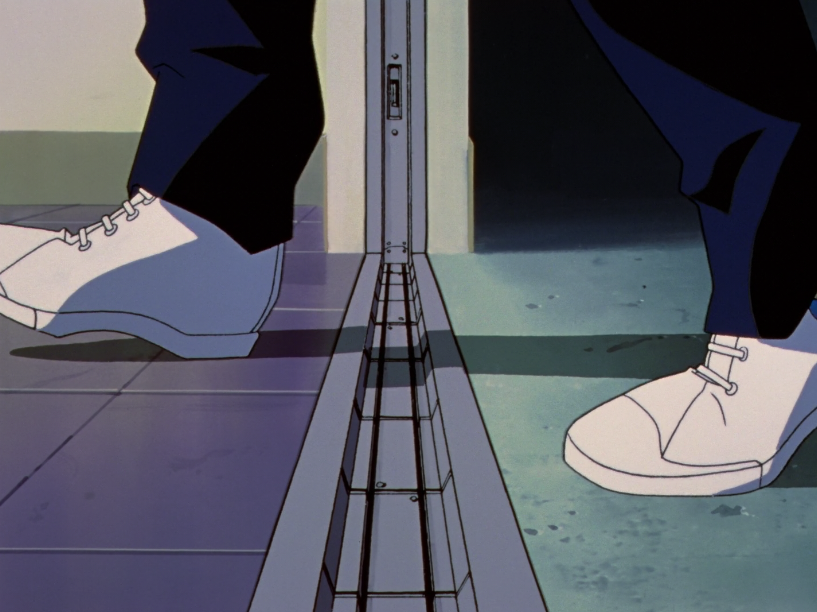
Shinji: *hesitant pause, finally steps into the apartment, crossing the sliding door lining along the floor, and stares upward shyly* “I’m–I’m home.”
Misato: *closed eyes, smiling* “Welcome home.”
[the apartment door automatically slides shut, revealing the tag M.KATSURAGI]
Misato: “Ummm, as you can see, the place is just a little bit messy but uh, heh, go ahead and make yourself comfortable.”
This is your home now. Wow. Just by reading this you can already get a feel for both of our characters. Shinji is shy, not wishing to impose upon anyone his own troubles. Misato comes across as casual, relaxed, and friendly. But just as how she makes her cameo in a flashy blue sports car with nothing but a seductive picture to go by, the atmosphere quickly shifts from one of formality to an air of light-heartedness. Evangelion masterfully plays with moods depending on how the characters should be reacting to certain situations, and Misato’s apartment, in fact, could almost represent the peaceful and joyful side of the chaos. Now that we’re all acquainted, it’s time to get to know each other beyond the name tags.
Make Yourself Comfortable
“Is this how you act in public? In front of your friends!?” You might have gotten this spiel by your parents if you’ve ever for a second acted, heaven forbid, without concern for public opinion or manners. Going back to the question, of COURSE I don’t act like this out there—this is home, and home is the one place where an individual should feel less pressured to “suck in their gut,” so to speak. Home is where I can let my guard down, and the characters in Eva do exactly that at the apartment. These moments make up the lighter side of a series otherwise known to offer psychological trauma and emotional turmoil.
This slideshow requires JavaScript.
Shinji, Misato, and eventually Asuka are free to lounge around with a temporary leave of stress that comes with saving the world. At first it was only a woman and her pet. Soon the dynamic opens up to invite a pseudo son (episode 2), followed by a pseudo daughter (Asuka in episode 9) and an anything-but father (Kaji). Even aunty Ritsuko comes along and plays house at one point!
Like mentioned earlier, Evangelion is rife with iconography. Some early examples include:
Episode 2’s introduction of the song, Misato’s theme
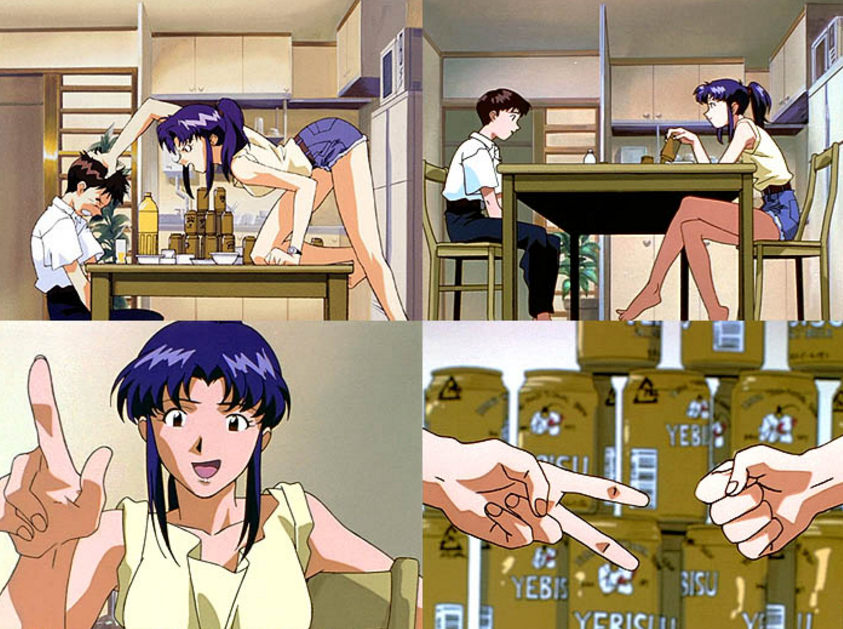
Episode 2’s fridge reveal of nothing but ice, snacks, and lots of beer
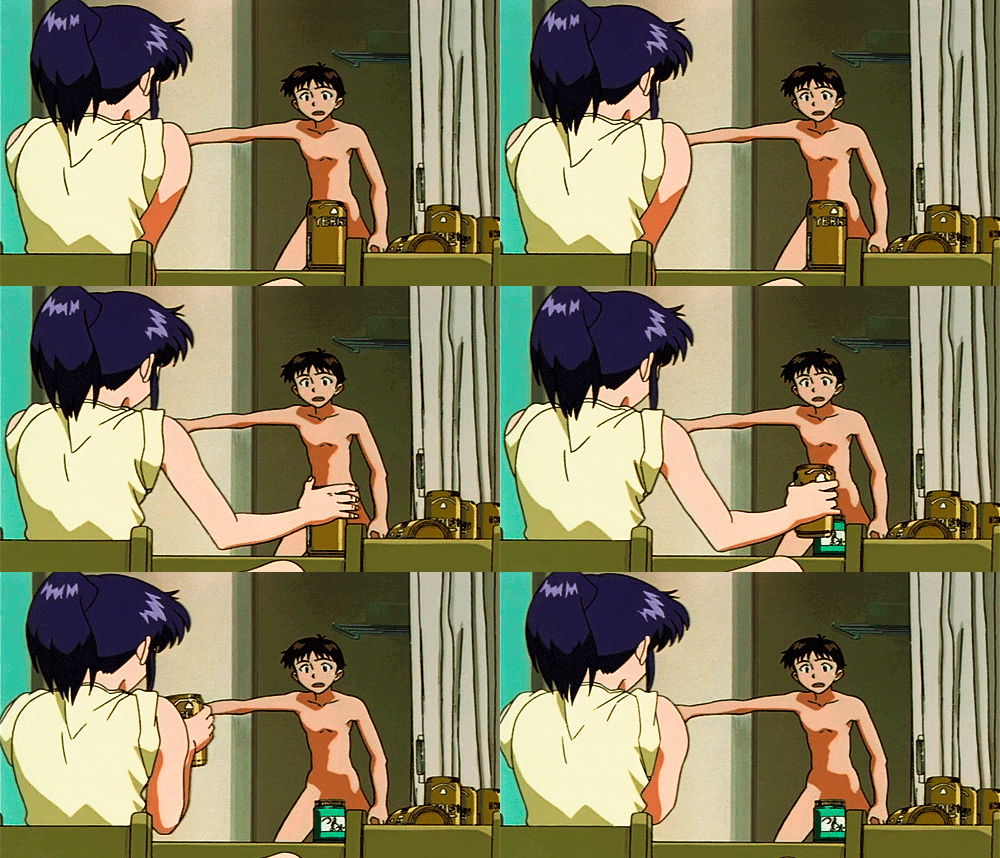
Episode 2’s infamous toothpick scene (adding on with the straw scene in the Rebuild)
Episode 2’s recitaiton of “Unfamilar Ceiling” (sheesh, one would think that episode 2 is important for some reason)
Episode 9’s synchronization training through DDR and fashion
Episode 16’s “I’m bored, so kiss me” by Asuka
Little Shin’s Room ❤
Homes allow people to ponder and create. In the show, we see the characters questioning their own existence, their place in the world, and whether the actions they take are justifiable. The apartment also allows philosophies to be revealed, such as Misato’s “Not everything must be answered with a yes m’am,” or “Wash away your troubles—bathing cleans the mind and soul!” Speaking of bathing . . .
Differing personalities invite conflict, for not everything in Misato’s apartment is happy-go-lucky. Time spent alone allows the darkness to sneak back into their heads. We are permitted to see the characters at their worst, such as this disturbing 20-second bath tangent by Asuka, portrayed by the incredible Tiffany Grant. Whereas bath scenes are supposed to be tranquil and stacked with fan service, Eva, being Eva, turns this cliche on its head to emphasize that not all acts at home are frivolous. Sometimes we get into fights, and that’s natural. Easily, the worst-case scenario remains the pinnacle choking scene from The End of Evangelion, which brings an entirely different and off-putting light to the children’s home, both figuratively and literally.
What’s So Special About An Apartment
Not much, actually, only that it’s not just a house—it’s a home. A sanctuary from work stress and the trivialities of daily life, if you will. Even though these types of apartments are numerous in Japan, Eva still goes the extra mile in presenting the physical space uniquely. For one, the cinematography is sharp. This is reflected by the angles used, enhancing censored scenes like Shinji’s toothpicks or items such as the bras and lingerie that hang from the ceiling. In this way, the show stays interesting and provides enjoyment for a second time through. Utilizing warm hues of yellow for lighting also provides a sense of ease, unlike the cold LED lights of a hospital or a laboratory (it is HUGE contrast to Rei’s apartment).
As much as it’s fun to break down the inter-workings of the minds of our favorite characters, or pick apart the cause and effect plots of our most beloved stories, taking a minute to admire the physical—locational settings—feels like a nice breath of fresh air.
It feels like we’ve nearly covered it all, but in fact there’s so much more to the development of the apartment itself. How its atmosphere changes over the course of the story almost makes it seem as if it were a living, breathing entity. Home is a place to relax and be comforted by all the things, living or not, you cherish. It should be a place of intimacy, of quietude, a place to be yourself without anyone telling you how to live. I know not everyone has it this way, and I’m sorry, but I hope you have found your own little sanctuary somewhere in this wild world, or that someone like Misato has provided this comfort space for you.
To those who do settle down at the house, aren’t you the most “yourself” in the comfort of your own home or room? I know I am, and I hope that doesn’t change for at least a little while now. We all need our me-time, and there will never, ever, be something wrong with a lil’ peace and quiet. For those in solitude, just remember that even if you’re all alone without anyone to come home to, your own home will be waiting for you, eyes closed and smile wide, just as Misato was to Shinji.
Welcome home.
Take care of yourself. – Neon Genesis Evangelion episode 26 title
Evangelion in its entirety clearly means a LOT to me. You could almost say that it influenced the shape of my character. If you’re interested in more of my ramblings and personal thoughts, please, feel free to browse the archives for more of that Eva goodness!
Hello cafe-goers, welcome to cafe talk, a segment where I ramble and you are more than welcome to ramble with me! Today’s post is the last one (for some of you thinking, thank goodness he’s done) concerning my recent EVA-Week, a celebration centering around the official English release of Evangelion 3.33. I hope you have enjoyed what has come out, and I ask you to join me on this last little voyage to Tokyo-3 for the foreseeable future . . . maybe . . . ?
Here is the calendar on my board. I’ve been filling in the days with their respective colors as they pass.
This goes more along with my 3.33 review which was recently posted. I thought dividing this into two parts would tremendously help cut down on the word count (it is so far the largest post on this blog)! This comprehensive aftermath will also explain the mindset I currently have with both Neon Genesis Evangelion and the Rebuild, so SPOILERS EXIST FOR ALL OF THE EVANGELION FRANCHISE.
Three groups of people exist when it comes to the franchise, and here are my thoughts on them:
Those who interpret the Rebuild as its own series of 4 stand-alone films.
Stand-alone meaning that I could watch 1.11, not look back, and be satisfied with what I got; the film should be able to support itself without additional knowledge like most movies. I’ll admit, this method works fairly well for 1.11 and I dare say 2.22 if you decide to overlook the last ten or so minutes. With 3.33, this all falls apart – and NOT because of the 14-year gap. I was honestly thrilled when Anno decided to take such a ballsy risk, and it would’ve worked if
A) the events between the gap were explained by the end (Shinji’s confusion is decently handled, so putting it at the beginning would be all for not);
and B) The mental states of each character, not just Shinji, were further delved into. This viewpoint, I believe, is defunct due to the lack of both of these. Sadly, 3.33 just doesn’t stand by itself no matter how you look at it (my review will further explain why).
Those who interpret the Rebuild as its own singular story, requiring knowledge of all 4 films.
This interpretation kinda piggy-backs off of the first, but in more of a coherent fashion. It is comparable more to a series, in that imagine if you watched the films back-to-back in one long slew (taking out credits, disc switches, etc.). This helps support the idea that the third leg of a four-person race is most tiring, complex, and occasionally (if you already assume how it’ll end), most climactic. I swam the 100-yd free, which is down-back-down-back. Without a doubt, that second down is the hardest part, as you have to manufacture your own adrenaline rush. For ROE, this means that 3.33 decides to take a more emotional approach and build up to the “beginning of the end,” much like a typical plot diagram. Still, this method lacks explanations for the unreasonable character motives and those deep psychological treats we savored in NGE. This viewpoint will be defunct should the last film present itself similarly to 3.33 or add nothing “new” like 3.33 did (I say “new” lightly, as causing the Fourth Impact isn’t something to just shrug off).
HEAVY THEORY/POSSIBLE SPOILERS FOR THE FUTURE AHEAD, TREAD CAREFULLY
Those who interpret the Rebuild as a rehashing of the original series, and believe elements between the two stories are interchangeable or that the Rebuild continues the story . . . somehow.
This is the wacky one. 1.11 is basically an exact copy of the first six episodes of NGE, only introducing Lilith earlier, showing off the red sea and the corpse outline on the hill, and sliding down the Angel appearance count by one – That’s it. It’s a wonderful remake of the original and deserves more appreciation. 2.22 is the break, the deviation. We get Asuka, but less Asuka (her name is even changed, WTF). Rei is kickin’ out hormones like crazy. Misato fails to tell her own story. Ritsuko is sidelined. Mari has little purpose other than to contrast against the others and be different. It’s a high-quality film, just a little lacking in the character department (nothing that the remaining two films can’t fix, right?). Then 3.33 comes along and breaks the flow. This is Anno’s different route, and unless that theory about the Rebuild being a successor to The End of Evangelion is true– That it might all be a “dream,” another world route, or a chance to redo the past – then this is what we get. This viewpoint FORGIVES EVERYTHING that the Rebuild has caused thus far, as we fans can just plug n’ chug the backstories and memories, but should this fantastical theory prove false then this viewpoint is defunct as well. It is a well-constructed theory with much evidence, though. Then again, there’s the keyword. Theory.
I have much concern for this series, this franchise, at this point in time. Making 4.44, 3.0+1.0, Shin Evangelion Theatrical Edition 😐| – WHATEVER you want to call it – a masterful conclusion to the Rebuild series like The End of Evangelion was so many years ago is nearly impossible (unless something like option 3 happens, but it sounds all too easy). Its lack of characters which thought for themselves and had psychological issues that were conquered by individual experience and self-evaluation doesn’t even feel like the same Evangelion. And god dammit, SHOCK VALUE that receives no logical explanation is a SIN. Should the last film fail, ROE will be remembered as a series loaded with Grade A+ animation and soundtrack, a high-powered story full of twists and turns, and an emotional ride for some that found their calling with it. But hardly will you hear them say, “That doctor chick with the blond hair was an excellent character full of dynamic and emotional struggle,” because kid, the Rebuild‘s Ritsuko Akagi is not such a powerful woman.
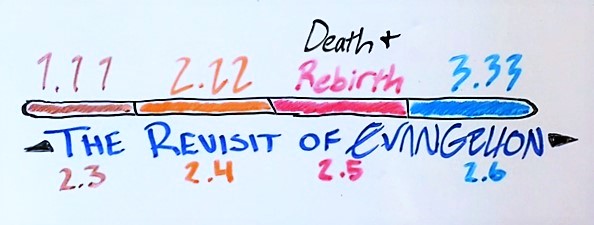
Here is EVERYTHING referenced throughout The Revisit of Evangelion, or EVA-Week. It is mainly here as a compilation for me to look back on and remember all the fun times we had. You’re more than welcome to browse the menu and comment/reminisce with me 🙂
This concludes the EVA-Week celebration here at the cafe . . I’m starting to get emotional now, trying to hold back the tears! If you stuck around to read, like, or even comment with your own meaningful thoughts once, I thank you! This series means a lot to me, to many of us, and we just want to see it do well – So damn well we cry our eyes out and meld into the proverbial sea of life. Do you have any similar thoughts on the subject, or are you completely indifferent and just watch it for the giant robots? How do you prefer to interpret the Rebuild? Any other interpretations?? Let me know so we can party hard in the comments! Thanks for celebrating this joy with me, and may the inevitable conclusion of a lifetime rock our world!~
– Takuto, your host
I’m gonna be humming “A Cruel Angel’s Thesis,” “Beautiful World,” and “Canon in D” for the next several weeks, aren’t I. . .
Hello Evangelion fanboys and fangirls, it would appear that EVA-Week is nearing its inevitable end. But don’t worry, if you’re not already sick of me going on and on about this series, here are two treats to the franchise you might have glossed by. After all, they are only a few minutes apiece.
Gosh, I’m starting to sound like a teacher emailing his students the latest assignments . . . I thank Wikipedia pages for helping me with this one!
Evangelion: Another Impact (CONFIDENTIAL)
This was an anime short project from Studio Khara and the media company Dwango. It was, like everything else, directed by Hideaki Anno, but produced by Joseph Chou and Tomohiko Ishii. Released on February 6, 2015, the website of the project describes the plot as follows:
“Another time, another place. An activation test of a decisive weapon was underway. With its development and operational trials shrouded in complete secrecy, the Another Number – Unit Null, suddenly breaks free of human control and goes berserk. For what purpose was Another Number – Unit Null created?
The story of an Evangelion’s activation, rampage and howling in another world.”
Supposedly it’s cannon, but I don’t think that was the intent. The project was meant to see what Evangelion looked like in realistic CG animation, and you know what? IT LOOKS HELLA COOL!! You don’t even have to be a fan of the series to enjoy this EPICNESS! Just enjoy the little clip:
This is the full thing, HD quality, though there is a voiceover in another language.
For those English buds who need the translation, here it is with subs, though in lower quality.
Evangelion: until You come to me.
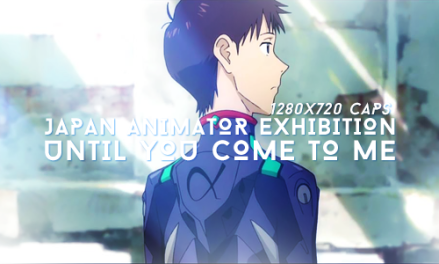
Now this one was specifically directed by Anno and released with more serious intent and style. It was an entry in the 2014 Animator Expo, and is designed as a sort of prelude/possible 3.0+1.0 hype/just-for-art for the Rebuild series, specifically set after 3.33 as it had “emotionally drained him.” The background song is Shiro Sagisu’s rendition of the popular Irish tune, “Danny Boy.”
Don’t get parts of it? All of it? Here is an excellent analysis which I encourage ALL EVA fans to watch REGARDLESS of having seen the original, as YouTuber GoatJesus does a wonderful job picking apart this piece of art and appreciating it for the sadness, beauty, and hope it inspires.
Had you seen either of these Evangelion shorts, or were you living under a rock like I was? I do hope you enjoy something out of this, whether it was the high-energy Another Impact or the more delicate, melancholic, emotionally-touching until You come to me. Both are more Evangelion, and both do it pretty damn well, providing not only new material but different medias the franchise can be viewed through. If you’d like to chat about any of it, drop me a comment below! Until the next and final EVA-Week post, this has been
Here lie my thoughts on the 2012 anime film “Evangelion: 3.33 You Can (Not) Redo,” also known as “Evangelion Theatrical Edition: Q Quickening,” produced by Studio Khara and Gainax, original story by Hideaki Anno. Specifically, this is a bit of a review, analysis, and diatribe . . . thing . . . over FUNimation Entertainment’s February 2nd, 2016 release of the prolonged English dub and translation. Be forewarned, we breech SPOILER TERRITORY, and this post will be rather lengthy and out-of-the-ordinary in comparison to my typical reviews. This compilation will (not) be for everyone, clearly, but if thus far you have enjoyed the musings of Takuto the host as a person, do consider taking the time to carefully read. I would greatly appreciate it.
While my Eva celebration concluded a week ago, I held off on this review. It’s not only hard to talk about from a statistical standpoint, but difficult to pass judgement on an emotional level. I think I’m finally ready to wrap this up, though. No spoiler, I enjoyed myself. However, my voicing of CONCERN for a franchise has NEVER been stronger than what is contained below – And I watched PMMM: Rebellion! For both of us to navigate this wasteland of crushed dreams and abundant thoughts, I’ll be dividing this into sections. Read parts of it, all of it, just the end, none of it – Whatever you’d like.
CG Evas never weighed so little! Also, best soundtrack to date!
This’ll be the easiest area to cover, as the quality of the Rebuild continues to impress. The dynamic perspectives in space, the desolate tone of old NERV HQ, the unbelievable action sequences, that godly piano scene, oh my!! I only hope that the last film (whenever it gets here, *sigh*) doesn’t rely so heavily on CG mapping because seriously, the entire first third of the series (which really feels like its own episode) is all CG, save for the characters. It’s not a bad thing, per say (the Mark.04’s last form looks like a shitty CG fan blade and the Wunder, Misato’s flagship not only lacks explanation for its abilities, but also looks dorky), I just remember when the Evas had so many moving CG parts and details, and now just a black line down the middle can replace that? Um, no. Also, not sure how I feel about the sharper face designs.
Yeah . . . ten-year-old me might have been a fan, but now . . .
Unit-08 in the trailer in 2.22
What we actually got in 3.33. Yeah, it sucks.
This was from the trailer (not that we should trust them anymore) for the last film. Doesn’t it look kinda ugly?
And why are they now weightless?? Giant robots are flyin’ all over the place towards the end looking like sprinting drunk fools. Also, do you remember when beast mode was a special thing only Shinji could do in NGE and 1.11? Well, not only can Mari do it (2.22) but so can Asuka now *facepalms*. Is best mode just a gimmick now, because it’s not even cool, neither does it make sense. The animation otherwise is absolutely stunning, and I mean that with every sense of the word! I still hope Khara is saving the good stuff for last . . .
Shiro Sagisu has done it again, that is, knock the atmosphere of EVANGELION OUT OF THE PARK!!! This was probably my favorite part of the entire film, his epic and otherworldly soundtrack elevating the stakes on every scene. While I love the reprisal of his old stuff, his new pieces, full orchestra or melancholic piano, are not something to cast aside. “The Ultimate Soldier,” “The Wrath of God in All its Fury,” “God’s Gift,” and “Scarred and Battled” are all bone-chilling masterpieces. They add SO MUCH to the movie! While at first I was very disappointed with Hikaru Utada’s new ending theme “In the End (or Sakura Nagashi), as the anticipation from the first two blew me away, I have come to delight in this change of pace. As for the English dub, it too is excellent! Not sure why a translation took so long, but hey, the acting is wonderful, and it’s so great to hear Allison Keith as Misato and Tiffany Grant as Asuka once again.
Not the world we thought we knew: Reintroduction and Basic Summary
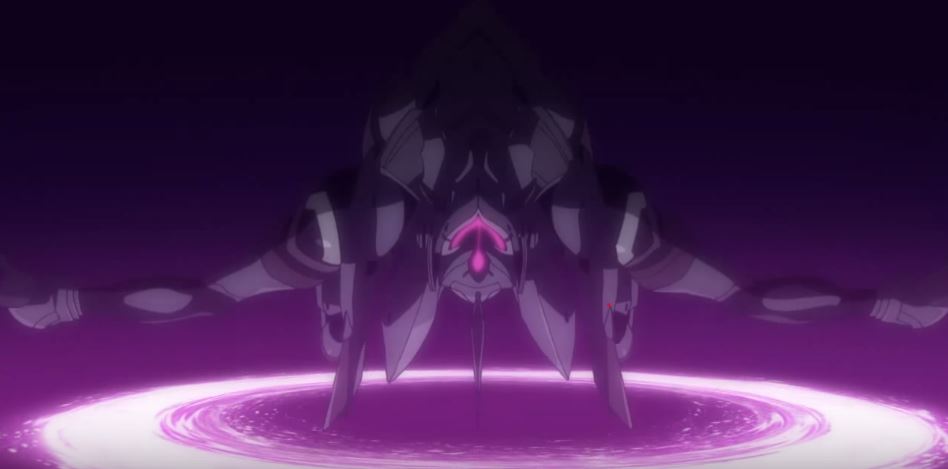
Following the cataclysmic Third Impact initiated by Shinji Ikari at the end of 2.22, 14 years of undefined strife have passed, leaving the Earth stained red. SEELE, revealed to be nearly crippled by mysterious attempts behind the scenes, has entrusted “World’s Best Dad” Gendo Ikari to carry out the remaining mission of returning mankind to a world free of human suffering and sin: Instrumentality. But Dr. Ikari has anticipated this, and instead proceeds with his own selfish plan of using the Evas to eradicate God in return for a reunion with his wife, Yui, who is revealed to be “trapped” inside the purple Unit-01.
Not all of the adults were very pleased with NERV’s true motives, however, and as a result Wille was born out of the crimson fires of rebellion. Headed by Misato, Ritsuko, three familiar NERV faces, and some new recruits, this “Will” is the only remaining organization fighting for the People.
While a decade and a half has transformed everyone around him (the “Curse of the Evas” preventing Mari and Asuka from physically aging, though), Shinji remains the same old idiot brat. He clearly still hates himself, and, upon hearing that he is no longer useful to anyone he loved AND that he failed to save his beloved Rei, fleets in anguish and rage.
Upon returning to old NERV headquarters, the third child encounters SEELE’s boy, Kaworu Nagisa. The majority of the film develops their intimate relationship, but when even more lies and secrets sneak their way out, Shinji once again mentally teeters on the brink of destruction, setting the stage for the beginning of the end of humanity.
The first ten minutes were fascinating – that space battle entranced me and left me dazed! What was so promising, however, became unexplained motives just for SHOCK VALUE. I wasn’t digging the Wunder or any of Wille’s musings at all simply because I don’t recognize anyone there! I can’t sympathize with something that has no feelings for its viewer! After, when we return to Shinji at NERV, things get a little more interesting but continue without regard to us watching. It was a deadly cycle of WTF after WHY?
This is how I felt.
3.33 is set in a world gone to shit. Our favorite mentally-disturbed NERV-lings now grit their teeth and point guns at each other. I understand wanting to shock the individual through Shinji’s dusty reopened eyes, but there is a difference between sudden character development and dun-dun-dun PLOT TWIST. The tonal shift is absolutely effective, but everything just feels wrong with this movie. It’s as if I’m stuck in the worst dream of my life, yet waking up is impossible not because I’m trapped, but because this intangible hope still fascinates me; an urge to scratch an itch.
Despite my love for its previous “Angel of the week” setup and watching the robots fight, Evangelion has always been more than that – It’s an assessment of the human condition, how we cope with loss, and the relationship between troubled individuals . . . With the Rebuild, I almost have to discard both of these beliefs because, after reading the pamphlet the set came with, it read:
“Volume 3 plunges headlong into unknown territory as it presents the viewers with unconventional plot twists that they never could have imagined. At the same time, it brings together all the story elements as “Shinji Ikari’s Story.”
That second bit could possibly explain the entirety of this new direction. It’s “Shinji Ikari’s Story” now, not necessarily being about the others. Shinji’s new development is much less noisome compared to the original. That might be a plus for some, but for others (NGE fans) the choices he makes and the unexpected backbone grown feels even more disconnected than before. He’s suddenly able to save chicks and initiate Third Impact just by going berserk, which makes NO SENSE considering that Third Impact is a ritual of sorts contained with the Dead Sea Scrolls. Then you want us to believe that Third Impact was prevented, yet it still managed to destroy the world?? What the hell?! 3.33 is more emotionally invested at the cost of its linear storytelling built by the first two films, and that investment is totally dependent on ridiculously high stakes timed with over-the-top action sequences – NOT character mentality. I want my real characters with real problems back, not heroes saving princesses.
Familiar faces . . . or are they?
I’ll get right to it. I hate this new Misato. The Misato that we’ve come to love from the previous two films would have understood Shinji and tried to comfort him like a mother. At the end of 2.22, she even remarks that he shouldn’t care about the rest of them or the world. “Do what you think is right” coaching. The only subtlety of her kindness is when she refuses to detonate the DSS choker around Shinji at the end of the first third. That part makes sense, but THAT’S ABOUT IT. It doesn’t help when she, being a main character in the first two films, gets a combined 5 minutes of screen time, if that. I despise those who keep comparing this series to the original, but we were cheated out on the beautiful relationship between Kaji and Misato. It was one of my favorite moments from the show that dives into the complex mind of NERV’s bossy gal.
And Ritsuko, HOLY GOD WHERE IS YOUR HAIR?!?! Like Misato and the rest of the crew, no explanations as to what occurred during that 14-year gap were given. In the original series, this would’ve been the point when Ritsuko fought with her past – her mother. While the absence of Misato and Ritsuko’s stories isn’t world-crushing for fans of the original series, it would be such a disappointment for someone who only knows of the Rebuild. At this point, Misato and Ritsuko are just hot husks for shock value, and that makes me cry.
Don’t even get me started with Asuka and Mari. At this point, they’re both in it just to say they were in it. Asuka is mad at Shinji and continues to bring the best fights in the entire franchise. Wow, that’s new. Had I only watched the Rebuild, I wouldn’t have even thought that she suffered from acceptance issues by her mother, and that the Eva is the only way of showing how awesome she is. Want to know why? BECAUSE WE DON’T KNOW IT! It’s that stupidly simple!
And Mari, oh poor Mari. She gets 2 minutes of screen time standing in the background sniping things that DIDN’T MATTER IN THE SITUATION. She’s clearly back up for Asuka at this point, but god is she unappreciated. Also, her psychologic state receives zero background, adding nothing new here. It only adds fuel to the fiery debate that Mari is pink fan-service that serves no purpose in the Rebuild. Is it sad that I’m starting to side with them? I feel disoriented with the Rebuild’s characters, much like Asuka spinning around in the dark loneliness of space.
As for Touji’s sister Sakura and the other old/new recruits? Either give us more than 10 minutes of Wille interactions or don’t add them at all. To quote the new Misato, “You do nothing.” Interestingly, for as much that explodes in our faces, 3.33 is the shortest film in the series. Would 20 extra minutes of integral building on Asuka, Misato, Mari and the others have helped the movie? You bet your sweet ass. This is yet another reason why I feel so cheated on by 3.33.
. . . Rei fans? Not anymore . . .
Ignorance of the hedgehog
SHINJI IS FOR ONCE A RELATABLE CHARACTER. If you woke up after a 14-year-long coma and everyone wanted to wring your neck – yet not tell you why – How angry and disoriented would you feel?? Shinji has every right to storm out of the Wunder. Wille did NOTHING to better the situation. By leaving Shinji in the dark then getting mad at him and scolding him, of course he’d be sick of it all! He didn’t intend to destroy the world, let alone do it a second time at the end. Why doesn’t someone inform him? Kaworu tried, but he’s too cryptic for Shinji to understand. Fuyutsuki told him about his mom, but this information only explains Gendo’s motives – NOT what he has done “wrong” as a human.
Finding love in a war-torn world, A “fanfiction come to life?”
Sittin’ in the cock . . . pit.
That’s right you KawoShin fans, here’s the part you’ve been waiting for. The film takes on the emotional side of the franchise, especially the pinnacle of Shinji’s depression: The rejection of others and the loss of a dear friend. 3.33 invests more emotional build up through this pairing and the opposition that Shinji is once again faced with, though this time feeling more artificial. In a world where no one will accept Shinji for whom he is anymore, seeking refuge with a new-found friend was the happiest thing for me. I was ready for the movie to end when they were tangled up in the magic of music, THE MOST beautiful scene in the entire movie in terms of emotion – I dare say of the entire Rebuild. I fangirled HARD. Kaworu filled the holes (in more ways than one *wink*) left after everyone’s betrayal and gave the first child a purpose for still living. More than that, he gave Shinji a friend. He needed that. The DSS choker, bearing the weight of sin, is taken by Kaworu, which signifies that atonement can be achieved through hope. “What was caused by an Eva can be fixed by an Eva.”
The HOPE for rebirth is out there . . .
I read a comment on YouTube a few days ago:
“Don’t worry Shinji, Rei’s got your Walkman, Asuka’s got your hand, Mari’s got your back, and between them they’ll eventually talk Misato around.”
The only problem with this is lovely statement is that in order for Shinji to cope with his depression in this route, the radio has to be left behind. It is, in short, the unwillingness to open up; the grudge against a cruel world and his father; a pact with solitude. I have a strong feeling that we won’t be hearing the next track in that same old player – It’ll be something new and full of hope because it HAS to be. 3.33 leaves us with Shinji, Asuka, and Rei (no Mari, see, even Anno doesn’t care anymore) ready to traverse the bloodstained wasteland. By themselves. No one else. This is very exciting!
The Rebuild has given up on coping with issues like depression and loss. That much is clear. Instead, it goes for a more conventional theme: Hope. 3.33 ends with neither closure nor satisfaction, and that is very frustrating. If EVERYTHING is explained and built upon in the fourth installment, then cool, this is a masterpiece. But that is highly unlikely. The Rebuild doesn’t need to look back at this point. The stage is set for the final act, and its heading is definitely fixated forward. In its third chapter, we were thankful that the ROE was focusing all of its energy on cohesively developing its main character, “Shinji Ikari’s Story.” Sadly, this comes at the incredible cost of its other leads and a cohesive plot. I fear more than anything that these great sacrifices and risks won’t be worth it.
Consider me shocked and impressed, but I’m not at all comfortable with these new developments quite yet. The Rebuild of Evangelion is still in the closet (with this film, in more ways than one). Not a whole lot was accomplished, as yet another step in Gendo Ikari’s ever-expanding, world-deconstructing plan was fulfilled, and it only leaves us on another verge as to what will ‘impact’ us next. Though it has blinded us with myriad shades of red, it has yet to show us its true colors. What will unfold? Only God knows.

















 Takuto's Anime Cafe