Fate/stay night: Unlimited Blade Works 1st Season English Dub Thoughts

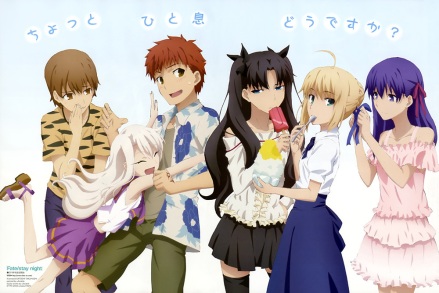
As you all know, I once again sold my left arm and my magic circuits over to Aniplex of America so that I could purchase their DVD set of the first season (episodes 1-12) for Fate/stay night: Unlimited Blade Works (TV). The fantasy action anime all about the 5th fight for that elusive chalice includes an all-new English dub. This is particularly exciting considering that I’m a veteran who watched the original Fate/stay night (2006) and the Unlimited Blade Works Movie (2010) in SUBTITLES. Curiosity did get the best of me, and I ended up watching segments from these Studio Deen adaptations, but their dubs sucked (just cuttin’ to the chase). Luckily, I pretty much only have positive reviews for the Ufotable version, so read on for more depth!

zxuY9g2.jpg (703×1000)

This is just epic. To watch it go from simulcast, to Japanese set, to English DVD is a beautiful journey.

114242.43778624_1000X1000.jpg (765×1117)

While the image above is the cool slipcover art, the DVD case itself contains this absolutely stunning artwork. The only difference is that where the text is, the English logo for F/sn: UBW is stamped.

Let’s kick things off with Shirou Emiya, portrayed by the infamous Bryce Papenbrook. Now, Papenbrook has quite the streak in misplaced voice acting, his role of Kirito being my biggest turnoff. But for a character like Shirou, his age and position, I thought Papenbrook pulled things off without a hitch! He does a damn good job at imitating Noriaki Sugiyama’s rather high and somewhat obnoxious voice, so my hat’s off to you, Papenbrook!

On to everyone’s favorite tsundere mage, Rin Tohsaka is voiced by Mela Lee. Apparently Lee’s been with Tohsaka since the first dub of the adaptations, but every one of her performances lacked the natural stuck-up attitude I’ve been searching for – Until now. Once you get past the first hour-long pilot, Lee’s voice stops ringing in my ears and becomes one of the more fun – and pretentious – performances to hear from. It sure isn’t as great as Kana Ueda, but it’ll do.

B*tchy-Mc-B*tch-Face Archer is brought to life by the smart-assy Kaiji Tang (as you can see, I don’t fancy Archer). Brilliant in every way possible, Tang milks all that he can out of Archer and puts up a stunning fight on the vocal front. He, too, fits the range of voice necessary to Archer’s arrogant dialect. Love it!

And last (but certainly not least) for the main cast, Kari Wahlgren once again dons armor and all to surmise Queen-friggin’-Arthur herself – Saber! *Slight spoilers* Because she is no longer partnered with the cold and distant Kiritsugu from Fate/Zero, Saber speaks with much more curt and “oogly” expressions as she develops her relationship with her idiot partner. And since I don’t speak Japanese, Ayako Kawasumi’s five-star performance doesn’t come for me as naturally as it does with my native speak. I’m obviously biased to this [literally] English role, so I stop before the sparkles start gleaming ^.^

Since those are the main characters, I’ll just list the minors with a brief reaction:

Todd Haberkorn as Assassin – F*ck yeah, even though I kinda forgot whom he was in the original, I’ll now never forget! Just YES, YES TO ALL!

Megan Hollingshead as Caster – THIS RIGHT HERE was surprisingly fantastic! Caster’s sly, mature voice reflects so well in Hollingshead’s performance. It was also so darn sexy 😉

Matthew Mercer as Kiritsugu Emiya – He’s only around for a couple of flashbacks, but those are just enough to bring tears to your eyes as you recall Fate/Zero‘s tragedy.

Julie Ann Taylor as Fujinee, or Taiga Fujimura – Always. Excited. Is the Taiga. Fujinee~ has a very nice English voice actress, simple as that!

David Vincent as Gilgamesh – More F/Z carry-over drama, and in fact, Vincent has such a pompous and snarky that its perfect for the King of Heroes. We’ll hear more of him in the second season, though.

Dorothy Elias-Fahn as Kane Himuro – One of Tohsaka’s classmates, can’t say she was very memorable, but not bad either

Crispin Freeman as Kirei Kotomine – This is one “fake priest” that you don’t want to run into on a dark night. Freeman will never be as solid as Jouji Nakata, but so, so damn close! It was a pleasure to listen to Kirei’s rich, melt-in-your-mouth voice again.

Lex Lang as Souichirou Kuzuki – “Mr. Kuzuki” as he is in the dub also shares the same voice as Count Cruhteo from A.Z, who just happened to be one of my favorites! Ironically, he was Issei in the old dub, the student who shares residence with Kuzuki.

Tony Oliver as Lancer – Oh boy, oh boy, Lancer’s English voice will not disappoint whatsoever! I’ll admit, Nobutoshi Canna was excellent, but Oliver wins it for me!

Erica Lindbeck as Kaede Makidera – Another one of Tohsaka’s gals, nothing fancy

Kyle McCarley as Shinji Matou – Now, this might be the only exception to an otherwise wonderful English dub. McCarley’s not by any means bad; Hiroshi Kamiya just has a skimpier edge and superiority to the damned Shinji we all know and hate :>

Cristina Vee as Sakura Matou – Agh, it’s Cristina Vee – and aww, it’s Sakura! This combo goes hand in hand, but I’m interested to see if they’ll keep the same actress when “Heaven’s Feel” makes it over here in the States, fingers crossed.

Brina Palencia as Ayako Mitsuzuri – Mitsuzuri is given a shocking amount of lines despite her role, and it was on the tip of my tongue as to who voiced her – and it was this chick all along! Hooray for Brina Palencia, I just love hearing her voice 🙂

Melissa Fahn as Rider – And the most enchanting voice goes to Rider without a doubt!! *Slight spoiler* It’s a shame she doesn’t last very long, as I could listen to Rider talk on and on. Yet another reason why they should’ve adapted F/sn instead of UBW, but I digress. Fantastic job, Fahn!

Robbie Daymond as Issei Ryuudou – Just another guy in glasses, what can I say?

Jessica DiCicco as Yukika Saegusa – A friend of Tohsaka’s? Gosh, I don’t even remember who this is.

Stephanie Sheh as Illyasviel von Einzbern – We’re gonna finish this dub reaction strong with another veteran from the original series and Fate/Zero. Sheh’s “Time to kill you” cute/deadly Illya voice is one I really enjoy. While she did sound too mature in F/Z, her older reappearance tosses that issue away easily. I love Illya, and Sheh does her justice, she really does, and I can’t wait for the epic fight in the second half. The only thing I’ll miss is her charming “Bah-sah-kah” *cue superhuman barbarian with a huge-ass club charging at you*

Below is the English Dub Trailer Aniplex posted a while back. See it for yourself!

I don’t care who says they hate this dub. I don’t care who thinks Papenbrook is a terrible Shirou. I don’t care how much people think Rin’s voice is a letdown. I LOVE THIS DUB, and I will be buying the second season, mind you! It’s gonna be a tragic long wait for the second half, and yes, it will break my wallet, but what can I say – I support things that I like! For those curious, the sub is still superior, and I recommend watching the entire series on Crunchyroll before blindly buying this uber-expensive dub (cause it was an atrocious $80 USD for only the first half on DVD only). However, like with A.Z, I had so much fun each night plugging in each of the voices and watching the first half of the Fifth Holy Grail War play out all over again . . .

But you mages and Masters, what did you think of this new English dub? How do you think it stands up to all of the previous versions and the Japanese itself? I’ll await your answers in the comments below, and until next time, this has been

– Takuto, your Servant, in this war or the next

Log Horizon Review

Log Horizon is the newest “stuck in a video game” anime since Sword Art Online. Rather than try to escape as the main goal, however, one brave geek steps out of his cloak and glasses to answer “Who’s gonna do what, what we’re up against, when things are going down, where we’re going next, but interestingly, not why we’re here” – and that could be Log Horizon‘s biggest fault.

Eight-year Elder Tales Veteran Shiroe among 30,000 Japanese players (700,000 worldwide) are suddenly transported into game that they all love upon installation of the “Novasphere Pioneers” expansion pack. Most everyone quickly realizes that the game is not quite as friendly when you’re actually in it: all of the food taste like the same mush, combat with the menus spinning around your head is difficult, and if you made your game avatar a little taller or shorter than in real life, well, now you have to adjust to it!

But here’s the most intriguing bit: when you die in the game, you simply revive at the cathedral, just like normal so no big deal . . .

That means you are trapped in the game.

With no known way out, no sense of order, player killers running about, and the CPUs (now “People of the Land”) acting strangely personal, the level 90 enchanter Shiroe picks up that you can’t just play in Elder Tales anymore – you have to live in it. Partnered with the faithful ninja Akatsuki and the beefy guard Naotsugu, Shiroe takes on his own quest of restoring order to Akiba, even if it means becoming a “Villain in Glasses” instead.

What’s best about this anime is the way it handles situations. Covering food to personal qualms to economics to ethics to community issues -all of these critical points in structuring modern civilization are hashed out with incredible detail and with consideration of the characters’ emotions. For instance, sparking the industry with the invention of the Crescent Burger was not only creative but it mattered in the context. The people wanted flavorful food and Shiroe need more money to execute his plan, so what a better way than that? It’s probably one of the best examples of world building I’ve ever seen.

Acting as the mastermind behind all operations is Shiroe, a socially awkward young man who is an expert strategist. To the kids, he’s a savior and a teacher, but to adults he’s a creepy guy with mysterious intentions. I’d say Shiroe’s a good mix of both; he means well, but the way he performs maneuvers could be considered rather extreme. He’s willing to make himself look like the bad/strict guy if it’s to better the people, which aggravates the ones that love him. Regardless, Shiroe’s best feature is that he values progress. He is the most achieving character I’ve seen in a long time, but often times, the plot just uses Shiroe as a means to convey this progression rather than developing his character.

Also, instead of the frontline swordsman, he’s the man pulling all the strings and gauging the stats, and makes for a really fresh, enjoyable point of viewa view not usually popular with this kind of story.

Though the majority of characters in the series lack any real development, there are several characters that I enjoyed because of their quirks: Akatsuki’s loyalty and shyness is super cute; Marielle and Henrietta (the playful Crescent Moon gals) are not only hilarious to watch, but a hardworking team, too; RUNDEL HAUS CODE and Isuzu are quarreling lovers that receive the best development; and finally Lenessia, a straightforward, lazy, cowardly princess who makes a few damn good speeches despite her lack of attention. Log Horizon‘s cast may be large and unremarkable, but it’s well-balanced and enjoyable as you’re watching.

Animation by Satelight is by far the show’s weakest point. Characters can look really botched at times, though during some of the fights scenes you’re sitting on the edge of your seat! The luscious green background of Akihabara is also standout artwork in itself. I guess the word is inconsistent.

Driving the fantasy story and installing bravery into the characters is the wonderful soundtrack composed by Yasuharu Takanashi, now a music genius in my book. The grand main theme “Log Horizon” is the most notable for carrying out Shiroe’s plans. “Daisaigai” welcomes players to foreign, mysterious lands with an eerie tone. “Akiba no Machi” celebrates with festivals, food, and friends. Finally, the “Elder Tale Waltz” elegantly reminds adventurers of their love for the game. While the story is inventive and the characters are fun, to me, the surely overused music is the best feature!

The obvious big problem for this series is that it’s only a small portion adapted from the books as well as not explaining the reason they were trapped there in the first place. Wouldn’t you be dreading to know what was happening to your body in reality? Why are we here? Apparently, the adventurers don’t seem to care, but hey, I’m glad they just didn’t drain episodes into this cause – there are a lot more interesting factors to consider besides whining to go home.

I was never much of a hardcore gamer, just glazing the surface when it tickled my fancy, and that was part of another problem as I watched this show. Terminology such as battle positions and skills/combos glazed past my ears, but the approach is what gripped me most. The show takes a very economic and political approach to a usually action-dominated premise, which is something that I am slowly starting to love. Rather than sword and shield being the issue, it’s supply vs. demand that we have to fight! Start stocking those shelves, boys! 😀

Log Horizon is a very peculiar show, as rather than acting with the laws of the land, characters like Shiroe constantly challenge the rules. He rebuilds the world with all things considered and frankly, it’s just fascinating to watch! Yes, the pacing can be slow with the kids arc, and yes, a lot of the opening dialogue is quite cheesy, but beyond that is Shiroe, a thinker, an enchanter, a teacher, a gambler, and a villain. If you understand the concept of RPG styled gaming and also love anime, drop what you are doing right now and check this show out! If not, well then, it’s completely up to you. Just know that all of us “gamer geeks” will be enjoying the ride.

“If you can’t do something, then don’t. Focus on what you can do.” – Encouraging words of Shiroe himself

+ Classic concept with a very different yet much more interesting viewpoint and approach

+ Story always seems to have some things kept secret, Shiroe’s world building experiments and rule-challenging offer engaging twists

+ Fantastic fantasy-appropriate OST with game theme included in story

– Filler episodes and slow pacing during times without Shiroe drag on

– Does not answer “why” they are there, does not end (more to come)

Presently Collections 1 and 2 of Sentai Filmwork’s Log Horizon English dub release stand fantastically on my shelf awaiting my next login to the hearty world of Elder Tales. The dub by the way is outstanding, new actors and actresses all around, my only problem being Nyanta the cat chef – what happened there?? *shakes head with disapproval*

Thanks for reading my review of a “Caffé Mocha” worthy series I absolutely love! Have you seen this anime? Comment below with your thoughts because I want to talk with you all! Want more Log Horizon? Check out my season two review here! Until next time, this has been

– Takuto, your host

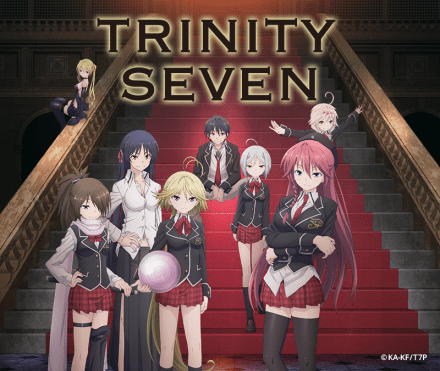
TRINITY SEVEN Review

Harem anime rely on three concepts to succeed, regardless of how stupid the plot might be:

1. A decently likable lead that undergoes some sort of personal growth throughout the show
2. An even more enjoyable and interactive ensemble cast that is attracted to said lead for some odd reason
3. Humorous dialogue and decent amounts of fan service

. . . Or so I thought.

TRINITY SEVEN demonstrates what happens when an anime relies too much on its harem, sidelining any plot explanation, and ultimately pays a heavy price for such unbalanced writing.

Arata Kasuga’s world literally comes crashing down on him when an apocalyptic event known as a “Breakdown Phenomenon” destroys the whole world and throws his cousin Hijiri Kasuga into a different one. Unable to get Hijiri back nor stop the catastrophe, Arata finds himself enrolling in a magic school, Royal Biblia Academy, that houses the great “Trinity Seven,” seven girls who have mastered their own “Thema” and are ace magicians. From here, Arata plans to “learn the magic” of these powerful ladies and control his “demon lord candidate” abilities in order to bring back his beloved cousin, Hijiri.

What caused this untimely “Breakdown Phenomenon?” What did the caster gain from this tragedy? How does one learn the complex system of magic?

These are just a few of the many reasonable questions that get little to no answer. Crucial explanation is tossed out for exploding clothes, bouncing boobies and nude scenes of Arata and the girls. I enjoy my fair share of fan service as much as the next guy, but TRINITY SEVEN has way way too much of it! I grew really tired of it :/

Unnecessarily convoluted plot aside, the show might score a win with its characters.

The lead boy Arata Kasuga appears to be your typical pervert, but he’s surprisingly different. He’s honest about his attractions, never stuttering while apologizing a thousand times; we’ve all seen it, don’t lie, it gets really old. “Thank you for the feast” is one of his quotes to witnessing nudity. Kasuga was a fresh harem lead, and I enjoyed the fact that he doesn’t use the Trinity Seven, but instead fights even stronger alongside them. Plus, his voice actor is Yoshitsugu Matsuoka (Kirito-kun) – you can’t get much better than him!

While a couple of the Trinity Seven are cutout characters, the ones that I found myself drawn to were Lilith Asami, Levi Kazama, and Akio Fudou.

First off, Lilith-sensei is one of the teachers at Royal Biblia Academy, and as such is Arata’s #1 tease. She wields a magical rail rifle weapon and knows how to fire it quite well. I love the concept art of her character, red-braided hair with blue eyes and a monocle on occasion, as well as her hate/love relationship with Arata. The two get along well, and by the end, hold respectful positions with each other. Also, Arata loves her giant jugs – the best out of the Trinity Seven 😉

Levi and Akio act more like supports for Lilith and Mira Yamana (the cute yet stern tsundere leader) respectively, and as such are mainly “power houses.” They both have their own motives, yet go along with Arata’s teasing. Truly a hidden comical duo!

Another one of the show’s better features was the animation by Seven Arcs. While intricate CGI architecture made up the school and its majestic hallways, characters had matching and rich color designs, be it in uniforms, hair color or eyes. The ecchi hot scenes are also a beauty; graceful curves and shining skin really do go a long way :3

OST-wise, the soundtrack contains lovely violin melodies for both combat and relaxation. Sometimes rap-like chanting is sung to help fill the space. It’s unique and adds its own touch to this anime.

The opening “Seven Doors” by ZAQ is freakin’ amazingballz! By using chromatic scales to create a haunting undertone, and mixing that with a sweet, reminiscing melody, you get a super cool song! Check it out – it is a must! BTW, I love Hijiri’s cute face when the verse starts ~

Now back to the rant. TRINITY SEVEN is nothing but boobs, attempted serious magic, exploding clothes, then more boobs. It’s awesome for a while and really could have been so much more, but by episode 6 or so I was utterly lost and just done. To be honest, I can’t believe I stuck it out, but then again, I’m a completionist, so yeah. “Connect to blah blah – Execute Thema!” Or whatever the hell it is.

Thanks for reading! Remember that these are my own thoughts, so feel free to drop a comment with your own. Until next time, this has been

– Takuto, your host

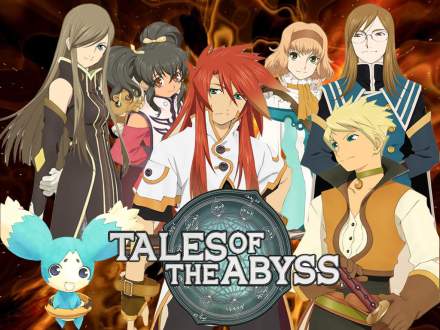
Tales of the Abyss: The Animation Review

After watching Tales of Symphonia I just had to check out more from the Tales series. Sadly, Tales of the Abyss was more of a letdown for me. So if I didn’t care for it then why write a review? Plot ideas can be tricky to come up with, I’ll admit, but when a story has too many ideas it ends up as a convoluted train wreck. The main story of Abyss derails itself so often that I found myself sleeping during the show, only waking myself up to see the character back stories. With that said, I want to inform you of the really cool aspects of this show, the occasionally crumbling plot aside.

Set in the common medieval atmosphere the Tales series likes to enforce, Auldrant is a world run by the Score, a prophecy written many years ago. Luke fon Fabre, the spoiled yet confined heir of the kingdom of Kimlasca, spends his afternoon in sword training with Master Van until a mysterious woman by the name of Tear Grants shows with the intent of taking Van’s life. Suddenly, Luke and Tear are warped across the world to the opposing empire of Malkuth. Now that Luke has the freedom he has dreamed of for so long, he begins to realize why he was restricted from the world, who he really is, and what his hidden powers are. All the while there is a band of look-alikes that are trying to kill the heroes, a not-so-holy church that wants Luke, a sea of miasma that threatens to destroy the planet, and an oncoming war between the two kingdoms.

These plot ideas sound kinda cool, no? But when all of them are thrown together it doesn’t benefit the anime.  Speaking of adaptations, Tales of the Abyss the Animation is actually based on an RPG, but an anime was released later on. You can ask anyone, but Tales of the Abyss is by far the closest recreation of a Tales RPG in anime format. Most of the scenes are translated exactly like they appear in the game, not taking away from the Abyss vibe.

I do not remember all of the characters from this series, and that is really a bummer because they all link together in one way or another.  Tear, a Seventh Fonist for the Order of Lorelei is a character I enjoyed because of her straight forwardness and her knack of guiding Luke in the right direction. She remains a strong and reserved character through the duration of the story. Though she acts coldly to Luke on occasion, she is quite respectful and well-mannered to everyone else. A second character whom I enjoyed was Jade Curtiss, the necromancer of fonic artes and a Malkuth army colonel. He is a generally happy character, but he doesn’t reveal his preferences or personality, making him seem complex to the other characters. With his dark background, one couldn’t tell if Jade was acting for the greater good or if he had something planned up his sleeve. The only problem with Jade was that some of his later happenings were predictable, but it is also like this in the game, so whateves. I love the way the Japanese always pronounced him as “Jeido Kaatisu” – I still call him that today!

Other than those couple characters, I found the rest of the cast to be decent, but nothing spectacular. Most of the best scenes were not when something epic was happening, but when all of the characters were just conversing with one another. The interactions were golden, especially any of them with Jade or Tear. The anime had also included many notable flashback scenes in just the right places to help flush out characters. A character death in particular made me bawl for hours; it was the way in which he made it sound that did me in. With as big a cast as this one, it felt as if some characters (clones or noblemen) were placed in just to balance another, and that is not how it should be! But it is an RPG, so some of those characters are necessary. Other than that, character motives made sense and dialogue was pretty interesting.

The OST for Abyss stands as . . . suitable, actually. Listening then and now, the concert band songs are beautiful and express grandeur. They keep to a fantasy adventure theme that sounds as if the pieces came straight out of the game, which they might have. Some tracks like Tear’s song that she sings and “Peaceful Times” are especially easy to remember. Most of the characters have a fitting theme that is a perfect reflection of their personality. The opening theme “Karma” by BUMP OF CHICKEN is the same opening the game uses, so fans of the game can appreciate that. Personally, I rock out to that song! All-in-all, the soundtrack is decent classical dance as it appropriately captures the moments from traumatizing to engaging.

Tales of the Abyss was animated by Sunrise Inc. in 2008, and they did a great job of adapting the art from the game into an anime. Again, I have not played the game, but if you view some concept art you will notice the breathtaking similarities. One of the highlights for this show was the artwork for the landscapes. Characters might just be conversing or walking into town and the background animation is just splendid! Adding in that and the year it was done up makes Tales of the Abyss one of the best animated adaptations for the Tales series.

While I may have been bored or confused at times, that does not mean that the entirety of the show was uninteresting. There were many entertaining scenes that make up for the tedious ones. The anime is definitely an adventure, but whether it is one I would traverse, I would have to say no. Show-wise I was amused, but it was not a driving force by any means; it is not one where you would drop whatever you were doing just to watch it.

I was not changed or moved in any way by this anime. It was good, yes, but no more than that. Other than a few characters and plot points, I can’t recall much from this anime other than it was a mess. While this show did not push me to do anything in particular like high-ranking anime should, this show was my first “okay” anime, for everything up until then was no letdown. If you enjoy somewhat heart-filling adventures with action and great music, are investing yourself in the vast Tales series, or are looking for new ideas to use in writing, gaming, or whatever, then this show is for you. Otherwise, spend your time with something more beneficial and organized.

Though I didn’t pick up a copy, you can purchase all four parts by Bandai Entertainment (sub only) on Rightstuf.com. I’m sorry if I sound like I hate this anime – maybe I just can’t appreciate all that it has to offer. Hopefully you will have better luck with this one! Until my next review, I’ll pass on Tales of the Abyss with a push of my sketchy Jade glasses and a wave of fonon arte magic as I steal an apple from the Malkuth marketplace, because, you know, “why do I have to pay for it?”

Thanks for reading!

– Takuto, your host

Negima! (season one) Review

After watching Negima!?, I just had to check out its first season, which I have to say I was a little disappointed, as prequels are usually better than sequels. This season was darker than its successor especially towards the end, which changes the entire picture of what Negima! is.

Season one of the Negima franchise starts off similar to its sequel. Negi Springfield, a 10 year-old wizard in training, is transferred to Mahora Academy in Japan, which is an all-girls school. Here, he fights with a vampire, makes pacts with middle school girls, teaches English and searches for his father. The major difference between this series and the next is that this one focuses on the girls more and the other magicians besides Negi. Minus the Star Crystal plot and the Black Rose Baron, you can check out my Negima!? review for a better synopsis of the plot. Personally, I prefer the second series.

The actual story doesn’t really progress until episode 20. Yes, you heard me. 20. Up until then, it’s all about the girls and a more in-depth look into their lives beyond the school. Specifically speaking, we get a look on why Ayaka Yukihiro, class representative, acts the way she does (I love that episode to its entirety!). When class 2-A travels to Kyoto, Japan, for a cultural trip, Negi and co. encounter Fate, an antagonist who is better described in the manga. Fate desires Konoka Konoe, who, unknowing to the class, possesses a rare magical background, which I will not spoil! Because Fate is thrown it the series to make up for the manga, he seems very unexplained and random, which I did not fancy.

During the climax of the series, Asuna gets dark. If you’ve seen this series, you know what I mean. Not gonna lie, I cried. A lot. It was a simple yet tragic story that I will never forget. To this day, I can’t watch the last couple episodes without getting all worked up. This plot device really shows that Negima! isn’t all fun and games; it does have a more depressing movement to it. It was such an unexpected twist that it literally changed my view on the Negima series.

In this first season, the characters are better defined. Unlike the sequel which only shows comedy, these characters reveal some sad memories. As I mentioned earlier, Ayaka gets a nice treatment in this series. To be revealed later, Ayaka’s brother actually died during birth. Negi reminds Ayaka of her to-be little brother and that is why she loves him. In the second series, she just comes off as a creepy shotacon, so it’s better to view her from this series than the other. Regardless of her attractions, I love Yukihiro as a character!

Not gonna lie, none of the tracks stick out. Besides I think “Magical Battle” and this one relaxing theme which I still have never found :/ , there is nothing else that I can recall. Season two has a more memorable soundtrack than this one. One moment that I can remember, however, is the following day of the grand plot twist. Holy crap! It starts with a sad cello soloing and more instruments are added until the weight is to heavy to bear. At that point, I break down in tears. Whoever wrote that song did very mature job! The opening, “Happy*Material,” is also a very motivating song to listen to. Its playful chords and different vocalists (who are, BTW, the Japanese cast for the girls) make it a magical and, get this, “happy” song to listen to!

For being animated in 2005, I thought it was decent. I haven’t seen many older anime so I can’t really judge this one. It’s not distracting to any degree, but there some awkward animation pauses where the “camera” just stops on a character after they are done talking. Because of this, dialogue doesn’t flow to well sometimes. On a side note, I did watch the English dub for this one; it’s fairly well done, but nothing superb. Unlike the second series, the view isn’t anything crazy like frames flying across the screen, so take it how you will. Some think that is distracting, but with the second series in particular, I thought it was a nice touch.

I feel like I keep comparing this season to its sequel, but one really can’t help it. The second season embellishes on what the first season failed while the first season dives into concepts that were not explored in the second. Both series balance each other nicely. As such, I was entertained a decent amount. The character stories are interesting enough but the small individual arcs do get kinda boring after a while

The Negima franchise keeps with a fun, magical atmosphere, yes, but the first series not so much. I know it was the first adaptation, but still. It’s good, but not great or stunning. Motsu is not in this one, so it gets old just watching the same characters attempt and fail at various tasks. Though it seemed thrown in, the ending did actually improve my score of this show. Negima! is a series that you can watch a few times and still not get too bored, which is a good thing for sure! All in all, if you are a fan of the sequel, go ahead and pick this up. Otherwise, it may not be worth your time.

Presently, FUNimation’s Complete Series of Negima! sits on my shelf performing its magical mayhem while awaiting its next viewing.

Thanks for reading!

– Takuto, your host

Negima!? (season two) Review

This anime has a special place in my heart as it is the first I had ever seen, besides random encounters with Sailor Moon, Yu-Gi-Oh!, Pokemon, etc. I watched it in the spring of 2012. For those of you who don’t know, Negima!? is slice of life, fantasy adventure, comedy, magical girl, fanservice anime. With that being said, it is an honor for it to be the first that I review! First review – here we go!

Negima!? revolves around Negi Springfield, a 10 year-old genius wizard who had just graduated from the Magic Academy, a school for wizardry and magic. As part of his training, Negi and his talking ermine fairy friend Chamo are transferred from their home in Wales, England to Mahora Academy in Japan, which is an all-girls school. His mission – to teach English class there while seeking out a partner to help in his sorcery. With this partner, Negi must form a pact, or “Pactio!” which involves a kiss on the lips. The partner then may have their contract invoked in order to use magic. The plot rolls along, however, when the loudmouth obnoxious Asuna Kagurazaka, student No. 8 in his 2/3-A class of 31 girls, sees him using magic. From here on out, Negi eventually makes partners out of his entire class, all while encountering twisted fairies, magical worlds and the darkness.

When I first watched this series way back when, I found it to be ridiculously awesome, probably giving it more credit then it actually deserved. The concept is easy, but not astonishing in any way, to understand, as most of the terms are thoroughly explained in the first episode. I found myself always wondering what would possibly happen next, then again I was younger when I first watched it. The surprises Negima!? had in store were nicely executed. This series also has a lot of cultural references, which made the experience a knowledgable one, too.

Negima!? has one of the largest casts that I have ever seen; 31 girls plus a few more is a handful to keep track of. Nevertheless, Ken Akamatsu, the creator, displayed valuable and unique traits for each of the girls. A decent amount of screen time (for a cast this large) was given to each one, which allows the viewer to love more than just the main eight or so. It was silly, at one time, I had all of the girls memorized! Looking back, it was a huge waste of time trying to remember all of them!:D Since it is a comedy, all of the cast members each have their individual quirks that make them stand out. This makes the dialogue for the English dub especially fun to listen, as the voice actors really get distinct in their respective character(s).

While characters in Negima!? made me laugh, they did not make me feel anything else. Aside from Anya, Negi, Nekane, Evangeline, Asuna and maybe Yue, the others were pretty static. I guess if the creator spent an episode for each one, then the plot would never advance. But, maybe a couple episodes dedicated to the side characters instead of useless boobage and banter would have been more beneficial.

I distinctly remember the OST, opening, and ending for this anime, which is a good sign. The OST for this show is small, which means the tracks are used over and over again. However, they are good songs and tend to fit the mood better than anything else. Some themes such as Nekane’s or the Chupacabra Research Society’s are especially easy to recall, for they are breathtakingly sweet and outrageously hilarious respectively. The series’s opening “1000% SPARKING” is really catchy and motivational and is also sung in English in FUNimation’s dub. Personally, I prefer the English one. The same is for the show’s ending “A-LY-YA!” – it is such a fun song.

Previous anime I had seen include Sailor Moon and Pokemon, so Negima!?‘s animation was a treat (no offense to those classics). The artwork was presented in one of the most memorable fashions. Sometimes they would have different camera angles in boxes and these boxes would just be floating and shaking on the screen depending on who is talking. Sometimes the background would be super ornate – like reeeally cool – and during other times it would just be one solid outline color. I recall even a few times they would include real life photos and crop them in. The differentiation in presentation made the show more exciting, as it was more of a show for humor over plot. Characters were drawn with individuality, so you could remember how certain characters acted just by looking at them. These people were also drawn in a simple yet fitting way to match with the background. In other words, the characters were easy to see but did not stick out like black on white. Negima!?‘s unique animation is definitely its highlight.

Overall, Negima!? was quite the entertaining show. Its mix of stupid comedy, quick jokes and decent plot make it a good first-time anime for those who are interested in the culture. I can say that I was fairly entertained. While this anime lacks in individual character development, it makes up for that in its one-liner character descriptions. Each character really does have an individual personality, and part of the experience is figuring out what roles certain characters play. A downside to this, however, is trying to balance this enormous cast with each of the single impacts on Negi Springfield. A tip from me is to just roll with it because you’ll pick up on who Negi hangs out with right off the bat.

As I mentioned at the beginning, Negima!? has carved a very special place in my heart and I will never forget it was my first anime. Whenever I see or hear make a joke with similar wordings, I immediately reference this series before any other. I find myself still drawing Motsu’s face on all of my papers! Motsu and Shichimi were, by the way, the driving forces of comedy!! I love them both so much! This show in particular is one that you could watch a few times over and still have fun doing so, as there is so much detail work put in to the setting, the character designs and the funny dialogue. A warning, however, is to enjoy it the first time through because if you spend your whole time fussing over the details, you will miss Negima!?‘s quick wit and crazy charm.

Currently, FUNimation’s S.A.V.E. edition of Negima!? “balances rather precariously” on my shelf, “In a good way.”

Thanks for reading!

– Takuto, your host