My Hero Academia (Eps. 1-5) Thoughts | Hero Week

A little introduction:

I know we all are a bit quirky, but in the universe of My Hero Academia, 80% of humanity takes quirkiness to the next level. Recently discovered super powers, otherwise known as “quirks,” have overtaken the daily lives of most people. Not all were blessed with powers though, Izuku “Deku” Midoriya being one downtrodden soul. 

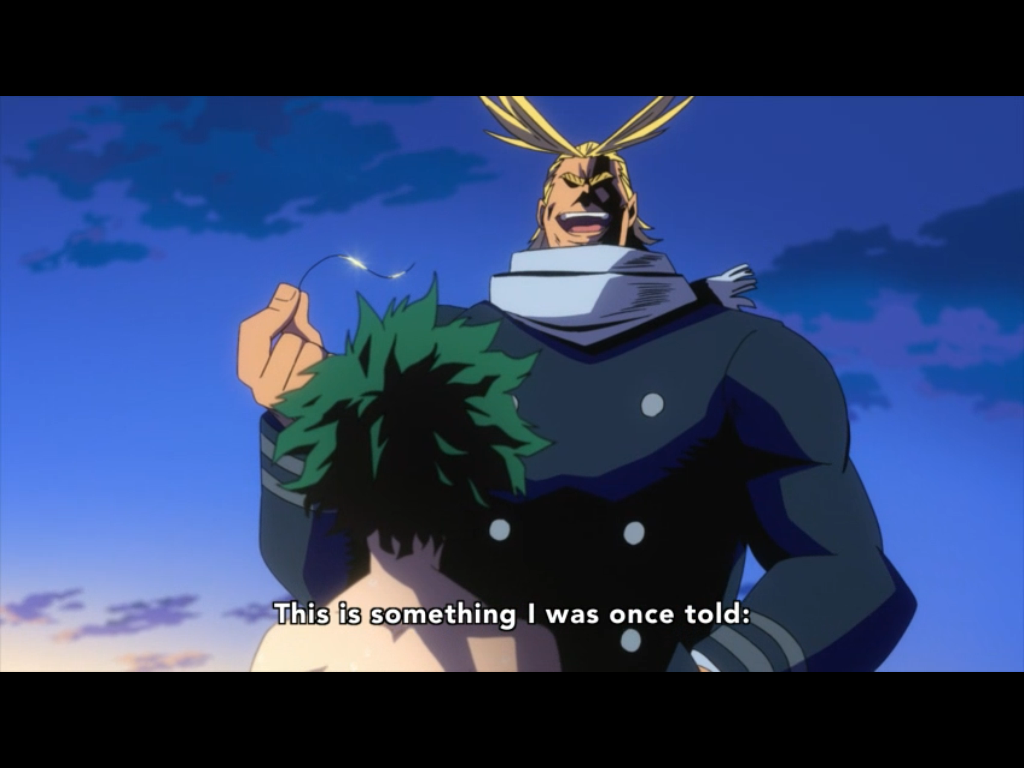
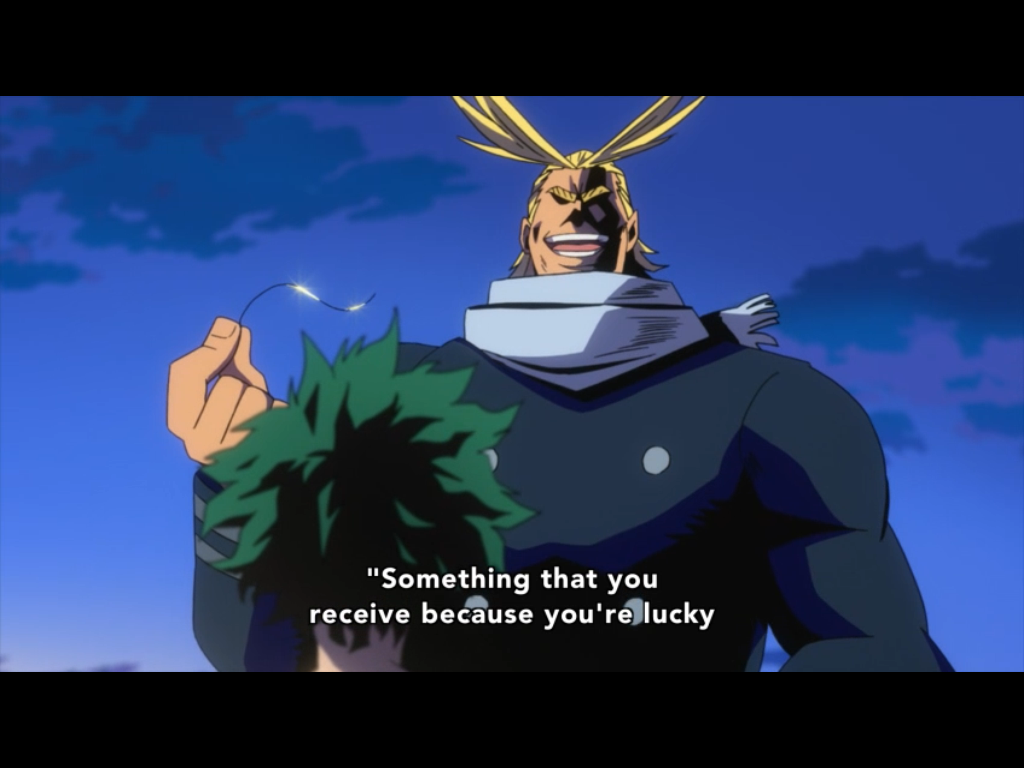
So while all of his friends (more so enemies) set their sights on the prestigious UA High School, an intense school dedicated to raising heroes, Deku continues his menial routine of taking abundant notes on local big-shot heroes and especially eyeing his idol – The almighty All Might!!! (Yes, the exclamation points are necessary). 

When Deku is suddenly caught in the chaos of rescuing his rival from a hideous slime villain, All Might, upon witnessing his unwavering heroism, vows to train young Deku into a muscular man and eventually pass on his quirk to him (because his quirk relies on inheritance). 

Flash forward past the months of rigorous training and it’s enrollment time – and Deku is intent on making the student roster. Not surprised to see his rival sitting at the back of the classroom, Deku’s new life full of new friendships and hardships begins. And through his academia, he will learn both the harsh realities  and unmistakable joy that come with being a true hero. 


My thoughts:

I like My Hero Academia. There’s not much else to be said that hasn’t been already. It’s a show about growing up, one of those feel-good anime that make you want to run out and punch a guy in the face after watching just because you swallowed your cat’s hair. But seriously, we’ve had more development with Deku and his two classmates than we’ve had with all of the characters in this season’s The Lost Village combined – and there are over 30 of those guys! 

Deku is a kid with a big heart for heroes, and I wish I could say that about most people. Even though he’s been quirk less since birth, his dreams are still set on UA and All Might, and while it was shattering to see that flashback of him finding out, I think that is what has made him such a loveable guy. Being of humble origins, obtaining powers from a supernatural source, and faced with challenges every day, every hour of the day, Deku practically had the hero formula drilled in him – And he knows it, too!


That development is nothing fresh, however, considering that it’s the same underdog story we all wish to resonate with. It’s managed to keep me invested thus far, and I’m daring to call it out as best anime of the season already just because of how straightforward and honest these first five episodes have been. 

It helps that the animation is bright, active, and uncensored in the body fluids department . . . I’m talking about blood, sweat, tears, and snot, of course. The action scenes with All Might are particularly empowering. It’s saddening to see him shrink to his normal scrawny human physique after being buff and superior. I hope the anime carries that torch straight through to the end, just like Deku is so far. 


Music is also pumped-up for the hero scene, yet more emotional to fit Deku’s resolves and inspiring speeches with his mentor. What especially caught my ears was the opening, “The Day” by, don’t laugh, Porno Graffiti (hah!). I can’t stop grooving to that and Kabaneri’s addicting OP. 

Full of colorful action, comedy, super powers, and likable characters, My Hero Academia is a comic book come to life by THE studio Bones being Bones again. If you’re not already heading to class each week with it, what’s going on? Add this anime to your schedule!

– Takuto, your host 

(PS: Sorry if any of this looks rough. I tried doing it all on my phone ^.^)

Loss Has Little Meaning in Yuki Yuna | Hero Week Review

A brief review of the 12-episode fall 2014 anime “Yuki Yuna is a Hero,” produced by Studio Gokumi, based on original story by Takahiro and Makoto Uezu.

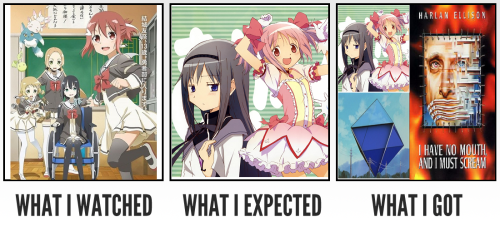
For the third segment of Hero Week, I’ll warn you now that this anime is extremely hit or miss, especially if you’re familiar with Madoka Magica. Despite any polarizing comments I make, I’d like to let you know that this happens to be my favorite of the three Hero Week anime I’ve reviewed, regardless that it is indeed the “worst-written one,” should I even have to pick. I found that it had the most to offer, and I have to be critical of it because something that means so much should be sought in full light.

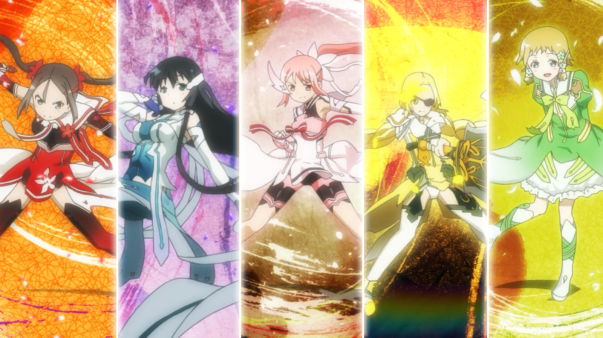
Five middle school girls—Yuuna, Togo, Fu, Itsuki, and Karin—are on a quest to save the world. That is, community service, volunteer work, and puppet shows for local children. It all seems trivial on the outside, but their Hero Club is determined to do good deeds for love, justice, and happiness, goals which are outlined and pursued religiously in the club’s Five Tenets. Such is the sweet and simple life of Yuuki Yuuna.

The club’s charismatic president Fu is living two lives, however, and upon phone call is forced to drag her friends into a mystical realm. There, they are to protect the God of the natural world and human blessing, the Shinju, from strange geometric entities called Vertexes. By the single tap on a phone app, the girls are transformed into the extraordinary heroes they so desired to be. But transcending the realm of God and obtaining unimaginable power comes with a price almost not worth paying.

As the girls fight for their lives and the people they love, their perception of the world dramatically warps into a cruel land of delusional grandeur. In the depressing struggle for power, the girls might have to point their guns at beings besides the Vertexes in order to preserve their very belief of what it means to be a true hero.

One of the biggest problems I had with Yuki Yuna was the lame world building. Had I not read the summary provided by Crunchyroll, I wouldn’t not have noticed that the story is set in the far future—YEAR 300, the Era of the Gods. WHAT, but it looks like modern-day Japan?! I enjoy it when stories have good reasons to break the rules set by the setting, but you can’t rebel against an outline that otherwise doesn’t exist!

My second beef with the anime was the lack of each girl’s unique drive to be a magical girl. They just sort of accepted the role because of the club’s influence. Individual motive is largely what make hero stories interesting and standout, so to have such weak trope characters (besides Fu and Togo) was a huge shame. For instance, what if the wheel-chair-bound Togo wanted to keep fighting because she could walk once again? That’s much more compelling than “I’ll do it because Yuna needs my help.” The way Yuna clings to the club tenets is also a bit cheesy and a weak excuse for ‘development.’

This is obviously less apparent if you are unfamiliar with it, but the last somewhat spoiler-free issue I had were the painfully obvious similarities to Madoka Magica. The magical girl system, character destinies, and dark, depressing themes in the second half all have strong correlation with its critically-acclaimed predecessor. Heck, even the music (which is still really, really good) and the animation sometimes feel like snippets borrowed from Madoka. While it is occasionally disappointing, Yuki Yuna managed to have fun longer than Madoka did, heavily maximizing its slice-of-life side for the earlier parts. And while I wanted darker, more twisted, nastier Madoka narrative, watching those girls have fun was what I needed more.

On a positive note, the animation was surprisingly incredible. The Vertexes themselves are CG, but because they are basically Evangelion angels crossed-over with the zodiac, it all works to create a fantastic off-putting vibe. I also appreciated the vivid color patterns for the Shinju realm and the cool magical girl outfits (Yuuna’s elegant armor was actually what got me into this show). The style was more rooted in Asian culture (petals, shrines, zodiac), while something like Madoka featured more European-like classical culture (columns, gates, witches).

HERO WEEK SEGMENT: Archetypical Hero qualities represented by Yuuna

I’ve taken a quick trip to Google to provide qualities of the typical hero. Let’s briefly exercise each prompt:

  • Hero is of humble origins
    • Yuuna is a very friendly and open girl, often willing to accept help and help others at no cost.
  • An event, sometimes traumatic, leads to adventure
    • The Taisha, the organization dedicated to the Shinju, calls upon Fu to advance on the incoming Vertex. Yuuna, even though given a choice, steps up to bat and becomes a magical girl
  • Hero has a special weapon only he can wield/always has supernatural help
    • Yuuna is a hero just like her friends. What makes her stand out is her unwavering devotion to the hero cause and her gifted fighting abilities. In episode one, she doesn’t just suddenly transform like the other girls, but is able to gradually make her armor appear upon demand. Her unusually rare strength and “true maiden’s heart” make her unstoppable on the battlefield.
  • The Hero must prove himself many times while on adventure
    • Besides fighting off the Vertexes, Yuuna must be able to lift the spirits of her comrades as the show’s ideal hero. The others will lose their way, and it’s up to Yuuna to lead them back on the path of righteousness. She doesn’t seem like a main character, nor does she change much as a character, and that’s mostly because I believe she’s not supposed to; she’s the guiding light of hope and justice, and as such doesn’t stop fighting even at the end.
  • ***SPOILERS START HERE***
  • PLEASE CONSIDER THIS THEORY TAG BEFORE PROCEEDING
  • The journey and the unhealable wound
    • In the end, the effects of going through Mankai so many times and taking on all of her friends’ pain leaves Yuuna in a catatonic state. When she does reawaken, her physical body is only a crutch for her soul, which is always off fighting. Upon the rebellion, Shinju-sama must have changed the rules so that girls don’t have to suffer long-lasting disabilities in the real world. This makes ALL LOSS ESSENTIALLY MEANINGLESS—All of the heartache the girls go through, then you turn around and say, “Oh, yeah, they don’t have to suffer anymore.” Now, I didn’t want a sad ending for the girls, especially Yuuna, but doesn’t that take away most of the emotional weight? Yuuna’s dedication to the heroic spirit causes her to be Shinju-sama’s ultimate protector, and is forced to keep on fighting even though her friends are retired.
  • Hero experiences atonement with the father
    • I like to consider the “father” not as Shinju-sama or the Taisha, but as the intelligent Togo instead. At first, Yuuna finds most of her purpose for fighting in protecting her friend and vice versa. When Togo is able to walk again at the end, she somewhat pities herself for letting Yuuna burden everyone’s pain even though she shouldn’t. Yuuna is praised like a goddess but somewhat frowned upon as a fool for sticking so close to the hero path.
  • When the hero dies, he is rewarded spiritually
    • Because I find the theory to be so interesting and quite possible, we can conclude that though her real-world body is somewhat “dead,” Yuuna is still alive and fighting behind the scenes. Her reward? She transcends the mortal world and becomes a goddess who will never stop fighting. Not exactly the prize I would want, but because Yuuna fell hook, line, and sinker for the whole hero bait, I’m sure that’s exactly how she would have wanted it from the beginning.
    • In the end, everyone’s illnesses go away, which contradicts the heavy theme of sacrifice Yuki Yuna spent its entire run on building up.
  • ***SPOILERS END HERE***

Much of Yuki Yuna is unexplained or at least not evident in the anime adaptation. Should the prequel light novels and the sequel manga ever make it here in the U.S., then I would be thrilled to revisit the franchise. Its fascinating world and the somber warriors fighting to protect it have so much more depth to them, and that lack of depth in the anime hinders a truly wonderful experience. The entire story and production of Yuki Yuna also has too many underdeveloped and forced ties to Madoka Magica, which sadly tampers with the mind-blowing aspect of it.

As a fantasy, drama, slice of life magical girl anime that attempts to see Madoka in a different light, I can appreciate all that it tried to pull off. It tackles the painfully realistic hero themes in the most interesting (and very dark) way that just excites me, yet also has rare moments of joy for our characters and a real built sense of unease instead of just scary/dark imagery like Madoka. Even though it stumbles in appreciating loss, we do wind up with one solid ideal: Ultimately, fight for what you want to save, not for what you are burdened by.

“You know that the fairest flowers fade first. But I made it.” – Fu Inubouzaki (best girl)

I award Yuki Yuna is a Hero with a benefit of the doubt 8/10, narrowly allowing it to breach the “Caffé Mocha” classification. It combats the fantastic with heavy ideals and characters that are honestly cared about (can’t say that for most series). Yuki Yuna won’t impress all—most are quite hard on it, actually—but I still encourage people to try it out especially if you like the wildly mentioned Madoka Magica. I’ve been forgetting, but both ERASED and Yuki Yuna is a Hero can be viewed for FREE on Crunchyroll! While I’d LOVE to own it on DVD, Ponycan is releasing these ‘premium’ sets with an okay English dub for a ridiculous $70 each—AND THERE ARE THREE OF THEM. How do you think Yuki Yuna did? Also, do you think Yuuna is a good hero? How about the other girls? Comment below!! Until next time, this has been

– Takuto, your host

One Punch Man is Absurd, Out-of-this-World Fun! | Hero Week Review

A brief review of the 12-episode fall 2015 anime “One Punch Man,” produced by Madhouse, based on the web manga by ONE (story) and Yusuke Murata (manga art).

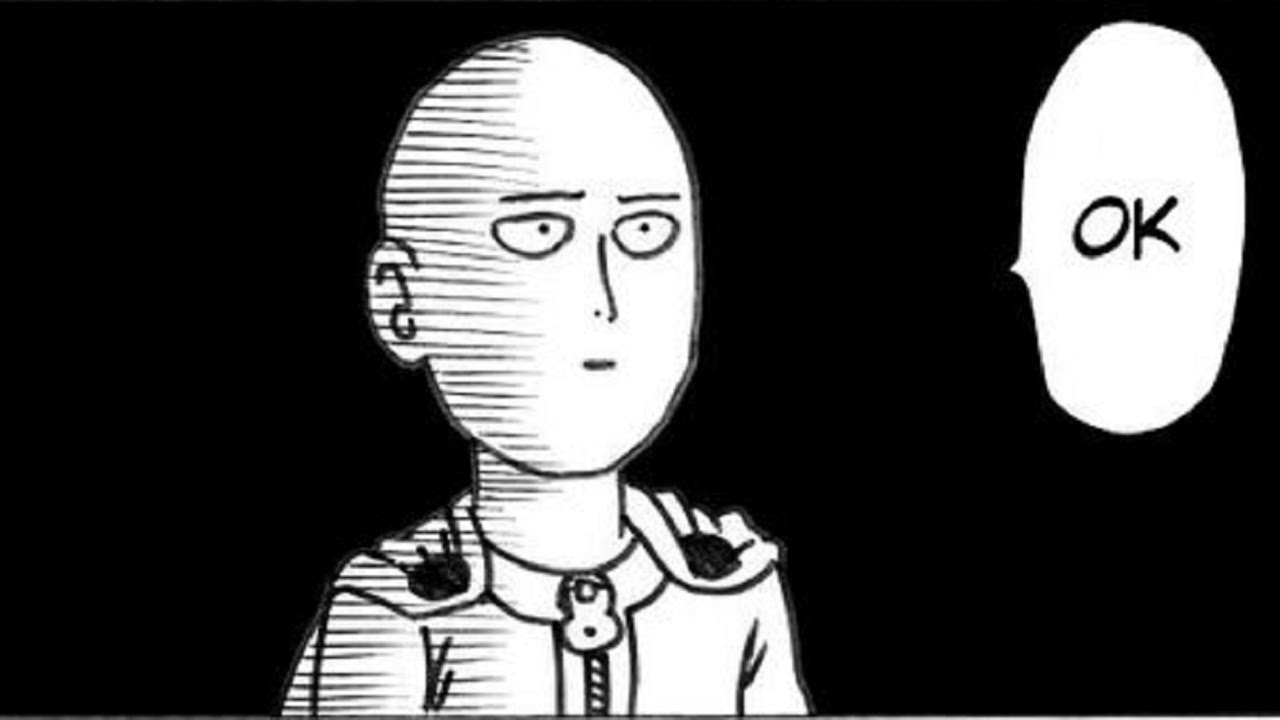
Travel back one season from ERASED and you have the anime that etched 2015 in history: One Punch Man. Its grossly over-popular yet dorky concept captivated web manga fans, and when an anime adaptation by THE Madhouse was announced people went hysterical; cosplay, fan art, and “OK.” memes circulated like no other. But what gives OPM a fiery kick like no other, and why do fans gloriously rave about this bald athlete?

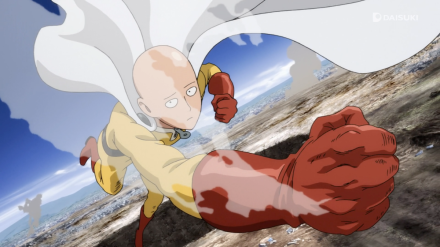
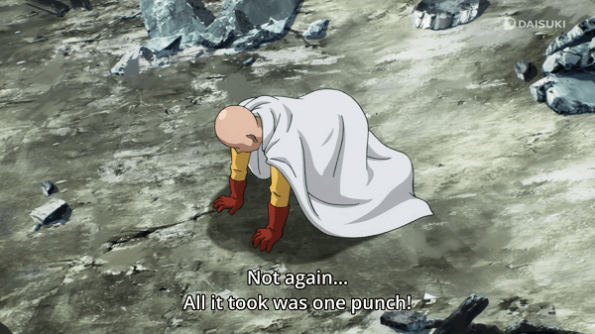
In a world under siege by gigantically wacky monsters and bizarre extraterrestrials, Saitama wanted to be a hero. So, he trained ruthlessly for three years, got abs, but lost his hair. Now he has arguably become the world’s strongest hero. Unequivocal strength comes with a price, however, as now all it takes is a single punch—ONE PUNCH—to knock is opponent into next Tuesday. What was thought to be a thrilling and rewarding hobby became tedious and unsatisfactory. Because he defeats his foes in an unbelievably swift manner, people and the media are also unable to credit him properly.

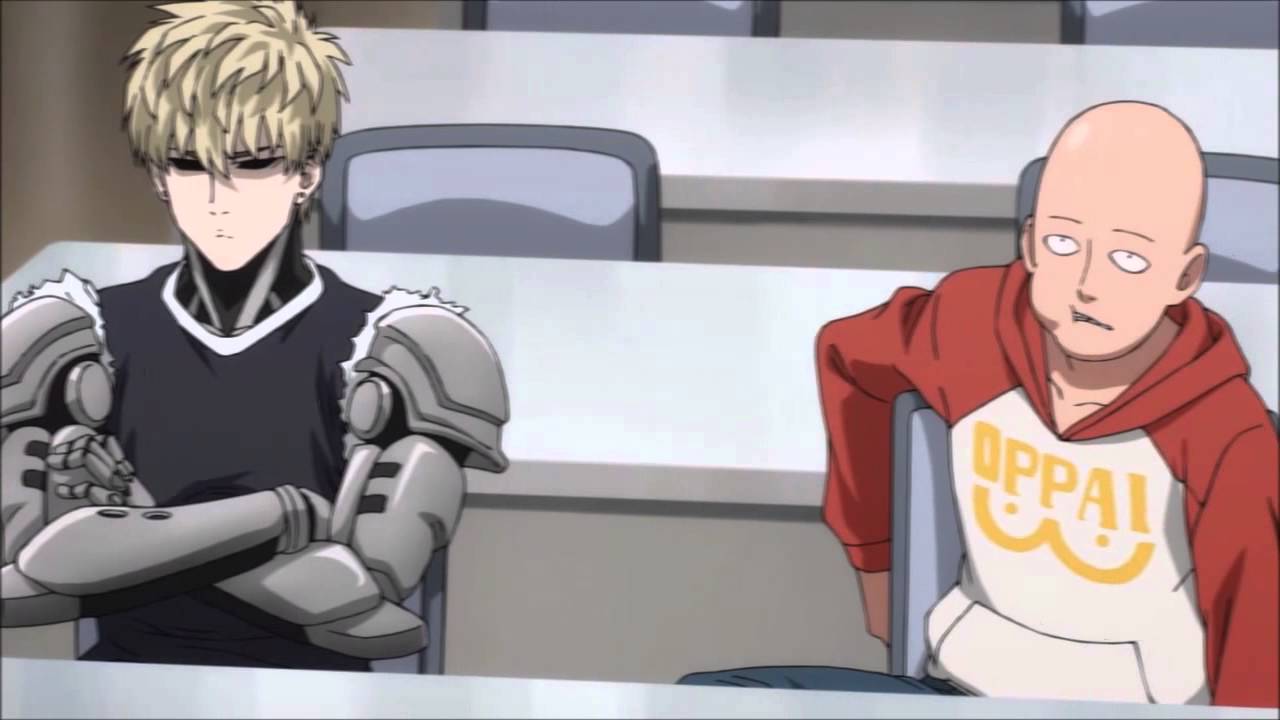
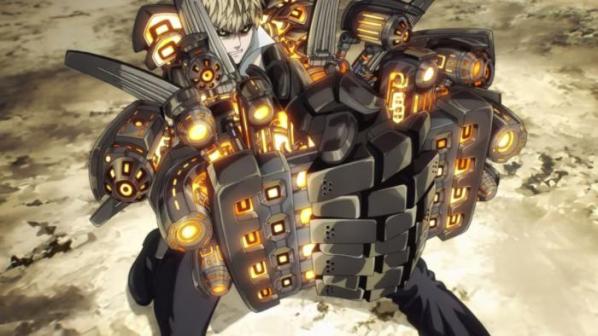
To keep the story fresh, life must change for Saitama. And it does. A cold, brutal, 19-year-old cyborg by the name of Genos stumbles upon the one-hit-wonder’s performance, and urges Saitama to take him as his disciple, admitting he has much to learn from him. Genos then leads his master to the Hero Association, where the two can become certified heroes and *fingers crossed* be officially recognized (and rewarded) for their work saving City Z. As anticipation reignites in odd Saitama’s eyes, he clings to the hope that tougher enemies will head his way, and that one day soon, the people might actually turn to him for help in this chaotic world.

One Punch Man is simple; a tough guy follows his all-powerful master in hopes that the two find excitement in experience, challenge, and fame. While most of the intent is on the explosive battles, much of what people took away from this experience was the comedy, in that it doesn’t try too hard to make us laugh because it’s inherently goofy. The whole scenario of a bald, self-proclaimed hero in a mustard-colored onesie running through the streets yet managing to obliterate any target in one punch is satire in itself. Saitama is an unapproachable fool who defies the typical superhero because he’s an egg-head who exercised a sh*t ton—not receiving any supernatural/monetary help as we know it—to become strong. Since battles are nothing for him, where we see Saitama struggle is against the public eye and the Hero Association’s ranking system itself.

But with the crudely drawn monsters and frankly disgusting defeats, I was turned off by the extreme ends of the repetitive earlier fights. I admit, I thought the anime would run out of steam quite early on, making it just another shounen series out there (but epic-er). Then episode 5 came around—the bout between Genos and Saitama—and I fully realized that this was going to be a good show.

I should applaud Makoto Furukawa’s performance as Saitama because holy crud, how can anyone sound so bland and ordinary yet make me sh*t bricks whenever he opens his dumb mouth?? He really did capture our Egg-head’s nonchalant dialogue, yet appropriately ramped it up for intense battles. I ended up enjoying Saitama as a character much more than I thought I did, for even though he’s clearly the world’s strongest man, he grows as a human in seeking attention and ‘raise’ Genos at the same time. Like the seemingly basic plot, much more development boiled within each emotional scene.

Genos is your typical knight in shining armor (literally, hah!), needing little introduction to sway the crowd in his favor. He’s a straight-up badass cyborg, after all, though he too knows his flaws and overly criticizes himself for the few things he couldn’t do rather than celebrating his accomplishments—there’s always room for improvement. I sympathize with Tin-can on this one. Good thing Genos has a buddy to support him.

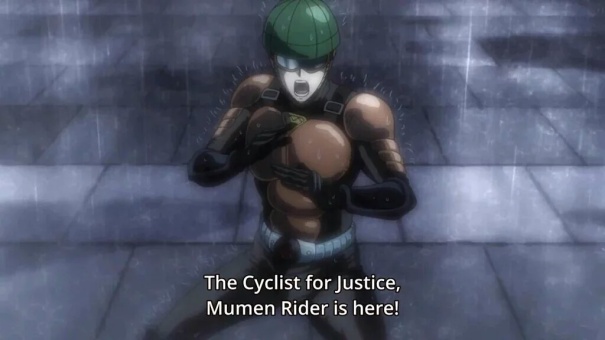
We also get to see the variety of heroes, low and high rankings, which are part of the Hero Association. Most A Class top dogs tend to do it for the fame and luxury life, while the C Class underdogs usually put the good of the cause before themselves. Such is the instance of MUMEN RIDER, a “catch-my-flying-balloon” hero who cycles all across the atomically-wrecked City Z to fight evil (even though he’s typically too little, too late). More than that, he represents the “man at the bottom of the totem pole,” and though his arms are weak, his heart burns passionately like a fool trying to stop the rain by yelling at it.

Madhouse. Ah, Madhouse. I’ve seen very little by them, and honestly, the first couple episodes made me cringe more than anything . . . until that episode 5, man, I’m telling you that’s the crazy action I was anticipating from the beginning. Each match just tries to absurdly 1-Up the one that came before it. After that, I was pretty much glued to the screen, appreciating the contrast between Genos and Saitama’s menial routine (hilarious faces and gestures, oh god) and the ridiculously high-octane fight sequences.

A musical score rides side-by-side with the energetic animation. Makoto Miyazaki combines fierce electric guitar rifts with overpowering strings and techno beats to form the definition of “action film music.” Personal favorites include the eerie “Kowa,” the epic “Crisis,” and of course, the “Theme of ONE PUNCH MAN” and its many acoustic and piano renditions. It’s enough to make you want to jump out of your bed each morning, shout a bloodcurdling cry, then proceed with air punches and a billion push-ups.

Where would I be without mentioning the show’s anthem OP “THE HERO!!” by JAM Project? While it alone contains enough awesomeness to serve as a substitute for your morning coffee, I also speak for the ending, “Hoshi yori Saki ni Mitsukete Ageru” by Hiroko Moriguchi. It was just such a nice balance between “GOOD FREAKIN’ MORNING, NOW GO GET ‘EM” and “Welcome back ~ it’s been a long day. Rest.”

HERO WEEK SEGMENT: Archetypical Hero qualities represented by Saitama

(Why not Genos? Because that cyborg fits the formula all too well. With One Punch Man also being an adaption of a longer-running series, we do not know how the overarching story ends. I have taken those bullets out to accommodate this cut-short adaptation.)

I’ve taken a quick trip to Google to provide qualities of the typical hero. Let’s briefly exercise each prompt:

  • Unusual circumstances of birth; sometimes in danger or born into royalty
    • We assume that Saitama is as average as middle-aged upstanding Japanese citizen as you can get.
  • Comes from humble origins
    • Saitama is about as humble as you can get. You’d frequently encounter him at the local convenient store.
  • Leaves family or land and lives with others
    • Again, we don’t know about his family background, but we can guess he lives alone and has bent his life’s goal on becoming a hero for the fun of it.
  • An event, sometimes traumatic, leads to adventure
    • No trauma here. Just a monster-invaded world that needs a hero to combat evil. I guess he trained daily with “100 PUSH-UPS, 100 SIT-UPS, 100 . . .” yeah, enough of that.
  • Hero has a special weapon only he can wield/always has supernatural help
    • Actually, no. This is just a normal dude who exercised like a maniac to be fit.
  • The Hero must prove himself many times while on adventure
    • It’s quite hard for Saitama to prove himself if every challenge just isn’t challenging. Instead, he must be deemed heroic by the public, and as frustrating as that often is, he somehow manages to push through if even just by a tiny margin. He must also prove a worthy master to Genos and a notable hero for the Association, which though humorous at times, it’s all ultimately not enough to bring about complete development (that is mostly due to it being a mere adaptation).

Notice the lack of similarities between typical heroes? Unlike ERASED’s Satoru Fujinuma, who received supernatural help, fought on to improve himself and save others, and even challenged fate, Saitama is a laughing stock, and his anime, the “proclaimed satire of hero genre” is more just for action and comedy than anything. HOWEVER, Saitama still manages to mangle himself into the hero mold—especially by the end—and I only wish we got more. I’m sure much deeper and emotional struggles await ALL of the cast, but based on these 12 episodes, you’ll walk away giggling rather than contemplating heroism and life as we know it, that blah-blah stuff. We like Saitama because he’s different—because he’s a dork.

Watch One Punch Man for the grotesque, energetic, explosive, out-of-this-world action scenes and the natural hilarity and fun that is Saitama. Should neither of those things intrigue you, then it wouldn’t be a crime to skip it (Genos might say otherwise). I had an epic time with the show, and I’ll leave you with an inspiring quote to contrast the nonsense the anime is more infamously known for. One Punch Man is A-“OK.”

“The true power of us human beings is that we can change ourselves on our own.” – Saitama

ZOOM-BANG-POW! These are my thoughts on 9/10 “Caffé Mocha” One Punch Man. As you can tell, I was pretty darn satisfied with what I signed up for. Most people were. Did OPM satisfy your craving for brutal bashing, or did the quirky facial expressions fuel your smiles? You really ought to let me know! Also, do you have any Saitama or Genos-like figures in your life? I’ve known this guy who’s always trying to do the right thing, but his clunky demeanor and unsuspected heroic deeds hardly ever get credited. Haha, the whole situation just makes me laugh, but should I? ‘Till next time everyone,

– Takuto, your host

This is why people are awesome. See? I’m not crazy. He does look like an egg.

“W” Does Not Stand for “Wonder” in Dimension W

A brief, spoiler-free review of the 12-episode winter 2016 anime “Dimension W,” produced by Studio 3Hz, based on the manga by Yuji Iwahara.

Enter the near future – 2071 to be exact – and you’d find a world transformed and reinvented by “coils,” battery-like bolts which tap into the fourth dimension to channel unlimited energy. Though New Tesla energy company’s coils can be bought off shelves, secretive bootleggers would rather sell illegal coils to earn a living in this seemingly Utopian era.

Not if they are stopped by Collectors, though. These individuals hunt down private companies and illegal coils for a bounty, often living reckless and dangerous lives lit by the night sky. Dimension W enlarges the life of Kyouma Mabuchi, a Collector with a pretty scarred past that caused him to detest coils—He refuses to use them for anything, be it powering his car or a gun. On one particular spree, Kyouma runs into Mira, a robot girl who runs on coils like we rely on blood. As Kyouma grudgingly extends his rough hands for a partnership in the biz, the two uncover the truth of this elusive fourth dimension and how its entire foundation might actually stem from Kyouma’s long-lost past.

Looks are deceiving. Much as how Mira (despite being a robot) is surprisingly more humane than Kyouma, Dimension W has the solid setting to create an unimaginable sci-fi story, yet falls short in nearly every department. Namely, it fails to further explain what exactly a “coil” is. We know what they can power (and what happens when they are disrupted), but we don’t know how they work. And for a science fiction series, breaking down what futuristic concept is being introduced should be the first priority. Now, we did get a half-assed reasoning in the last episode, only to find out it was based on a faulty concept all along. Pretty sure that’s not how energy works . . .

Where this anime does shine is in its characters. Specifically, the leads, Kyouma and Mira. The dynamic between them is great, the vintage Kyouma always muttering “piece of junk” rather than the android’s name as if he defies the idea that coils can produce something so human in nature. In fact, he’s like an old man resisting an iPhone because he knows how unprotected technology leaves folks these days. Kyouma’s veteran past may have left him stubborn and grim, but Mira, for some odd reason, is able to break through his wall and find a beating heart under that worn, red happi coat of his. I mean, Mira is adorable as f***, so it makes sense. Over the course of the series, Kyouma will grow to accept and respect this lime-haired heroine, and that development in itself is a huge driving factor for the show.

The actual plot lacks a cohesive run. Dimension W’s first five episodes are an incredible mix of mystery, high-energy action, and wonder (I even thought for a while there the title’s “W” stood as such), but after an intense two-episode story midway, the setting is shifted towards a location rooted in memories of the past – Easter Island – and the plot becomes unraveling the events which took place back during Kyouma’s Grendel days. We seem to have ditched building on the futuristic setting and the ‘wonder’ surrounding the coils for a lame survival battle with a crap ton of new characters with zero background. Like, what? I thought the show was about Mira and Kyouma and their suspenseful jobs as Collectors fighting off the enigmatic masked cyborg “Loser.” This could’ve been the next Psycho-Pass, but instead we got yet another sci-fi with an unmemorable plot! All was especially disappointing considering FUNimation Entertainment’s first-ever assistance/partnership with the show’s production. I was really hoping for a bang!

At least the technical execution was pretty faithful. Very little has come from Studio 3Hz, but the team managed to pull off a halfway decent-looking anime. While watching Kyouma throw his skewers all over the place was amusing, there were quite a few noticeable shortcuts made. One is that on occasion, characters will be zoomed up during dialogue with solid-colored backgrounds behind them. Another was the lazy animation in the last couple of fights, particularly that of with the show’s lame antagonist. Again, I really enjoyed the character designs and the first few episodes. After that, not so much.

What really got me was Yoshiaki Fujisawa’s epic music. You may recognize his soundtracks in Gate, Love Live!, Yuri Yuri, and others. Watching FUNimation’s Production Diaries on YouTube, we got insight into his inspiration for writing not only DW’s music, but soundtracks in general. Really interesting stuff for a music buff like myself.

By now it should be no surprise to you that I was pretty disappointed with this anime, especially after seeing many behind-the-scenes clips and knowing the work that went into the project. When it comes down to it, the plot is the one at fault. Dimension W had great potential, starting off with strong leads and an impressive premise. Once the ball got rolling, all I kept doing was looking back at the previous episodes (well, that and the clock to see how much more time I had to wade through), and I felt the show itself was doing the exact same thing. The conclusion was also pretty lousy, given that I came in wanting to exploit the coil system rather than the scientists who made it. Fantastic start, but a hard flop to the finish.

“I think things that remain even after time passes are wonderful. It’s proof that the people who made them and used them were alive. By holding them dear, I think it makes the present shine even more.” – Kyouma’s wife, Miyabi Azumaya

Enough about being trapped in the past! What did you think of Dimension W? Did you make it all the way through? I know several decided to drop the show, and while I wish I was able to do that, I’m the kind of guy that needs to see things through ‘till the end. My report: Dimension W will be recognized as a “Coffee” here at the café! Not bad, just a bit too bitter for my taste. I’m still catching up on comments from the last review, but let’s talk more about the show down below! Until next time, this has been

– Takuto, your host


Cowboy Bebop, A Journey of the Blues

A brief, spoiler-free review of the 26-episode spring 1998 anime “Cowboy Bebop,” produced by Sunrise, based on the original story by Shinichiro Watanabe.

Come 2071, planet Earth is not the only home for humans. Most of the solar system has been colonized leaving a densely polluted Earth left behind. With a series of space gates that facilitate quick n’ easy cosmic travel, criminals cower to the deepest corners of space while mafias run rampant in the back alleys of distant planets. The Inter Solar System Police can only extend its justice so far, and as a result outlaw bounty hunters AKA “Cowboys” are deployed to muddy their hands with a huge cash reward dangling in front of their noses.

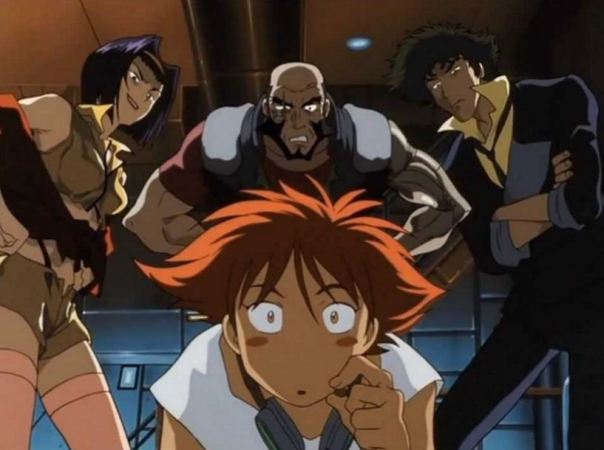
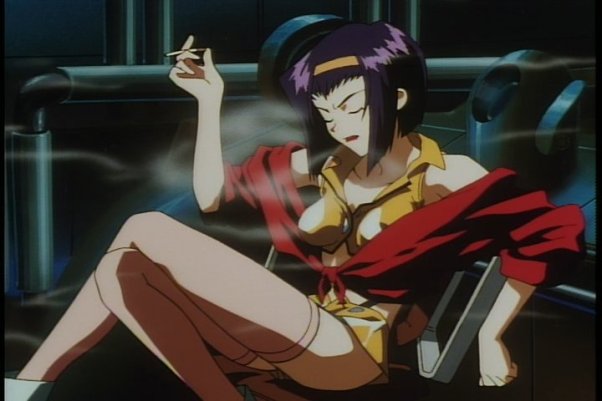
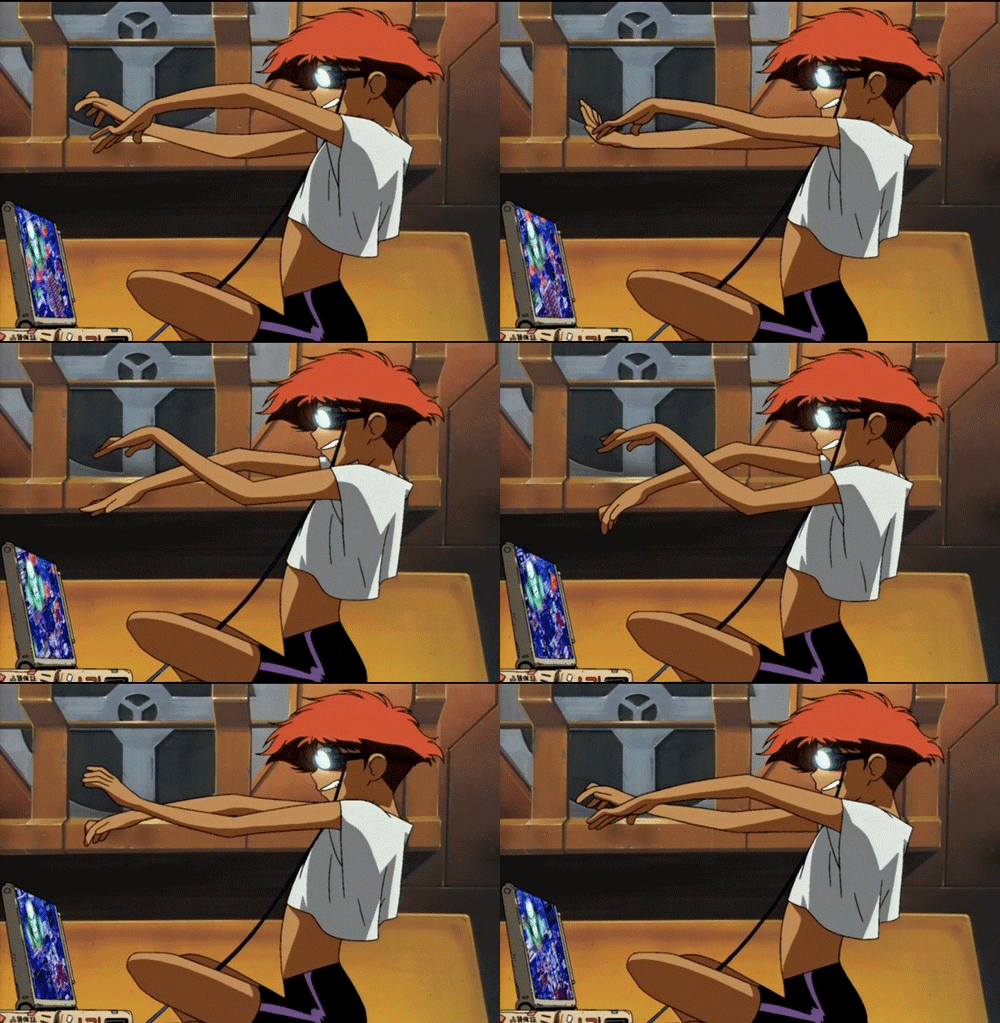
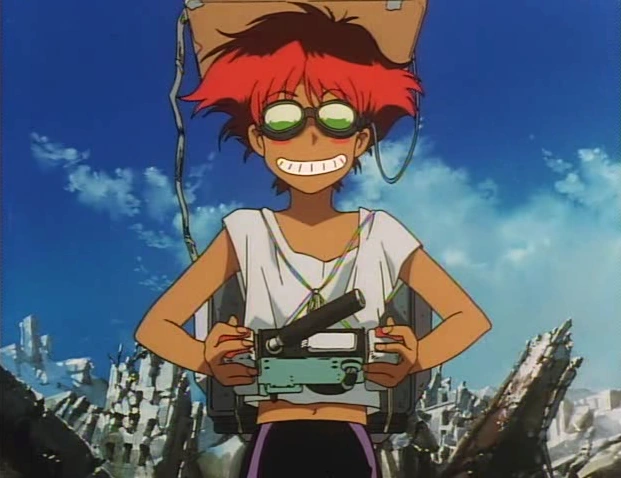
For cowboys Spike Spiegel and Jet Black, a single woolong (a dumb penny) is enough elicit risking their lives in chasing bounties and hauling dinner. Born as men for the good of the cause, life aboard the Bebop goes south when the ship recruits three new members that will eventually detour its steady course: Ein, the last purebred Welsh Corgi; Faye Valentine, a formidable and seductive cowgirl in her own right, yet currently searching for her elusive past; and Ed, a bizarre lil’ fella’ who knows how to use a computer quite well . . . scary well, actually.

bebop

As the eccentric crew aboard the Bebop get themselves into all sorts of mayhem, we gradually uncover the shady events that brought them all together.

There are two reasons Cowboy Bebop has withstood the test of time. One is that the animation by Sunrise is stunning and artistic, encompassing more meaningful symbolism and well-choreographed action scenes in the first episode alone than what I’ve seen in entire shows as of late! Two is the fact that its episodic rhythm followed up with its smooth flow of fragmented “memories” detailing the characters’ bygone lives is more than well-written. It’s brilliant, mostly because it doesn’t feel artificial; by the halfway point, we feel the passionate weight these characters are dragging with them, and how their past influences their present choices. Though the story doesn’t get kickin’ until episode five, the action-packed opening episodes are an amusing gateway to the show’s darker themes.

Bebop is not, however, a mind-blowing series of bleak revelations, but a journey cram packed with themes that jive with the soul. It is much more light-hearted, with enough emotional weight to rub the heart in a melancholic way—much like warm chicken soup or a deep blues tune would do—yet not enough turn off the viewer. You can feel this impact with the leads themselves, the subtle placing of the classic jazz-inspired episode titles, or the bluesy soundtrack masterfully composed by Yoko Kanno. All three work together to provoke sorrow, joy, regret, reminiscence, and wonder, in a futuristic world driven by detached hearts and jazz music.

Bebop‘s ending, which perfectly captures the nature of the show.

Most of the light-hearted nature of Bebop comes from the goofy or sassy interactions shared among the crew. Spike (dubbed “Cabbage Head” by my sister) is a way-too-lax and easily irritable man with a particularly complex history that frequently bumps heads with the present. His roots to the mafia come back to haunt him (like the mafia typically does), and his development is found in the monumental decisions he’ll be forced to make regarding the safety of the crew—and that of his own life.

Jet is an ex-cop now bounty hunter. ‘Nuff said. If Spike is the ill-tempered dad who always leaves the house for personal biz, then Jet is that mom who A) won’t tolerate your shit, and B) will cook dinner each night if YOU buy the ingredients. Rough around the edges, yet the one with the biggest heart, Jet serves the plot by being restrictor of reckless actions, even though he occasionally loses his temper. He holds Spike and Faye back from doing stupid stuff that could get them all killed, and as such plays a necessary role for this ragtag crew.

Lastly are the two sisters, one a troublesome teenager, the other a weird child. They are the tough-on-the-outside/terrible gambler Faye and the noodly Edward, and are mainly aboard to service the fans (Faye brings the sexy, Ed brings the laughs). While Faye will go on to have a much darker, richer past, Ed is pretty much there for the ride. The two share one thing in common, however, that being this common question burning the at back of their brains: “Why am I here, and where am I going?” It’s a romantic notion of growing up and dealing with acceptance. And that’s why they both work so well in Bebop—it’s the story of finding your place in this huge, cruel world.

Watching Cowboy Bebop is equivalent to revisiting an old website that you used to frequent back in the day, yet haven’t seen in ages. Does it feel nostalgic? Euphoric? A bit melancholic? Perhaps a bit of all three, but one theme Bebop enjoys feeding us is that internet is more than a tool—it can be a place for some, putting literal meaning to ‘home’ page. For me, this online café has given me a place to chat with and meet new friends. For the characters in the anime, the web is a place for an old man to play one last game of chess before giving his last breath, or for a disabled kid to vent his faith by becoming a God himself. It sounds a bit odd, but seriously, how much does the internet mean to you?

You should watch Cowboy Bebop because, in one way or another, it’s the story of our lives. Everything that challenges the Bebop crew and everyone they meet along the way represent a fragment of our deepest worries and regrets. Should you merely enjoy this anime for the comedy, then hey, that’s awesome, it’s got a lot of funny moments! But Bebop sure does have this genuine way of letting you know you’ve reached the end when it comes. With all of the interlaced light-hearted moments, it’s as if the show is reminding us that “Nope, sorry, this wasn’t the show you signed up for—and you know that.” Instead, you’re probably like myself and most Bebop fans, in that once it’s over, you’ll find yourself detached from the solar system, solemnly jiving to The Real Folk Blues.

“Life will challenge you to do things . . . sometimes, you just have to let go!” – Spike Spiegel

However you watch this anime, here’s advice straight from the Host: DO NOT string your viewings out for THREE months! It’s terrible! I endured this journey with my family, and being like all families, it’s hard to squeeze in quality movie time. But we did it, and now who knows what we’ll watch together, if anything. Rated a “Caffe Mocha” here, did you enjoy my review of this classically-acclaimed space western? Also, what’s your favorite aspect of Cowboy Bebop? Should it have lasted longer? I barely scraped the surface to avoid spoilers, but let’s talk about it in the comments! Thanks for reading and until next time, SEE YOU SPACE COWBOY . . .

– Takuto, your host

End of March Update 4/10/16

Hello cafegoers! March was a big month for me. I finished all ongoing anime that I started way back in the winter and concluded my research over one particularly tedious project. With all slates wiped clean, it’s time to move on to bigger and better anime. But first, we must recap the cool things I finished! Onto the update!

Recently Finished:

Cowboy Bebop – We (my family) arranged a weekend solely dedicated to finishing this classic “space western.” Let’s just say we were in for a long (12 episodes) and emotional haul. The end was a bit underwhelming, yet at the same time being everything that I wanted from a show such as this. The manner in which the crew disperses towards the finale is a sort of wake-up call, like a reminder that this wasn’t the kind of story we’ve been really following. It left a depressing hole in my heart, but that’s not to say I wasn’t satisfied. More thoughts to come in a brief review!

Girls und Panzer – You might recall this lil’ title in a previous haul, but yeah, finally got around to watching it. While the dub was pretty cringy (probably the worst I’ve ever seen), I managed to love EVERY SINGLE MOMENT of this tanks-meet-chicks comedy. I marathoned it in like two or three days, actually! Review on the way!

Baccano! – Mhmm, that’s right, the mafia stopped by to tell me that my job wasn’t over. In just 16 episodes, I witnessed a ragtag chase in the back alleys of the Big Apple, the struggle for immortality by alchemists, and a chain of bloody, grisly murders aboard the continental train The Flying Pussyfoot (HAHA HE SAID PUSSY). This was one of the most confusing anime I have seen, but oh boy, does Baccano! do A LOT of things right! You can bet your sweet tuckus I’ll hit more on it in a future review!

Erased – This one kept me entertained until about the last two or three episodes. It tried – it really did – but I just found the end predictable and lackluster. The thriller vibe it upheld through the entire ride, however, was absolutely incredible. Erased was only the most-watched and reviewed show of the season, so if I do write a review, it’ll be brief like my Bebop one would be.

Dimension W – This was the greatest disappointment of the season for me. I came in expecting so much: It was the season’s only big sci-fi, FUNimation had a part in the anime’s production, and the premise was thoroughly invested in a futuristic concept. It was only natural to expect something grand to come from all of this, but the story fell so short so early on. After episode 6 or so, I lost interest. Don’t worry – I still finished it and plan to write a semi-rant/review.

Yuki Yuna is a Hero – Last but certainly not least is this seemingly innocent magical girl anime . . . Gosh, have there been any pure, fluffy magical girl anime since Madoka Magica? This one takes inspiration from its groundbreaking ‘predecessor’ by throwing all kinds of twists and turns in the typical magical girl system. As such, you can expect it to go from zero to one hundred come two-thirds into watching. I have many good (and iffy) things to say about Yuki Yuna coming soon, particularly why the show falls a tad bit short of PMMM!

Currently Watching:

One Punch Man – That’s right! Takuto finally gets around to the top hitter of last season AND possibly the best anime of 2015! Is it a man? Is it an egg? Is he bored with all things in life? Yes to all! I’m three episodes in, and so far it’s not half bad. Will I like it more than, say, Sound! Euphonium or Food Wars!? Hmm, probably not . . . but I’m very excited to see how the show will carry on without dulling its satire.

Simulcasts I plan to follow this spring:

Kabaneri of the Iron Fortress – HYPE HYPE HYPE ATTACK ON TITAN HYPE HYPE HYPE

Kiznaiver – It’s studio Trigger and it’s not Ninja Slayer. Need I say more?

My Hero Academia – THE REAL HYPE. Mainly watching this to know what all the buzz is.

Mayoiga – I’m a sucker for mysteries, and this one looks genuinely interesting. It also sounds sort of like a survival game, which is another trick to bait Takuto.

Any Sword Art Online fans out there? I wrote this humongous five-part comprehensive analysis over the first season’s second half, “Fairy Dance.” CLICK HERE for the series! Be warned, it’s quite wordy, but it’s so far THE hardest thing I’ve ever written for this blog. I had a blast writing all of it, and I encourage you to check it out if you’ve enjoyed my musings thus far!

Now that the “Fairy Dance” analysis is out of the way, I’ve been slowly working on a lot of new projects behind the scenes. Some involve just tackling new simulcasts, some just checking on previous popular shows, and some are secret. More to come on those later, hyuk-hyuk-hyuk.

I had the time of my life at Naka-Kon 2016! Click here for more!

I’ll also be testing out some new review formats, so be on the lookout for your favorite one and let me know! I normally clock in with 1,000 to 1,400 words per review, but I’d like to try writing these next few in under 900. Partial reasoning for this cut is to practice my wording, but another comes from the fact that most bloggers (and readers) prefer shorter posts. It’s rare to come across a person who enjoys 5,000+ words of analysis 🙂 so I want to try shorter, more meaningful posts! I’m sure we all know the struggles.

So yeah, that’s about it. I’ve been busy with music and academic competitions these past several weeks (studying, practicing, studying). As you can see, I have no problem fitting in time to watch anime. It’s just hard to get around to writing about it, publishing a post, reading other posts, commenting, then replying to everything – WAH! But I enjoy reading from you guys, and I definitely get motivational-boosters from reading the comments you leave. 😀

In other news, it’s getting much warmer here . . . so much so that some afternoons are unbearable, ugh. Why can’t we get more rain?? I’ll be up all night drafting reviews for the many shows that I want to talk about, so I better end things here. What shows did you recently complete that knocked your socks off? Y’all have a pleasant week, and until next time, this has been

– Takuto, your host

CAFÉ NOTICE | Aftermath of Being Logged in ALO

Hello café-goers, how should I start this? Well, it’s evening here, so perhaps “Good evening, all!” or something to that effect. What I’m about to talk about is more on the serious side, but don’t worry, it’s that good kind of serious – that satisfactory seriousness that comes from adult praise, for instance. The topic? You read the title. I was logged into ALO for admittedly far too long, and you’ve probably realized that. Also, I lost a lot of you guys from my first anticipation post of the project, haha! What happened?!

I started to analyze Reki Kawahara’s Fairy Dance not by choice; I was sick and tired of nearly every goddamn anime fan beating up on SAO’s second half, and I had to change that by defending it as my sole right as a reviewer and a fan. We stick up for things we appreciate, see, and we also criticize the aspects that could’ve been better. But this was a defense series for the positive aspects, not the negative ones. I’m not saying Fairy Dance is pure gold – Oh gosh, no – but aren’t there other series out there begging to be picked apart like the literary vultures we are?

Now you probably think, “What about all those fans out there that praise SAO as the chief of all anime, huh? We must stop their ignorance!” Well, I agree, you can tear Sword Art Online limb from limb, whether that be the anime, the novels, or both, but the series’ problem is rooted in the the lead character himself, and sadly I can’t do much about that. However, I can point out a few of the cool tricks the series performed correctly. Hence, my motives for writing this.

This journey of 10,000 words starts with a single letter. Cheesy as it sounds, it is what it is. Clocking in at around 10,000 words altogether (parts I through this reflection), this is one of my greatest achievements as a blogger. A Word document this large is at risk of EXPLODING! Am I proud that I threw a sh*t ton of words on a page and called it an analysis? Not necessarily. I proclaim this to be one of my greatest achievements in blogging because this is my grandest collection of argumentative text on this blog. I dare say it means more to me than my reviews . . . This is a project I can look back on and actually feel really, really proud of the hours of work that went into this. I went into it thinking it would just be another review series. Hah, how little did I predict the longstanding effects it would come to have.

I realize this topic is taboo by bloggers, but here I go. “In Defense of Fairy Dance” had quite possibly one of the worst ‘statistical’ receptions on this blog – and THAT’S FINE. I believe it to be one of my highest of highs even though the number of likes and comments dictate it was one of my lowest of lows. It just means that you as a reader didn’t want to, well, read it, and that’s totally okay. Read what won’t waste your time, after all. That’s how I’ve always seen it. Just know that despite my efforts (and I don’t blame you AT ALL for not knowing the struggle), they ultimately mean so little, statistically. Thus, I’d like to extend my warmest thanks to those who stuck around, read, liked, commented – You know who you are. Thank you, it is an absolute joy reading your comments overflowing with your own responses and opinions!!!

If you’ve learned anything by now, it’s that Sword Art Online is a franchise rich with irony. Dramatic Irony ringin’ any bells? Gosh, we’ve beaten this horse quite dead. I won’t rattle on more, but I hope you’ve been able to take out this popular theme and apply it to other media. SAO doesn’t do anything particularly special with it; it just does a fantastic job working it into the story and characters. I also hope that, through reading this, you’ve been reinforced with the thought that “appearances aren’t everything.” Oh, it’s a juvenile theme, but one that applies itself here in many more ways than one.

Lastly, before I bow out of this enchanting land of fairies and bid the franchise farewell, I have one last lesson to reign it all in. You question, “What could possibly be more important than dramatic irony, Takuto???”

La vie est drôle

“Life is Funny,” eh?

You might recall this phrase rolling off the tongue of Ragyo Kiryuin from Kill la Kill, but its meaning is can be equally applied to the entirety of Sword Art Online.

A story of kids who finally get their hands on virtual reality, only to get trapped in it with death as the only escape.

How about when they finally do manage to return to the real world, and the main character’s lover has been relocated into another cage?

Or even when she gets out, and a mysterious marauder threatens to kill players in-game with one pull of his trigger?

Heck, even a girl struggling through terminal illness seeks refuge in the game world.

What about a blogger who expended his time, energy, and soul into a project that got less hits than his dinky little haul post? I think you get the picture.

When you look at it, life sure is funny, eh?

I’m using the wings I gained from ALfheim Online to soar to new heights. This experience has been troublesome, yet surprisingly a wake-up call much-delayed as well. I am still trying to work out a review format I am comfortable with, and this comprehensive review stuff has helped reduce my options (because at this point, I just can’t decide). Maybe now you’ll get to endorse yourself with tastier content. Or, perhaps, things could take a sour turn. Anything could happen, and so whatever does come our way, I’d like to reaffirm my thanks to all who have flown by my side during this journey. Don’t feel bad if you didn’t – I’m sure there’s a reason for your absence. Just know that we had a grand ol’ time here with dramatic irony, right fellows? Yeah, don’t answer that.

With more positive announcements on the horizon, I sincerely hope you have emerged as enlightened as I have! Keep on rolling with the punches, and until the next post, thank you very much for reading!

– Takuto, your host

Oh, before I leave, I’ll be dropping the headers for each section of the series below. You are encouraged to click on the image (if my computer’s not being fickle) to direct you to the page. Everything under “In Defense of Fairy Dance” will be compiled under the “Cafe Talk” section of the blog for future reference! 🙂

dayii_HHS017710B1_1

dayii

dayiii

dayiv

dayv

Overfly, To Be So Close Yet So Far Away | PART V & FINALE: In Defense of Fairy Dance

This is part five and finale of the five-part series “In Defense of Fairy Dance,” a collection and comprehensive analysis defending the positive aspects of Reki Kawahara’s “Fairy Dance” arc in Sword Art Online. Research was gathered from the anime (sub and dub versions) and volumes three and four of the light novel series. This is in NO WAY written to justify all of the second half of the series, nor is it to say that it is particularly well-written. Instead, it is a half-full glass of the neat things the series did, and why I enjoyed myself with most of the content despite the glaring flaws. HEAVY SPOILERS EXIST.

Well readers, we’ve reached the final stretch! Instead of boring you with another wave of novel quotes and anime screenshots, I decided to go out on a limb [insert World Tree joke here] and bring in sound to this comprehensive analysis. Specifically, Sword Art Online’s second ending (my favorite song) “Overfly” by Luna Haruna. For this post, I’d like to seek the great YouTuber and vocalist Amanda Lee and her cover of “Overfly” to wrap everything up, as its lyrical brilliance encompasses the heart and soul of the “Fairy Dance.” Even though the multi-meaningful lyrics can be applied to practically all characters in the franchise (dramatic irony and all), I want to tag-team with AmaLee and let one Sylph in particular shine above the crowd.

I DO NOT OWN “OVERFLY” OR THIS COVER. THE SONG BELONGS TO LUNA HARUNA AND THE COVER BELONGS TO AMANDA LEE.

First, a note from AmaLee herself. If you read the description box, she quotes:

“I wanted to chime in about this song (rare, I know!) If you’ve watched the anime you can probably see that this song is written from Sugu’s perspective. (spoiler warning) Throughout the song she’s realizing that her love is one-sided and is trying to deal with that heartbreak. I know many people don’t like Sugu but I just want to give her a big hug after singing this song~ ;;;A;;; I the lyrics are extremely touching because everyone knows the feeling of wanting something so badly but ultimately knowing that no matter what you do, you can’t make it happen. Betcha didn’t think this song was that bittersweet when you heard it in Japanese!”

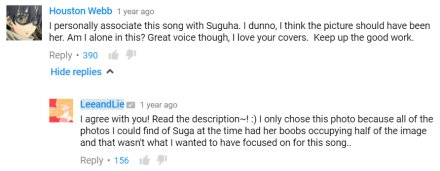
Oh yeah, then why the Asuna picture instead of Suguha? How does this play into the sad irony we’ve thoroughly established?

nosuguha

Ah yes, the truth is polarizing. Onto the song!

ENGLISH “Overfly” Sword Art Online (AmaLee)


Hands up high Raise them high

And cast your worries to the sky

There’s no doubt Not one doubt

As I make my wish and let it cry out

Two hands in the air not only represent a surrender, but also an “AGH, I give up!” action. And that’s exactly what Suguha’s doing here – She’s throwing her burdens and troubles towards the heavens in hopes that – without doubt – she will be able to dream without worry and just let it all out.

If I gathered all the love in my heart

That grows with every passing day

I would find a confusing puzzle

That changes and rearranges

Every day, Sugu’s love for Kazuto grows more and more. Love isn’t an emotion to stop by for an hour, sip on a drink, then depart. No. Each passing moment she shares with him adds to the complexity of the scenario – Should I love him, should I not . . . ? Sugu knows the chaos that would spread should she declare her love to her brother, and that not only hurts but confuses her. Shouldn’t she be entitled to pursue love passionately and freely? In this case, society (and some health studies) indicate otherwise.

Will I ever find my place? I’m not sure

Or will I forever feel insecure?

And the moment all the questions fade

I notice my tears

But I can’t hold them back

Will Sugu eventually find a place where she is comfortable with this forbidden lust? She doesn’t know. Perhaps she’ll be clutching that intangible and silly reality forever, like a kid at a carnival still waiting by the Ferris wheel with a ticket despite it having closed hours ago. However, the moment she thinks she’s come up with a solution and/or breaks the ice, Sugu is reminded about how wrong that love is, and cries indefinitely.

Maybe it’s too late

I’ve lost my chance

All of my questions shall go unanswered

Will I keep fighting to find the light or

Will I descend to a bitter end?

It might even be too late! I mean, Kazuto loves Asuna with a desire unlike any other; Perhaps Sugu should just throw in the towel now. I mean, the two are a good match. What would you do – Pursue love passionately and vigorously, or end the struggle only to wallow in more regret, guilt, and heartbreak?

Hands up high Raise them high

And cast your worries to the sky

If you can’t stand

Then take my hand

And I will rise to fight by your side

My beating heart is burning on

And as it races I realize

There’s no doubt Not one doubt

As I make my wish and let it cry out

Chorus time. Toss up those hands in prayer, as all will eventually be fine. Here, I imagine Leafa’s personality peeking through the clouds. The fierce Sylph warrior is reaching out to Kirito’s hand in an effort to help him rise and rescue his seemingly long-lost ‘wife.’ This encouragement, in turn, causes reinvention to take root within Leafa. “Now I have purpose,” and this excites her heart into motion. If he can pursue that wildly at impossible odds, so can she. The wish is back into focus.

I have always danced to my own beat

But you always throw me out of sync

‘Cause around you I am holding back

And I’m mastering a fake brave smile

Sugu is tough on the outside and on the inside. She’s in kendo, and damn good at it, too! Ever since, she’s had her own rhythm – her own ebb and flow. Even in ALO, flying through missions is the only thing on her mind. But romance keeps disrupting the waters; a heartbeat that keeps accelerating. Leafa has to act tough around Kirito so that he is not discouraged, even if her heart is overflowing with anticipation and mixed signals.

Maybe it’s too late

I’ve lost to my dreams

All of my wishes come true only here

If I wake up now, I’ll lose this moment

I fear my dreams will fade around me

Kazuto returned to the real world nicer than ever before, and that also offsets Sugu. “Why is he so kind to me?” As reality keeps tormenting her, indecision crawls back into the forefront. All of Sugu’s greatest dreams come true in the enchanting land of the fairies, ALfheim Online. She can fly, rest, make friends, and most of all, be truly free. If Sugu decides to “wake up” and choose Kazuto over ALO, she knows she’ll lose many things in the process, including her one true dream of flying higher than the clouds.

I’m so close yet so far

I can’t reach out to where you are

I’d give my heart I’d give my soul

But somethings are not in our control

“I’m so close, yet so far.” This is the ideal caption for Sword Art Online’s second half. It ties to Asuna and Kirito being in the same gaming world, yet not being able to meet up. It applies to Kirito standing over her real body in the hospital, yet not being able to say a word. It enforces the thought that Suguha has tragically fallen in love with her own brother, and despite them being closer than ever before (they live in the same house for chrissake), she feels so far apart. How about Leafa wanting to break the flight barrier? She’s so damn close all the time, yet the game has set it so that it’s impossible to breech. It’s all of that damn Dramatic Irony crap we’ve been delving into for the past two weeks!! Everyone on this cruel stage is willing to risk their heart and soul, but whether it be game admins, societal roles, or virtual connections, it’s not for them to decide the rules.

Your hand’s not meant for me to hold

And I’ll be lonely when you’re gone

I’m aware So aware

Only through my memory you’ll be there

A sister knows she cannot be with her own brother in matrimony. Thus, when Asuna and Kazuto go off and wed in the real world, Sugu will feel very lonely. Same with Kirito – Once he finds the princess he’s searching for, Leafa will lose her daring knight and precious friend. Only in reminiscence will she savor these wonderful joys.

It’s not the destiny that I’ve dreamed of

And as I cry I know this is goodbye

How can I ever reach you

When I can’t even see the sky?

She didn’t want to fall in love with Kazuto – That’s why she moved on to Kirito! But when Kirito proclaims his lover’s name, “Asuna,” she realizes that she was just another player in this punishing game of tag. Why she “can’t see the sky” could represent her tears filling and blurring out the view. Or perhaps another hint at the flight barrier which she cannot breech. Even more so could be that at the beginning of the song (and at the end here), Sugu cast her dreams to the sky, and that vision has now become muddied.

Hands up high Raise them high

And cast your worries to the sky

If you can’t stand

Then take my hand

And I will rise to fight by your side

My beating heart is burning on

And as it races I realize

There’s no doubt Not one doubt

As I make my wish and let it cry out

Regardless, the sky will always hold her heavy heart and greatest wishes. If Kirito needs help, then she will help him like he did for her. Simple as that, and this foreshadows the route she takes following the revelation (Sugu finds out) and the conclusion. Fighting with him excites her, and as her heart beats firmly, the Sylph now knows where she stands: In the sky, high above spiraling towers where her desires can cry out, yet out of reach for anyone else to hear. What else could “Overfly” mean?


Thank you for reading! Please, share any thoughts below and stay tuned for a brief REFLECTION!

(I own neither the anime nor the light novel series of Sword Art Online. All images and videos belong to A-1 Pictures and Reki Kawahara. “Overfly” belongs to Luna Haruna, and this English cover belongs to AmaLee.)

The Deadly Power of the Game | PART IV: In Defense of Fairy Dance

This is part four of the five-part series “In Defense of Fairy Dance,” a collection and comprehensive analysis defending the positive aspects of Reki Kawahara’s “Fairy Dance” arc in Sword Art Online. Research was gathered from the anime (sub and dub versions) and volumes three and four of the light novel series. This is in NO WAY written to justify all of the second half of the series, nor is it to say that it is particularly well-written. Instead, it is a half-full glass of the neat things the series did, and why I enjoyed myself with most of the content despite the glaring flaws. HEAVY SPOILERS EXIST.

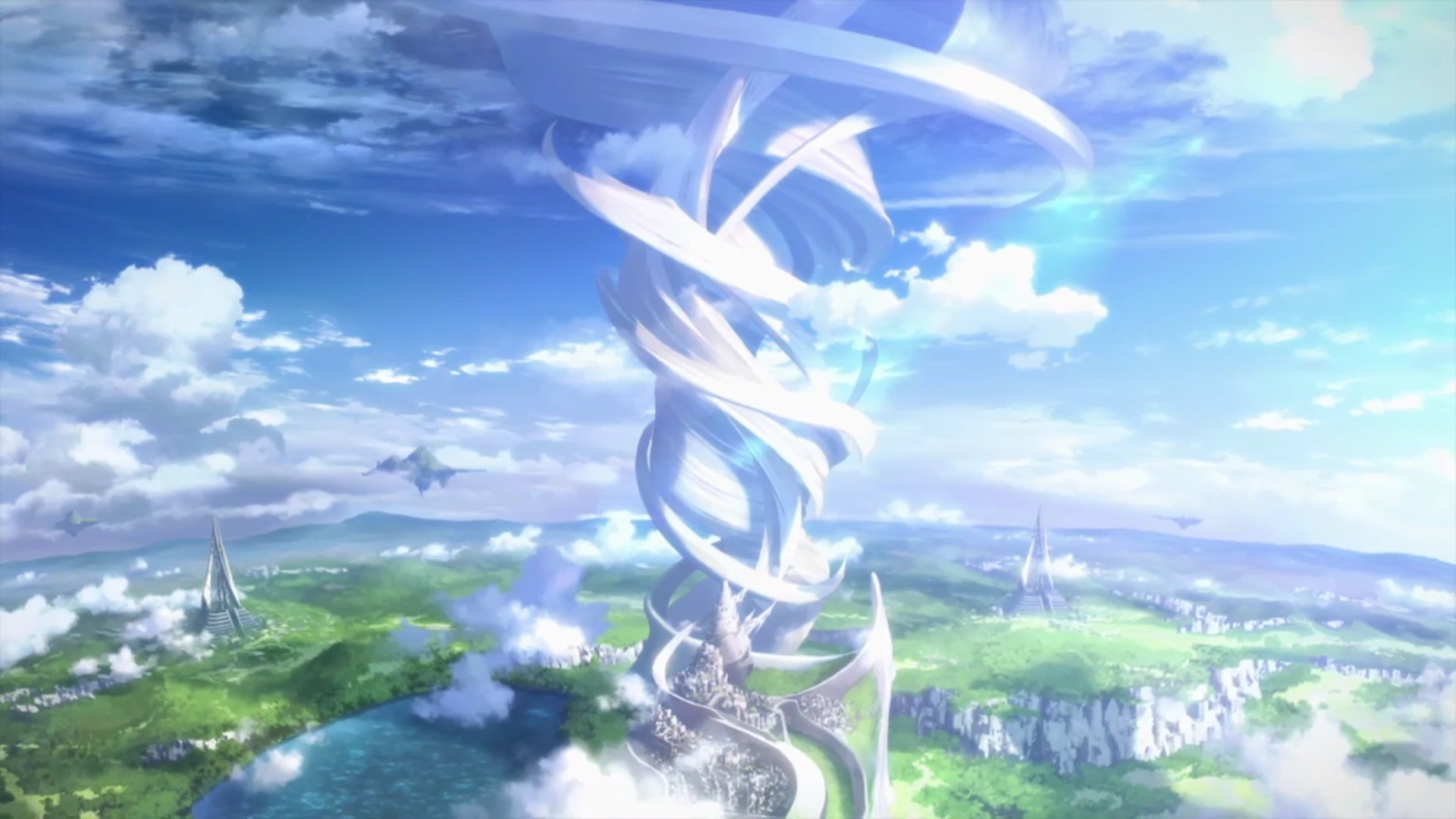
Much like with PART III, this section will focus on the dramatic irony behind ALfheim Online itself, along with VR gaming altogether. Again, we’ll be analyzing many of the quotes from the light novels to bring the truth to light. The anime does a fair job at captioning the satire of the entire ordeal, so bringing in further clips would only clutter the analysis. There are pictures, though. Many pretty pictures.

“Land of the Fairies,” Eh?

Don’t worry, Kazuto thought the exact same thing. I mean, what’s a bunch of fairies doing in games anyway? After nearly dying in a world of knights and castles, nobody wants to be a dumb fairy – They’re just bloated pixies. But when Kazuto questioned Agil, apparently ALO isn’t just another laid-back, casual MMO. No, in fact it’s “actually pretty hard-core,” as the system is set up to be entirely skill-based so that player skill is rewarded. PK-ing is encouraged as a result. Where each VRMMORPG tests its players, Leafa believes that pride is what was being challenged in ALO. “How hard could you struggle? If you lost, how would you regroup and hold your head high? That was the test, (24, vol.4).” Also, imagine losing to a bunch of fairies. That’s dumb.

Right off the bat irony is up and ready for a home run. That should be every viewer’s first thought – What’s so tough about ALfheim? The second arc’s game is totally based on athletic abilities rather than keyboarding techniques, essentially meaning that if you lose in-game, it means that you literally weren’t strong enough. It’s also funny how they mention it’s basically SAO with magic. Magic. Doesn’t ALO feel magical? Everyone has glittery wings that allow them to fly higher than in any other MMO, and who doesn’t want that? ALO must be a DREAM COME TRUE, no flaws whatsoever. HAH! What a joke.

The Sad, Scientific Truth behind ALfheim

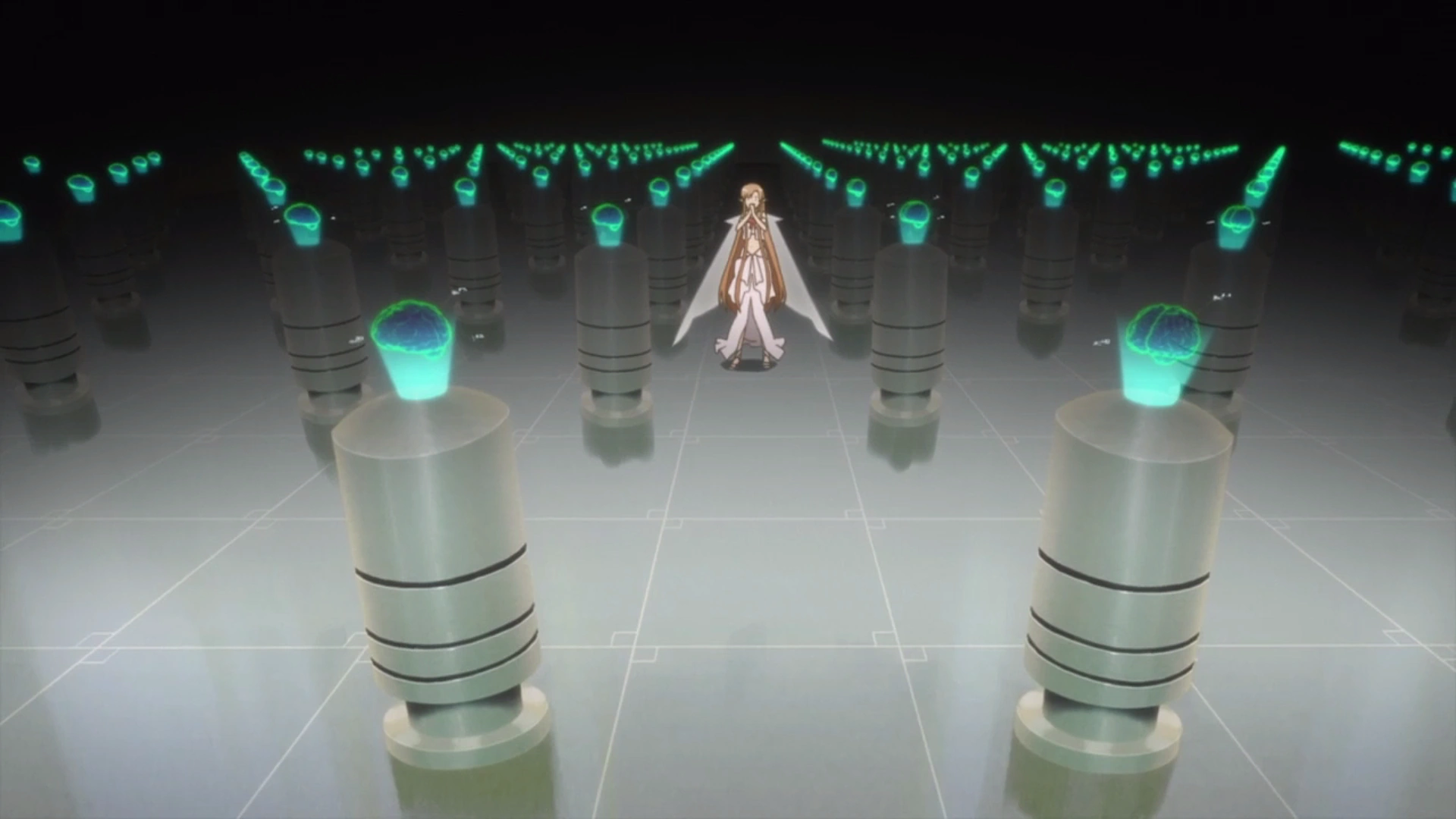
I don’t want to turn this already-way-too-long series into a summary, so let’s just jog our noggins. Sugou inverted SAO into ALO, kidnapping +300 entrapped minds as tools to further his research. That being, to study and prove that if the brain could be significantly controlled, then so could emotions.

“’Ha-ha! You won’t be singing that tune for long. Very soon, I will control your emotions in the palm of my hand. Look, Titania. Can you see them? Thousands and thousands of players, diving into this expansive world, enjoying the game. The thing is . . . none of them has any idea that the full-dive system isn’t just a tool for mere entertainment!’ (102, vol.3).”

Games are meant to be innocent fun, nothing more or less. But here, the grand Fairy King has rewritten the rules and taken control of all pawns on the board. He cheats, abusing the gift of the virtual world to benefit his own research – And at the extent of risking human lives, to which he casts aside! Sugou is a villain in both pixels and cold blood, and I’d say he’s a good one at that. He is, after all, a scientist, and furthering one’s knowledge of the world whenever and WHEREVER possible is sincerely worth pursuing. While you can only go so far to justify his motives, Sugou is still a creepy bastard who treats his soon-to-be wife without any regard, and he also kidnaps kiddos and pokes around their brain while they sleep. His jealousy over Kayaba’s success drove him to be even more passionate, yet he was outraged when the creator sacrificed himself.

“’Mr. Kayaba was a genius. But he was also a fool. How could he utilize that incredible potential just to create a stupid game?’ (103, vol.3).”

But his methods are where I see the crowd diverge. His henchmen find it more humane than exposing test animals’ brains to open air and jamming electrodes into them. “I mean, all they’re doing here is dreaming.” Very true, it’s all one big farce, and the series mentions that research on the human brain is incredibly slow due to the, well, human subjects needed. It’s not like you can get folks to consent on the matter, though. Otherwise we’d be leaps and bounds ahead of what we know! His research is admirable, but Sugou’s methods cross the line of sanity. He’s also an ass, which adds to what makes pure villainy – hatred. He’s supposed to be unlikable, and I think we can all agree that he is without falter.

This is One Tree You Can’t Climb

After giving Kirito the info-dump as to the features in ALO, Kirito assesses that the World Tree – The Master Quest – is essentially unbeatable because the only indication to standing a chance involves guild cooperation. However, the prize is only awarded to a single race that completes the mission, and no one would compete if it just means forfeiting the prize to the other team.

A while later, Kirito truly understands the game’s irony. “’ALO’s a nasty game, testing its players’ greed like this. I’m guessing its designer is a real piece of work,’ (191, vol.3).”

Oh trust me, he is. He is the self-proclaimed “Fairy King.” He’s also a narcissistic fiend.

Even Leafa, while tackling the Tree at the end of the series, feels the unfairness in the omnipresent guardian knights. She’s starting to sense that this world isn’t built around the hopes and dreams that flying fulfills. Something’s amiss. I just love this quote:

“But now, for the first time, Leafa began to sense a kind of malice within the system. Some unseen force, which was supposedly keeping everything in a fair balance, was wickedly, cruelly swinging a bloody scythe at the players’ necks within this arena. There was no way to overcome this trap, (124, vol.4).”

And when Kirito finally resurfaces (because he’s too OP) he becomes speechless. He has some excellent mental grammar, though:

“The grand quest at the center of the game – to reach the city atop the World Tree and be reborn as true fairies – was nothing more than a giant carrot, endlessly dangled out of reach of the game’s player base? So not only was this battle’s difficulty set to the extreme, the door was locked by nothing more than the will of the game manager . . . ? (133, vol.4).”

THIS RIGHT HERE is the MOST SIGNIFICANT piece of DRAMATICAL IRONY found in the work. We’ve covered Suguha and Asuna, but this realization is the ultimate plot underlying Sword Art Online. Even the revelation to Kirito that Sugou – the nasty man trying to steal his girl IRL – is the mastermind doesn’t compare in shock value to this. The game is rigged. It was from the start to its game manager’s end. Those who fought for life in this world – to fly high among the stars and one day, a palace in the sky – is all for not. Hell, the option doesn’t exist. Just like you couldn’t log out of SAO, a freakin’ game, ALO’s master storyline isn’t designed to finish – EVER. What keeps players like Asuna and Kirito coming back to VRs if they only bring painful revelations and ironically cruel clickbait?

Treasures ALO Gave its Players

The irreplaceable positive memories and true friendships formed, that’s what. People form ideals off of scenarios like these. For Kirito, everything was just a game. “Kill what you want, take what you want.” After surviving SAO and enduring ALO, he’s seen enough to realize that “there are things you have to protect and uphold because it’s a virtual world, even if that makes you look stupid, (168, vol.3).” Paraphrasing from the novel: Though it sounds paradoxical, you can’t completely separate the player and the role-playing. Letting your inner greed run wild in the virtual world and that will come back to haunt your real-life personality. The player and the character are one in the same. That’s powerful; it’s an influential statement I’m sure actors, cosplayers, gamers, and the like can relate to.

For Leafa – No, for Suguha – she found true friendship along with hope and purpose through her wings of freedom. When rescuing Tonky from the three-faced giant, Sugu wasn’t going stand and watch the murder of something she’d labeled as a friend and given a name. There’d be no point to playing a VRMMO if it’s all fake! Even when they get out of Jotunheim, she reflects on the happy accident that arose from falling in the first place, and all of the rare experience and friendship they gained being side-by-side.

To think that Sugou can manipulate these emotions is catastrophic, and Asuna of all people knows this by heart. “The research being done here was one of the great taboos, like human cloning. It wasn’t just a simple crime. This was the destruction and desecration of the last vestige of human dignity: the soul, (59, vol.4).” Robbing humans of emotions doesn’t make them human anymore, yet the person reaping the souls of others is the most inhumane of all. It’s almost unfathomable, really, and I only wish the series took this issue more seriously.

Lastly, along with memories, friendships, and ideals comes initiative – the drive to take charge and change fate. In his final bouts, Kirito reflects that ultimately, a virtual world is just a game, and he thought it was all real. He ponders his desire to return to the deadly SAO just because he was that world’s strongest hero. This notion of might clouded his judgement upon landing in ALO to foolishly save the princess without professional help, and it sadly resulted in borrowed mental toughness, nothing more. “I must have been very happy regaining my imaginary power, crushing other players and satisfying my ugly pride and self-esteem, (151, vol.4).” And even though the hideous God of this world is in absolute dominance, Kirito still prays. To a God in the real world? To a system glitch? To fate itself?

The most logical choice is the one whom blessed him with strength in the first place. The God of that old world. And just like that, Kayaba shows up in disappointment at what has become of the ideals which blossomed from their duel – That the HUMAN WILL could surpass a COMPUTER. Kirito wins not because his stats were higher, or that his blade was sharper. He wins because his will overpowered Sugou’s corrupted vision. The God of Old indirectly causes the downfall of the New God by channeling his spirit into the knight that beat him in a past life. That’s golden irony.

Thank you for reading! Please, share any thoughts below and stay tuned for PART V & FINALE!

(I own neither the anime nor the light novel series of Sword Art Online. All images and videos belong to A-1 Pictures and Reki Kawahara.)

Wings of Freedom, Cage of Gold | PART III: In Defense of Fairy Dance

This is part three of the five-part series “In Defense of Fairy Dance,” a collection and comprehensive analysis defending the positive aspects of Reki Kawahara’s “Fairy Dance” arc in Sword Art Online. Research was gathered from the anime (sub and dub versions) and volumes three and four of the light novel series. This is in NO WAY written to justify all of the second half of the series, nor is it to say that it is particularly well-written. Instead, it is a half-full glass of the neat things the series did, and why I enjoyed myself with most of the content despite the glaring flaws. HEAVY SPOILERS EXIST.

For this third part I think we’ll have a little more fun. Are you sick of dramatic irony yet? No? Good, because realizing how large of a role it plays in Sword Art Online’s second half could make or break the experience, and here at the café, enlightenment is something we strive for!

As I mentioned, today’s post a little different. Instead of analyzing one line for +1,500 words, I thought I’d briefly list quotes from the light novels hinting at the rich irony in play, this being the symbolism behind the fairy wings and the birdcage suspended in the heavens. It’ll largely be, once again, a look into Suguha and Asuna.

Wings of Freedom, a Look into Suguha’s Case

“But she knew that when it happened, Kazuto’s heart would be forever beyond her reach, (92, vol.3).”

Ah, this refers to the incest we glanced over due to its taboo nature and my modest stance with the whole thing. Regardless, isn’t it funny that the person whom she is closest to – they live together for crying out loud – is the one person whom she is not allowed to love? Siblings, cousins, or otherwise, that’s pretty cruel.

“. . . Leafa felt the heavy, clinging web of hassles descending upon her. The only thing she wanted from ALO was the feeling of flight, of escape from pressure. To cast aside her troubles and fly as far as she desired. Nothing more. But it seemed that was a naiveté born of ignorance. Perhaps it was just a fantasy of hers, that this virtual world where everyone had wings would be enough to help her forget the gravity of real life, (116, vol.3).”

Apologies for the lengthy passage, but this is the bottom line, the viewpoint through which Sugu sees ALO and gaming altogether. Stats, battles, monsters? She couldn’t give a ‘flying’ flip. How can we tell? She could’ve joined any other game, but she chose the one VR with flight capabilities – Wings of Freedom (no, not a tribute to the overly popular titan-slaying hit). After school when she logs on and becomes Leafa, she believes she can sprout her wings and take off, leaving her problems grounded. She wants to float around, to soar against the moon and the stars, to leave it all behind and fly away from her issues. She knows it’s a foolish thought, yet here she is still playing the same game.

“’I wonder . . . Why does everything have to come down to control-or-be-controlled? I mean, we have these wonderful wings . . .’ (120, vol.3).”

“The stronger she grew, the wider her range of activities. Just flying through the sky over unfamiliar territory was a thrill. But as she became one of the strongest sylphs in the game, along with her knowledge came hassles. In time, she felt she was just going through the motions. The obligation to fight for her race became an invisible chain shackled to her wings, (133, vo.3).”

Here’s that punchline again. Imagine having weighty responsibilities in the real world, like most of us do. These obligations are noisome, so we log on a play games to leave these worries behind if only for a brief moment. Now, just because she became attached to flight, Leafa has become a significant figure in the game, and her controlling guild leader has burdened her with unnecessary responsibilities. It’s just a game, sheesh! All the girl wants to do is fly, so quit dragging her off to be a battlefield celebrity!

“Suguha’s stature was far from large for a kendo athlete, but compared to Leafa the sylph, she was rather big-boned. When she moved her shoulders, stomach, or thighs, the muscles rose to the surface of the skin. She thought her breasts had grown quite a bit recently, too. She couldn’t help but feel that the inescapable reality of that body reflected her own inner conflict, so Suguha shut her eyes tight again, (132, vol.3).”

This is another long but good one. We don’t get this in the anime. Also, another point from my heart to Suguha. Sugu is a big-boned, short, well-endowed women. To her, she’s anything but a woman, that being her sylph idol. Leafa is slender, tall, big-chested (as well), yet just as strong, if not more so. That’s not fair. All of her painful kendo training and I look like this? That’s what she probably is telling herself. It doesn’t help that her bro is a perfect fem-boy – Even Klein wants a piece of Kirito’s meat. Sugu, I feel your pain. Any chance I get to create a virtual avatar, I change the hair color to blond (because I’m a brunette), change the eyes to bold blue (cause mine are dull brown), and chop off a good +50 lbs just because I CAN. I’d RATHER look like this! Having body-image issues makes us feel like we have done something wrong, and sometimes, kiddo, that’s just the way this world works.
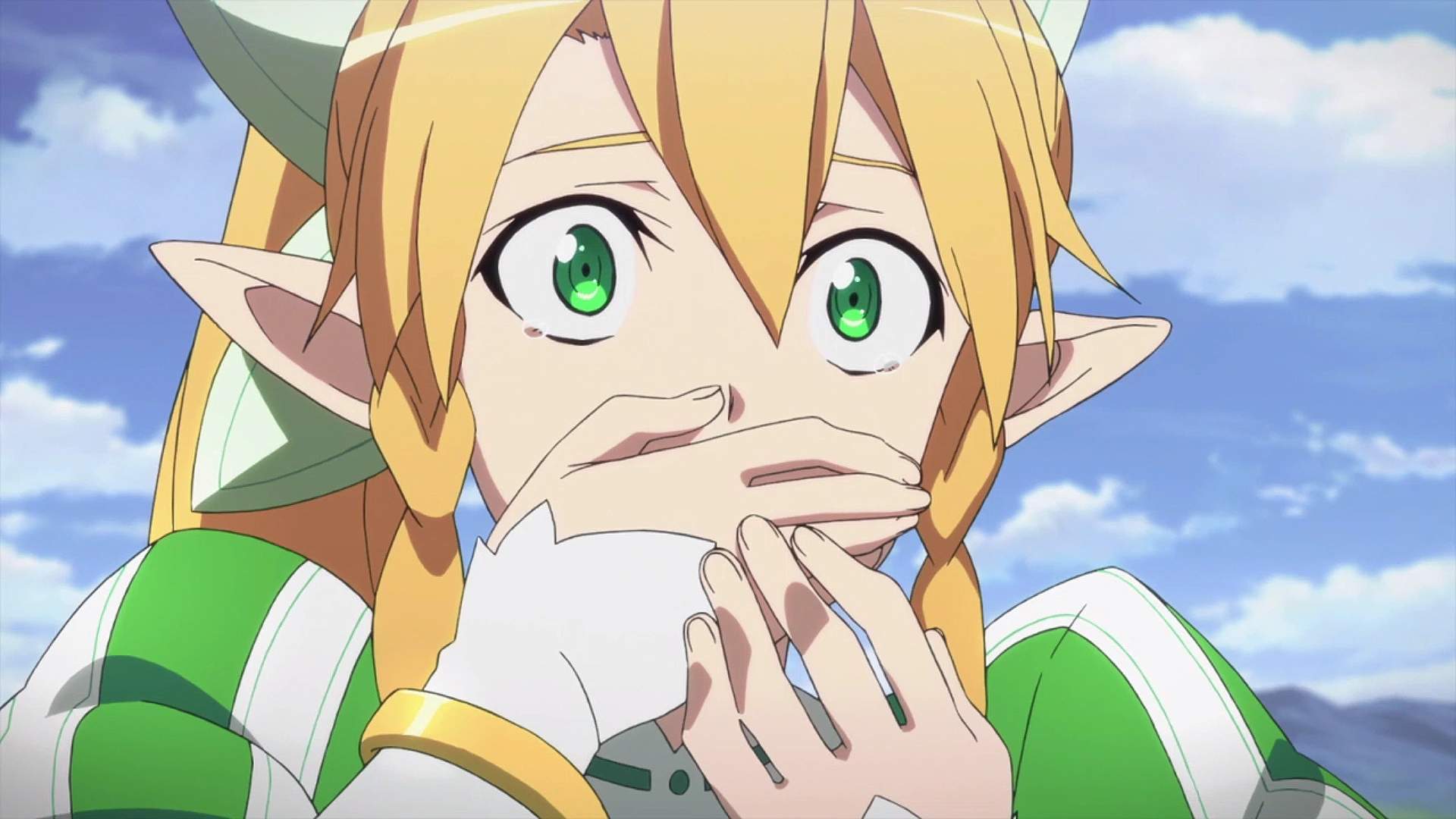
“She’d be lying if she claimed that loving Kazuto as Suguha and being attracted to Kirito as Leafa didn’t fill her with guilt. But it was Kirito who had taught her that the world of ALfheim didn’t have to be just an extension of a virtual flight simulator, but another true reality. Because of that, Leafa had realized that the feelings she felt here were true, not just digital data . . . ‘This can’t be happening . . . This is so wrong,’ (101, vol.4).”

This is the grand reveal we covered in PART I, and might I add that the entire five or ten pages this encompasses could’ve been marked down as quote material. Obviously, the irony here is that Sugu loved her brother, but that was ‘wrong.’ Thus, she put her mind to VR games like he did and discovered flight. It wasn’t long before she buried those feelings and met Kirito, a gamer who brought a whole new level of experience to her. Her life feels forever revolutionized – that she’s moved on – until the boy (should’ve been obvious duh from the start, as the similarities are off the chart) reveals himself to be the knight she found new love in. She betrayed her own heart, and the guilt is incomprehensible.

“I was on top of the World Tree. The peak of the world. The place that Leafa . . . that Suguha had dreamed of for so long. But . . . ‘There’s no city in the sky’ . . . It was all an empty gift box. Past the enticing wrapping paper and ribbon, it was empty lies. How could I explain this to Leafa, after all of her dreams of being reborn as a high fairy? ‘This is unforgivable . . .’ (137, vol.4).”

Right before the fated reunion in the clouds, Kirito gets a peak at the world of fairies for what it truly is – A huge hoax. I put this here because, as he brings up, this was Suguha’s biggest dream: To soar through the clouds, and beyond. Now, Kirito is high above in the World Tree, only to realize that what the high and mighty sylph was clinging to this whole time was false. There is no master race, only one terrible, greedy man behind it all. Even though I’m not old enough, it’d be like breaking it to your daughter that the Tooth Fairy doesn’t exist . . . I still cry about that one, not that the idea broke my heart or anything, but that almost every other kid will have to go through the same trauma. Why even do it in the first place? You give me wings, ALfheim, but I’ll never truly be free?

Cage of Gold: A Look into Asuna’s Case

“The space between the bars was just wide enough that Asuna could have squeezed through if she tried, but the system prevented her from doing so. The intersecting golden bars stretched vertically before meshing together overhead in a dome . . . Which made this room a giant golden birdcage, hanging from the branch of an impossibly large tree – but no, that description wasn’t right. The birds who came to visit could come and go freely between the metal bars. It was a cell designed to hold a single prisoner: Asuna. A fragile, elegant, beautiful, but cruel cell. (98, vol.3).”

This is the punchline in Asuna’s case. Can you imagine the beauty of a floating golden birdcage with foliage wrapping around the bars and the horizon melting through each day? Don’t be fooled, as its beauty is insulting. The bars are purposefully positioned far enough to feed a sense of escape, but only after a natural attempt would one realize it was all a joke – You can’t actually squeeze through. Birds can weave in and out whenever they please (pair of black and white birds represent Kirito and Asuna’s relationship, BTW), stretching their wings wide outside the bars, and here you are not being able to move a wink. I’m surprised she didn’t go crazy on us and start talking to the birds.

Anyway, this “fragile, elegant, and beautiful” cell is more than cruel. It’s an insult to the prize it has imprisoned, and that mockery is pointed at ALO’s current Fairy Queen, Titania. Remember covering the story of Oberon and Titania in PART II? Well, how does the fairy world’s strongest fairy look now? That’s pretty ironic. Also, who puts a bird in a birdcage OUTSIDE ON A TREE?
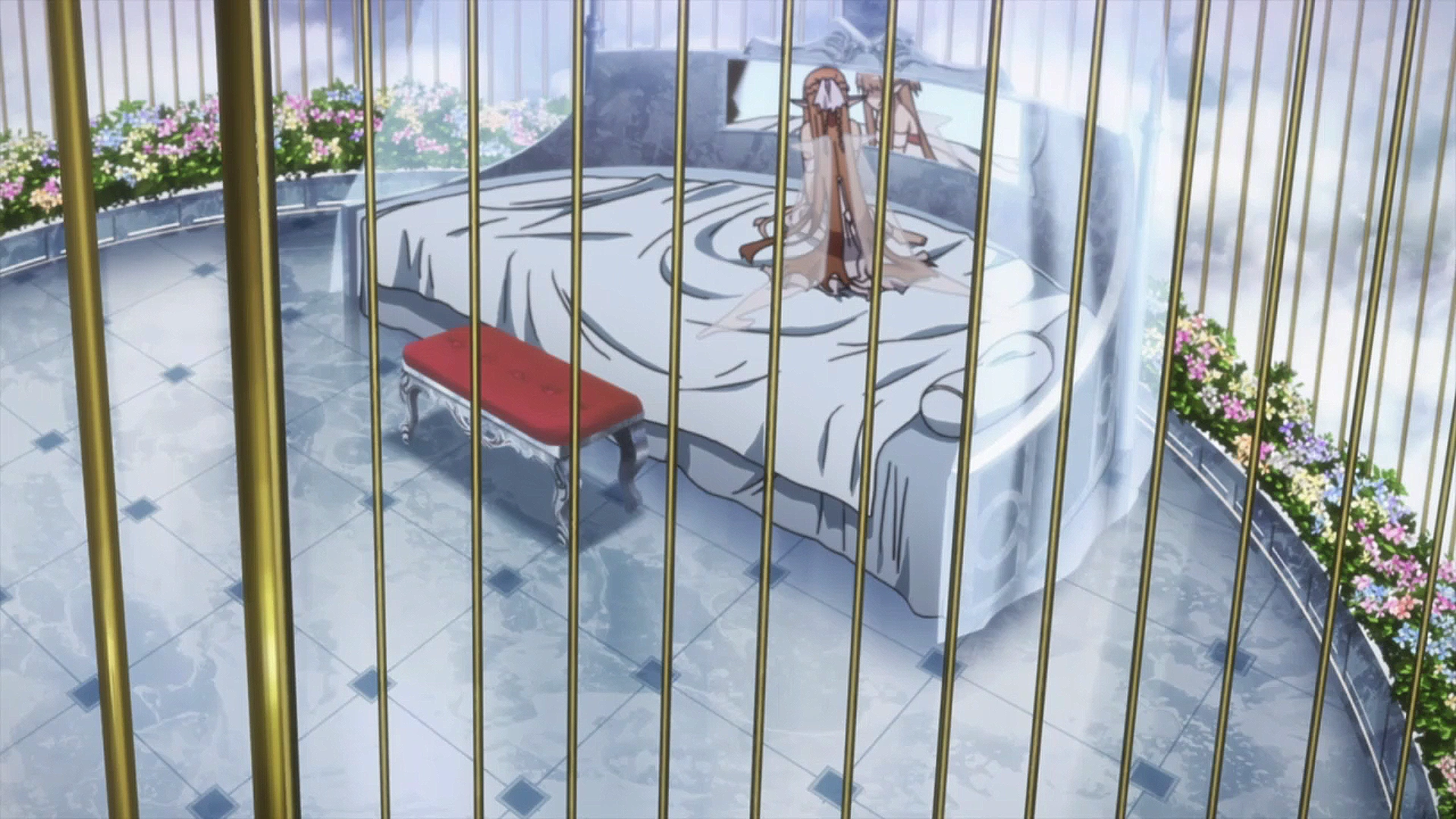
“It was that world she longed for now, even more than the real world that she couldn’t be sure actually existed anymore. When she realized that tears were coming to her eyes, Asuna shook her head to get her feelings under control. Kirito was waiting for her in the real world. The only place she truly belonged was in his arms. She had to keep moving to make that happen. This hallway was not quite so long, (57, vol.4).”

So the cage has warped Asuna. While she would love more than anything to fight alongside her best friend and lover, after all she’s gone through, Asuna would rather rest in his arms. Is that weakness? No, that’s what we call settling down, hence the cabin in Aincrad and her “motherly” stance after this season. She just wants to relax with her love and put this cruel mockery of gaming behind her. But, even in desperate times, Asuna is always strategizing and being sneaky, much like her old avatar. Time passes when reminiscing on nice, old, happy memories, which is why the current hallway she is pacing, though identical to the seemingly never-ending one beforehand, went by so quickly, and she’ll cling to these memories to pull through.

“Suguha forgot to breathe when she saw the girl sleeping on the spacious bed. For a moment, she thought it wasn’t a person. It must be a fairy – one of the Alfs, the true fairies that lived on top of the World Tree. Such was the otherworldly beauty of the sleeping girl before her, (72, vol.4).”

Hmmmm, you can put this one together without my help . . . Funny how things turn out, huh? The irony is dripping wet.
asunasleeping

“Asuna’s fighting, too. She’s doing her best to resist, to escape this world. There must be more that I can do, (87, vol.4).”

If Kirito’s not already got a sense of direction, then here’s his eye-opener. Asuna deliberately dropped a key card to them from above. She senses Kirito and Yui, and they sense Asuna. With passion starting to reignite, this is the excitement leading up to the fantastic, cataclysmic reveal! In other words, Suguha’s about to find out the cold truth that’s been staring her dead in the eyes.
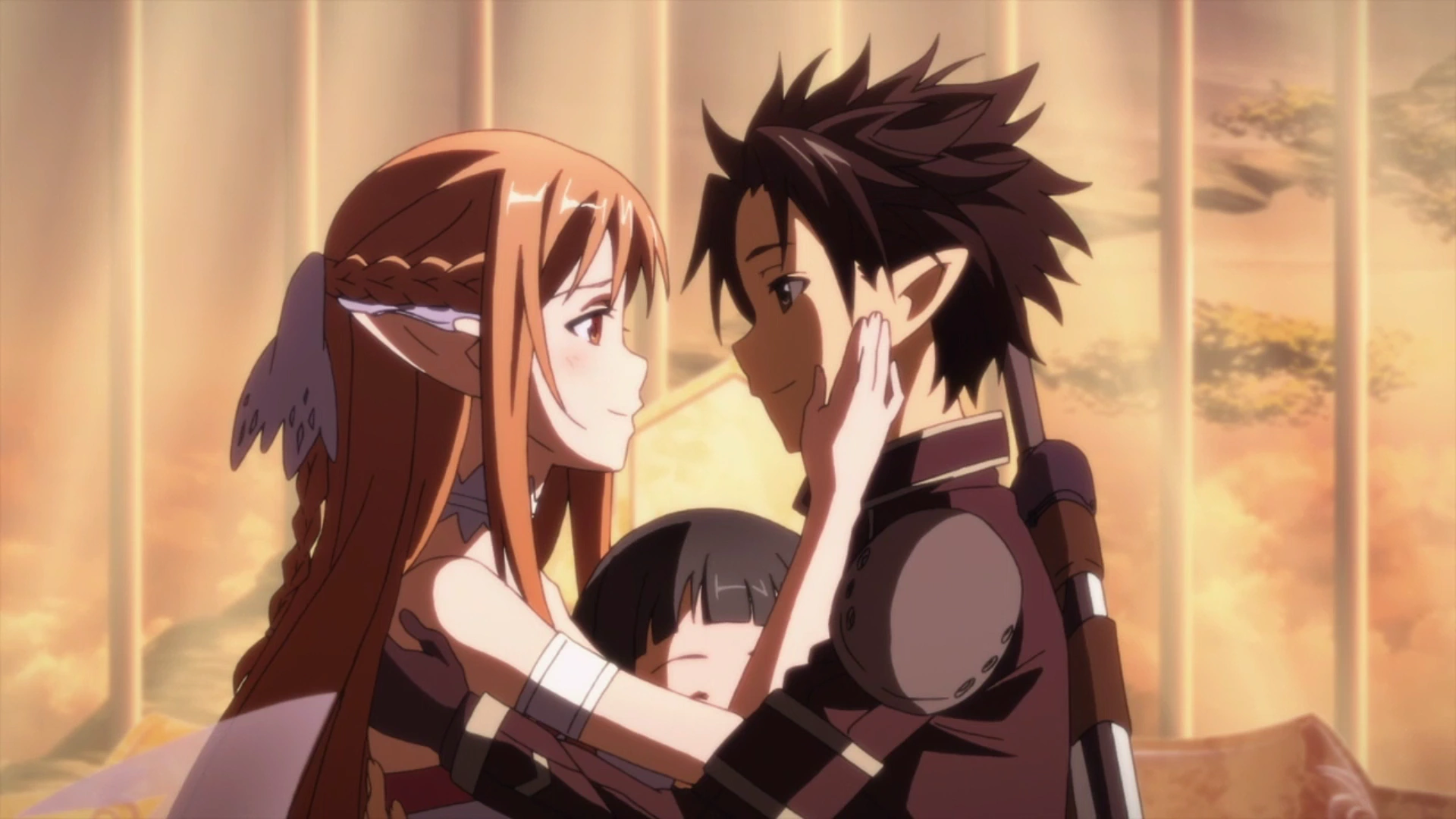
“’I always believed . . . No . . . I still believe. I did in the past, and I will in the future. You’re my hero . . . You’ll come to save me anywhere, anytime . . . (158, vol.4).”

From peasant fighter, to powerful knight, to heart-warming wife, to caged princess, to freed women, Asuna has grown reluctant to struggling anymore. She hardly recalls the SAO days, let alone her own real home life. The cage has brought unnecessary strife and resignation to the resilient fighter. The quote, however, implies with “I did in the past” that she depended on him, and this could be tracing back to as early as when he saved her guild, or even when they first teamed up, though unlikely. Point is, I’m not surprised that she is tired of carrying the torch. She’s by no means weak all of a sudden, just that the front lines are a place of the past now. Everyone can have a hero in life.

“Her thin arms were resting in her lap, holding a shining, blue, egg-shaped object. Her NerveGear. The crown of thorns that had held her prisoner for so long was finally silent, its job finished, (173, vol.4).”

This is a statement of closure. Do you recall Suguha in her final moments spotting her “shining crown ahead of her” to place it atop her head? Notice how they are both identified as “crowns,” but for different reasons. A crown of thorns is one full of burden, imprisonment, and painful sin; horns, almost. Meanwhile, Sugu’s shining crown is a halo that will transcend her into a free being with wings. Again, both are crowns, but they crown the wearer for drastically different reasons. I honestly wish the story ended here, rather than with Kayaba’s cheap RPG maker egg. This crowning glory where one bestows themselves with it while the other relinquishes it is much more symbolic, much more touching, and much more . . . dramatically ironic.

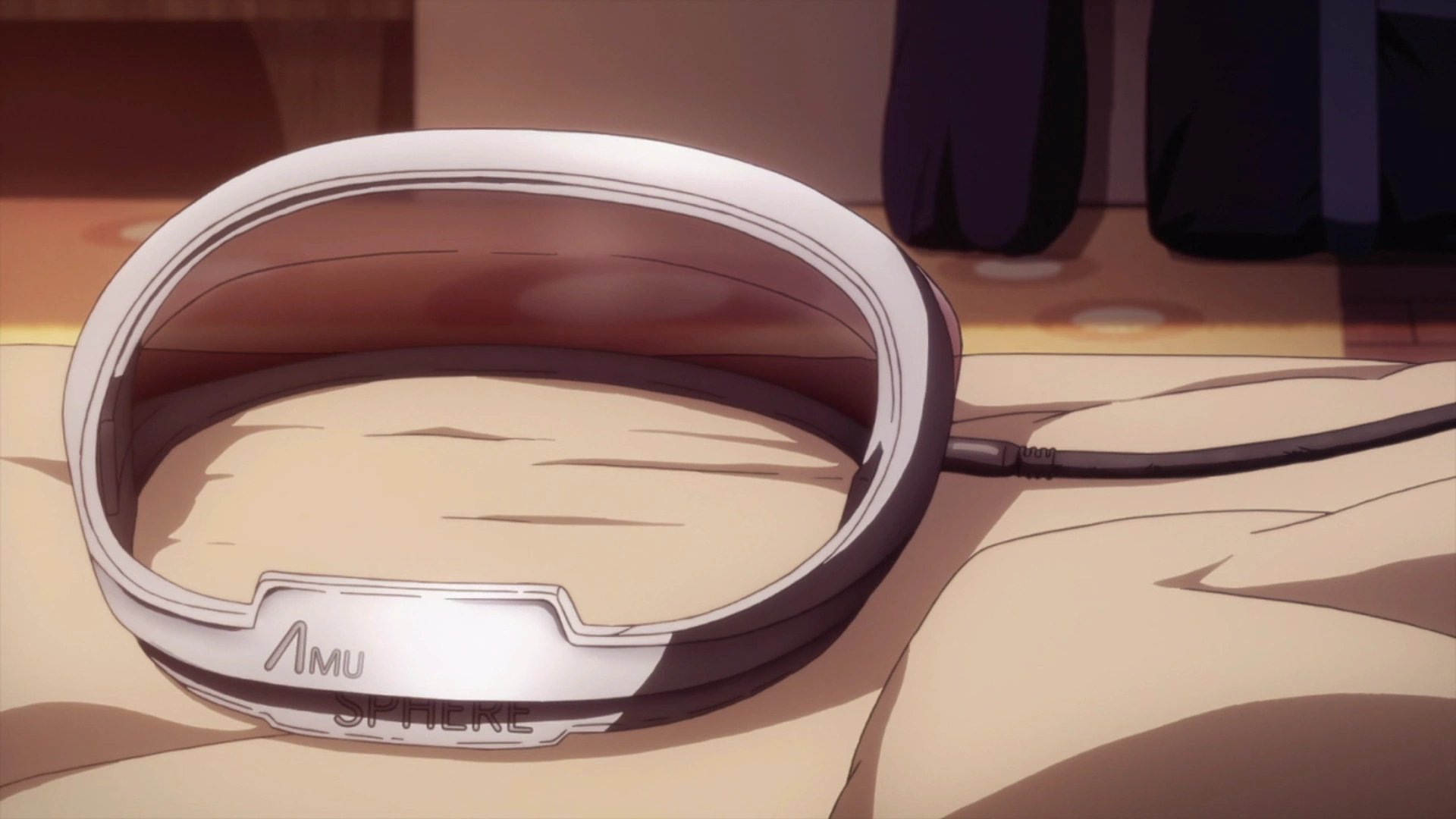
Thank you for reading! Please, share any thoughts below and stay tuned for PART IV!

(I own neither the anime nor the light novel series of Sword Art Online. All images and videos belong to A-1 Pictures and Reki Kawahara.)