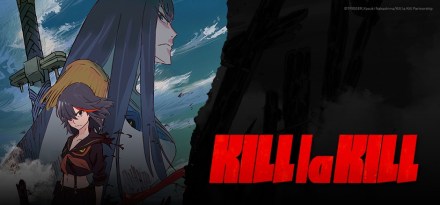
Kill la Kill Review

It’s been a while since I have been wowed like this. Mocha-quality Kill la Kill strips down a basic yet stupid idea, over sexualizes women, showcases butt-naked men, and gets rough, rowdy and ridiculous all for the sake of boldly venturing where not many anime go. The burning question at hand: “Why do humans wear clothing?”

Hot-blooded high school girl Ryuko Matoi is in search for “the girl with the scissor blade;” the same girl who killed her father. Her clue hunt has led her to Honnouji Academy, a militaristic school structured by the “Goku uniforms,” uniquely ranked suits that grant students superpowers. As such, there is a fine line drawn between the mighty and the weak. Law and order is maintained through the school’s “Elite Four” and their supreme student council president, Satsuki Kiryuin, who rules over the domain with unquestionable judgment and absolute authority.

As the unwavering Lady Satsuki and fierce Ryuko meet face-to-face on the bloodstained battlefield that is Honnouji Academy, the threads of fate begin to unravel, and the whole school – as well as the world itself – is at risk of destruction.

Starred uniforms that give students unimaginable power? Yep, it sounds stupid. Very stupid. But through countless fights against a variety of opponents, Kill la Kill makes it work. Why they were made, how they were made, and what they actually are made of are all concepts that the anime explores thoroughly. Don’t try to wrap your head around things – Kill la Kill is NOT a “concentration-necessary” show.

Though fast-paced, the show never seemed rushed. Starting from the fateful encounter, the series gradually builds up to about the ¾ point, after which like any other 26-ish episode anime, it becomes a dramatic and serious blaze to the finish! The anime never seems convoluted in plot and serves as a great storyteller.

Ryuko Matoi is our main heroine. She will do anything to uncover the truth about the powerful Scissor Blade and to avenge her father, including “sacrificing” her body to Senketsu, one of the most powerful sailor suits in existence. While she’s hot-blooded and eager to fight aggressively, Ryuko always seems have issues with Senketsu; the two struggle to agree on matters and as a result have bonding troubles. “Losing her way” would be the proper term to explain her conundrum.

But Ryuko undergoes numerous transformations that make her easily likable and somewhat old-fashioned. Her character reminds me of the typical heroine, yet one embodying the resolve of the classic male hero, too. Because we get to see both sides to her, feminine and masculine, Ryuko becomes a relatable and rather enjoyable lead female – one of the best I’ve seen!

On the other side of the coin is Satsuki Kiryuin, the commanding figurehead and rival to Matoi. A Machiavellian leader, Lady Satsuki is calculating, observant, influential, and above all, sexy. Her iron rule comes from her infamous tagline, which I’ll put in quotes at the end of the review.

In a very similar style to Ryuko, Satsuki exemplifies the feminine and masculine qualities of the archetypical hero. While I can’t leak too much for spoiler’s sake, I can say that she carries a softer side as well. Satsuki is brilliant and inspirational – a rare beauty and one of my favorite characters in general! “HAIL SATSUKI-SAMA!!”

The supporting cast can be broken down by simple goals and stereotypes. The Elite Four consists of 3-star fighters who serve and protect their Satsuki at all costs: the guardian, the fighter, the brains, and the little girl you should probably be terrified of. “Nudist Beach,” the organization opposed to the Goku Uniforms also resembles the usual resistance team.

One other character to point out is Mako Mankanshoku, a goofy, hyperactive student at Honnouji Academy. After literally diving into Ryuko’s life, the two become best friends. Even though she is the moe girl, Mako and her wild family stand as a constant reminder to Ryuko as to what a good family is. Mako is a bit too much at times, leaping in at the last minute to save Ryuko from inescapable doom, but beyond that she is entertaining, friendly, and loving.

Animation by Trigger – hate it or love it. The style is rough, extreme, and lacking in detail. It’s a great change of pace compared to the typical class room setting, however, the obnoxious bold lines sketched all over the place occasionally take things too far. Tension, comedy, and impact are perfectly-balanced strengths, shown best through the very first 10 minutes of the show. Sometimes the animation is very expressive and does the show justice, but other times it’s indistinguishable. The best things about the animation are the communicative facial expressions and high-energy fights. Trigger clearly wasn’t scared to show anger and explosive rage, as they hit that ball out of the park!

For the OST, this is by far Hiroyuki Sawano’s best work. Superior tracks such as “Blumenkranz” are pure evil (fitting for the f*ck-tastic villain Ragyo, might I add), while Satsuki Kiryuin’s theme or Jakuzure’s anthem match their character PERFECTLY. And as much as I hate Nui Harime, even her theme gave off this bizarre feeling of creepy. I NEVER got sick of Kill la Kill’s over-the-top, epic soundtrack! 😀 (PS: 2nd OP “ambiguous” by GARNiDELiA is really awesome)

The only possible turn-off is the surplus of fanservice. Naked men from Nudist Beach and Kamui crop-tops with miniscule panties are overbearing. The director probably wanted to attract as much attention as possible, and hey it worked; thin straps covering well-endowed breasts and sword-wielding beauties? Yep, that’ll stop traffic. But also consider this: the show rebels against clothing, so doesn’t the nudity in a sense support the main message . . . ?

Kill la Kill is great because it is not afraid to show some skin and express itself boldly, however brash it seems at times. It doesn’t hold back when it comes to furiousness, fiery combat, or majestic speeches – it let’s all hell loose, and it’s fantastic. I full-heartedly recommend Kill la Kill for an awesome story, memorable protagonists, and the best rainbow-haired, purely evil antagonist IN EXISTENCE – just get past the nudity first and you’re golden! If you like action and overwhelming emotions please do yourself a favor and check it out. Its nearly mindless-fun approach to storytelling might intrigue you.

“Fear is freedom! Subjugation is liberation! Contradiction is truth! Those are the facts of this world! And you will all surrender to them, you pigs in human clothing!” – One of the greatest leaders to live, Satsuki Kiryuin

Thanks so much for checking out my thoughts on Kill la Kill! I love this anime so much it’s crazy! IT HAS A VERY SATISFYING ENDING. If you enjoyed the review, hit that like button – I’d really appreciate it. Feel free to drop a comment below, too! Until next time, this has been

– Takuto, your host
Ben-To Review

While ramen bowls and instant rice make for a quick, cheap meal, the premade bento box featured in grocery stores is the dinner for kings – some say it’s even to die for. Today, an anime centered on retrieving that ultimate dish not only for the driving guts, but for the incomparable glory.

Yo Sato, a high school pervert who revels in playing old SEGA games, decides to purchase a bento box from his local grocery store when he realizes that was his first mistake. Waking up from his unconscious state, he sees that all of the bento are gone. “Wolves,” intense brawlers who live thrive for the taste of a half-priced bento fight in the store until only the mighty survive. Yarizui, the “Ice Witch,” is the head of the Half-Pricer Club at his school, and upon his cold knockout, forces Sato to join the club and to enter the battle of the bento!

Taking an unnecessarily serious approach to the art of low-budget dining, Ben-To is hilarious. There really isn’t much more to say. It is a pure comedy, lacking any dark history or overly dramatic plot twists. The show is perfect for “rinsing your anime palette,” especially after watching something really intense.

The characters are also light-hearted. They each have their own unique names they are coined for: “Ice Witch,” “Lady of the Lake,” “Wizard,” so on and so forth. Over the course of the show, you begin to realize how they got their name, their concentrated strategies and styles, but most important, their motive and willingness to fight – the honor of the bento. None of the characters come from a distorted past, meaning that they are pure enjoyment! That’s not to say that “what you see is what you get,” however; you’ll be surprised by the interesting personas provided by each character.

It’s also amusing to watch the stereotypical archetypes duke it out in what? A grocery store. The quiet girl, the perverted girl, the ordinary high schooler, the “older sister,” the twins, the leader type – it all works, and it’s fascinating! J

I’ve never seen animation by Production David, but they did a fine job with the dramatic brawls that unfold in the store. And while the characters look really beautiful up close, specifically the eyes, even a couple feet away from the viewer the characters’ eyes appear really spaced out/messed up. It becomes distracting after a while, and during a few of the softer moments it kinda trashes the overall appeal.

Interestingly enough, the OST for Ben-To features many brass instrumentals, which is a cool change in music compared to other anime. For those who’ve seen it, it’s reminiscent of C: The Money of Soul and Possibility Control.

The saucy opening “LIVE for LIFE” by Aimi matches perfectly as far as lyrics and context. The in-depth views of characters in the supermarket make the scene look very busy, and in the anime, it most certainly is! In contrast, each day concludes peacefully with the ending, “Egao no Housoku” by Mariya Ise, featuring a soliloquy-esque spotlight by the cerulean-haired red-eyed babe Yarizui.

There is plenty of ecchi scenes and fanservice, and while I’d like to say it’s for the girls, for a change it’s actually for Sato. Oshiroi, the perverted girl and innocent classmate, never stops shipping Sato with the other boys and older men in the series. She reminds me of Rikka from Haganai. Characters such as the student council president or the head of the judo club also have a bolt to pick with him. As a guy, the natural hatred by the setting followed by the slow growth to fondness is comical. Besides this, there are still plenty of skin-revealing scenes for everyone, so yeah . . . awesome.

There isn’t really much else to add besides the known fact that Ben-To is a must-watch comedy series. The ”shop till you drop” story makes for fantastic hand-to-hand combat, my favorite being Shaga, though I also like Yarizui, and it never loses its touch. Though the show’s not family friendly because of the platefuls of fanservice, it’s definitely a great watch after a really sad/dramatic or intense thriller anime. Ben-To will make you hungry, so why wait? The laurel wreath sticker has been placed, the “Wolves” are ready at their marks, the doors close, finally BAM – it’s time to dine!!

“Say your thanks before you eat.” – Sen Yarizui

Thanks for checkin’ out my rather quick review of Ben-To, a comedy action series booming with fun! I have not seen the dub yet, but I love Trina Nishimura, so yeah, got to check it out. Please give me a like if you enjoyed the review, as it makes my day! Until next time, this has been

– Takuto, your host

Date A Live Review

So I crossed this show when I saw some of its key visuals: a powerful warrior clad in a violet, pink and gold-armored dress, with hair of a rich purple hue. Some know her as Tohka, but she’s also known as the girl who was revoked by her own show. Today, a shambling show of plot, yet a decent display of boobage – Date A Live.

Itsuka Shidou is yes, your average high school student. He lives a normal life with his red-headed little sister Kotori, despite him having bold blue hair (she’s got to be adopted). His life is disrupted, however, when another “spatial quake” explodes in his city, causing mass destruction and panic to spread.

These spatial quakes bring Spirits, mystical and powerful beings of unknown origin, coincidently hot/cute chicks. His sister also just happens to be the commander of an Anti-Spirit Team aboard the Fraxinus. As she and the other crew have analyzed, the only way to seal the powers of the Spirits is by making them fall in love with Shidou – and by giving them a kiss. “Kill or kiss the world,” as they say! Failure to accomplish the mission will be met by deadly firepower from the AST’s flying powered suits – worn by half naked women, might I add.

Date A Live is a harem, romance, action, school, comedy, mecha, sci-fi . . . so on and so forth . . . anime. It poorly jumps around between being absolutely serious, bat-sh*t crazy, and fluffy as daily life can be. I enjoy really dark, thoughtful, and intense anime, with a few slice-of-life scenes splattered during the appropriate times – and there are a couple of crafty surprises packed within the show. But this anime is not organized with its plot whatsoever.

Recall that scene from episode 3, the one where Tohka and Origami face off and she accidentally shoots/kills Shidou? That was easily the best moment of the anime; it was second to Kurumi’s creepy assault on the humans in the woods. Too bad the end of the series was met with just a mech fight (not hating on mecha anime or anything, but seriously). – _ –

Also, I don’t really see how the dating sim system the AST uses is helpful. By the time everyone reads the three weird options, votes on one, and tell it to Shidou through ear piece, the moment is long gone and would be too late to respond to questions. But whatever.

Besides Shidou having a really cute face, he’s just the boring middleman between the Spirits, taking in and returning expressions of “absolute concern,” because you know, he’s the good guy. I suppose he can be comical at times, and he’s not an annoying protagonist too, which are pluses, but yeah, he’s not anything new either.

I could sit here and talk about each of the Spirits and how “different” they all are, but really they can be grouped by stereotypes: Yoshino, the shy and quiet girl, Origami, the secretly-in-love-with-classmate, Kurumi, not gonna lie, a decent villain yet tossed to the side the last couple episodes, Kotori, the little sister, and that just leaves one girl – Tohka. While they are all entertaining, comedic, and cute (with great curves :3) they lack the flushing-out that I enjoy most.

Tohka is the first Spirit we are introduced to. She’s tsundere at first, but develops into waifu for Shidou. It’s similar to Asuna from SAO, though Asuna is a much better fighter and character! Anyway, not only does Tohka have a heart-warming food-consuming personality, she also has a beautiful design. When I think about it, Tohka is just Saber (Fate/Zero) if Saber did not have such strict social contracts binding herself. I love the purples, pinks, light blues and golds on her armor and in her sweet eyes!

Yet the one thing this anime had going for itself was put to the side because WHO THE HELL KNOWS. Tohka is a great fighter and by this point she is the best character, so why dump her? For the other girls I guess, but it ain’t worth it. After episode three, Tohka doesn’t get the spotlight again until the end; that’s +6 episodes of Tohka just eating and sitting on her ass. A shame.

This was the high point for the show – the animation by AIC Plus+. Again worth mentioning are the superb character designs, but additionally the sharp and colorful background scenes. I can’t recall low quality of any kind from this show, so a round of applause to them! The only thing I could complain about are the fight scenes, which rarely happen – and I’m talking all-out fights, not a missile launch here and there. The action sequences featuring the dominant Spirits clashing with the AST units are spectacular, but sadly few and far between.

The soundtrack was a real surprise for me. Not only are the daily life scenes well-supported by casual themes, but the dramatic sections are gorgeous and truly melancholic. Anthems for battle ring with a full on orchestra plowing down the field, and intensity is never lost by the OST.

Infamously known, the opening “Date A Live” by sweet ARMS quickly catches attention as an opener. Its passionate choir vocals along with an addicting melody are a great way to start each episode! The ending second “SAVE THE WORLD” by Iori Nomizu is also so catchy! I’m quite attached to them both!

But great background music and quality detailed animation won’t save the failing date that is Date A Live. The show brings nothing new besides its unique yet unorganized story idea, and if you’ve already waded through several harem anime, then you’ll know all of the ins and outs, getting more and more tired of this show’s determination to be something it’s not. If you are not a critical viewer and are simply looking for time to blow on an action/romance with comedy, impressive fights, and fan service then this is perfect. Otherwise it doesn’t live up to the hype.

“Just killing and killing and killing? You deserve to die and to die and to die.” – Tohka Tatogami

Yeah, bummer, it was disappointing. However, there is a second season, so I will be checking that out soon. Since I watched it in subs, I hear the dub for Kurumi is really awesome, so I might give that a watch too . . . if only I could ever find the time. Thanks for reading – slap that like button if you enjoyed my review and until next time, this has been

– Takuto, your host
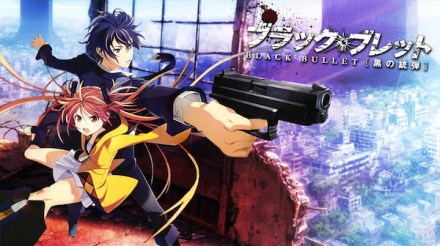
Black Bullet Review

The apocalypse cannot be summed up in thirteen episodes, especially when half of those episodes are pointless loli fights.

In the near future, humans have been defeated by the giant viral insects called the Gastrea. Shortly after, mankind created Varanium, a weakening metal that is immune to the virus and wards off the Gastrea effects. Black Varanium walls were erected around the Tokyo area to keep the insects out, but the real toll has already been taken in the form of the “Cursed Children.” Due to Gastrea infecting the mothers, Cursed Children were born as red-eyed girls with superhuman powers.

Satomi Rentarou lost his family to the Gastrea in an earlier war, and because of his hatred for them ended up joining Tendo Civil Security as a Promoter, one of the many organizations fighting against the Gastrea. Teamed up with his loli partner, Aihara Enju, the two receive requests from Tokyo’s leader, Seitenshi-sama, that involve protecting her from harm’s way, managing public safety and of course, killing off the Gastrea with their black bullets.

I expected this series to be an action rom-com, similar to Aria the Scarlet Ammo, and I got that impression, that is, from the first half of the series only. The first half follows Rentarou and Enju beating up all who oppose Seitenshi-sama. There are comedic scenes, decent character development and yeah – just pretty laid back.

But around episode eight or so, the government gets involved, and we all know what happens then. Our little fights become all-out war and by then the show isn’t even interesting anymore.

And for a show about the Gastrea, they never show up in the city after the first episode, so I don’t really know what genre to classify this series as. Replacing the Seitenshi-sama bits with in-town Gastrea fights would have at least kept the consistency of the overarching plot.

At least the anime does a decent job at defining the discrimination between ordinary citizens and that of the red-eyed Cursed Children. I got really emotional when any of them died, but maybe because they are only little lolis. Still sad stuff though!

The only characters worth mentioning are Enju, Rentarou and his boss, Kisara Tendo. Enju constantly asks to marry Rentarou, but we never really find out why – or at least it’s not memorable. Other than that flaw she’s pretty cute, innocent, and a kick-ass fighter!

Rentarou’s only redeeming quality is the fact that his voice actor is Yuki Kaji (Shu Ouma, Eren Jaeger). He does such a phenomenal job at capturing the youth male in an expressive and active manner. Towards the end, I only watched the series for Kaji’s amazing acting.

Kisara is . . . hmm, Rin Tohsaka? Pretty much, only that Tohsaka’s a billion times cooler. They belong to involved families, aid the protagonist, act somewhat, and I say this lightly, tsundere, and they both look the freakin’ same.

But I still liked Kisara. She and Rentarou actually push the romantic level in this series to a point where I was satisfied, and not overdone. Her end, though, makes me question her bi-polar-ness. “I am evil.” What the hell?

The reason I started this series was for its animation by Kinema Citrus Co. I love the bright colors and matching pallets on the characters. Eyes, hair, clothing, boobs – just everything was nicely done. The only problem was the cheap CGI animation in the Gastrea. They seriously look like dumb indistinguishable blobs.

As far as sound goes, the OST is pretty vivid. A variety of different styles were used to caption the different moments. Techno, choral, orchestral and even Western-inspired tracks were present. Emotional death scenes are well supported by the soundtrack. I can’t really complain.

Now the opening –I love the J-pop band fripSide after hearing them perform the openings for A Certain Scientific Railgun and its sequel, but their new song (the opening) certainly raises the bar. “Black Bullet” (original, I know) amplifies itself with rushing choir chants similar to Attack on Titan’s second opening, and it’s such a catchy beat. CHECK IT OUT!

The ending, “Tokohana” by Nagi Yanagi, also deserves a shout out for its haunting glow. It subtly captions the cries of the Cursed Children. I bow to you, Nagi Yanagi.

At its end, Black Bullet finishes with an epic fight, yet ultimately resolves nothing. I guess the Cursed Children get it good, but Kisara only gets a start to her story. Along the way, the show answers no questions, adds new ones, and just fails to explain anything. Had the last ten minutes specifically been taken out then I could have made an enjoyable experience out of the whole thing, but sadly, no.

I guess Black Bullet falls into the trend of “good animation, unexplained plot,” similar to TRINITY SEVEN that I recently finished. If the anime just answered its own problems before adding new ones – antagonist Kagatane, I’m talking to you – then again, I would have had a lot of fun with this series. And because of its lack in explanation, I can’t really recommend this anime. Perhaps if you enjoy loli combat, colorful animation and fripSide, then go ahead. Black Bullet had something going, but shot too many holes in itself by the end. “The scariest thing about killing people is getting used to it” – Satomi Rentarou

If you had similar or even favorable thoughts on Black Bullet, feel free to leave a comment below! I want to know if it was just me who was unsatisfied. Thanks for reading, have a good one, and until next time, this has been

– Takuto, your host

Psycho-Pass Review

I haven’t watched a lot of “good” sci-fi anime, for instance, Ghost in the Shell. Because of that I can’t really preach in this department. I have, however, seen a couple of works by Gen Urobuchi, so I kinda expected your average themes to be turned on their heads in the dark and thrilling anime that is Psycho-Pass. But does it live up to the reputation?

Set in the near future, law and order are maintained through the Ministry of Welfare Public Safety Bureau. Behind the scenes, however, is the all-knowing Sibyl System, a complex system that can quantify any person’s state of mind or personal tendencies. Once this number, one’s “Psycho-Pass,” becomes cloudy in hue and their “Crime Coefficient” reaches too high in count, you’re pretty much screwed.

As such, simply thinking about crime is enough to earn you a lifetime behind bars or even death.

Justice is served through the Dominator, a destructive weapon connected directly to the Sibyl System’s judgment that can either stun or instantly blow someone to smithereens if fired. Though, if Sibyl deems one’s Psycho-Pass clear or low in number, then the Dominator will enter safety mode and ceasefire.

Two divisions exist between maintaining this peace: Investigators, who are tasked with unraveling civil cases and Enforcers, contained criminals who chase down the target(s) in the Investigator’s stead so that the Investigators’ Crime Coefficient remains a healthy number.

Akane Tsunemori is a newbie to the PSB. She lives a simple and idealistic life granted to her by the Sibyl System, yet slowly begins to question its judgment throughout her career as an Investigator. Even though she can be naïve at times, Akane never comes across as weak, as she quickly adapts to the new, shady lifestyle as a detective.

Many people ignored Akane, dismissing her because she was boring and dull – realize that this was Urobuchi’s goal! In the beginning, she is meant to represent your average, clean citizen. But like anyone would, she changes as she discovers the secrets behind Sibyl. I was drawn to her scenes and found Akane to be a very great lead character.

And yeah, her eyebrows are jacked up and her haircut is styled kinda funny, but people this is anime – at least she has a few stand-out characteristics instead of being some indistinguishable moe chick.

The male lead is hunting dog Shinya Kougami, a rough young man who was once a talented Investigator, but because he got too invested into a case regarding the series’ main villain, his Psycho-Pass became cloudy. As a result he was demoted to Enforcer status.

Akane and Kougami share a unique and respectful relationship, for the two get close enough to understand each other, yet never get romantic or lovey-dovey either. In the second half or rather last few episodes, Kougami splits off from the crew in an act of challenge against Sibyl to hunt down the antagonist, Shougo Makishima. Because of that, along with her recently acquired knowledge of the truth behind the Sibyl System, Akane must step up her game as a leader. I am quite fond of both Akane and Kougami’s balancing act.

The rest of the PSB’s Unit 1 include Ginoza, the statistical Investigator who follows the Ministry of Welfare Chief’s commands, usually no matter how messed up; Masaoka, a worn-down Enforcer who receives gracious amounts of screen time despite his roll; Yayoi, an ex-musician who only gets an episode to herself then is tossed to the side; Shion, an analyst for the PSB who is presumably a lesbian; and finally Kagari, a rebellious joker who lacks any kind of characterization besides one scene with Akane, in which we find out that he was taken in at age five.

Yep. You heard me. He could barely read and write before being written up as a criminal. Messed up sh*t, this system is.

All in all, the cast is well supported, giving off a vibe similar to that of Black Butler’s characters. My only problem with them is their lack of background information, though it’s not really necessary to fully enjoy the show.

The animation by Production I.G does a great job at drawing the line between the cleanliness of this utopian society and its corruption behind the scene. Action scenes are well choreographed and quite entertaining. The concept art for the Dominator is deadly yet sophisticated, too!

Thing is, as a whole the animation tone is quite drab. Neutral colors are used so often that no other emotions pop out. I suppose it does its job, but it could have shown more color (for example, all people have the same pasty white skin).

On the other hand, the OST enhances drama, suspense, and all of the action. The OST includes everything from dubstep and techno for fights, blues for laid back moments at HQ, and thoughtful, curious beats for mystery. Hats off to “Kansatsugan.”  Excellent stuff.

The show’s first opening, “abnormalize” by Ling Tosite Sigure, depicts rapidly flashing visuals reminiscent of Guilty Crown’s opening. While this first opening captures the law and order side of Psycho-Pass . . .

The second opening, “Out of Control” by Nothing’s Carved in Stone, questions that same justice, and instead focuses more on chasing down the enemy.

These are very fitting openings, as they accurately symbolize both halves of the show.

Half one establishes the laws and rules of society, what is wrong and what is supposed to be right. Build up is met through confusing mystery cases that try to establish mood, setting and characterization.

The latter half dives into the burning question behind Psycho-Passwhat is justice, and what is humanity willing to risk for a utopian world, if even achievable? Makishima, the mastermind of all evil, seems to be able to bypass Sibyl’s judgment by containing his emotions, even though he commits multiple crimes and murders. Is it really that simple to undermine the great and mighty Sibyl?

Psycho-Pass is a show that, although implies a very cool setting, never manages to reach the heart of things. It encompasses a powerful system of understanding and is even a likely future for humanity, that is, if we just go along with society’s ways. I just wish there was more depth to this anime – in all categories.

Nevertheless, Psycho-Pass is an outstanding and notable piece of science fiction. It does contain a fair share of gore, however, so it’s not for everyone. Otherwise, I recommend this series to those willing to challenge the boundaries of the human mind and psyche. It’s thrilling to the end and I enjoyed every bit of it!

Part One and Part Two of Psycho-Pass, with a nice dub by FUNimation, await the order from the Sibyl System as to whether I should blow up my own brain after watching this series to protect its true identity . . . “Your Crime Coefficient is above 165; Destroy Decomposer enabled. Carefully aim and destroy the target.” – Dominator

Whew! I had a lot to say about this anime. Thanks for reading and hit that like button if you, well, liked this review! Follow for more reviews and until next time, this has been

– Takuto, your host

selector spread WIXOSS Review

I should be able to watch a season one and if I didn’t care for it – or was satisfied with what I saw – no big deal. I can drop the series, yet still retain a complete story given from the first season. Sequels are follow-ups designed to add more character depth, continuation of new plot (if any), answer lingering questions, and build upon/improve the first season if need be.

I usually find myself disliking sequels, however. They either make or break my impressions of the first season even though they should be just as good, right?

Season one, featuring the dark fantasy card game, selector infected WIXOSS, leaves off on a very large cliff hanger. As such, its second season presents more of a continuation rather than a whole new idea. I had to continue selector, whether I liked it or not. So while ‘sequel’ might not be the correct term for this season, selector spread WIXOSS is nonetheless twisted, thrilling, and overall successful. Though keep reading to find out why.

selector spread WIXOSS picks back up on Ruko, a distressed WIXOSS player who had recently lost her LRIG, Tama, to the wicked Iona in their last fight. Things are also different now, as Iona has become Ruko’s LRIG, and Tama has supposedly been swept away to the “White Room.” Without one of her closest friends, all seems lost for Ruko. She quits battling for a while and even ignores Iona. That is until she and her other friends begin to unravel the darkness surrounding the selector games by visiting the creator and author of the WIXOSS book series – a series that has already foreshadowed the fate of the girls.

Already the premise of this season is ten times more intense than the last. Ruko must cope with her worst enemy, which requires forgiveness on a whole new level. Their current relationship forces the two to come out of their shells, providing the much needed depth missing from the first season. It’s a good kind of weird feeling ~

And their meeting with the author of the accompanying novel is like chatting with that of a god! It was just such a clever and well-thought out solution to the girls’ issues. But although helpful, there were still many questions surrounding their minds at the time.

There is also a shift in character leads. Akira (my fav from last season), Tama, Iona and Mayu (hinted at the first season) all receive major development and backstory. Akira on a psychological level whiles the others on a more emotional level. The supporting characters also hop aboard the improvement train; Chiyori and her LRIG, Hitoe’s current LRIG and friend Yuzuki, and Ulith become crucial contributors to the plot. Even Ruko rounded out nicely – and I was satisfied with her already! Character development was well executed in this second season.

For the main part, the animation (J.C. Staff) remained just as boring and dull as it was in the first season, the only exception being the furious battle scenes and Mayu’s “White Room.” The shady atmosphere and bright magic attacks contrast brilliantly on the battlefield. Mayu’s world encompasses light pastel patterns followed by glimmering shapes and stained glass works on the vast walls. I Love the concept design for this room, and when Mayu seems particularly angry, she shifts the room around to her pleasure. Quite cool indeed.

OST-wise, it’s the same dubstep and techno groove the first season sported. There are a few more dramatic tracks for the new developments, but otherwise it remains decent at best. I say decent because while the battle scenes are awesome, daily life or casual scenes are very empty and unfulfilling. The new opening, “world’s end, girl’s rondo” by Kanon Wakeshima, rivals that of the first in terms of powerful string melodies, upbeat tempo, and sauciness. I love them both sooo very much! The songs represent the world the selector series paints, and the new ending, “Undo –Ashita e no Kioku-“ (Undo –A Memory For Tomorrow) by Cyua also follows that trend.

At first, selector infected WIXOSS is too easily compared to Puella Magi Madoka Magica, for they both support the same twisted and dark themes behind the magical girl genre. But after selector spread WIXOSS, I can officially say that the series continues to step away from Madoka’s shadow to create a purpose and end for itself. I recommend all of the selector series to anyone! The card game part of the series is also further explored in this sequel, so never fear that aspect. WIXOSS is different, and deserves so, so much more. “We cry OPEN!!” – opening lyrics

Thanks for reading and I hope you enjoyed my thoughts over selector spread WIXOSS! FUNimation Entertainment will be releasing an English dub on blu-ray and DVD later this year, and I definitely plan to pick up both seasons. Check out my selector infected WIXOSS review if you haven’t done so already! Have a great one and until next time, this has been

– Takuto, your host

Sword Art Online II (Caliber) Review

Following the much dragged-out Phantom Bullet arc is the Caliber side story arc. This will be my brief thoughts about these few high-spirited episodes.

Kirito and Leafa discovered the legendary Holy Sword Excalibur a year ago, but could not acquire it due to guardians blocking the path. Well recently, towards the dawn of New Year’s Eve, Suguha discovers that the “Caliber” quest has been unlocked to the public. Kirito immediately bands with his friends Asuna, Klein, Lisbeth, Silica, Sinon, and his sister’s avatar Leafa to conquer the castle Thrymheim in Jotunheimir and claim the most powerful weapon in ALO before the year is up!

The whole GGO experience lacked the traditional SAO feeling of ‘playing’ in a game, considering the high stakes. Now, Sword Art Online II brings back the basic concepts of gameplay to add a very crafty and cool mechanical undertone. Many people do not like ALfheim Online, and for obvious reasons I can understand why, but this arc doesn’t dig up those brash emotions and opinions for the Fairy Dance arc; this here, fellow cafe-goers, is traditional RPG, and with its playful references to game terminology envisioned in unique, colorful and appealing animation. This change of pace is absolutely necessary to Kawahara’s planned plot progression and character development, whether we like it or not. Besides, it’s just the characters doin’ what they do best and love!

It’s always wonderful to see the older characters, but I have to spotlight Sinon and Asuna in particular. Upon entering this new fantasy world, Sinon dons the Cait Sith cat attire, complete with cute little ears, and becomes flying fan service! She’s not all fluff, though, as she uses a magic bow to target enemies from far away. This subtle yet crucial decision is very befitting for her sniper-like character.

And Asuna, dayum! She is given the front lines for parts of the fight against King Thrym, pulling out hidden rapier for combat, and might I say that Asuna battles with the swift furiousness of a true KOB commander once again; however, it’s not quite enough to make up for her time served as “Titania.”

So if ALO is a Norse-based world, then why the hell Excalibur of English legend?! The World Tree design in SAO is by far favorite, and the consistent “-heim” worlds add to the Norse feel, but I don’t know why they chose Excalibur; is there no other legendary weapon from Norse Mythology?

*spoilers ahead* Now this side story was pretty mediocre, so what made me change my view was the way Sinon let it end, or rather, didn’t let it end. Thrymheim begins to collapse, and ultimately Kirito is forced to leave the heavy Excalibur behind. Sinon, disagrees, and whips out her bow, calculates distance, takes aim and fires a retrieval arrow at the holy sword, hoisting it back up by a magical rope then giving it Kirito as a token of remembrance in her honor. This on-the-spot action was just so freakin cool, as it made the whole arc worth it. Seriously, Sinon is waifu material :3

Last thing to mention was the new opening, “courage” by Tomatsu Haruka, Yuuki Asuna’s voice actress. It is matched in its fast beat with crisp, brightly colored visuals of Alfheim and the characters. It’s a really respite-filled and cheery song, so give it a listen!

Thanks for reading! Check out my Sword Art Online II (Phantom Bullet) Review for more thoughts on SAO’s fun and adventurous sequel. You can watch the entire anime for free at Crunchyroll. Till next time,

– Takuto, your host

Sword Art Online II (Phantom Bullet) Review

It’s funny that I do this review before the prequel, but it’s been a while since I’ve seen the first season and I didn’t want to half-ass a review. Enjoy ~

It’s been one year since Kirito escaped the deadly game that is Sword Art Online. Meanwhile, ALfheim Online has gained much popularity, for it serves as a peaceful outlet for Kirito and his friends to escape from real world troubles.

Evil doesn’t die so easily, though. Roaming around another famous VRMMORPG by the name of “Gun Gale Online” (GGO) is “Death Gun,” a cloaked man rumored to kill individuals in real life through the game’s avatars. Kirito once again risks life and limb through virtual means to apprehend the mysterious assassin, but he’s not alone – the best sniper in the game, Sinon, with her highly destructive PGM Ultima Ratio Hecate II, proves worthy of battle herself in this world of guns. As the world tournament Bullet of Bullets commences, Sinon, Kirito, saber in hand, and Death Gun enter the arena among many other foes, guns locked and loaded.

After the events of last series, SAO had a little repairing to do, and GGO was the best tool to do so. This arc in the light novel series by Reki Kawahara made up for the lack of action and strength in the first season’s Fairy Dance arc. Phantom Bullet reminds us of the quality characters and themes that the SAO series was famous for; a powerful sequel that matches the strong will and survival feel of the first arc, Aincrad. Sword Art Online II is engaging and thrillingly eerie through to the end of the arc.

Kirito logs into GGO as a . . . girl? Yep, and it’s just great. His particular model possesses long dark hair, and his breastplate, well, yeah, adds emphasis. While he continues his unwavering badass style, he crumbles when he finds out that Death Gun must be a member of the “Laughing Coffin” guild, a player-killing group from SAO. The vibe from the first season returns as Kirito realizes that he could actually die in this harsh, cold, foreign world. He starts to recall haunting memories of the PK-ing he committed himself when fending off the Laughing Coffin members. This new revelation builds on past his one dimensional superb fighting skills.

Asada Shino is weak, quiet, and had shot someone when she was very young, and that terrifies her. She can’t even hold a weapon without trembling and then vomiting. But in GGO – a virtual world, she’s not actually killing anyone, so she masks her fears through Sinon, the cerulean-haired, lime-armored heroine. In the gun world, she’s stronger, faster – better. She doesn’t have to worry anymore, because Sinon protects her and fights for her. Sinon puts a new spin on “the will to fight” that makes her my favorite character. When she meets Kirito, she thinks they are both girls, and acts in a friendly manner, but quickly goes tsundere when she finds out the truth.

Kirito and Sinon balance each other out very well – I couldn’t have asked for better pairing besides maybe Asuna, who supports Kirigaya Kazuto on the other side of the amusphere. Sinon does, however, fall to Kirito’s irresistible charm when she becomes weak, but hey, that’s just her real-world self breaking through, not a whole new and sudden change.

I would tell anyone to watch SAO for the character costume designs alone because holy sh*t this is where it’s at! Match these colorfully crafty armor and weapon designs with fluid visuals pumped with action and A-1 Pictures really has something going on! As mentioned previously, there are many more battle scenes in this sequel, and quality never dipped once. The landscape of GGO is give a desolate color palette to that of a ruined desert city. Graphically and artistically, the anime does take me to the mature and virtual world of GGO.

Yuki Kajiura adds to this unique universe by providing an adventurous soundtrack. There’s not really much to say, as it is still just as amazing as the first season’s. She did, however, take the “Survive the Swordland” track, the epic main theme, put it on flute, and up the tempo to add a new sense of glory to the Kirito and Sinon action. Nice 🙂

While the opening “Ignite” by Eir Aoi was befitting for a show with this quality of animation, the true delight is in the lovely ending, “Startear” by Luna Haruna. It features Asada Shino young and old along with her avatar, Sinon, providing a reminiscent feel of childhood and maturation.

Sword Art Online II is a strong follow up to its first season, as it contains much action, brilliant music along with fluid animation, and reminds us of the themes the very first arc held. I recommend all of the SAO series to young viewers because of its genuine romance and characters. While more mature viewers might get bored of the concept , I still recommend this season for its high quality animation and soundtrack. This second series definitely lives up to the hype, so I’d get aboard the SAO train before it’s long gone.

You can watch all of the anime for free at Crunchyroll! Sword Art Online II continues to cross the bridge between the virtual and real worlds, proving to us that they might not be as different as people think. “The virtual world is just a different form of reality.” – Asada Shino
It has been tons of fun following this thrilling adventure! Till next time ~

– Takuto, your host

Guilty Crown Review

If I ever were to become a writer, should I ration out all of my “good” ideas for other works or use them on one? Well that depends, really. Am I writing to cover my point only; for no sequels whatsoever, am I trying to make my work the next big series, or am I trying to get famous for the sake of being such? The anime Guilty Crown attempts all three ideas and, let me say, puts all of its eggs in one, crushed basket.

Ever since “Lost Christmas,” an apocalyptic virus pandemic that swept through Japan in 2029, Japan has been under the influence of a government organization called GHQ that is set out on curing the virus while managing public safety. Shu Ouma, your average normal high school teen who is bound by “fake” friendships, is thrown into a rebellious group by the cold name of Funeral Parlor when he gets infected with a stolen Void Genome. Given the “King’s Power,” a biological weapon that allows him to draw out voids, which are physical manifestations of one’s heart or soul, distraught Shu is forced to fight on the front lines against the twisted government and their ultimate plan to resurrect the “Eve” of the apocalypse virus.

When I summarize the plot for my reviews, I do so with the intent of leaving out any spoilers that might ruin one’s experience, like ya do. But in this anime’s case, I left out A LOT. For spoiler’s sake? No. Simply because there is way too much going on in Guilty Crown. I know this anime was wanting to be the next “end of the world” type that covers every single detail to the finale, and that’s fine, but some of these ideas don’t even flow well together. The show’s story steals something precious from every solid robot/action anime prior to its own existence, so why would I not want to watch it? It’s too choppy; fails to explain itself and its motives by just throwing in ridiculous action scenes, one-liners, or ways to put the main character through hell.

While many people disagree with the many, many characters, I think that they are one of this show’s few saving graces. I found Shu Ouma to be a very relatable character (I love his hair). He lacks confidence and so he regrets his mistakes too much – but that’s what makes him such an ideal protagonist. He is, in his friend Hare’s words, “The Kind King.” You can especially witness his behavioral changes a little more than halfway through the series. There is the most powerful and memorable event in the anime (I cried, and I don’t ever cry for anime).

Gai Tsutsugami is the other male lead. He acts without feelings to his followers yet when he does express the slightest emotions, they are meaningful and inspiring. Leadership is one of the story’s main themes, and Gai presses that issue to the point where you’d follow him to the end, too. Though corrupt, he truly is a good leader.

I was actually a bit disappointed in the show’s female lead, Inori Yuzuriha. I can’t mention a whole lot about her for spoiler’s sake, but she is pretty static as a character. I mean, she’s a famous Japanese pop singer, a dangerous fugitive of Funeral Parlor, and more. She plays the role she is given, but you’d wish she did a little more in the first half of the show. However, she does have brilliant costume designs if that counts for anything!

As I mentioned earlier, the animation by Production I.G is stunning. Everything from the vivid voids, the sharp, geometric architecture, and detailed characters are brilliantly done up. There are many unique character outfits, so that is also a plus. The animation quality remains strong to the end.

The openings, “My Dearest” written by Supercell, performed by Koeda and “The Everlasting Guilty Crown” by Egoist, a unique band from the show featuring the voice of Inori, show rapid flashing images with upbeat tempos. The sweet first ending, “Departures – Anata ni Okuru Ai no Uta,” is also performed by Egoist. A shout out to “Euterpe,” the best insert song I have ever heard and have even memorized the lyrics to J which is also performed by Egoist.

Hiroyuki Sawano brings to the show epic techno soundtracks that add to the wonderfully choreographed battles. He provides suspense and drama in softer times, too. “Bios Delta,” the main theme of the show, is just mindblowing – a perfect interpretation of Shu Ouma’s struggle! Give all of the songs I listed a listen – you won’t regret it!

Now back to the top, Guilty Crown is a huge, disastrous train wreck, but at that, one hell of a ride. In a similar way to Sword Art Online, I feel that younger viewers would see past the bi-polar character motives and glaring plot errors to just focus on the action and character relationships – well, that and the awesome music! At its time in 2011, the anime tried to be the next big thing, and sadly because of that goal, it was just visually epic; failed to deliver a consistent story to the end. If you enjoy a decent crack at science fiction and the apocalypse, amazing action and intricately romantic scenes, then hey, give it a go. Otherwise I think you can skip this one; it’s just a messy conglomeration of past sci-fi anime. I liked it way more than I should have, though, and its impact on me couldn’t be replaced by any other anime!!

I admit I LOVED GC, and presently, FUNimation’s limited edition copy of Guilty Crown occupies a neat section of my shelf, waiting to be downloaded and heard by the world as the song of the apocalypse. “The right to use my friend as a weapon – that is the sinful crown I shall adorn.” What a great caption for Shu.

And with that I hope you all have a less complicated day! I say “Hi and welcome to Takuto’s Anime Café” for all new followers and viewers. You’re awesome 😉 Hit that like button if you enjoyed this review and until next time, this has been

– Takuto, your host

The Devil is a Part-Timer! Review

These past couple of weeks I have been telling myself that I just need go out to my local Hastings, pick up an anime, and marathon the whole thing regardless of time. Well, I got to do that, and let me just say that I wish it didn’t ever end. Today I will review The Devil is a Part-Timer!, a light-hearted comedy-adventure of the Devil and the Hero struggling in modern-day Japan.

Years of war have resulted in bloodthirsty demons conquering about ¾ of Ente Isla, the foreign medieval world. When the Devil’s palace is stormed by armies of rebelling humans led by Emilia the Hero, Satan, lord of all demons, and his general, Alciel, flee through a portal to the human realm with the Hero tagging along. They find themselves in present day Tokyo, a world deprived of magic and mana. Without his demonic force slaving away for him, Satan adopts the name of Sadao Maou, rents a cheap apartment shack, and gets hired as the “perfect employee” at the local MgRonald’s. Alciel, now Shirou Ashiya, remains as a “stay at home mom” for Maou, tending to all of the basic needs of the household, cooking included. With this new unexpectedly mundane lifestyle Emilia, now just Emi Yusa, finds employment as a call center agent all the while keeping a watchful eye on the humble demon king.

One of this anime’s best features is its fresh plot. The top moments, in fact, are merely watching the Devil and the Hero struggle with the basic troubles of our own lives – missing a wallet, paying for rent, acquiring a job, and even getting a tummy ache.

What the story also wants us to notice are the setting/character/stereotype relationships. The Devil is supposed to be evil. The hero is good. The Devil is a Part-Timer! puts Satan in a position where he can’t necessarily commit evil, so why should he? And with the Devil just trying to earn enough money to feed himself, does the Hero really need to step in? No. And that’s why this anime is so good at deconstructing the “good guy” and “bad guy” roles – heck, Satan even saves some humans in later episodes, so I guess you can’t judge based on appearance alone! The characters are fun and bring out their true selves when they are simply around each other, eating plentiful quantities of udon.

While the animation by White Fox is nothing fancy, it gets the job done. The show uses bright colors on in-anime advertisements to support itself. Great dynamic moments include the many expressions of the show – Emi in particular has many rage faces that are just awesome.

There are few notable tracks, such as “The Strength of the Hero and the Devil” and “Give Up on Ente Isla,” which are both stand-out pieces. Otherwise, the OST is plain silly, complimenting the tone of the anime quite nicely. The opening, “ZERO!!” by Minami Kuribayashi, though nothing special at first, really grew on me after a while. It’s catchy, upbeat, and has decent animation sequences to go along with it.

The only problem I had with this near-perfect anime was, well, it ended. Maou and Emi never completely sort things out and the *spoiler* main antagonist is technically still around. I hope a second season is produced, otherwise this first season of great material kinda goes to waste.

The Devil is a Part-Timer! is a wonderful yet short anime. The English dub is also really good! I recommend this anime to anyone simply because it’s a light-hearted comedy show, but specifically because of the interesting characters getting worked up over simple things like cash and noodles. Comedy shows depend on your tolerance of humor alone. But if you’re like me, it’ll make you laugh a genuine laugh, and you’ll want to find a job at a fast food restaurant, trust me. The show is a juicy hamburger complete with crunchy lettuce and melted cheese that will inevitably be eaten up by your eyes – but “would you like some black pepper fries with that, sir or madam?” – Maou

I believe you can watch the whole series subbed on FUNimation.com, or you can support the official release like I did! A copy of The Devil is a Part-Timer! rests on my shelf awaiting the next hungry customer. This is one anime that you won’t fully appreciate until it’s over! Agh:)

Thanks for reading! Hit the like button if you enjoyed this review or if it inspired you to check it out. Same with the follow button – stay up to date with me and read other material I’ve written. Till next time! ~

– Takuto, your host