Battle Angel Alita is SOOO GOOD!!!

SAVED FROM THE SCRAPS 💥🦾

Hey guys, I’ve been wanting to try out this new style of manga video for quite some time now. So, today we are diving headfirst into the chaotic world of The Scrapyard in volume one of Yukito Kishiro’s classic manga, Battle Angel Alita.

I decided to try this new video with the Alita post that just went up yesterday! Basically, the blog post here serves as the script for the video. If you like this format, let me know! 🙂

Be sure to let me know your thoughts on the manga or this video down in the comments! I’m excited to pick up more and see where Alita’s journey of rediscovery takes her! 💥

Interested in more anime, manga, or K-pop content? Subscribe to stick around!

Thanks for watching~!

– Takuto

Battle Angel Alita: The Original Cyberpunk Classic || Manga First Impressions

First impressions for volumes 1-2 (Deluxe Edition Volume 1) of Yukito Kishiro’s manga series “Gunnm” or “Battle Angel Alita,” published in 2017 by Kodansha Comics.


Saved from the Scraps

Only the few and the fortunate are permitted to live in the shining space city of Zalem, a utopian metropolis which floats high above a desert wasteland. What trash and unnecessary dealings the people of Zalem find expendable are tossed into The Scrapyard, an enormous stockpile of waste below the city which is surrounded by a clustering of ghettos and shacks. This is where the rest of humanity–flesh and cyborg alike–eke out a living, surviving by grit and brute strength alone.

While scavenging a pile of discarded android parts, Daisuke Ido, a cyborg repairs doctor, finds the head of a young female cyborg amid the scraps. Dr. Ido builds a new body for the head and names her Alita. Although Alita’s memory upon activation is foggy and lost to her, she still wishes to stay by the good doctor’s side.

The caring relationship between the two is challenged when Alita discovers Ido’s night job as a hunter-warrior, a bounty hunter working for The Scrapyard’s government, and she decides to become one herself against Ido’s warning. While pinning down wanted criminals in the shadows of the slums, Alita awakens to her forgotten knowledge of fighting techniques. As it turns out, Alita is a warrior, though her origins are still unknown. With her newfound strength, Alita determinately fights for justice, recovering bits of her fragmented past to rediscover her original identity.

Lawlessness and Chaos

I love cyberpunk. Whether the clean-cut, glowing neon feel or the technologically clustered vision (as with Alita here), I enjoying seeing how different artists approach their worldbuilding. Whereas Ghost in the Shell is more cerebral-focused–showing how cyber enhancements in the brain transform humanity’s relationship with the Internet–Alita sticks to altering the physical body. The toughest of cyborgs that enjoy fighting in the arena are equipped with metal arms capable of lifting megatons. Might makes right in The Scrapyard.

When not admiring the glorious physiques of the various strongarm hunter warriors, we can look to the background art for cyberpunk influence. Often, pages of the comic will pass with little to no dialogue, leaving the reader to simply awe at the setting artwork and detailed landscape imagery. Yukito Kishiro structures the worldbuilding aspects of the series with elements of action or moments of self-discovery, imbedding the story of The Scrapyard within key character backstories or set pieces.

I’m especially referencing the ghastly yet vast and mazelike conditions of The Scrapyard’s sewer system–a seemingly bottomless world of gross infestation and hellish living for any creature. The bubbling bog’s curious plumes of stench contrast fantastically against the arid and metallic cityscape of the surface world. What binds them, however, is a prevailing sense of lawlessness and chaos.

If You Liked the 2019 Film, You’ll Love This

Despite having come to the manga from watching the 2019 live action film, I found Alita to read incredibly easy on its own. Each story element flows to the next well enough to warrant having the series on your shelf along with the film’s Blu-ray. Both the film and the manga have their own subtle differences (mainly concerning changes to the appearances of certain characters, or their omission entirely), but again, they both hold well on their own.

Perhaps the only major crime (as a film watcher) is the sad discovery that motorball isn’t in the manga at all! Or, at least not in the first couple volumes (*cries anyway*). Kodansha’s first Deluxe Edition volume ends on the film’s climax, so I’ll have to see how that cliffhanger is resolved in the manga. I wonder if it’s anything like the cool ending of the film . . .

Alita is, by and large, one of the most important titles in the cyberpunk genre. Its influence extends far beyond the main genre it belongs to, including the realms of action, adventure, science fiction, and even dystopia. What I discovered from my read of the first 10 or so chapters of the manga, however, was that all of the praise for Alita is well-deserved. Whether you liked the film as much as I did or not, you’re bound to love the empowering female narrative of the Battle Angel Alita manga even more.


“I believe that every human can choose her own way of life! We can choose to be ugly or beautiful!”

Alita


Afterword

I’m sure you’ll hear more about my Alita journey as I pick up more volumes, but we’re off to a fantastic start so far! Now the question is whether I should continue the series in the Kodansha Deluxe hardcovers or move to digital since, you know, it’s cost-effective (and saves a ton of shelf space)! I’ve got lots to think about.

One last thing! With all the cyborg skull-crushing and limb-smashing violence, Alita does lean more on the graphic side. Just wanted to let you know in case you are entirely new to the franchise. 🙂

Have you ever tried out this classic cyberpunk manga? Let me know in the comments! So far, I love the world and the characters in it, and that’s enough to keep me throwing money at this franchise. Thanks for reading these first impressions, and ’til next time!

– Takuto

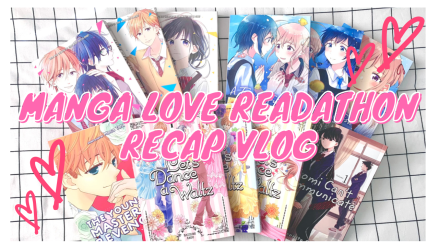
Manga Love Readathon Recap Vlog! || FEB 2021 #mangalovereadathon

Hey guys!

Here’s just a short vlog video discussing all the manga I read for the Manga Love Readathon this past weekend. I’ll try to review some of these titles on my blog over the coming days! 🤞

What did you read this Valentine’s Day weekend? Did you finish the readathon? Let me know in the comments! ❤️

Interested in more anime, manga, or K-pop content? Subscribe to stick around!

Thanks for watching~!

– Takuto

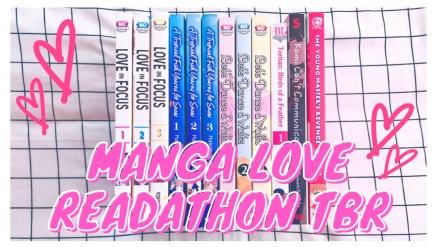
Manga Love Readathon TBR! || FEB 2021 #mangalovereadathon

Hey guys! I had other plans for the weekend (like a Gunbuster marathon for my annual V-Day Special—don’t worry, it’s still coming), but when I saw Shae’s first video for the Manga Love Readathon go up, I couldn’t resist the temptation to just sit down, bundle up, and read some manga this weekend. Soooo here we are! 💕

Sub to Shae’s Channel: https://youtu.be/gfj1ltk2MK8

Follow Shae on Insta @ shaegeeksout
And the hashtag #mangalovereadathon! ✨

What are you reading this weekend? Are you participating in the readathon? Let me know in the comments! ❤️

Interested in more anime, manga, or K-pop content? Subscribe to stick around!

Thanks for watching~!

– Takuto

The Four Dragons Assemble: Yona of the Dawn 7-9 || 25 Days of Manga

After years of sitting on my shelf collecting dust, I finally finish reading Yona’s first nine volumes.

Loose thoughts on volumes 7-9 of Mizuho Kusanagi’s manga series “Yona of the Dawn,” initially published in 2016 by VIZ Media. Spoilers will be present.

CLICK HERE TO READ MY THOUGHTS ON VOLUMES 4-6


History is Made at Night

Unlike the past few volumes of Yona, volume 7 opens with action. Yona and Yun begin their escape to the upper deck of Kum-Ji’s human trafficking ship along with all the other women aboard. I love this opening chapter because it gives us a glimpse into Yun’s calculated thought processes. He really is a strategist, always assessing the situation for both himself, his enemies, and now, his friends. Before, all he had was Ik-su the shepherd. Now, Yun doesn’t just look out for himself; instead, he worries about Yona, Hak, and everyone else in the party. Point is, he’s already grown a lot from when we first met him. Even though he can’t save the princess on his own, we all know that Team Yona would’ve been doomed from the start without Yun’s genius. Praise for the pretty boy!

Anime watchers will immediately recognize the downfall of Kum-Ji as the moment where Yona takes on the mantle of power and courage, officially making a name for herself among the Awa port town residents. This scene is drawn so impressively. The backgrounds may be plain, but this allows Yona to literally leap out of the page with with her sharp gaze and even sharper arrow tip. Such a legendary scene. And I’m witnessing Kum-Ji die for the second time is just the icing on the cake.

A startling reunion with Su-Won tosses the main conflict at hand–reclaiming the thrown–back into the picture. The new king sure does have a handsome face, but Yona has changed a great deal herself. Though she crumbles after their encounter, she did muster the courage to attempt reaching out for Su-Won’s sword. I don’t think she could’ve killed him. Well, maybe . . . The remainder of the volume is full of joyous celebration and, likewise, bittersweet goodbyes. The scene of Yona running back to Gi-Gan to embrace the maternal figure one last time will never fail to break my heart.

War Games

Volume 8 is by far the most different volume in the story, both in terms of narrative focus and storytelling style. The first few chapters introduce a normal campfire evening with the party. Suddenly, Yona is joined by an innocent traveler radiating the light of the sun. Little does she know that her new companion is actually the Yellow Dragon! His name is Zeno, and he’s a bit of an oddball (which is really saying something, given that this is the same team with Gija and Sinha in it). But he’s kind, caring, and observant, and these qualities mark him as a dragon even if his abilities are yet to be realized. The anime ended with Zeno’s introduction, so I’m excited to see what he does from here on out.

Shifting focus, the next few chapters are told from Su-Won’s perspective. His ventures traveling the Kohka Kingdom have shown him small ways to make major changes in a village’s prosperity, as seen in the work he does in the Earth Tribe capital. The general there, Lord Yi Geun-Tae, has enjoyed a lazy lifestyle since King Il took the throne. Lately, however, the general craves combat, as battle is the only way Geun-Tae believes he can prove his worth to the kingdom. Su-Won provides him this long desired action, but in the form of a festival celebrating the Earth Tribe and its general. We get a laydown of the festival war game rules, the entire “battle,” and even the aftermath. It turns out the festival was a way to stimulate trade in the capital once again. Whether for tea, minerals, or even soldiers, Su-Won sure knows how to encourage the masses.

Off in the forest, Team Yona reunites with Ik-Su to seek instructions on the prophesy originally bestowed upon Yona. I’m not sure if the “Shield” and “Sword” they will eventually meet refer to Hak and Su-Won(?), but regardless, Yona wants to train. Desiring to take up the sword, she is met by humorous resistance from the party. However, we all know that our dear princess always gets what she wants–even if it’s skill of swordsmanship!

The Dark Dragon and the Happy Hungry Bunch

Despite taking a dark turn in the middle, this is by far the funniest volume in the series yet. Each chapter had something that made me laugh out loud, or at least crack a pretty big smile. We get to know more about Yun, how he grew up trading with local villages in the Fire Tribe lands while also supporting them with food and health needs. Watching Yona, Hak, and the Dragons bumbling through the village insisting on helping was just the sort of mood-lightener we needed.

Quickly, Yona resolves to put together a team of “bandits” to push out greedy Fire Tribe officials. In the name of happiness and hunger, the crew strive to protect inhabitants in this roundabout way so that they can prevent the villagers themselves from rebelling (which is punishable by the selling of one’s children, yikes!). I find it interesting how Yona’s team endeavored to bring safety by wounding (but not killing) the officials’ guards. This is in direct–and definitely deliberate–contrast to the previous volume, where Su-won essentially brought the same results without the use of any violence or manipulation. Is this what the power of the true king can do . . . ?

As previously stated, volume 9 does take a brief dark detour in the midst of the action. Forced to use his forbidden ability for the first time in 14 years, Sinha awakens to a newfound desire for power spurred on by his dragon eyes. The imagery here of the giant shadow dragon devouring the guards was the stuff of legend, I absolutely loved it. It’s nice to see best boy get the glow up he deserved, though the cost is surely great. Lastly, Fire Tribe prince Kang Tae-jun is up to no good once again–especially considering that he’ll soon find out that the princess he “killed” months ago actually survived the fatal fall!


IK-SU, THESE PEOPLE YOU PREDICTED WOULD SHAKE KOHKA UP ARE ALL IDIOTS. BUT, THEY’RE IDIOTS WHO CAN LAUGH EVEN WHEN THEY’RE HUNGRY. WHEN THEY HAVE TO DEAL WITH BIGGER PROBLEMS DOWN THE ROAD, I BET THEY’LL FACE THOSE WITH A SMILE TOO.” — YUN


Afterword

After YEARS of these books sitting on my shelf collecting dust, I’ve at last finished reading the first nine volumes of Yona of the Dawn. Although I’m done for now, you can bet my next RightStuf purchase will include the next dozen or so, as I simply love this series and its characters with all my heart! We’re finally getting past what the original anime covered (I believe . . . it’s been years since I saw it), and I’m excited to see where the story goes. If it’s as my fellow blogger and mangatuber friends are telling me, I’m in for the ride of my life! Thanks for reading, and ’till next time!

– Takuto

The Start of a Long Journey: Yona of the Dawn Manga Volumes 1-3 || First Impressions

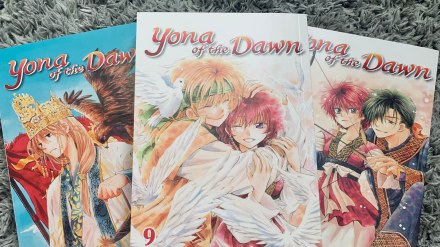
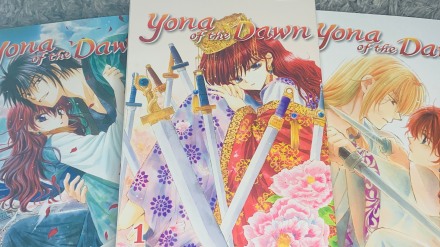
First impressions and loose thoughts on volumes 1-3 of Mizuho Kusanagi’s manga series “Yona of the Dawn,” initially published in 2016 by VIZ Media. Spoilers will be present.


A Terrible, Terrible Birthday

I’m no stranger to the beautiful and cruel world of Yona of the Dawn. I followed the anime when it first aired many years ago. Loved it. Since then, I decided to pick up the first NINE volumes of the manga to hopefully quench my thirst for a sequel we’ll probably never get. Wellll, you know how I do these things—the manga sat on my shelf for a good couple years, untouched, and the dust started to collect.

Until now! My rekindled love for manga has motivated me to tackle my shelves before buying new titles, which naturally placed volume one of this long-awaited read in my hands. And guys, what can I say that hasn’t been said already? Yona is a wonderful shoujo fantasy series with a compelling cast of characters living in an interesting Asian-inspired world. BANG. What more could you want?

But in case you know nothing about Yona, the shoujo manga follows the titular Princess Yona, whose bright red hair makes her the crown jewel of the Kohka Kingdom. After her doting father, the king, is murdered in cold blood by her childhood friend and lover, Su-won, Yona flees for her life with her faithful guard Hak. Now, Yona sets out on a journey to reclaim her country with hak, which includes tracking down the four dragon warriors of ancient lore.

Out on the Run

Right off the bat, I think the most striking thing about Yona’s world is the choice to use Korean-inspired names instead of the typical Japanese names. In fact, the series draws more inspiration from Korean culture than it does Japanese, making it an intriguing blend of both cultures. The series carries with it a heavy traditional feel, but also contains a surprising amount of fun and comedic moments despite the tragic start.

Following their flee, Hak seeks out his home village of Fuuga to avoid further pursuit from Su-won’s soldiers. The village’s chief (and Hak’s foster grandfather), Mundeok, is an admirable figure who I’m sure could’ve taken in Yona and raised her very well—but that wouldn’t be much of a story then, would it?

No, instead, Yona puts her foot down and decides to leave the village herself, demanding Hak continue to stay at her side. (The audacity, I know!!) Shortly after, Yona and Hak confront their pursers, and we get the powerful scene where Yona slashes her own hair—which she is adored for—to free herself from Kang Tae-Jun’s captivity. If that’s not symbolic of a woman choosing strength and independence over frailty and vanity, I’m not sure what is. The passing of Yona’s cut lock to Su-won leads him to believing that Yona has truly perished, which deeply hits him, interestingly enough. Like, Su-won isn’t a good guy, but, is he truly bad . . . ?

She with the Crimson Hair

Volume 3 is where we finally start to get a glimpse of the overall plot Yona is about to take up. Now that we’ve become acquainted with Yona’s rare fiery side as well as Hak’s reliability and loyalty on and off the battlefield, we are introduced to Ik-su, a lackadaisical priest who fled the capital when the regime changed years ago, and Yun, a haughty young pretty boy whose talents in cooking, fashion, and herbal remedies will prove incredibly useful on their journey going forward.

Ik-su tells Yona (and the reader) a great deal about the world, the legend of the dragon warriors, and Yona’s role in all of it. He prophesizes the assembly of the four dragon warriors, and how their coming together will awaken the monarch and resurrect the red dragon of dawn. The spirit of the dragons is passed down through four individual bloodlines, each of which still bear fealty to their beloved crimson dragon even to this day.

After a sad parting, we leave behind Ik-su, and Yun joins us in traveling to the White Dragon Village. There, in the land of the wind, we meet the first dragon warrior, a beautiful young man named Gija who possesses the “arm of a dragon,” scales and all. Although Gija bumps heads with Hak, the pain in Gija’s arm makes him realize that joining Yona is his life’s calling—and the destiny that has been passed down his family for generations. Another bittersweet parting between Gija and his grandmother sets us on the long quest to finding the other dragon warriors.

A Fantastic Historical Fiction Drama

Mizuho Kusanagi’s art style is the stuff of legends. Almost flawlessly, she recreates an era in time that dates back to the Three Kingdoms period of Korea. Mind you, it’s all historical fiction, so none of the setting is real, but Kusanagi reimagines this period from architecture and fashion style to customs traditional of this period. It’s such, SUCH, a gorgeous manga.

All of Kusanagi’s characters are beautiful (as one might expect in a shoujo manga), but also brazen and fierce. There’s a fire in Yona’s eyes that is unmatched; in Hak’s, a gaze of strength and familiarity; and in Su-won, a dark, melancholic sadness. Each cover piece alone is a work of art, as the coloring is so pretty and vibrant, much like Yona’s captivating red hair.

So, will I be reading more Yona of the Dawn in the future? Well, duh—I already bought the first nine volumes, or did you already forget? Haha! Seriously though, if I didn’t already have them, I would’ve placed an order immediately following the second volume. Yona has a lot of promise, which comes as little surprise given how highly talked about this series is. I’m excited to embark on this long journey with Yona, and I do hope you’ll be tagging along for the ride.


If it were a person . . . if this were a battlefield . . . I’d need my arrow to fly true. Drawing your bow means taking a life—or letting someone take yours.Yona


Afterword

I could talk on end for how much I love Hak, how much I love Yun, and how endearing of a protagonist I find Yona to be growing into. But, I’ll save that for future manga write-ups. After all, this is only the first three volumes, and there are well over 20 volumes available in English! I do hope you’ll continue with my reading of Yona of the Dawn. What are your thoughts on this highly beloved series? Let me know down in the comments! ‘Till next time!

– Takuto

CLICK HERE TO READ MY THOUGHTS ON VOLUMES 4-6

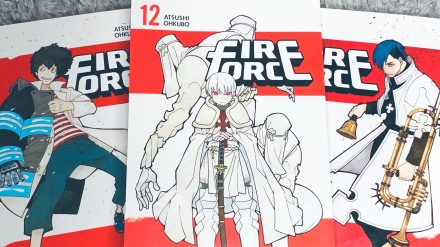
The Fires of Revelation: Fire Force Manga Volumes 10-12

Loose thoughts on volumes 10-12 of Atsushi Ohkubo’s manga series “Fire Force,” initially published in 2016 by Kodansha Comics. Spoilers will be present.

CLICK HERE TO READ MY THOUGHTS ON VOLUMES 7-9


Shinra vs. Sho

Ok, ok, so I take back everything I previously said about Sho’s powers just being boosted speed. The kid can stop time. STOP TIME. WITH FIRE. THE PHYSICS. MAKE LITTLE SENSE. BUT I LOVE YOU ANYWAY OHKUBO. For real though, this is going down as one of my favorite fights in manga EVER. (Which doesn’t say much saying that I don’t read much shounen manga, but whatever, it’s freaking cool as hell.) And, having seen it all animated, I can confirm that the fight is even more glorious in the anime, WOWZA.

More than the combat, we also get a glimpse of the other side—the world that the White Hoods are given permission to see. This is the stark landscape that the Evangelist resides in, which is hell itself. Words cannot describe how ethereal the Evangelist looks. Like, she/it feels divine through the panels. Certainly, the Evangelist is an otherworldy being capable of great and terrifying powers. I mean, if the Evangelist is where Sho gets his spark from, there’s NO WAY in hell that Company 8 will be able to stand up to this deity of the flame.

Shinra accelerating to the point of self-destruction and then reconstructing himself thanks to his link to Sho (who is blessed by the Evangelist) is also SUCH an intriguing concept. Having Viktor off to the side rambling on the physics of Shinra’s and Sho’s abilities is helpful, but only so far in the way of a scientist trying to rationalize ridiculous phenomenon in a super-powered shounen action series. Children with Adolla links really are on a whole ‘nother level, you know?

I love how this climactic, highly anticipated fight ends with the introduction of a new trickster-type character, Haumea, who supposedly possesses powers on par with Shinra and Sho. It really gives us a peak into what the second “season” of Fire Force will bring. As Captain Burns approaches Shinra with the truth, suddenly, everything comes to light.

The Truth Revealed

If volume 10 wasn’t full of enough revelation, volume 11 shatters the illusion Shinra has held since the terrible accident that scarred his youth: not only his brother, but his mom is also alive and somewhere in the world. I kinda figured she was the horned infernal from his memories, but to think that she’s lived this whole time, it’s crazy. We also get another peak into the Evangelist’s world and more haunting imagery of Adolla. Oh, and Captain Burns’ abilities are also revealed in a weirdly timed fight with Shinra (who was just HOSPITALIZED)! If he is constantly controlling a flame from deep within his being, it would make sense why he’s so strong and revered—really, the dude’s flexing 24/7!

This is also a transitional volume for the series. At this point, the world and story are entirely different from the first volume’s humble origins. We are onto a new story now with different goals and new faces to encounter. And it starts with a  . . . nude calendar shoot!? BAHAHAHA!!! This shit had me CRACKIN’, yo, I kid you not. I love how Ohkubo still includes customs like this that are part of the normal firefighter tradition. Obi’s cobra/gun show arm flex left me gasping for air, and seeing all the other companies engage in this stupid calendar was hilarious. As for Company 8’s picture for this year, LOL, I’m deceased.

We also get more Hinawa getting made fun of for his nonexistent fashion sense, which even Obi acknowledges. The girls dress him up in a ridiculous bunny suit, and Shinra pays the price for mocking the lieutenant. It’s fun stuff like this that make transitioning to the next big story easier. Speaking of . . .

Ohkubo continues to expand the world by revisiting Shinra’s academy days at Company 4, the branch which focuses on training new recruits to be deployed out in the force. Some old faces to Shinra (but new to us) make their debut, but most odd of all is the Company 4 Captain Hague, who is so obsessed with Adolla to the point of begging Shinra to burn him alive just to feel the flames of the Evangelist. He’s an oddball, but an ally for sure, and a valuable resource for intelligence on this world of fire and ash. Just when things get interesting, however, Haumea brainwashes Shinra and sends him into a demonic frenzy!

The First Pillar

A lot happens in volumes 10-12 of Fire Force, which includes wrapping up the first big story arc and developing the beginning of the second. Volume 12 opens with Arthur’s attempt to quell Shinra’s scary brainwashing. We finally get Arthur’s backstory, how his parents raised him loving knights and castles, and how they eventually abandoned him, leaving the house behind with him in it as its sole king. WHAT THE FUCK OHKUBO, I’m crying FR. This was so, so sad—and not to Arthur, my poor onion baby. ;__;

Once Shinra finally snaps himself out of Haumea’s spell, Shinra remembers a mysterious girl trying to take over his urges and desires—the “First Pillar,” whatever that means. She whispers that a fifth Adolla burster is about to awaken, which sets Company 8’s sights on recovering the “Fifth Pillar” and protecting them from the Evangelist. As Obi tries to reason with the chief of the fire defense agency—the very man who created Company 8 under Obi’s command—Obi spills some incredible truth about what it means to be an adult. I’ll leave it below.

As always, though, things move fast in Fire Force, and Inca—a young girl who can sense flames before they erupt—bursts onto the scene. She pilfers from fire sites out of a thrill for danger, and that puts her in inevitable contact with the Haumea, her dangerous partner Charon, and the enigmatic First Pillar. As Shinra fends off Charon’s unbelievable strength, the Fire Force companies begin to assemble. But for how long will Tokyo burn? Perhaps Inca’s powers hold the key to mankind’s salvation . . .


[What does being a grown-up mean to you?] It means caring more broadly and deeply. I will never give up on protecting this world. — Akitaru Obi


Afterword

This shit only gets better. MAN, who would’ve thought that this is the kind of ride Ohkubo would be stringing us along for? If it keeps up this consistent quality and world-building intrigue, I have absolute confidence that we’re looking at the next Fullmetal Alchemist: Brotherhood right here with Fire Force. What do you guys think of these new developments? Oh, and since this overlaps with the latest couple episodes, what do you think of the Fire Force sequel anime that is currently airing? Let me know down in the comments! ‘Till next time!

– Takuto

Pride Month 2020 Recap + Aftermath (WE DID IT!)

Hey guys!

I decided to take a week off following my last Pride Month post to refresh myself after reading and writing for 30 days straight! While on my little holiday, I also filmed, edited, re-filmed, and re-edited a YouTube video recapping my month’s reads and watches for you all. YES, after much exporting headache, WE DID IT, and I can finally rest having delivered on my promises! If you haven’t seen it yet, you totally should! 😉

I’ve had a lot of fun recording videos this past month. To think that 39 people have already subscribed makes me so happy! I put a good deal of work into this one, so if you have watched it, I’m extremely grateful. (Thank you!!!)

What started off as a small feat of tackling my shelves (mainly to validate having bought all this LGBTQ manga) ended up becoming a journey of self-searching and enlightenment. This past month brought with it lots to read, of course, but also lots to learn. These characters and mangaka come from all different walks of life, and as such tackle LGBTQ themes in slightly different lights. No two stories were the same; similarly, I found that all of these reads were worth having on your shelf. Truly, I had an amazing time!

Here is a list of everything I reviewed for Pride Month 2020:


Ten Count: My First Yaoi Manga Series || Review

Seven Days: Will You Still Love Me When Monday Comes? || Review

Candy Color Paradox: Sweet Yet Sour || First Impressions

Claudine: Sexuality, Tragedy, & Growing Up Transgender || Review

Melting Lover: The Shadowy Side of Affection || Review

That Blue Sky Feeling: Preciously Queer & Wholeheartedly Delightful || Review

Love Stage!! – A Coming-Out Worth Celebrating || Review

Escape Journey: Chasing After Love in a Heteronormative World || Review

I Married My Best Friend to Shut My Parents Up: Gentle Romance & Silly Humor || Review

Hitorijime My Hero: Unrequited Feelings & Forbidden Love || Review

Goodbye, My Rose Garden – A Poignant Victorian Romance Between Women || First Impressions

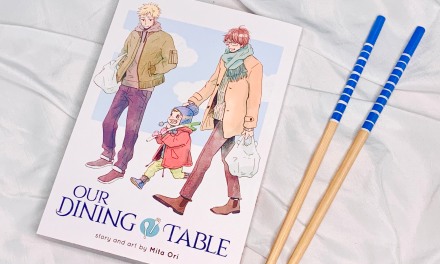
Our Dining Table: Growing Closer One Meal at a Time || Review

Our Dreams at Dusk: Ending Pride Month on a High Note || First Impressions


Every like, comment, share, and follow gained over the last month became fuel for me to try my best and to not give up. Some days I just woke up not wanting to write, but it was reading your kind and supportive words that encouraged me to get the next post out. Really, we did this together. THANK YOU for following me on this journey!

Lastly, I want to let you know that I’ll be archiving these works (in addition to their respective review category in the menu) under the “Projects” tab for future reference. (I mean, it is a series of 13 posts PLUS a 28-minute recap video!)

While I’m here, what can you expect next? Well, I’ll be posting my big quarterly update in the next day or two, which will tell you everything that I’ve been doing behind the scenes, as well as what big things I have coming right around the corner. It would seem that now, at the end of a wonderfully long month, new things can finally start to take root. Please look forward to it, as you have my June Pride Month posts! Thank you again for reading this, and ’till next time!

– Takuto

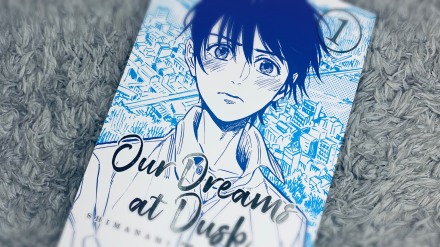
Our Dreams at Dusk: Ending Pride Month on a High Note || First Impressions

First impressions for volume 1 of the manga series “Shimanami Tasogare” or “Our Dreams at Dusk,” story and art by Yuhki Kamatani, and licensed in English by Seven Seas Entertainment. Minor spoilers will be present.


“My Life Probably Ended That Day”

As the new kid, high schooler Tasuku Kanama was able to slip by his first semester thanks to having friends in the table tennis club. But, his world quickly starts spiraling out of control when the other kids find out that he may be gay. Teased and outed for being found with gay porn on his phone, Tasuku prepares to commit suicide when he sees another woman off in the distance jump off a cliff. Panicked and startled beyond belief, what he find upon rushing to the sight of her fall was not what he expected . . .

At the peek of this steep countryside hill, Tasuku finds a “drop-in center” with a lounge open to all who enter. The people there are unusually friendly, but what catches Tasuku’s eye first is seeing woman who jumped off the cliff there, completely unharmed from her fall. The others introduce her as “Someone-san,” and remark how although she’s mysterious and keeps to herself, she is in fact the owner of this fine communal establishment.

Drawn to her presence, Someone-san offers him an ear only if he is willing to talk about his problems. Through speaking to her and reflecting on his own actions, Tasuku realizes that what hurts the most is his own inability to accept his sexuality. An emotional introduction to a much larger story, Our Dreams at Dusk follows Tasuku and all the other gay, lesbian, bisexual, and transgender people he encounters as he tries to come to terms with his sexuality.

our dreams at dusk chapter 1

“Why am I Like This . . . ?”

This first volume does a beautiful job at illustrating Tasuku’s pain and anguish as a closeted gay kid. Anyone who’s ever been in his shoes know the frustrations of having to hid their sexuality from others. Whether to parents, friends, or even simple acquaintances, it doesn’t matter—in a society that shuns the notion of being gay, coming out can be the most relieving OR excruciatingly painful thing, and Tasuku knows this. He’s constantly weighing the relationships he’ll have to give up in order to gain what he wants, and it’s that toxic mindset that haunts Tasuku day-in and day-out.

Tasuku is gay, no doubt about it. He’s in love with a classmate on the volleyball team, or so we are led to believe in this first volume. I’m sure we’ll get more on this in the next volume. Until then, we just have Tasuku and his new friends at the drop-in center. We don’t know much about them either, except for Daichi Haruko, a young outgoing woman who greets Tasuku everyday with a smile. She invites him on her non-profit work, which involves tearing down dilapidated buildings and renovating them for the city.

He likes working out in the summer sun, and he likes Haruko, too. But what throws him into a bit of shock is finding out that she’s a lesbian. Not only that, but Haruko also has plans to marry her girlfriend, a kind gal named Saki, whom he meets one day during their outdoor work. I loved hearing Haruko’s story, especially how she left her old job and moved out to the countryside where she met Someone-san (and eventually created the drop-in center we know today). The place really is special, even down to its foundation.

our dreams at dusk haruko

“There’s a Guy I Like”

Yuhki Kamatani’s Our Dreams at Dusk is a highly expressive and emotional read. This first volume demonstrate’s Kamatani’s strong art style, including her stark use of black in blocking out spaces, using a warped lens view and dramatic lighting for effect, and emphasizing the power of eye contact. Eyes can tell a lot about people, and Kamatani uses strong gazes like such to convey mood and inner turmoil.

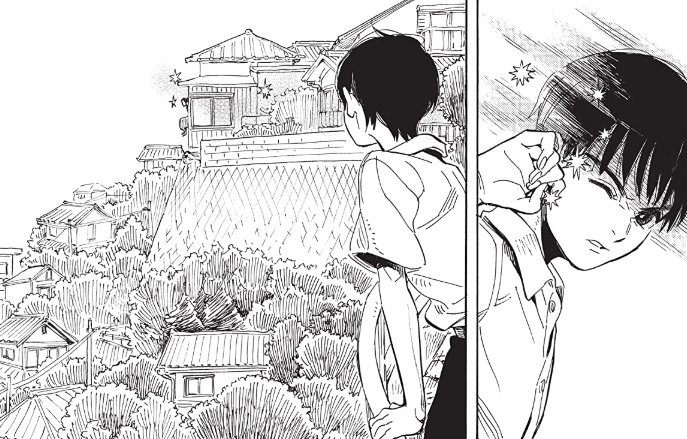
Kamatani’s panel construction is also genius; sounds, textures, and feelings carry from panel to panel seamlessly, as if this were a movie printed onto the page. The story moves, even in pages where there is no dialogue. Sometimes the most fantastic or simplest of gestures can be enhanced by the absence of dialogue, like when Tasuku daydreams about touching another man’s face. Even in silence, Kamatani’s magical realism invites supernatural imagery to convey intriguing feelings and ideas (like the sparks that fly whenever Someone-san leaps into the air). These really are some of the most impactful and striking images I’ve ever seen in a queer drama manga!

This is going to be a thought-provoking, psychological read—I can already tell. Looking at Tasuku, I am reminded of the same kind of self-torment that plagues Shinji Ikari of Evangelion fame (the two also look similar). Volume one alone is full of serious meditation and self-reflection, highlighting the importance of inclusivity with Tasuku finding the drop-in center and Haruko extending her job invitation to him. Where the story goes from here, I have no idea. But, I already know for a fact that Tasuku’s coming out will bring with it a powerful coming-of-age tale.

our dreams at dusk imagery


I’m a kid. I’m not brave. I’m always confused. But I felt pretty glad that I didn’t kill myself. I felt that at Someone-san’s drop-in center . . . as the heat of August scorched me. — Tasuku Kaname


Afterword

It’s a shame I didn’t get my rear in gear during the first week of June. Otherwise, I would have been able to provide for you a full series review of Shimanami Tasogare today instead of just a first impressions post. If and when I get around to writing that full review, I hope you will come back to see how my thoughts on this fantastic series have changed. Should my hunch prove correct, I definitely think Yuhki Kamatani’s Our Dreams at Dusk is a masterpiece in the making. Again, I’ll be able to confirm that later, but I DO have the other three volumes and plan on reading them ASAP! I’d love to hear your thoughts on these gorgeous publications, too—just no spoilers, please!

Well there you have it, friends. My Pride Month celebration has officially concluded with the publishing of this post. It’s been an absolutely incredible month full of amazing reads, and I’ve learned so much through reading all these different stories. I WILL be writing a follow-up post (and filming a video!) wrapping up all of June’s Pride reads and watches, so stay tuned for my proper reflections with that. Thanks for reading—it was a sprint to the finish, but we did it! Haha! ‘Till next time!

– Takuto

Our Dining Table: Growing Closer One Meal at a Time || Review

A brief spoiler-free review of the standalone BL manga “Our Dining Table,” story and art by Mita Ori, and licensed in English by Seven Seas Entertainment.


Boys’ Love for the Soul

Despite his excellent skills in the kitchen, salaryman Yutaka has always struggled with eating around others since he was little. This changes when he encounters a hungry little boy named Tane and his much older brother Minoru. Eager to eat more of his tasty onigiri, the two brothers invite Yutaka over to teach them how to make his delicious food. Slowly, Yutaka starts developing an appetite for their warmth and acceptance around the table—as well as feelings for Minoru and his little family. This is the story of love that starts at the stomach, and gradually grows more heartwarming one meal at a time.

This slice-of-life shounen ai manga made waves in the manga community when it was announced for release by Seven Seas Entertainment. At the time, I wasn’t reading much BL, but even I heard about this highly anticipated title and was eager to pre-order my own copy the minute it went on sale. As a one-shot BL manga, Our Dining Table reads quick, closing out the story in just eight chapters. It even includes a short epilogue that, well, I won’t spoil for you. But it’s great, and it brings adorable closure to a story that I otherwise could’ve kept reading for decades.

To make the deal even sweeter, Mita Ori’s art is stuff to drool over. She draws food well. Very well. Too well. I grew envious of Minoru and Tane whenever Yutaka brought his cooking supplies over to their house. Right off the page, you can practically smell the delectable dishes they make together. The characters themselves are also drawn with a soft aesthetic to them, Tane in particular being the cutest little rugrat I’ve ever seen in manga! The way his eyes light up upon seeing whatever they’re having for dinner is an image I’ll never forget. I also love how Mita Ori used Tane’s childish stick-figure drawings as a transition to telling Yutaka’s backstory. Very clever and effective.

yutaka meets tane

Bonding Over Food

In both his personal and professional lives, Yutaka is a character who seems deeply misunderstood by those around him. People can be shallow and selfish, not to mention non-inclusive, and over time, being an outcast just becomes commonplace. We should always care for our friends and family, but things happen, and sometimes you find yourself eating alone at the dinner table each night. This is Yutaka’s life. Or perhaps, I should say was, as now he has Tane and Minoru in his life, and they really do change everything for him. Tane and Minoru aren’t just good company for Yutaka—they’re companions, the kinds you’d want with you your whole life, and I’m so glad they met.

Minoru and Tane aren’t without their sad family story either, though. Their mother passed away when Tane was just a baby, and Minoru has had to step it up as a parental figure to raise Tane in her stead. He loves his baby brother, but not everyone takes kindly to a 23-year-old who drags his 4-year-old brother with him wherever he goes.

It’s a good thing Minoru isn’t alone in his efforts, however; the brothers also have their loving father who makes a living as a potter, and their grandmother who looks after them by sending them off with nutritious meals whenever she can. Not everyone accepts or respects each others’ family lives, so the fact that Minoru and Tane can come from a place of understanding and accept someone like Yutaka into their home really is a delightful thing. It’s like seeing two lost souls find each other in the dark—their own glimmering light complements the other, and as they grow closer, they only radiate with a brighter glow and comforting presence.

yutaka and minoru

A Gentle Foodie Read

Mita Ori’s story about food, family, and friendship takes pride in the little things. Enjoyed are the quiet moments of tender living and merely existing with others, but celebrated are the joys of cooking and the sheer happiness that can come from cuisine when it’s made from the heart. Although Japan’s winter draws closer and colder, the bond between Tane, Minoru, and Yutaka only grows warmer and more wholesome.

Our Dining Table is just about the sweetest, most gentle foodie manga you will ever read. Yes, it is BL, but don’t let that label send your mind down the gutter. Through soft gestures, Mita Ori’s story is wholly dedicated to building meaningful bonds that capture the day-to-day life of two men from very different families, and how they intersect at the crossroads of food.

From cover to cover, this standalone slice-of-life BL manga promises to deliver pleasant vibes and positive energy, even when addressing the loss of a loved one. This is BL manga for the soul, and easily one of the best stories I’ve ever had the pleasure of enjoying. It is an honestly written manga with solely pure intentions, and however wonderful and filling the ending is, I assure you this—you will only be left hungry for more.

our dining table


I’m so happy. So stupidly, totally happy. To think eating with someone could bring me this much joy. — Yutaka Hozumi


Afterword

Guys, I’m speechless. Really, this is the fastest review I’ve ever written, and while it’s also one of the shortest, I can’t think of anymore praise that I can give this manga. THIS is what a “Cafe Mocha” manga title looks like. It’s not perfect, and it doesn’t need to be. The story, characters, and art style just have to speak to me in a way that I not only connect with but love unconditionally, faults aside. Sure, Mita Ori could’ve elaborated more on Minoru’s father’s job, their mother, or Yutaka’s job. But she didn’t need to—the characters feel alive enough as-is, and the story speaks for itself. I really, really loved this manga, and if you did too, please let me know your favorite part about this endearing little title! I honestly can’t recommend this book enough!!

We’re almost at the very end. Tomorrow, I will at last be diving into Yuhki Kamatani’s critically acclaimed Our Dreams at Dusk. Although it will likely not be a full series review (due to time restraints), I hope nonetheless that you will enjoy my final Pride Month post. Besides, I’ll probably return and do a full review anyway, just not in June. ‘Till then, friends, I’ll be looking forward to it!

– Takuto