
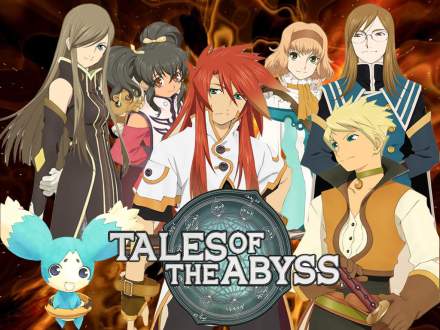
Tales of the Abyss: The Animation Review

After watching Tales of Symphonia I just had to check out more from the Tales series. Sadly, Tales of the Abyss was more of a letdown for me. So if I didn’t care for it then why write a review? Plot ideas can be tricky to come up with, I’ll admit, but when a story has too many ideas it ends up as a convoluted train wreck. The main story of Abyss derails itself so often that I found myself sleeping during the show, only waking myself up to see the character back stories. With that said, I want to inform you of the really cool aspects of this show, the occasionally crumbling plot aside.

Set in the common medieval atmosphere the Tales series likes to enforce, Auldrant is a world run by the Score, a prophecy written many years ago. Luke fon Fabre, the spoiled yet confined heir of the kingdom of Kimlasca, spends his afternoon in sword training with Master Van until a mysterious woman by the name of Tear Grants shows with the intent of taking Van’s life. Suddenly, Luke and Tear are warped across the world to the opposing empire of Malkuth. Now that Luke has the freedom he has dreamed of for so long, he begins to realize why he was restricted from the world, who he really is, and what his hidden powers are. All the while there is a band of look-alikes that are trying to kill the heroes, a not-so-holy church that wants Luke, a sea of miasma that threatens to destroy the planet, and an oncoming war between the two kingdoms.

These plot ideas sound kinda cool, no? But when all of them are thrown together it doesn’t benefit the anime.  Speaking of adaptations, Tales of the Abyss the Animation is actually based on an RPG, but an anime was released later on. You can ask anyone, but Tales of the Abyss is by far the closest recreation of a Tales RPG in anime format. Most of the scenes are translated exactly like they appear in the game, not taking away from the Abyss vibe.

I do not remember all of the characters from this series, and that is really a bummer because they all link together in one way or another.  Tear, a Seventh Fonist for the Order of Lorelei is a character I enjoyed because of her straight forwardness and her knack of guiding Luke in the right direction. She remains a strong and reserved character through the duration of the story. Though she acts coldly to Luke on occasion, she is quite respectful and well-mannered to everyone else. A second character whom I enjoyed was Jade Curtiss, the necromancer of fonic artes and a Malkuth army colonel. He is a generally happy character, but he doesn’t reveal his preferences or personality, making him seem complex to the other characters. With his dark background, one couldn’t tell if Jade was acting for the greater good or if he had something planned up his sleeve. The only problem with Jade was that some of his later happenings were predictable, but it is also like this in the game, so whateves. I love the way the Japanese always pronounced him as “Jeido Kaatisu” – I still call him that today!

Other than those couple characters, I found the rest of the cast to be decent, but nothing spectacular. Most of the best scenes were not when something epic was happening, but when all of the characters were just conversing with one another. The interactions were golden, especially any of them with Jade or Tear. The anime had also included many notable flashback scenes in just the right places to help flush out characters. A character death in particular made me bawl for hours; it was the way in which he made it sound that did me in. With as big a cast as this one, it felt as if some characters (clones or noblemen) were placed in just to balance another, and that is not how it should be! But it is an RPG, so some of those characters are necessary. Other than that, character motives made sense and dialogue was pretty interesting.

The OST for Abyss stands as . . . suitable, actually. Listening then and now, the concert band songs are beautiful and express grandeur. They keep to a fantasy adventure theme that sounds as if the pieces came straight out of the game, which they might have. Some tracks like Tear’s song that she sings and “Peaceful Times” are especially easy to remember. Most of the characters have a fitting theme that is a perfect reflection of their personality. The opening theme “Karma” by BUMP OF CHICKEN is the same opening the game uses, so fans of the game can appreciate that. Personally, I rock out to that song! All-in-all, the soundtrack is decent classical dance as it appropriately captures the moments from traumatizing to engaging.

Tales of the Abyss was animated by Sunrise Inc. in 2008, and they did a great job of adapting the art from the game into an anime. Again, I have not played the game, but if you view some concept art you will notice the breathtaking similarities. One of the highlights for this show was the artwork for the landscapes. Characters might just be conversing or walking into town and the background animation is just splendid! Adding in that and the year it was done up makes Tales of the Abyss one of the best animated adaptations for the Tales series.

While I may have been bored or confused at times, that does not mean that the entirety of the show was uninteresting. There were many entertaining scenes that make up for the tedious ones. The anime is definitely an adventure, but whether it is one I would traverse, I would have to say no. Show-wise I was amused, but it was not a driving force by any means; it is not one where you would drop whatever you were doing just to watch it.

I was not changed or moved in any way by this anime. It was good, yes, but no more than that. Other than a few characters and plot points, I can’t recall much from this anime other than it was a mess. While this show did not push me to do anything in particular like high-ranking anime should, this show was my first “okay” anime, for everything up until then was no letdown. If you enjoy somewhat heart-filling adventures with action and great music, are investing yourself in the vast Tales series, or are looking for new ideas to use in writing, gaming, or whatever, then this show is for you. Otherwise, spend your time with something more beneficial and organized.

Though I didn’t pick up a copy, you can purchase all four parts by Bandai Entertainment (sub only) on Rightstuf.com. I’m sorry if I sound like I hate this anime – maybe I just can’t appreciate all that it has to offer. Hopefully you will have better luck with this one! Until my next review, I’ll pass on Tales of the Abyss with a push of my sketchy Jade glasses and a wave of fonon arte magic as I steal an apple from the Malkuth marketplace, because, you know, “why do I have to pay for it?”

Thanks for reading!

– Takuto, your host

Negima! (season one) Review

After watching Negima!?, I just had to check out its first season, which I have to say I was a little disappointed, as prequels are usually better than sequels. This season was darker than its successor especially towards the end, which changes the entire picture of what Negima! is.

Season one of the Negima franchise starts off similar to its sequel. Negi Springfield, a 10 year-old wizard in training, is transferred to Mahora Academy in Japan, which is an all-girls school. Here, he fights with a vampire, makes pacts with middle school girls, teaches English and searches for his father. The major difference between this series and the next is that this one focuses on the girls more and the other magicians besides Negi. Minus the Star Crystal plot and the Black Rose Baron, you can check out my Negima!? review for a better synopsis of the plot. Personally, I prefer the second series.

The actual story doesn’t really progress until episode 20. Yes, you heard me. 20. Up until then, it’s all about the girls and a more in-depth look into their lives beyond the school. Specifically speaking, we get a look on why Ayaka Yukihiro, class representative, acts the way she does (I love that episode to its entirety!). When class 2-A travels to Kyoto, Japan, for a cultural trip, Negi and co. encounter Fate, an antagonist who is better described in the manga. Fate desires Konoka Konoe, who, unknowing to the class, possesses a rare magical background, which I will not spoil! Because Fate is thrown it the series to make up for the manga, he seems very unexplained and random, which I did not fancy.

During the climax of the series, Asuna gets dark. If you’ve seen this series, you know what I mean. Not gonna lie, I cried. A lot. It was a simple yet tragic story that I will never forget. To this day, I can’t watch the last couple episodes without getting all worked up. This plot device really shows that Negima! isn’t all fun and games; it does have a more depressing movement to it. It was such an unexpected twist that it literally changed my view on the Negima series.

In this first season, the characters are better defined. Unlike the sequel which only shows comedy, these characters reveal some sad memories. As I mentioned earlier, Ayaka gets a nice treatment in this series. To be revealed later, Ayaka’s brother actually died during birth. Negi reminds Ayaka of her to-be little brother and that is why she loves him. In the second series, she just comes off as a creepy shotacon, so it’s better to view her from this series than the other. Regardless of her attractions, I love Yukihiro as a character!

Not gonna lie, none of the tracks stick out. Besides I think “Magical Battle” and this one relaxing theme which I still have never found :/ , there is nothing else that I can recall. Season two has a more memorable soundtrack than this one. One moment that I can remember, however, is the following day of the grand plot twist. Holy crap! It starts with a sad cello soloing and more instruments are added until the weight is to heavy to bear. At that point, I break down in tears. Whoever wrote that song did very mature job! The opening, “Happy*Material,” is also a very motivating song to listen to. Its playful chords and different vocalists (who are, BTW, the Japanese cast for the girls) make it a magical and, get this, “happy” song to listen to!

For being animated in 2005, I thought it was decent. I haven’t seen many older anime so I can’t really judge this one. It’s not distracting to any degree, but there some awkward animation pauses where the “camera” just stops on a character after they are done talking. Because of this, dialogue doesn’t flow to well sometimes. On a side note, I did watch the English dub for this one; it’s fairly well done, but nothing superb. Unlike the second series, the view isn’t anything crazy like frames flying across the screen, so take it how you will. Some think that is distracting, but with the second series in particular, I thought it was a nice touch.

I feel like I keep comparing this season to its sequel, but one really can’t help it. The second season embellishes on what the first season failed while the first season dives into concepts that were not explored in the second. Both series balance each other nicely. As such, I was entertained a decent amount. The character stories are interesting enough but the small individual arcs do get kinda boring after a while

The Negima franchise keeps with a fun, magical atmosphere, yes, but the first series not so much. I know it was the first adaptation, but still. It’s good, but not great or stunning. Motsu is not in this one, so it gets old just watching the same characters attempt and fail at various tasks. Though it seemed thrown in, the ending did actually improve my score of this show. Negima! is a series that you can watch a few times and still not get too bored, which is a good thing for sure! All in all, if you are a fan of the sequel, go ahead and pick this up. Otherwise, it may not be worth your time.

Presently, FUNimation’s Complete Series of Negima! sits on my shelf performing its magical mayhem while awaiting its next viewing.

Thanks for reading!

– Takuto, your host

Tales of Symphonia: The Animation Review

In the summer of 2012, I happened to be browsing for cool J-pop music and ran into Starry Heavens by Day After Tomorrow – Tale of Symphonia’s game opening. After brief research over the game, I noticed that this game had an animation for it as well. This made me curious. I watched all of the episodes on YouTube until I reached the unfinished United World Arc. When the last two episodes were later released, I couldn’t help but smile and share this to a couple others.

The two worlds of Sylvarant and Tethe’alla share a mana link between each other, which is unknowing to the population of the world. When one world gets mana poured into it, the other is drained. To restore her world with beauty and life, Colette Brunel, the chosen, who has the job of reawakening seals to become an Angel, must set out on a journey of World Restoration. Along with the protagonist Lloyd Irving, their intelligent friend Genis Sage and his older sister/their teacher Raine Sage, Colette and Co. begin to realize that their world is actually more twisted than it seems. Interesting characters who also tag along include a clumsy ninja, a lifeless girl with crazy strength, a former baron and now fighter, a mercenary who stays quite and a bumbling ladies-man – all of which who have their own tragic and memorable back stories.

The story itself is best told through the view point of Lloyd Irving, whom struggles with school but makes up for in sword skills. Why this person? Not only is Lloyd the main protagonist, but he is also unintelligent, meaning that when the plot needs to be explained, the series just uses Lloyd to vent out the news to the viewer. When Lloyd figures something out or learns something new, so do you. I find this concept of two worlds, one of which is always in decline, to be exciting. It adds for two distinctive ways to see the world. Is it loving and beautiful, or is it actually cruel and dry? This theme can be applied to parts of the our world today, which makes it more relatable and powerful. All in all, it is a fairly solid idea that can lead to many open opposing stories and character view points.

The only thing that drags down the plot is the fact that it’s an animation based on a game, which means that there are many terms that are randomly thrown in there because they were in the game. Because the series fails to link some of these devices, there can be many WTF moments at times.

I can recall the main casts’ names and their stories – even a couple years later. Namco Tales Studio did a phenomenal job on the character designs and motives. What was nice was that I couldn’t brand characters by a stereotype, as they were all really intricately done. Sheena Fujibayashi, for instance, was the clumsy ninja whom I mentioned earlier. While she appeared as an assassin out to get the Chosen who also had love quarrels, she bore a really strong and sorrowful weight from her village.

Zelos Wilder was by far the most unpredictable character out there. Not only is he half comical and half murderous, he also works for several opposing forces in the Symphonia world. Whenever he betrayed a group I got really mad and started to hate him, but then he always came back and I admired him once again.

All of the older characters, Yuan, Kratos and a few of the generals also had intriguing pasts. One of my favorite parts of this anime was seeing the past of the main antagonist, _______, for he ended up being much more than the rumored hero of the Kharlan War. Long live the Four Seraphim!

One downside to this selection was actually the main character Lloyd. I found him to be caring yet annoying at the same time. He was that only exception to the sterotype list, and that is that he is the hero. He wants everyone to live in peace and harmony and blah blah blah – it gets annoying really fast! If you can get past some of Irving’s dramatically heart-filled speeches, then you will find this cast to be one of the best you’ve ever seen.

I’ll immediately start with the show’s second opening, “Canary in the Sky” by Nana Mizuki. Holy Hima it is amazing! Its effective use of a violin and a guitar take my breath away. The song fits and represents the Symphonia series perfectly. Whether this anime is interesting to you or not, go ahead and give it a listen – you will not be disappointed. As for the rest of the OST, the only stand out moment was at the end of OVA nine. TO THIS DATE, I have only encountered few plot turners who threw me for a loop like this one. The song “Ta ga tame no sekai” sung by Shikata Akiko is one of my top few favorite ending themes, as it transcends the series to a whole new level of epic. Her voice is haunting and calming at the same time and when she is accompanied by the upbeat drums and a full on choir who sing with her, I could just die right then and there. I also love the series’s last ending 🙂 . So tropical!

The animation was done by Ufotable, who is good at what they do and this is no exception. Action scenes and attacks were splendidly animated and the way the technology appears in the series is just cool. You can really tell the difference in quality when you compare the first arc done in 2007 compared to the last episode in 2012. One thing I did notice is that on occasion, the faces would look funny, as in the eyes just didn’t line up correctly. On that note – where are their noses!? In some scenes they have no nose, which is very distracting. However, I think the game is like that too at times

I distinctly remember sleeping through the first four episodes of the series. The Sylvarant Arc was so slow I almost dropped the series as a whole. It was only because of its music and characters, however, that led me onward. When you watch it, just know that it gets a hell of a lot better when you hit the second arc, Tethe’alla. For the rest of the series, I was thoroughly enjoyed. All of Symphonia’s epic chorus songs make me wanna wave around a sword, too!

I always doubt this series when I compare it to others. But then I realize – this show was actually really good! It has enough plot twists to keep one interested and it provides excellent sad stories to pass the time (if you can say that sad stories are “excellent” :P). The relationships the characters share are priceless and respectful to witness as well. I did love this series, a lot. If I’ve inspired you at all to go for this series, do keep in mind that it is based off of a game, so some of its conclusions will seem a little far-fetched.

This show is not available for purchase in the states, but the sorrow of Mithos, the goodness of Lloyd and the faith of Colette rest in a seed of remembrance at the bottom of my heart.

Thanks for reading!

– Takuto, your host

Negima!? (season two) Review

This anime has a special place in my heart as it is the first I had ever seen, besides random encounters with Sailor Moon, Yu-Gi-Oh!, Pokemon, etc. I watched it in the spring of 2012. For those of you who don’t know, Negima!? is slice of life, fantasy adventure, comedy, magical girl, fanservice anime. With that being said, it is an honor for it to be the first that I review! First review – here we go!

Negima!? revolves around Negi Springfield, a 10 year-old genius wizard who had just graduated from the Magic Academy, a school for wizardry and magic. As part of his training, Negi and his talking ermine fairy friend Chamo are transferred from their home in Wales, England to Mahora Academy in Japan, which is an all-girls school. His mission – to teach English class there while seeking out a partner to help in his sorcery. With this partner, Negi must form a pact, or “Pactio!” which involves a kiss on the lips. The partner then may have their contract invoked in order to use magic. The plot rolls along, however, when the loudmouth obnoxious Asuna Kagurazaka, student No. 8 in his 2/3-A class of 31 girls, sees him using magic. From here on out, Negi eventually makes partners out of his entire class, all while encountering twisted fairies, magical worlds and the darkness.

When I first watched this series way back when, I found it to be ridiculously awesome, probably giving it more credit then it actually deserved. The concept is easy, but not astonishing in any way, to understand, as most of the terms are thoroughly explained in the first episode. I found myself always wondering what would possibly happen next, then again I was younger when I first watched it. The surprises Negima!? had in store were nicely executed. This series also has a lot of cultural references, which made the experience a knowledgable one, too.

Negima!? has one of the largest casts that I have ever seen; 31 girls plus a few more is a handful to keep track of. Nevertheless, Ken Akamatsu, the creator, displayed valuable and unique traits for each of the girls. A decent amount of screen time (for a cast this large) was given to each one, which allows the viewer to love more than just the main eight or so. It was silly, at one time, I had all of the girls memorized! Looking back, it was a huge waste of time trying to remember all of them!:D Since it is a comedy, all of the cast members each have their individual quirks that make them stand out. This makes the dialogue for the English dub especially fun to listen, as the voice actors really get distinct in their respective character(s).

While characters in Negima!? made me laugh, they did not make me feel anything else. Aside from Anya, Negi, Nekane, Evangeline, Asuna and maybe Yue, the others were pretty static. I guess if the creator spent an episode for each one, then the plot would never advance. But, maybe a couple episodes dedicated to the side characters instead of useless boobage and banter would have been more beneficial.

I distinctly remember the OST, opening, and ending for this anime, which is a good sign. The OST for this show is small, which means the tracks are used over and over again. However, they are good songs and tend to fit the mood better than anything else. Some themes such as Nekane’s or the Chupacabra Research Society’s are especially easy to recall, for they are breathtakingly sweet and outrageously hilarious respectively. The series’s opening “1000% SPARKING” is really catchy and motivational and is also sung in English in FUNimation’s dub. Personally, I prefer the English one. The same is for the show’s ending “A-LY-YA!” – it is such a fun song.

Previous anime I had seen include Sailor Moon and Pokemon, so Negima!?‘s animation was a treat (no offense to those classics). The artwork was presented in one of the most memorable fashions. Sometimes they would have different camera angles in boxes and these boxes would just be floating and shaking on the screen depending on who is talking. Sometimes the background would be super ornate – like reeeally cool – and during other times it would just be one solid outline color. I recall even a few times they would include real life photos and crop them in. The differentiation in presentation made the show more exciting, as it was more of a show for humor over plot. Characters were drawn with individuality, so you could remember how certain characters acted just by looking at them. These people were also drawn in a simple yet fitting way to match with the background. In other words, the characters were easy to see but did not stick out like black on white. Negima!?‘s unique animation is definitely its highlight.

Overall, Negima!? was quite the entertaining show. Its mix of stupid comedy, quick jokes and decent plot make it a good first-time anime for those who are interested in the culture. I can say that I was fairly entertained. While this anime lacks in individual character development, it makes up for that in its one-liner character descriptions. Each character really does have an individual personality, and part of the experience is figuring out what roles certain characters play. A downside to this, however, is trying to balance this enormous cast with each of the single impacts on Negi Springfield. A tip from me is to just roll with it because you’ll pick up on who Negi hangs out with right off the bat.

As I mentioned at the beginning, Negima!? has carved a very special place in my heart and I will never forget it was my first anime. Whenever I see or hear make a joke with similar wordings, I immediately reference this series before any other. I find myself still drawing Motsu’s face on all of my papers! Motsu and Shichimi were, by the way, the driving forces of comedy!! I love them both so much! This show in particular is one that you could watch a few times over and still have fun doing so, as there is so much detail work put in to the setting, the character designs and the funny dialogue. A warning, however, is to enjoy it the first time through because if you spend your whole time fussing over the details, you will miss Negima!?‘s quick wit and crazy charm.

Currently, FUNimation’s S.A.V.E. edition of Negima!? “balances rather precariously” on my shelf, “In a good way.”

Thanks for reading!

– Takuto, your host