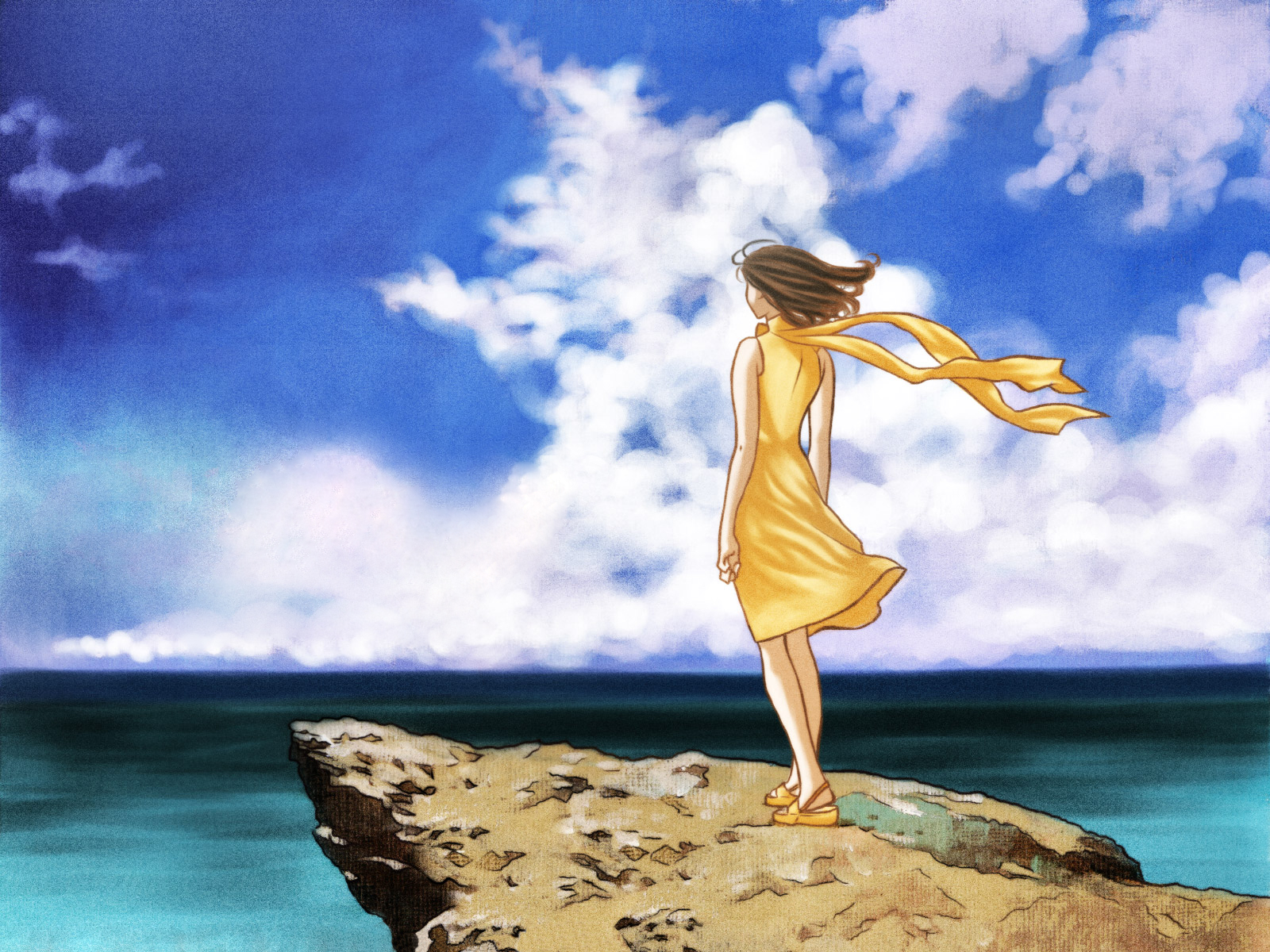
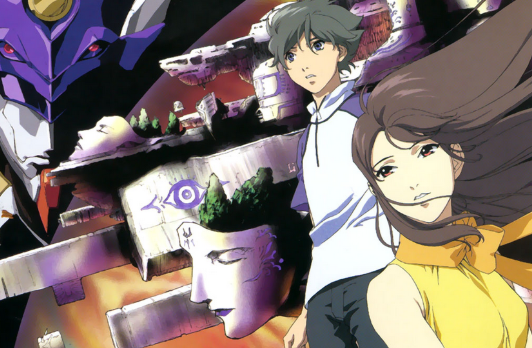
Typhoon Noruda: A Storm of Emotions || Review

A brief spoiler-free review of the 30-minute 2015 anime original film “Typhoon Noruda,” animated by Studio Colorido, and directed by Youjirou Arai.

typhoon noruda storm brewing.PNG


Thunder in the Distance

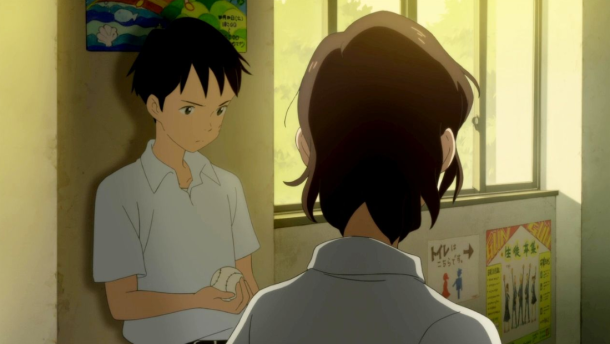
On the eve of his middle school culture festival, Azuma has a fight with his best friend Saijou after suddenly deciding to quit their baseball team. Azuma’s reasons are his own, but Saijou just can’t understand why his friend would depart from the sport they’ve been playing together since childhood. Any time for reconciliation is cut short by the shattering of a glass window in their classroom, and the fierce winds of a typhoon rocking their little island.

Right before the rain hits, Azuma notices a girl who, despite wearing their school uniform, doesn’t actually attend their school. Or at least, she shouldn’t. Shrouded in mystery, the girl quickly flees, and the storm rages on. What connects this enigmatic girl to the typhoon that is shaking up their island, and can Azuma and Saijou’s friendship be saved by this tempestuous storm of emotions?

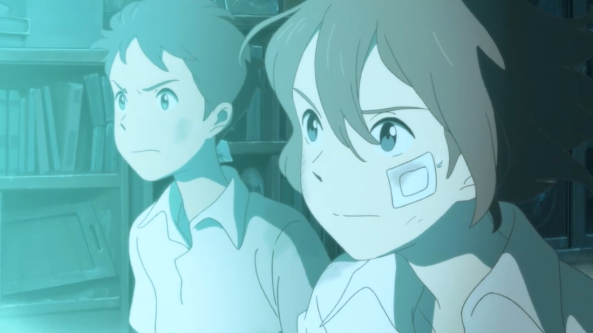
As far as characters go, Azuma and Saijou aren’t the most memorable boys out there, but they tell their story well enough to convey their frustrations with miscommunication and self-esteem. They are charming in their own way, Saijou embodying the “prince” of the class, confident and always willing to lend a hand, and Azuma being a total introvert just wanting to mind his own business and figure out what kind of person he truly wants to be. Dynamic as they are different, they really do mirror the interplay between thunder and lightning, rain and wind—one following the other in this clash of ambitions.

saijou and azuma.PNG

To save a young girl, two boys must first save themselves. Azuma uses the girl’s dire situation to prove to himself that he can help other people, and Saijou takes Azuma’s abrupt disappearance to reflect on their relationship. I can’t really say anything about the mystery girl without spoiling the entire plot, but I find her mere presence and willingness to lend an ear to a complete stranger to be proof that people are—as they have always been—worthy of redemption.

Soaked in Aesthetic

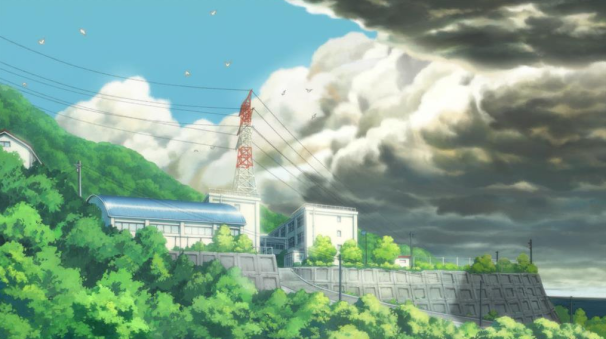
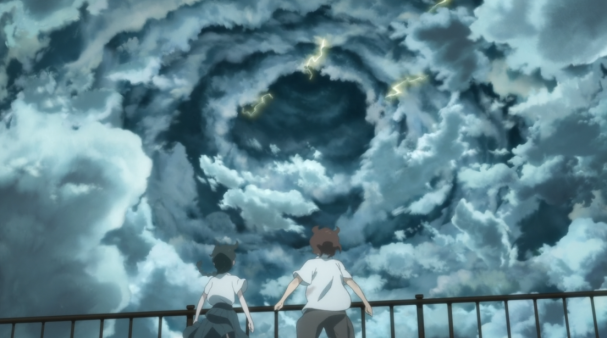
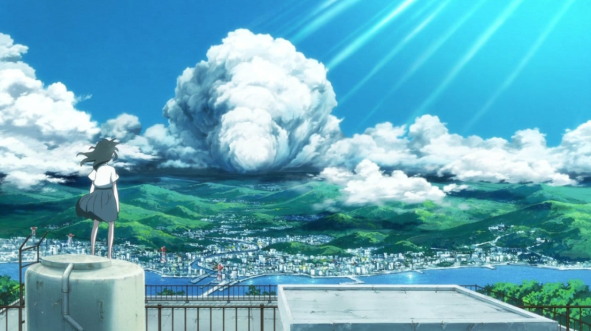
What immediately draws the viewer to Typhoon Noruda is the animation, no two ways about it.  From the sparkling rain to the leafy trees, busted wooden floorboards, and colorful school festival debris blowing in the wind, the attention to detail in crafting this turbulent environment truly paints the picture of a severe tropical thunderstorm.

The film looks incredible, with fluidly animated and expressive character designs, and the titular storm intensifying in the background. And the ash-colored clouds, how they move with such majesty, as if to shout, “Behold the storm!” Talk about a stunning sight. Down to the last drop, Studio Colorido produces a visual spectacle, and an ode to all us thunderstorm lovers. It’s as if a Makoto Shinkai setting and Mamoru Hosoda characters were married off and bang, Typhoon Noruda. Well, Comix Wave Films was listed in the credits, so it’s no wonder the Shinkai aesthetic feels so present here. 

typhoon clouds.PNG

For sound, Typhoon Noruda is supported by your standard string orchestral soundtrack, 15 minutes worth of music that follows the characters through to the climax. The real gem here is the credits song, “Arashi no Ato de” or “After the Rain” by Galileo Galilei, which is so good it gets its own official VEVO video, how about that. Seriously though, reminiscent of youthful days and fleeting childhood, this ED theme was how I was introduced to the film—and it’s arguably better than the film itself!

Lastly, John Swasey directs a solid dub, Greg Cote conveying the honesty and extroverted nature Saijou’s rash character, and Adam Gibbs nailing the discomfort and insignificance of Azuma’s naivete. I found myself really relating to Azuma through Gibbs’ performance, as I certainly know what it feels like to be the social outlier in class.

saijou and azuma blue light.PNG

Rain or Shine, We’ll Make it Through

Just as it sounds, Typhoon Noruda is a school fantasy short film anchored around youth and friendship. Despite only 26 minutes to tell its story, the film does follow a decent progression of exposition, rising action, and climax, never sticking on one plot point for too long. By the end, the conflict between the two boys feels decently resolved, and you’re only left briefly pondering a bit of the fantasy aspect (which I won’t spoil for you). It’s not perfectly convincing by any means, but for a mere half hour, the experience of the storm itself makes the film worth watching.

Simply, Typhoon Noruda is an entertaining, endearing story about insecurities and self-expression. As a small indie project from Studio Colorido, the visual and audio quality of the piece far outshines any looming clouds one may have about the plot and characters. Save this one for a rainy day, and you just might find yourself whisked away by the storm, left only to the freeing pleasure of having watched two relatable teenagers face life head-on—and leave their misgivings with youth behind with no regrets.

Noruda and the storm.PNG


Remember, cherish what you have. — Noruda


Afterword

I remember chatting with Neha over at Biblionyan, saying how I’ve been wanting to watch this film for sooo long, and how I even owned the Blu-ray yet just left it sitting on my shelf! Well, part of me was saving it for a rainy day (literally) to soak in the entire ambiance of stormy afternoons, which I finally got. I talked more about that feeling in my most recent “Cafe Talk,” so be sure to check that out. Anyway, I’m really glad that I enjoyed the “Cake” worthy Typhoon Noruda. It’s not a novel piece by any means, but for 30 minutes of unfiltered thunder and rain, what’s to lose?

I’d love to hear whether or not you enjoyed this recently licensed title by Sentai Filmworks! If you’ve yet to see it, but have been wanting to as I was, I pray for a cloudy day on the forecast just for you! Until next time, this has been

– Takuto, your host

Perfect Blue: Life is Anything But Glamorous || Review

A brief spoiler-free review of the 80-minute 1997 anime film “Perfect Blue,” animated by Madhouse, directed by Satoshi Kon, script by Sadayuki Murai, and loosely based on the novel “Perfect Blue: Complete Metamorphosis” by Yoshikazu Takeuchi. 

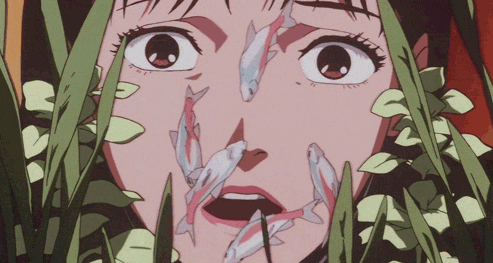
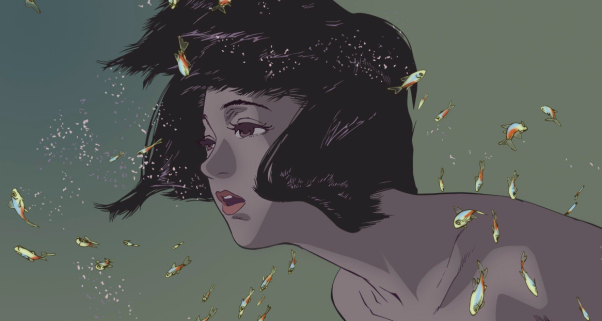
mima fish.PNG


Fantasy & Reality

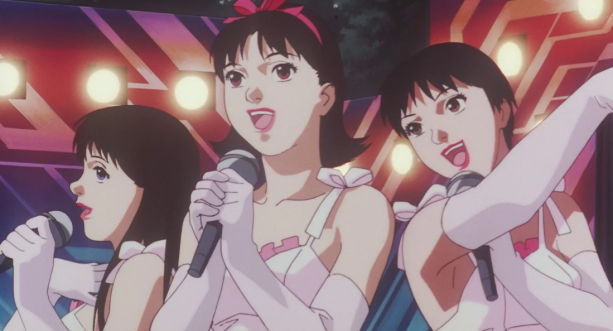
Rising star Mima Kirigoe has just announced her retirement from her Japanese idol group to pursue an acting career. While she tries to convince herself that this is what she wants to be doing with her life, others couldn’t be in greater opposition. Namely, her fans, and one deranged creep in particular who begins to stalking her. As the people responsible for her career change are gruesomely murdered one by one, Mima herself starts to teeter on the edge of sanity.

From the genius mind of Satoshi Kon comes the bizarre story of a singer-turned-actor desperately trying to escape from the delusional head space that is causing the lines between fantasy and reality to blur. The film is swamped in Kon’s signature quick-cut directing style, with creative transitions, wacky visual perspectives, and bright colors guiding the eye through this terrifying narrative.

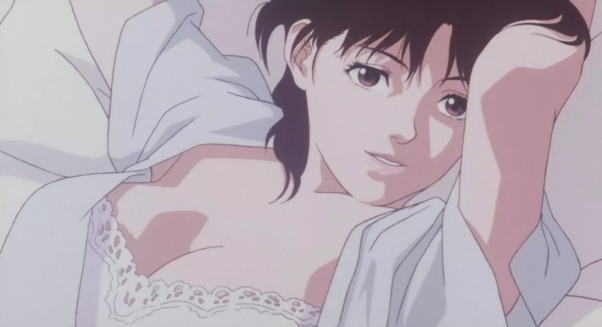
idol mimi.PNG

Kon’s attentiveness to defining the boundaries of fantasy and reality is exemplified in Perfect Blue. Sometimes we are shown Mima acting in a scene, while other times the stage is very much mirroring reality. Figures from Mima’s imagination haunt both her visions of reality and the viewer’s perception of it. You often find yourself asking, is this a dream? Or, perhaps, the nightmare that Mima’s reality has become?

Set at the dawn of the Internet Age, this psychedelic trip puts the viewer on a wild roller-coaster ride through the darker tunnels of human emotion. Paranoia, loneliness, and fear are thoroughly explored in this masterful film that demonstrates what the psychological thriller genre of entertainment can do when a gripping story is met with heart-pumping suspense and a clever directing style that shows you exactly what it wants, when it wants.

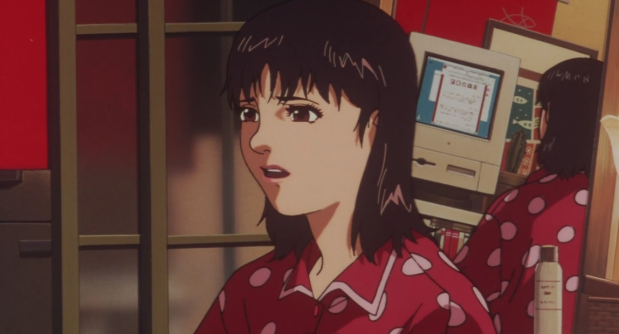
mima in red.PNG

Living in Duality

Perfect Blue begins at the end. That is to say, the end of Mima’s career as a pop idol, and the beginning of her acting career. Despite being a beloved icon on stage, her back stage life is actually a realistic mess. Her apartment is cluttered, and she’s so in-and-out all the time that the cheese she buys at the beginning of the film expires a few scenes later. Mima is, to be frank, just another teenage girl trying to make a living in modern day Japan.

As such, it’s no surprise that Mima’s idol career was suffocating her. Much like a high school memory, sure, she had fun. But maybe it’s time to move on now. She is characterized by a sense of modesty and passion for her work, although she’s perfectly fine with moving on to a new phase of her life. That is, until the industry starts to exploit her talents.

mima exploited.PNG

Without going into spoilers, I merely can offer this small sentiment: We really don’t have any idea of how the industry works, unless we are actively a part of it. In the world of money and fame, it’s not about you want to do, but rather about what other people want you to do. Sure, a girl can give her verbal consent, but that doesn’t necessarily mean she would be comfortable with being used for someone else’s gain. As an actor, you serve the director, and sometimes that can conflict with your own moral values as a person.

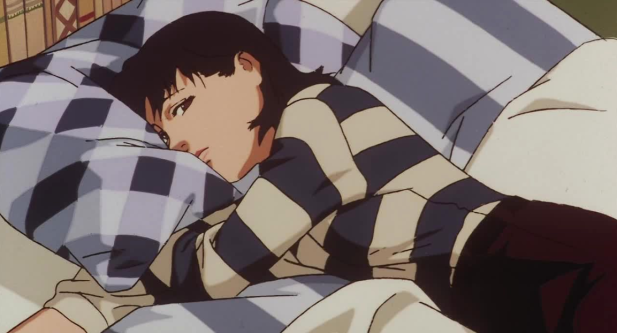
As the story goes along, Mima becomes a victim of forced maturation. This includes being thrust into horrific rape scene that, despite knowing it is fake, scars her poor young mind. She is also met with increased anxiety, depression, PTSD, and even a separation of self by means of superstition. This delusional mindset causes negative thoughts to rise, as in so long as someone is Mima, who really cares if Mima is Mima. How the mind repairs itself and subconsciously shields you for self-protection is absolutely incredible, and that underlying theme is what ties every red thread in Perfect Blue together in one complex, disorienting knot.

mima in bed.PNG

Sensation, Perception, & Direction

Madhouse boosts Perfect Blue‘s production value with an unbelievable amount sensory detail work that I can’t even begin to comprehend. Flashing stage lights, rattling AC units, the motor noises of a 90s desktop computer, the gentle hum of a fish tank—it’s almost sensation in excess, which is just what this film needs. Transporting us to modern day Japan, the attention to detail enhances the setting, and makes the story feel all the more real.

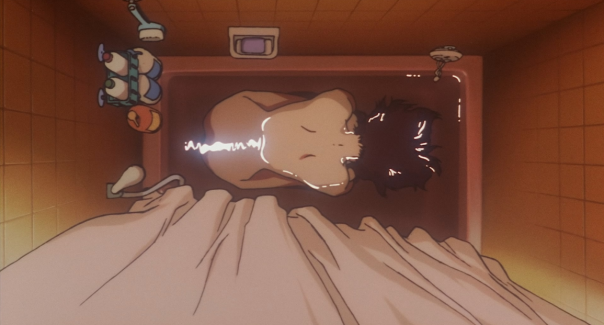
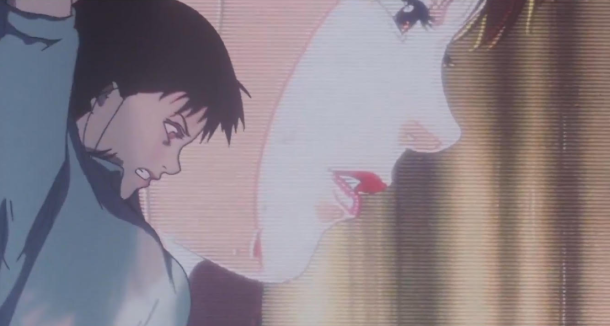
Another gift of watching this film is getting to understand the iconography that makes it so famous beyond being just a really good movie. The bath scene where Mima curls up and screams, bubbles rising from the air of her trapped emotions is particularly beautiful. Seeing Mima hold a knife in midair against a flashing digital backdrop of own image embodies the epitome of suspense. And although creepy in context when paired with the scary music, the scene where Mima chases her dancing, skipping pop idol self through a hospital building conjures up true feelings of horror and hysteria.

mima in bath

Speaking of music, Masahiro Ikumi’s music score for the film adds an eeriness that today’s horror anime just can’t compete with. When we’re not jamming out to light idol music from the 90’s (or listening to it in the elevator . . .), pounding sound board effects, uneasy remixing, and metallic screeching accompany a wailing chorus of uncanny cries. It sounds unpleasant, and it is. But, without Ikumi’s OST, I doubt Mima’s experiences would’ve felt as intense and life-threatening as they were.

mima raised knife.PNG

It’s A Maddening, Cruel World

Perfect Blue takes an introspective look at how fantasy can shape reality, and vice versa. In subtle ways, it asks the question that, as creators of some kind of content, what do we owe our consumers? Are we ever miscommunicating with our readers and viewers, and how would we know? Also, if our successes define us to some extend, how long will they cast shadows into our future?

The world is cruel, scary, and unfair. If it can take something from you, it will. And it won’t give anything back. But Perfect Blue also tells us that if any of these thoughts we are having bother us, then it’s all reality because these thoughts still shape how we feel in real life. Even the most seemingly sane people in our lives . . . We have no idea what they may be going through. Life is a performance, a stage, and if we don’t tell people about what’s going on, they might not ever know. 

In that way, Mima’s story is one about winning yourself back. What does it take to feel confident in my words and thoughts, and how can I get to that place—that’s what I got from Perfect Blue.

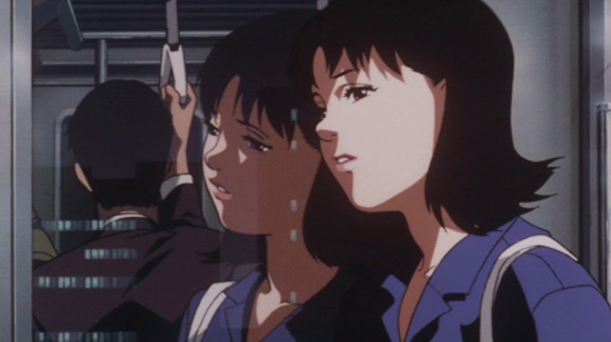
mima on the train.PNG

A harrowing journey through a young woman’s psyche as she tries to escape from the fever dream that her reality is becoming, Perfect Blue effectively uses deception in anime to play with his viewer’s mind. The perception of reality cannot be trusted, especially as the psychodrama heightens towards the climax. But WOW is it a compelling mystery. You actively want Mima to figure out what’s wrong with her life—you want her to solve the case. And with a sucker punch ending that’ll hit ya right in gut, the whole experience comes to a satisfying conclusion.

Believe it or not, for a story that began with existential worry and cleverly crafted chaos, the ending of Perfect Blue provides an outlook that favors hope, confidence, and independence. And seeing the light of those perfect blue skies completes this wild yet captivating journey through the complexities of the human psyche.

perfect blue art.PNG


The truth is that today more than ever, I wanted to have a good time with you. — Mima Kirigoe


Afterword

While I would recommend this film to every fan of anime out there, it IS full of gratuitous sex and violence. So, if either of those are triggering to you, definitely steer clear for a bit. More than just thrilling, suspenseful, and entertaining, Perfect Blue ponders so many ideas, from how the internet will forever change privacy, to the savagery in the entertainment world. A compelling mystery by master storyteller Kon himself, “Cafe Mocha” certified Perfect Blue can truly make you feel genuinely scared for your life (especially if you watch this at midnight by yourself like I did, eep).

I’d love to hear what you think of this classic film down in the comments! Special thanks go to GKIDS for rescuing this long out-of-print title and giving it a lovely Blu-ray remaster—they really are the best! Now, if you’ll excuse me, I have to go binge Love Live! . . . you know, to maintain my own sanity. ‘Till next time!

– Takuto, your host

Ultimate Luck and Hope & Despair: Danganronpa 2 as a Manga . . . From Nagito’s Perspective | Review

A brief, spoiler-free review of the 3-volume 2012-2016 manga “Danganronpa 2: Ultimate Luck and Hope and Despair,” based on Spike Chunsoft’s game “Danganronpa 2: Goodbye Despair,” art by Kyousuke Suga.


A Spin-Off Full of Despair

Sixteen students from the prestigious Hope’s Peak Academy suddenly awaken on a deserted beach. Their teacher, a white and pink “magical girl” rabbit named Usami, proclaims that their first assignment is to become friends with one another by means of touring the island and collecting hope fragments together. Storm clouds quickly gather over this isle of palm trees and blissful breeze when Monokuma, a sadistic bear of monochrome hue, takes Usami down and gives the students a new assignment: to kill one of their peers and get away with murder in the class trial.

To the victor goes the only spoil these teens want—escape from the island. The students swear to one another that they’d never commit such a crime, but as Monokuma slowly and meticulously introduces calculated motives that play on the whims and desires of these kids, temptation is given into, and blood is spilt.

Forced into this deadly killing school trip, what once was an island paradise has become a hell on earth. But when these poor kids find that they’ve been deceived far more than what is even imaginable, the very fabric of their world hangs on the thin threads of hope.

nagito hope

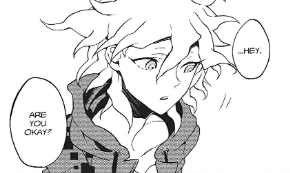
Greatly truncated for the sake of this review, this is the plot of Spike Chunsoft’s groundbreaking game “Danganronpa 2: Goodbye Despair,” and the sequel to the equally influential “Danganronpa: Trigger Happy Havoc.” But as you can tell, this review isn’t about the game; rather, we’re looking at the manga spin-off today. Instead of playing this survival game through the eyes of main character Hajime Hinata, we experience life from the view of Nagito Komaeda, the Ultimate Lucky Student, and the bane of the class’ existence.

The Ultimate Lucky Student

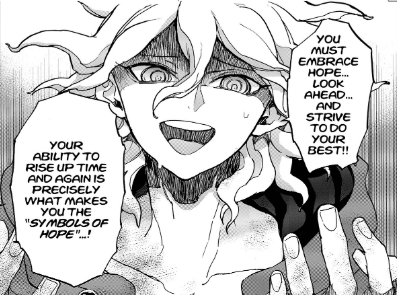
Infamous for his willingness to take his “friends” down yet beloved by the community for his twisted nature and bromance with Hajime, Nagito is a complicated human bound by irrational thinking and a moral compass that always points south. Above all, he believes in the talents of the Ultimates of Hope’s Peak, and the insurmountable hope that can arise from their collective efforts. Weird, I know, but it gets worse.

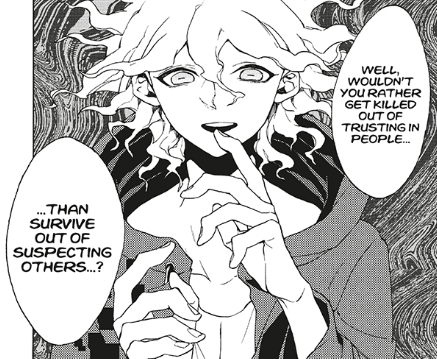
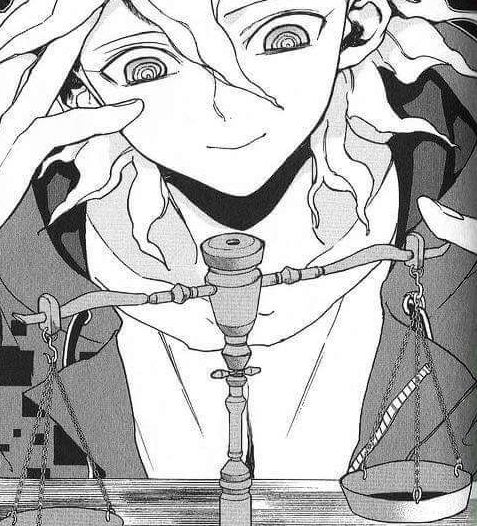
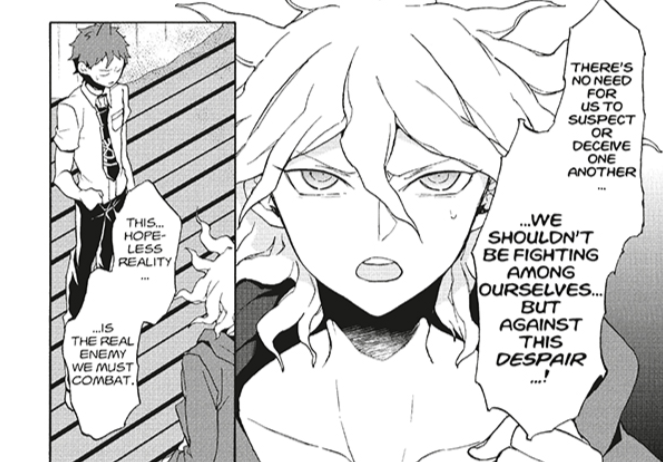
Placing complete faith in his ultimate luck and the hopes and dreams of his friends sounds like a good thing, right? Well, not when you add in that twisted personality part I mentioned earlier. He derives pleasure from inflicting pain, suffering, and humiliation on his peers, without a doubt, but only because he deeply believes that his friends are Ultimates—students handpicked by hope itself. That means that no matter the size of the despair, hope always comes out on top. This flawed logic of his causes him to create scenarios that put everyone at risk just to watch the Ultimates overcome the despair. After all, according to Nagito, their talent can overcome any despair.

So, not only is this scrawny emo a huge Hope’s Peak fanboy, but he’s also a nut job with more than a couple loose screws. The PERFECT player to have in a killing game, right?

nagito belief.PNG

To give him credit, there’s never a dull moment around Nagito. In fact, many of the game’s most exciting moments revolve around Nagito’s lies and schemes. By packing the best reveals and most fascinating plot points into this short 3-volume series, you’ve got a spin-off that is anything but boring. Nagito’s trademark luck carries him through numerous plots and conspiracies—many of which he is directly involved with—at the behest of everyone else’s security.

Madness and Maliciousness in Manga Form

Danganronpa is one of the most stylish games out there, arguably more so than even the hit Persona 5. Its iconic gun-and-target imagery offers fun gameplay effects, sure, but the flashy courtroom gimmicks and screen-shattering special effects aren’t just for looks. The series prides itself with the class trials, the bread and butter of the franchise, and this motif of breaking through lies—shining through despair—to uncover the truth. And thankfully, Kyousuke Suga’s adaptation faithfully adapts this matter of style into the fast-paced panels of his manga.

That’s right. Most if not all of the crucial lines and moments are replicated nearly word-for-word in the class trials. Although we only get the first three (for reasons I can’t explain without entering spoiler territory), I was quite surprised with how full and thorough the trials felt, given the immensely short length.

Like anyone should be, I was skeptical about a measly 3-volumes doing Danganronpa 2 any justice. By limiting the story’s POV to that of Nagito only, however, you realize that the Ultimate Lucky Student’s time spent with the Ultimates of Hope’s Peak is short, perhaps, but immensely impactful.

nagito scales.PNG

The only turn-off to this little series is the character designs. All the guys look anorexic, while the ladies have totally unrealistic “curves,” almost as if everything was somewhat over-sexualized. Even if the seemingly sloppy, disproportionate bodies and facial expressions feel uncharacteristic of the game’s original designs (which were boldly outlined and always on point), there’s beauty in the quirkiness of Suga’s style, though.

This lax, less faithful style allows for us to see character expressions and reactions that the game just couldn’t keep up with. A sprite system might feel more stable, but this adaptive style manages to keep up with the subtle dark humor and self-deprecation (given that now we’re Nagito) that I felt the game just didn’t. Suga’s work is much more organic and less “cardboard cutout,” literally, and it makes for a nice afterword piece to the franchise.

nagito and hajime.PNG

Why Should You Read This Spin-Off?

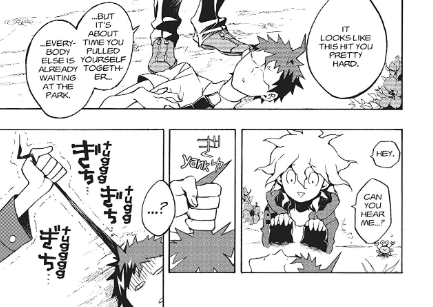
For one, it’s short. At three volumes, I finished it in a day and a half. Plus, it fills in some gaps of the game. During chapters two and three, Nagito is tied up (don’t ask) and unconscious (also don’t ask), meaning that while the others (namely Hajime) are experiencing the events of the story live, Nagito is playing catch-up. And boy does he do a damn good job at assessing the evidence of each crime scene.

Instead of running around and talking to our classmates, we enter Nagito’s nightmares and delusions of self-reflection. We see his fears, understand his motives, and get a better picture of why Nagito antagonizes his peers like he does. Much better than in the game (save for chapter 4), we get inside Nagito’s headspace and see what makes him tick, allowing the viewer to connect with him a bit more—even if he’s still a freak at the end of the day. You can practically regard this spin-off as cannon, as it never strays from the original plot, nor does it add conflicting details. That’s always a plus.

Additionally, we get different angles from the game. The “camera” shows us live conversations with multiple characters in a shot at different angles talking to one another, as opposed to the game where 2D characters are layered on top of a 2D backdrop. Plus, Kyousuke Suga just seems to understand that Nagito is not a character to be disgusted or hated all the time; Nagito is an oddball to the class, an anomaly that can’t always be understood, and I appreciate Suga’s more comedic take on Nags’ obsession with hope.

nagito and hajime talking.PNG

Like Loki to Marvel’s Thor franchise, Nagito is a trickster that is fun to watch and frustrating to befriend, but undeniably inseparable from the equally quirky work in which he comes from. As such, it’s a real treat to have an entire narrative devoted to his character, even if it’s both a rehash of the game’s events (with a few dream sequences of backstory and inner monologues added) and, frankly, a series tragically short for its own good.

This manga series shows you some of the parts you wish you saw in the game, and it does so craftily without tampering with the existing plot. Is it for newcomers to the franchise? Absolutely not. But as supplemental material for those pining after anything extra to do with Hope’s Peak Academy’s 77th Class, Ultimate Luck and Hope and Despair is your stepping stone toward hope.

nagito waking hajime.PNG

Komaeda, you aren’t trash. If you died, or helped someone commit murder, it won’t give rise to hope. Just the opposite . . . it’ll wind up extinguising a ray of hope. ‘Cause . . . ’cause hope . . . is already shining inside you, Komaeda. — Monomi


Afterword

I had a blast reading this short little spin-off, especially given that I finished playing the second game right before starting this series. All the parts of this franchise connect together so intricately, so purposefully and creatively, and this manga spin-off is no exception. It’s extra material for sure, but if you love Nagito Komaeda’s guile as much as I do, you’re bound to love Suga’s work.

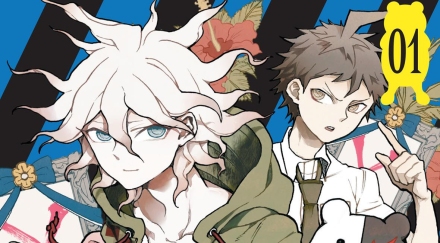
And can we talk about those volume covers?? The first two are so brightly colored and stylish with all the characters wrapping around from front to back, while the third is a haunting minimalist piece of Nagito looking like he’s preparing for the final show (if you know what I mean). I think Suga could’ve split volume three into two separate volumes, adding in more content from the ENTIRELY SKIPPED fourth trial, as the third book is nearly twice the size of the other two. Oh well, at least we got the series (in all its matte-cover glory) thanks to Dark Horse.


I doubt many of you will end up checking out this series, but if you do, I’d love to hear your thoughts on it! Although a manga series, I’ll give Ultimate Luck and Hope and Despair the “Coffee” rating for being a fun read but not an essential one. I believe the regular manga adaptation of the second game along with Ultra Despair Girls are coming out this fall, so I look forward to picking those up. Till the next review, this has been

– Takuto, your host

Majestic Prince: The Dumb, the Horny, & the Brave | Review

A brief spoiler-free review of the 24-episode spring 2013 anime “Majestic Prince,” animated by Doga Kobo and Orange, directed by Keitarou Motonaga, and based on Rando Ayamine’s manga of the same name.

izuru smile.jpg


Born to Fight

In the near future, humans have begun to live in space through large satellites connected via space elevator. It’d be natural progression for the human race to eventually leave Earth and migrate elsewhere, but hostile aliens launching attacks from the outskirts of Jupiter are making this progress a little trickier than humanity would’ve hoped.

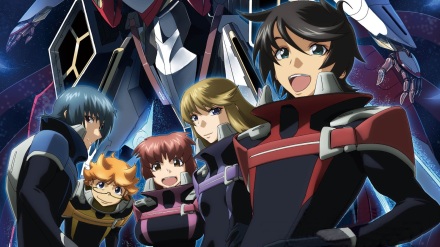
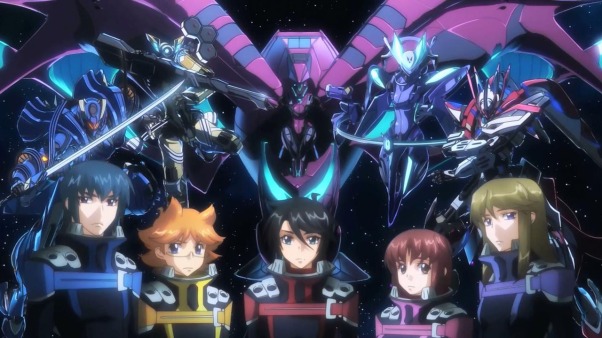
To adapt in their new zero-gravity environment and combat the foreign belligerent threat, genetically engineered children known as “Princes” by the public eye are artificially raised and trained to pilot giant armed robots. These units, the AHSMB, are humanity’s last line of defense, and as the egocentric, lust-driven Wulgaru forces close in on Earth’s orbit, five young pilots from the academic city Grandzehle are forced to fight on the front lines—or die trying to defend their home.

Ginga-Kikoutai-Majestic-Prince-large.jpg

Majestic Prince tells a simple story. Aliens = bad are after human DNA so as to satisfy their hunt for life in the universe. Meanwhile, humans = good are trying to protect themselves from the invaders. I was really hoping for the anime to be at least somewhat more complicated than that, but I’m afraid that’s as gritty as it gets.

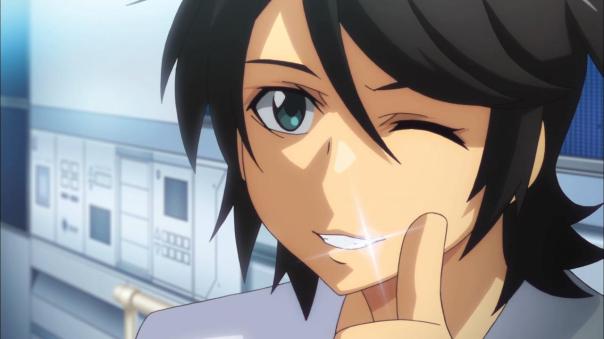
Following a lucky victory in the show’s opening episode, Izuru Hitachi and his classmates get a taste of what the battlefield is really like, as well as how society reacts to humanity’s “super soldiers.” After these first six episodes of training, the kids come to realize that their lives are much more complicated and meaningful than fighting aliens. They have become symbols for justice, the “Majestic Princes,” and although Izuru and his friends were not expecting this kind of life post-graduation, such is what fate *cruelly* delivered. 

In a series of 2 to 3-episode mini arcs, our heroic group of teens is given missions involving disabling enemy technology, fighting, or scouting out enemy territory. The goal: push the Wulgarian forces to the edge of the solar system. Despite inching closer towards liberation, each of these little victories feels hollow. Majestic Prince is most certainly a plot-driven series, but despite the progress, the story and all of the pieces that make it up just aren’t that interesting. Plot twists, when unveiled, are few and unsurprising, and the biggest reason for this lackluster delivery lies in the dreadfully written characters, both good and evil.

mjp izuru friends.jpg

The Fail Five (that’s literally their name)

Ok, it’s actually Team Rabbits, but regardless, I don’t really like these kids. Not that I have anything against them, but there’s quite honestly nothing about this cast that stands out. Izuru is the hero (or at least he desparately proclaims himself to be so), Asagi is the friendly-fire rival, Tamaki is the cute one (boooo), and Suruga is the annoyingly smart and techy one (UGHHH, I hate this guy).

The only one of Grandzehle Academy’s infamous “Fail Five” that strays from the mark is Kei, the constantly-tired big-sister-type that ironically sucks at anything home-ec. In any other show with this kind of cast, the hero would be paired with the cute one, but not in Majestic Prince. Instead, the series gives Kei unrequited feelings for Izuru, who’s denser than a brick to notice. I . . . kinda liked this scenario, but the execution is half-assed. The series abruptly ends with no emotional or romantic conclusion for our poor, purple-hued tactician. Talk about a wasted investment.

izuru and kei.png

At least the alien Wulgaru are nasty and cool, right? Hah, WRONG. This is probably the most boring cast of humanoid villains I’ve ever seen in a mech show. Characterized as manifestations of the darker side of human emotions, these pleasure-driven, war-hungry tyrants are only in it for themselves, which would’ve been fine had they served as more than just slaves to this destructive ideology. The Wulgarian elites possess half-hearted motives, and their emperor is a total snooze. He doesn’t do ANYTHING!

I would’ve loved to have seen the drama of betrayal commonly found in any series with a collapsing evil monarchy built up much more than it was, but I suppose even Majestic Prince‘s antagonists aren’t on the bright side.

mjp wulgaru.jpg

Visual Forte: “With Our Powers, Combined!”

Perhaps the animation is the most impressive thing Majestic Prince has going for it. The series is listed with having two production studios; I would imagine that Doga Kobo took over the 2D stuff, while Orange (Land of the Lustrous, Black Bullet, Dimension W) handled all the 3D CG mechas and space fights.

While the quality of the CG is actually pretty good (the mechas themselves looking faaaar more impressive than the Wulgarian blob creatures), the fight choreography can be hard to follow at times. Dramatic zoom ins and outs, constant spinning around the battlefield, no focal point to really anchor at—to be frank, it’s too much at times. You almost get space sick, if such a thing exists.

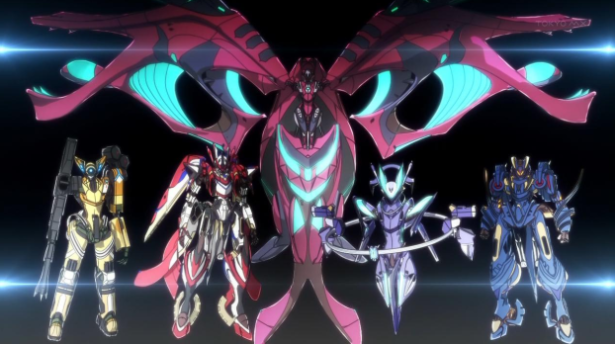
But, seeing as it’s a giant robot series, let’s talk about those for a sec. It should be the goal of any mecha designer to create a look that is both appealing to look at and memorable in some way, shape, or form. Each of the Fail Five pilot a mecha unique to their strong suits, stylized by mechanical designer Kouji Watanabe. Suruga likes guns, so he’s the sniper. Tamaki and Kei are protectors, so they make up the shield and strategist, respectively. Meanwhile, Asagi is that ninja/senpai figure, so naturally he wields a sword, and our hero Izuru is the fighter, hence fists, guns, and a mild combination of everyone’s skill set, really.

mjp mecha

This works really well for the audience. It allows the viewer to associate not only a color to these frankly unmemorable characters, but also their own unique AHSMB unit. Add in the crisp CG imaging and a little transformation sequence at the start of each battle and you’ve got a good routine going—a factor of many great mecha anime that few seem to acknowledge. Even if the characters all kinda have the same moe face, the distinctions on the battlefield marked by the varying colors, positions, roles, weapons, and unit designs make up Majestic Prince‘s visual forte: the collaboration between these two great studios!

As for sound, Toshiyuki Watanabe’s orchestral tracks add a classic vibe to this series—even if the visual effects are anything but. While I can’t recall any specific music moments (aside from the combat start-up sequence) that caught my ear, Watanabe’s OST adds another wonderful layer to this otherwise high quality production.

mjp izuru mech.png

Another One Bites the Dust

Half of Majestic Prince was boring; the other was unmemorable. Easily, its most interesting plot point was how such a society would view child mecha pilots—and that only lasted throughout the first half. My favorite episode didn’t even have any fighting in it; rather, it gave us insight into what the daily lives of these teens are like, and all the business they must tend to off the battlefield. Whether it’s repping a brand to gain financial support, volunteering community service at a daycare to ensure public trust, or even modeling for the media, these are realistic issues that most mechas wouldn’t dare to waste time on. And yet, that’s where Majestic Prince thrived.

But when you put all the pieces together, something still doesn’t fit quite right, and it’s honestly the characters that ruin Majestic Prince for me. First, the series insults its cast with unintelligently written dialogue. Second, these kids are dumb (a result of their terrible scrips!) and when they try to get you to laugh—cause you know, there’s always some sort of innuendo to be made with a bunch of horny teens around—you find yourself more so rolling your eyes. And third, the series insists on being funny, and yet when it tries to be, it gets worse. Some of the characters even drag porn into the mix just to squeeze a laugh out of the viewer. Straight up PORN. No, I’m not joking, and no, it didn’t work.

Had I been five or even ten years younger, maybe the series would’ve worked on me. But it’s very hard to pass Majestic Prince on anything when its story and characters are so obviously flat and dry. This is especially sad considering that its production values are pretty damn decent for its time, a combined effort between visuals and sound that clearly tries to salvage this wreck. At the end of the day, however, I’d still just prefer to leave this mess out in space—floating with the dust, and far out of my reach.

mjp gdf

I’m not fighting because I want to fight. I’m doing it to protect those who are dear to me. And because . . . I want to become a hero! — Izuru Hitachi


Afterword

Despite my misgivings with the show, I’m glad I finally gave Majestic Prince a watch. It’d been in my backlog (and on my shelf!) for what had felt like forever, and when at last I decided that the wait was over and plugged in the first disc, well, this is what happened. For all its dorky characters and dull plot points, I’m barely letting Majestic Prince squeak by with the “Coffee” rating. Barely. What saves it is its animated space fights, which allows the piece to at least be entertaining at times. Apparently there’s an OVA episode 25 and a film to follow that make the ending feel less abrupt, but I’m in no hurry to get to them, especially since they aren’t currently licensed.

Leave it to me to once again review a throwback that NO ONE asked for, yet I delivered, haha. What did you think of the Majestic Princes (or Fail Five if you fancy) and their valiant efforts to protect Earth? Be sure to let me know, especially if you thought better of the show! Thanks for reading, and until next time, this has been

– Takuto, your host

Izetta: The Fairy Tale That 2016 Slept On | Review

A brief spoiler-free review of the 12-episode fall 2016 anime “Izetta: The Last Witch,” animated by Ajia-do Animation Works, directed by Masaya Fujimori, and based on the original story by Hiroyuki Yoshino. 

Image result for izetta the last witch the white witch


Die Letzte Hexe: The Last Witch

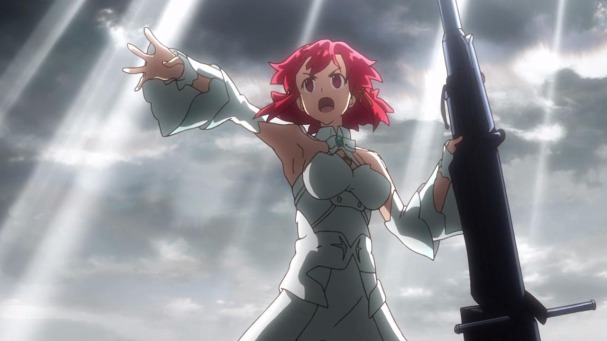
Back during the ages of old, a witch with pristine white hair wielded her powerful magic to protect her country of Elystadt, defending its people until her last dying breath. Years later in 1939, militaristic giant Germania invades a neighboring country, plunging Europe into a devastating war. Boasting far superior technological prowess in this industrial era, Germania sets her sights on Elystadt, a significantly weaker alpine country in the way of Germania’s great conquest.

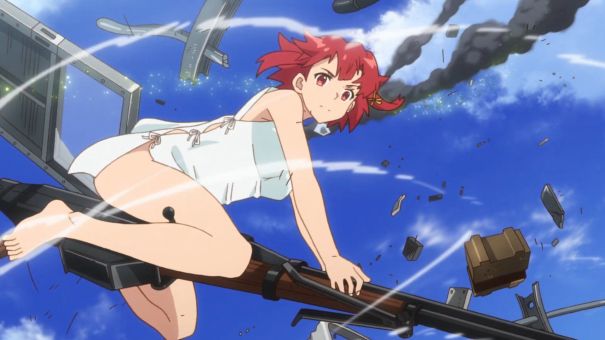
To make matters worse for the tiny country, Germanian soldiers capture their princess, Ortfiné “Finé” Fredericka von Eylstadt, as she is heading to a decisive meeting with Britannia. When trouble aboard the transport plane breaks loose, another piece of precious cargo, Izetta, the last witch alive, escapes. Recognizing Princess Finé from a childhood memory, Izetta transforms a soldier’s rifle into a flying “broomstick” and rescues Finé.

izetta gun.jpg

Now reunited with her princess, Izetta pledges to protect Elystadt from the clutches of Germania—just as the White Witch of legend once did—and with the last surviving witch on their arsenal, Elystadt hopes to turn the tides against the imperialist war titan.

Original projects excite me. There’s nothing more freeing than hearing a studio trying to bring together a story from the their own combined passions, and then seeing the results. Izetta was no exception. While underwhelming in its finale, Izetta provides a magical spin on a historical setting where a world war is fought . . . by a witch.

izetta wave.jpg

What if a World War had a Witch?

Izetta is a bumbling little mess of emotions and crimson hair. She’s kind and overly humble, but often disregards her own well-being for the object of her affection: Princess Finé. Speaking of, our Princess of Elystadt herself is quite the noble woman. Just as Izetta, she’s loyal to her countrymen and responsible to a T. Respect is another quality that runs deep in the Elystadt family’s lineage (or at least the legend has us believe), but trust me when I say that Finé is the genuine article.

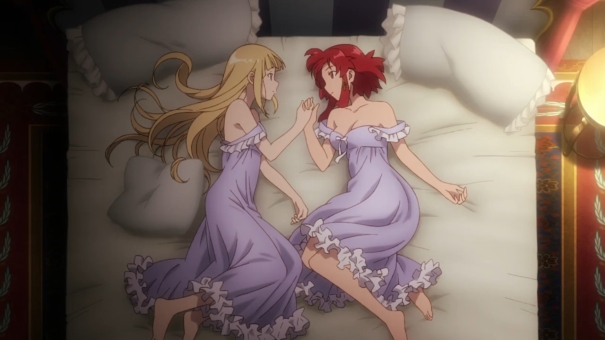
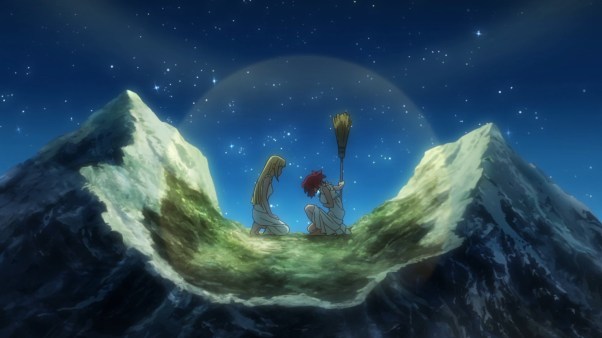
The two are a power duo, and many of my favorite scenes don’t revolve around the engaging combat, but rather the quiet nighttime conversations that are exclusive to the pair. Although they act selfishly so as to preserve the others’ safety, Izetta and Finé are undeniably a cool couple bound together by lore and destiny.

Aside from Izetta, Finé, and a young Germanian spy boy named Ricelt, none of the characters’ motives felt resolved, however. If this were an adaptation of a larger work, then I could understand why some details might’ve gotten left out. But Izetta is an original story with an entirely original cast, and to have interesting characters that serve little more purpose than to act as mere decorative pawns is a crime. If one character’s role can be performed by a separate entity and the story pans out the same way, then that’s a sign you should probably rethink your character count.

izetta and fine.jpg

Banking on Design: The Art of Izetta

Ajia-do isn’t a studio known for producing the most outstanding works (the most noteworthy to me being Emma: A Victorian Romance‘s second season), but they definitely did Izetta justice. The magical dogfights featuring Izetta flexing her powers are super fun to watch, as she enchants a variety of guns, swords, and missiles to fly by her side and “aid” her. All of the CG armaments gliding around the battlefield are well animated, and the background villages, landscapes, ballrooms, and regal offices are splendidly colored.

Speaking of colors, the character designs are surprisingly detailed and ornate, especially Ortfiné’s. BUNBUN’s light novel-esque character designs mirror the quality of Abec’s works of Sword Art Online fame. The hauntingly gorgeous ED theme “Hikari Aru Basho e” by May’n features the beautiful original artwork in an elegant slideshow fashion. As for the rest of the music, Michiru delivers wonderful militaristic anthems for on and off the battlefield. Overall, the soundtrack supports both the dramatic and the more lax moments of the series fairly well.

bunbun izetta

For dub fans, Funimation’s got you covered with another high quality English script. Mallorie Rodak brings a nobility to Princess Finé that is very reminiscent of her lovely work as Space Battleship Yamato‘s Yuki Mori. Derick Snow’s young boy voice for the soldier-spy Ricelt was, wow, perfect, and Jad Saxton’s Sophie makes for a wicked antagonist, even if I dislike the character. I found Skylar McIntosh’s Izetta to be the weakest performance here, but even then I grew to enjoy her natural naivete that fits so well with the role.

The End of Magic and Fantasy

Amidst the hype of the incredible fall 2016 anime season (which included Drifters, Bungou Stray Dogs‘ 2nd Season, Haikyuu!!’s 3rd Season, and the phenomenon that was Yuri!!! On ICE to name a few), Izetta slipped by the radar fairly undetected. Its flashy moniker and simple yet exciting world-wars-meets-magic premise was pretty well received by fans that somehow didn’t have enough that season to chew on, although few stuck around for very long. (Don’t worry Izetta, I made time for you back then.)

After the first stunning and smart six episodes, the promises and high stakes let on by this thrilling first half see a weak follow-up (and even weaker conclusion) come the end of the story. The introduction of a villain, aside from the uninteresting Germanian emperor, in the latter half serves more thematic purpose than anything else. That is to say, the addition of an actual antagonist to directly oppose our titular witch doesn’t make this story of war any more exciting.

izetta the white witch.jpg

Prior to this reveal, the series was building up to one big narrative conclusion: that war is bad. It’s not novel, but it certainly fits. Seeing as how there are radicals, spies, and heavy losses on both sides of the border, I would’ve been quite satisfied if Izetta had held a more neutral position.

But then they go ahead and say, “Aha, this new villain is TRULY evil,” and any hopes of an appeal to the enemy side are lost in the muddy trenches. Maybe that kind of story works for you, but I just wasn’t a fan of the big baddie because it didn’t feel like the finale Izetta was building up towards. As an original tale, you could’ve gone anywhere . . . and this is what you decided on? At least Izetta looked great soaring high in the sky on that rifle of hers—I’ll certainly miss our little witch and her magic, even if just for that.

izetta's vow.jpg

I, for one, am glad we saw the magic. It may not seem like much, but I think the fairy tale of the White Witch who appeared in modern times left something good inside the hearts of people all over the world. — Izetta, the last witch


Afterword

It’s been three years in the making, and it took receiving a physical copy of the Izetta Blu-ray as a gift from my brother to finally make the time for a rewatch and give this series a proper review. Even if I was disappointed with parts of the ending, the final sentiment of leaving magic behind and looking towards the future will always bring a tear to my eyes. More than not, I’m so happy this project became realized by the production team behind it—it’s a noble little piece, and an achievement in my eyes. Izetta: The Last Witch receives the “Coffee” rating, a title that you, eh, might enjoy, but I wouldn’t recommend like crazy.

Were you one of the few who stuck around to see the end of the magic, or did you bail out of the plane halfway like Finé did in episode one? Let me know, because literally no one talks about this series! Really, the show is kinda dumb, but it’s fun popcorn material if you just want to turn your brain off. On another note, I’m in the reviewing mood, so I’m hoping to churn out a few more before the inspiration passes! So, until next time, this has been

– Takuto, your host

I Finally Watched the Old Fruits Basket | Review

A brief spoiler-free review of the 26-episode summer 2001 anime “Fruits Basket,” animated by Studio Deen, directed by Akitarou Daichi, and based on the manga of the same name by Natsuki Takaya.

zodiac cat.PNG


The Girl with a Big Heart

Despite losing her mother in a car accident and being kicked out of her grandfather’s house due to renovation, 16-year-old Tohru Honda manages to love life like no one else you’ve ever known. Lying to her friends and family that she’s already found a new place to stay (so as to not burden them) Tohru sets up camp *literally* in the woods.

One fateful night after a long shift at work, Tohru returns to her tent only to find it crushed and flattened by a landslide. Desperately digging through the rubble for the last precious picture of her mother, Tohru faints in the mud. Luckily, the prince of her high school, Yuki Sohma, and his author cousin, Shigure Sohma, come to her aid and even invite Tohru to stay with them until her grandfather’s home renovations are finished.

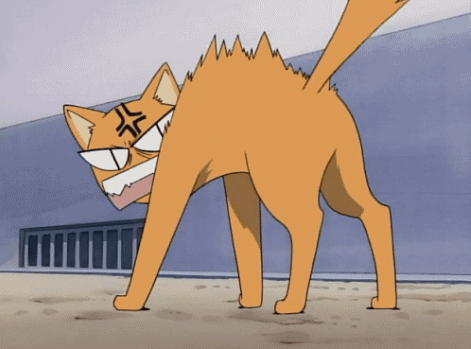
But as life (and the shoujo genre) would have it, a roof over one’s head doesn’t come free, and so Tohru works as a housekeeper at the Sohma house in return for room and board. The Sohma’s aren’t an ordinary family, however: if a Sohma is hugged by someone of the opposite gender, POOF, they temporarily transform into one of the animals of the Chinese zodiac! (Plus, they return to being human without their clothes on.) Toss in Kyo Sohma, the fiery zodiac cat, and you’ve got quite the crazy household.

Image result for fruits basket 2019 kyo

While the Sohmas’ secret causes more sticky (and silly) situations than not, this strange phenomenon isn’t all giggles for Tohru and especially the members of her new family. Rather, the curse of the zodiac has caused all of the Sohmas to bear the tremendous weight of their dark family history. Some are more complacent about the situation than others, but none of them are happy with what the curse has brought them.

As Tohru meets more of the family’s members, she continues to see the light casting such great shadows across each of their hearts. But even with her unusually big heart and kind yet resilient nature, is there a limit to the heartache that Tohru can take?

kyo and yuki.PNG

Welcome to the Sohma Household!

Oh Tohru, where to begin with you! She’s just about the sweetest young lady you’ll ever meet, so determined and steadfast, yet also gentle and supportive. Full of gratitude for her life and warmth to spare, I couldn’t think of a better protagonist for such a story as this. I love Tohru’s character, I really do, and I totally get why you all do, too! But as a dub fan myself, I couldn’t fully appreciate Tohru without giving praise to Laura Bailey for bringing this clumsy yet polite high school girl to life. UGH, I just love listening to old dubs and hearing Laura Bailey as anything, but this, without a doubt, is a hallmark role for a reason.

kyo and tohru

Now for mah boys, where are my Prince Yuki fans? Kyo Sohma stans?? Prior to watching, all I knew about Fruba was that all of the male Shomas were supposedly boyfriend material. I get it now. Kyo and Yuki are ICONIC, like fire and ice, cat and mouse (rat), respectively; the Asuka and the Rei of the shoujo world. The smart one perfectly imperfect, the stupid one imperfectly perfect. Although both are unable to open their hearts to “normal” people, these two rivals in arms compete for the affection of Miss Honda without holding back, unbeknownst to their own feelings in the beginning.

And yeah, in case you were wondering, #TeamKyo ALL THE WAY. After voicing Kaworu in Eva 3.33, I never thought I could fanboy over Jerry Jewell this badly. Turns out, I can.

I couldn’t wrap up the Sohmas without mentioning some of my other favorites, however; if Kyo is #bestboy, then Shigure is best man cause DADDY AM I RIGHT. Jokes aside, I really do love the zodiac dog and all his whimsical teasing. John Burgmeier’s Shirgure is just as slippery as his personality should be. Same could be said about Chris Sabat’s overly frilly pompousness for Ayame Sohma, our resident snake, cause wow, just such dream casting.

fruits basket sohmas.PNG

Sweetly, Softly, Serenade Me

Ah, here we are, Fruba‘s biggest deal-breaker: the animation. Studio Deen isn’t known for producing the most beautiful works by any means, and it pains me to report that as much as I love the characters, the show kinda looks like ass. To be honest, not many early 2000s anime fair as well as those that came before (and most certainly those we have now), but the inconsistently drawn faces and blocky body structures make Fruba 2001 a pretty bland watch, especially when compared to the 2019 remake (I mean, I would hope so, at least). The chibi art style for the many comedic moments in the series is iconically well-done, however, so I’ll at least give it points for being extra cute and even hilarious at times.

There’s also a problem with the anime-only ending, but I can’t and won’t add more on that simply because I do not know how faithful that ending is to the manga. While it may seem totally out of touch given the fluffier content of the earlier half, perhaps the original story does go that dark, that suddenly, to which I can only really say . . . yikes. Emotional, absolutely, but it still hits hard from waaaay outta left field.

Much of the actual OST for me is a blur, but I loved the reprises and acoustic versions of the OP and ED featured throughout the series’ run. The actual theme songs happened to exist during the days of dubbing the music, so the OP and ED are in English. And I love that too. Hearing Laura Bailey softly signing along to “Chiisana Inori” at the end of each episode was the gift you earned for having to watch the drab animation. But to hear the bittersweet “For Fruits Basket” immediately following as the OP was, well, emotionally draining to say the least. (It really just HITS ya.) Ahh, my heart, what a lovely pair the two make!

for fruits basket.PNG

Acceptance Begins with Understanding

From the synopsis alone, I can see why the series has become so iconic to the genre. The scenarios in Fruits Basket are as classic as they get—I can only imagine, if there’s an anime romance trope out there, Fruba‘s got it. Whether the quirkiest or steamiest of situations, however, the series handles the delivery more gently than most. It’s almost as if the series, despite how depressing it can be, is too kind for its own good. And you can bet Tohru is a huge part of why Fruba manages to be simultaneously innocent and full of depth and heart.

The story is richly woven with character dramas and inspiring little tales reminiscent of a child’s bedtime storybook, Tohru serving as both the narrator and the characters’ guiding light. Each of the Sohmas possess an individually distorted view of their dark pasts, and after years of rejection, isolation, oppression, and feeling like an outcast, who could blame them? These are wounds that even time cannot heal—scars that will never fade—and yet, Tohru tries to bandage them up anyway. Through her accepting essence, Tohru allows Kyo, Yuki, and so many others in the family to vent their frustrations, their past errors, and their regrets.

tohru hugging kyo.PNG

After what feels like a long, exhausting therapy session, our zodiac friends slowly come to peace with themselves and, at last, feel proud for being who—not what—they are. As someone willing to understand them, Tohru offers to do what no outsider has ever done before and help shoulder their burden, however tremendous the weight, and I couldn’t even begin to fathom how relieving that must feel. “Finally, I can tell someone. FINALLY, I can be me!”

From me to you, don’t sleep on this story as long as I did. With the new season airing, tons of fans around the world are reconnecting with their favorite zodiac friends and passionate OTPs and ships. To miss out on such fun would be tragic. So, whether the old, stale, yet genuine 2001 version or this latest vibrant retelling, watch Fruits Basket. Then you, too, will see what all the ruckus is about in the Sohma household—and why it’s such a heartwarming, endearing little place to stay.

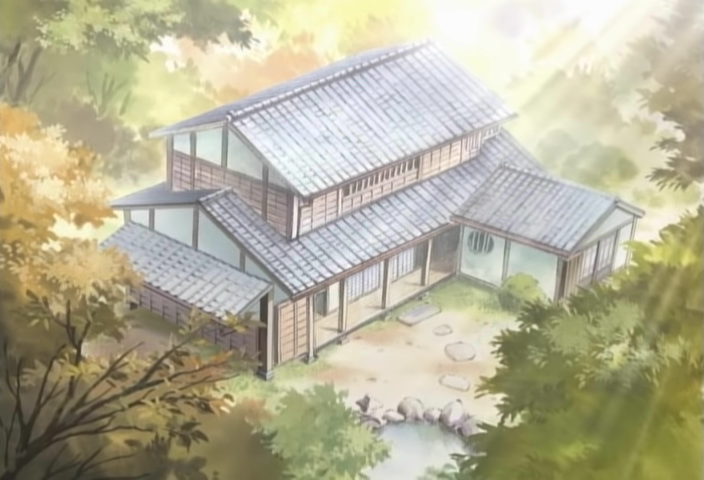
Image result for fruits basket sohma house

You never know what will happen tomorrow! If it’s not tomorrow, then maybe the next day. Maybe after a year, or even ten years . . . But even so, as long as you’re alive, things keep happening. As long as you’re alive, wishes keep getting made. — Tohru Honda


Afterword

What more can I say, Fruits Basket is a classic after all. So classic, in fact, that I’m awarding this long-awaited series with the “Cake” title, a series so sweet it’d be a crime to skip out on. That said, I’d only make it a true must for shoujo fans. If romance and cutesy fun stuff ain’t your thing, skip it, or better yet try the 2019 version. At least that one looks pretty (not to say I won’t crush over 2001 Kyo for the next year). There’s so much heart in this series, guys—I GET WHY Y’ALL LOVE IT SO MUCH. And the dub, oh my god, they really milked this one for all its worth. So honestly, truly wonderful.

Image result for fruits basket anime yuki

Do you have any memories with Fruits Basket 2001? Ooh, what about a favorite zodiac member?? You’re gonna have to let me know in the comments for sure! I’ll forever treasure this past spring, spending my weekends watching this beloved show with my sister. In fact, the remake may be why I decided to watch it now, but my sister’s the one who shared this series with me in the first place! Thanks so much for reading another rambling gush-fest of mine, and until the next post, this has been

– Takuto, your host

Run with the Wind: Wholesome, Heartfelt, & Inspiring Every Step of the Race | Review

A brief spoiler-free review of the 23-episode fall 2018 anime “Kaze ga Tsuyoku Fuiteiru (Kazetsuyo)” or “Run with the Wind,” animated by Production I.G, directed by Kazuya Nomura, and based on the novel of the same name by Shion Miura. 
kazetsuyo line up


“Hey, Do You Like Running?”

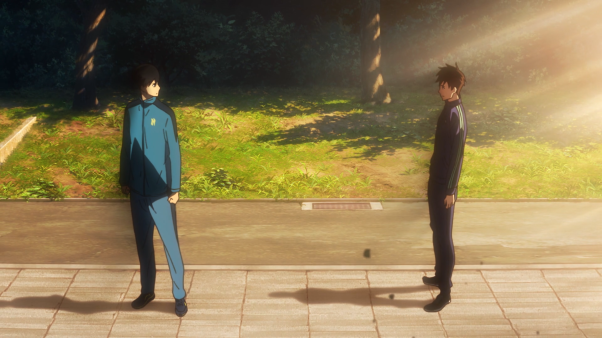
Kakeru Kurahara has hit a low point in his life. Once a former elite runner at high school, the young college freshman finds himself alone, lost, and starving. While being chased for stealing food one night, he runs by Kansei University student Haiji Kiyose. Haiji  saves Kakeru and persuades him to live in the old dilapidated “Chikuseisou,” or more fondly “Aotake,” apartment building.

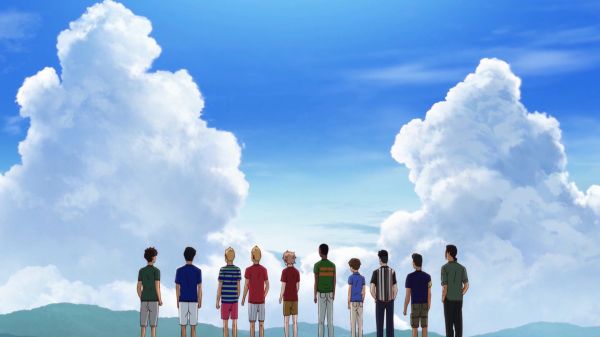
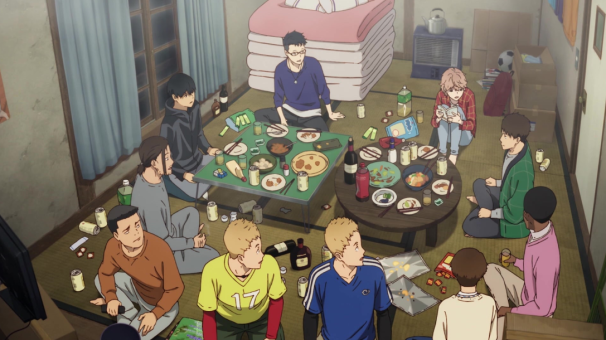
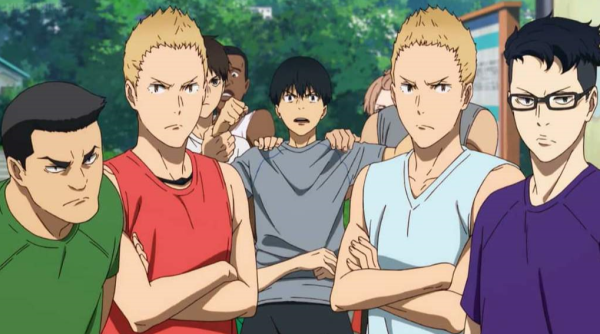
Unbeknownst to the other Aotake residents, Haiji’s spent the last four years of his college career carefully crafting and assembling the “perfect” team so that they can all enter the Hakone Ekiden Marathon, one of the most prominent and prestigious university races in the nation. Kakeru just so happens to be his number ten. Now realizing that they were all deceived, the guys are understandably left speechless with confusion and rage. But even more shocking is when Kakeru quickly finds out that aside from Haiji and himself, all of his new roommates are complete novices.

An air of reluctance hangs over Aotake for a while, but eventually everybody comes around (some definitely more optimistic than others). Slowly but surely, this oddball mash-up of personalities matures into a humble and inspirational group worthy of the name “Kansei University Track Team.” They train hard and work tirelessly to reconfigure their individual lifestyles, and as the fated day of the Hakone Ekiden draws nearer, the boys hope to answer the question lying at the bottom of each of their hearts: What does running mean to me?
kazetsuyo face off.png

As one can imagine, getting the entire crew on board with Haiji’s wish isn’t as simple as just “learning how to run.” These guys have their own troubles to worry about, be it job hunting, maintaining a social life, or figuring out what to do after college. But oh man, the dude doesn’t back down! (Haiji’s a terrible person, yet it’s actually hilarious and kinda charming??) I had so much fun looking forward to each week’s episode and seeing what new evil thing Haiji would cook up to torture the guys.

But through their communal living experience and Haiji’s agenda—which includes torturous practices, rigorous diet reconstructing, bath house relaxation, and endless hours of running—the lives of ten young men slowly intertwine as they bond together.
kazetsuyo family.jpg

Realism, Recourse, and Reinvention

As a sports anime, Run with the Wind breaks away from the pack by building a story around a group of guys who, for the most part, have no interest in the titular sport. Some even detest running, and the tensions formed through these clashing viewpoints and personalities result in quite the compelling drama. Add in individual character motives grounded in realism and you’ve got the perfect formula for a story with even more motivational pathos than your average Joe sports anime (and one that’s five times better, might I add).

At first, each of Kazetsuyo boys takes running at their own pace, the fast ones (namely Kakeru) leaving the slackers (like Prince) in the dust. While the more resilient guys use the sport as a means to confront personal troubles, others take running as a chance for reinvention—an opportunity to better one’s physical and psychological health. One guy, Nico-chan, takes a complete 360 and decides to both quit smoking and lose weight! Another guy, Prince, surrenders to running not because he likes it, but because he’d detest himself even more if he didn’t get out and try it. That’s some powerful writing, and I’m barely scraping the top of the iceberg here.

Anime has gotten a mixed rep for how it handles issues like weight loss and self-worth. In most sports anime, our cast is already pretty fit and motivated; perhaps the leads are just searching for how to take down their foes and rivals and rise to the top. But for every single one of the Kazetsuyo boys, they themselves are their own enemy. We have characters screaming how much they HATE running, not love it. How much they HATE themselves for the way they are, not celebrating the things they are good at.
kazetsuyo defense.jpg

And that’s why these ten men need each other—to acknowledge and accept one another’s flaws and say “Hey, let’s work on improving that together.” Kazetsuyo is FULL of these kinds of raw emotional moments, and you can bet these were the ones that made me tear up most while watching. I don’t think the anime community has realized how truly important it is to have a show like Run with the Wind representing the sports genre.


I’m not sure if these people are my friends or not, but at the very least, they recognize me, my ideas, and my worth. Among them, there is no high or low level. The only thing that matters is who we are! — Kashiwazaki Akane AKA Prince


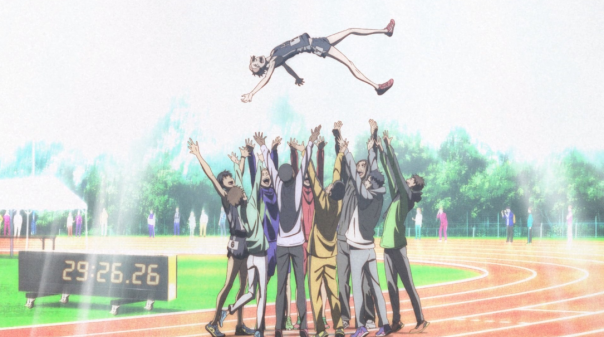
Celebrate the victories, but never forget the losses. As I’m sure anyone else who watched the series figured out, Run with the Wind was never about winning. Rather, it was about finding purpose in the things you do, and moving forward only when you’re 100% ready. It’s a story about us, the norm, not the exception.
kazetsuyo prince.jpg

My NEW Favorite Production I.G Sports Anime

Production I.G has this thing with their sports anime where they like to reuse some of the same exact scenes ad nauseam for emotional impact and thematic consistency (love ’em both, but see Haikyuu!! and Welcome to the Ballroom). For Run with the Wind, it was the first episode’s “Do you like running?” bike scene, and thankfully they stopped shoving it in our faces around the second half to replace it with symbolic animation of Haiji chasing a glowing Kakeru.

Not only was I glad they made this switch, but it established a powerful positioning of characters and a nice check for how they evolve over the series. In their minds, Kakeru and Haiji were constantly chasing after one another, and the spatial light show really shines as an iconic duality unique only to this series.

kazetsuyo kakeru glowing.jpg

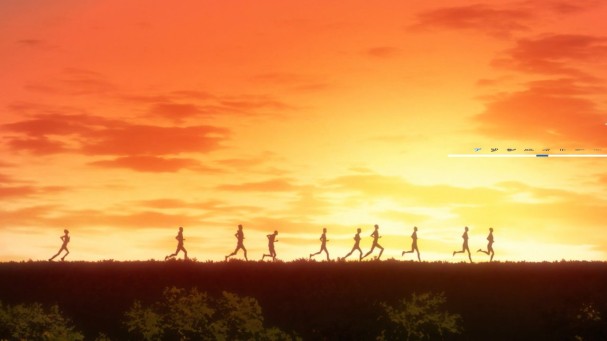
Speaking of beautiful directing, Run with the Wind features stunning landscape shots, whether a chill rainy morning in the park, the blazing sunset against the Hakone mountains, or a quiet night in the city under a blanket of stars. Particularly, the emphasis on changing seasons creates such a mood fit for the show. The scenic framing leaves you stunned speechless, and as our all-star team stands side-by-side gazing out at the countryside view, you’re left not with words, but with feelings. Inspiration. Passion. A breath of fresh air. Nature. Life. Taking it all in, and letting it all out.
kazetsuyo sillhouette

The track races are also animated with intense energy and vigorous movement. Production I.G pours a lot of time crafting its breathtaking still-frames, but you can tell the animation budget was reserved for the Ekiden race itself, which encompasses the entire finale, a mammoth five episodes of constant motion.

Subtle shifts in character postures and habits (like Prince’s god-awful running form, Nico-chan’s thinner body, and the way Kakeru slowly moves closer to his teammates during practice and starts to crack a confident smile here and there) also lend themselves as a great source of characterization, to which I.G delivers without fail. Best of all, the animation syncs astonishingly well with the real force driving this show: the beat of Yuki Hayashi’s soundtrack.
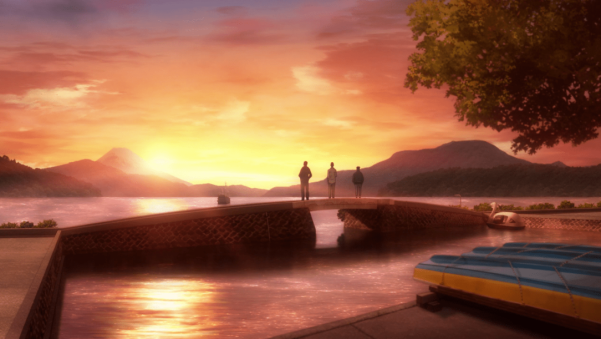
kazetsuyo sunset.png

Chill Vibes, Heart-Pounding Winds

I’m honestly not sure what more I can say about Yuki Hayashi at this point. You’d all probably know that he’s my favorite composer for anime. The entire soundtrack Hayashi has put together for Kazetsuyo is by far one of his most emotionally resonant ones. His slow piano tracks transcend into harmonious ballads once you add in the glorious vocals and his signature soaring string melodies. It’s lengthy and intense build-up, but oh-so satisfying pay-off each and every time, much like the story itself.

For more subtle moments, Hayashi sticks to playful jazz-like guitar plucking and simple percussion for accompaniment. I have a playlist on my iPhone labeled “Vibes” (no joke), and literally half the OST is on it to inspire me when I need it.

Above all, the main theme of the series is by far the most positively-charged anthem I’ve ever heard in an anime—and it kicks in RIGHT when it needs to every single time. Even now, just listening to that piece brings happy tears to my eyes as I remember the spirited efforts of this underdog team, the trials and tribulations they had to overcome to get as far as they did. Through his ascending melodic lines, Hayashi is able to paint the picture of a runner on a dewy, drizzly spring morning, the sun just barely peaking through the city skyscrapers . . . Clearly, he was meant to write the music for this series, and I know only he could’ve made each uplifting moment so raw and powerful.
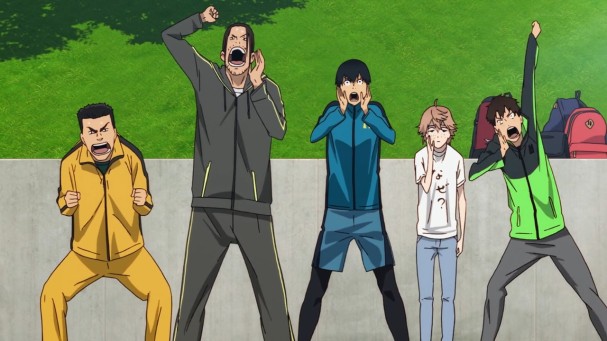
kazetsuyo cheering

And if you didn’t think it could get any better, Run with the Wind was BLESSED with four equally exciting and motivational OP and ED themes! Fan-favorite UNISON SQUARE GARDEN starts us off on a high note, while Q-MHz feat. Mitsuhiro Hidaka (aka SKY-HI) follows it with a pumped-up OP worthy of the show’s second half.

The real gems here, however, are Taichi Mukai’s ED themes. “Reset,” the first (and my fave of them all) focuses on Haiji and really suits the tranquility of a misty morning run. And whereas the first is all about the individual spirit, “Michi,” the second, ties the entire series together with feelings of celebration, family, and at last, freedom.

(Special shoutout to Toshiyuki Toyonaga who makes Haiji’s lines flow out so naturally. It was dialogue unlike anything I’ve ever heard from observing a Japanese dub, and Toyonaga is just, AGH, so perfect!)
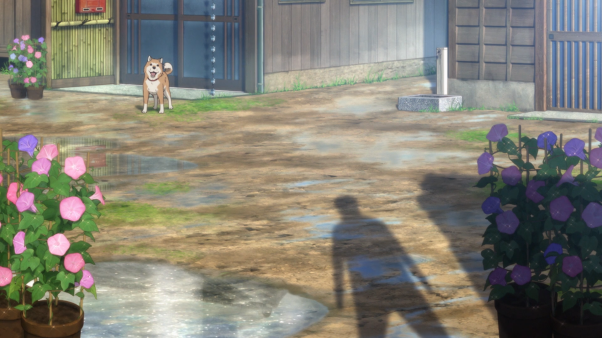
kazetsuyo michi.png

Against the Flow

Run with the Wind could have been a very simple anime. It could have just been a fun comedy shounen series with sports as the subject and winning as the goal. But it didn’t do that—it became something so, so much more. Drama anime usually revolve around unique circumstances, over-the-top twists, and a focus on “How shocking” as opposed to “How painfully relatable.” And yet here we are with a sports drama series that excels at everything it sets out to do and then some with delicacy and honesty. Every single leg of this well-written, 23-episode-long circuit remains simultaneously down-to-earth and extraordinarily heartfelt.

This anime is so much more than a simple sports comedy series. It’s the greatest feel-good story I have become this fond of in quite some time, and rooting for these goofy guys for over half a year was easily one of the greatest pastimes I could ask for. I fell completely in love with the cast and the music, plus it’s incredibly well-written and well-paced. For comparison, while I fell head-over-heels for the Haikyuu!! cast, I felt for the Kazetsuyo characters.

Every step of this journey felt sincere and wholesome, and I absolutely enjoyed laughing with the Aotake guys just as much as I did crying with them. Whether you’re a fan of sports anime or not, a genuinely passionate and realistic series like Run with the Wind isn’t the kind that comes often—so don’t miss it. Otherwise, you’ll be sleeping on what is perhaps one of the best anime to come out in years.

In Kazetsuyo, complex feelings and conflicting agendas clash both on the track and off it. We learn that not everyone will want to support your endeavors in life—some individuals would dare to directly oppose you, in fact. But sometimes, in the long-winded process of finding ourselves, we have to go against the flow to truly run freely with the wind. Just like the Kansei Track Team, we have to be willing to shout “We are here. We are running. And we are aiming for the top no matter what you do or say about it!”
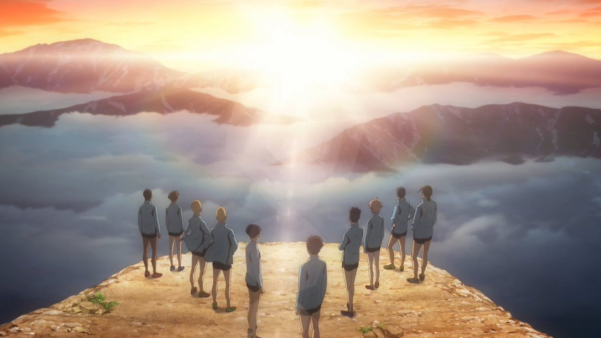
kazetsuyo mountains.jpg

The mountains of Hakone are . . . the steepest in the world! — Haiji Kiyose (The Kansei Track Team Motto)


Afterword

For one of the most painfully realistic yet wholesome anime I’ve ever seen, Run with the Wind is without a doubt worthy of the house “Caffe Mocha” title. Winning a solid 10/10 from me (as well as my heart), I’m happy and proud to honor Run with the Wind as one of my favorite anime of all time. Every chord it struck resonated with me so hard, and the ending is just made me melt with happiness.

That said, I don’t believe the series is perfect; I mean, anything could use some sort of improvement. But the point I wanted to make with this post was that none of the faults bothered me enough to seriously stick out. Heck, I would’ve loved to learn more about the other guys besides Haiji and Kakeru (like Yuki, or Musa), but I simply can’t complain with what we got. Watching Kakeru grow from an angsty, easily set-off teenage firecracker into a helpful and considerate team player was really something special.

Man, I enjoyed this emotionally-charged journey so much! I’m really going to miss these idiots. I’ll miss Aotake. So much character, so much heart.
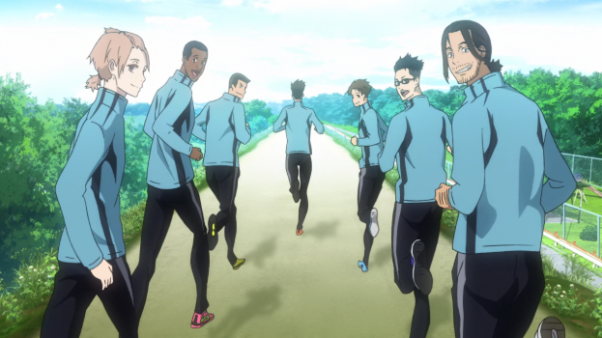
kazetsuyo running away

Whew, this review has turned into me gushing over Kazetsuyo for 2,000+ words, but I guess it can’t be helped, hahaha! What did you think of Run with the Wind? Did it grab at your heartstrings as much as it did me, or did you find other areas of the series to be critical of? I’d LOVE to hear your thoughts, so please, share to your hearts content! That’ll be it for me, but before I leave, tell me . . .

“The mountains of Hakone are?”

– Takuto

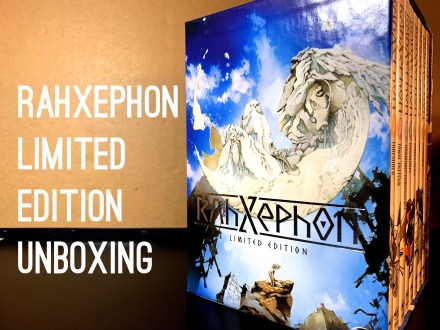
The Biggest Anime DVD Box Set I Own: RahXephon Limited Edition | Unboxing

Hello!

I’ve got a bit of a different post today. Believe it or not, unboxing and haul posts are some of my favorite to write because once the pictures have been taken, all I have to do is write a couple sentences and upload, easy-peasy.
Specifically though, I’m writing this post because, like any well-researched collector, I wanted to know whether this was the edition of RahXephon that I wanted to buy. But when I began scouring the web for pictures of this box, I found nothing. Now, maybe someone will be able to find security and satisfaction in this A-grade product.

Because oh man, what a fantastic set this is.

I’m gonna boast for a minute here and hail the RahXephon limited edition as the biggest anime DVD box set I own. I know these kinds of box sets have been around in anime for quite some time, but this is my first foray into the classic anime collecting scene (where you’d supposedly spend $30 on a DVD containing four episodes and do this seven times until you eventually roped in all 26-odd-some episodes), so let me have this one.

I was lucky enough to buy from a seller who not only sold it for just $45, but kept it in mint condition. Seriously, this beast is IMMACULATE—and it’s over 15 years old!! Proof that there are good collectors out there who take care of their stuff. And they packaged it so nicely too, bonus points! Really happy with this find.

But you just want to see this beautiful box, don’tcha? Alright, me too, so let’s go!


(NOTE: All of these images are placed in slide shows, so you might have to change browser to view them fully.)

This slideshow requires JavaScript.

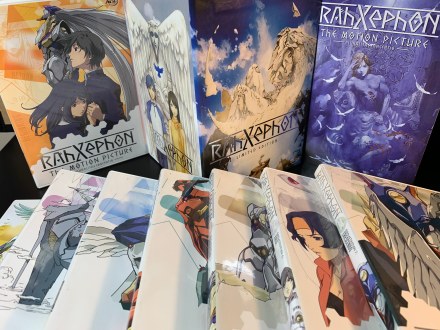
Here’s the box’s exterior: the front, back, top, and sides. I love the holographic foil printing on the logo (which is consistent on EACH of the DVDs as we’ll see here in a bit. The artwork is also particularly exquisite, capturing the mysticism of the story with these divine pieces worthy of framature in any museum. It’s really cool to see all 8 of the DVD spines together as well. Each is consistently laid out and color-coded, almost as if they were meant to go together or something!

This slideshow requires JavaScript.

Onto the DVD cases themselves, each one contains key art from the series on a pristine white background overlaid with that holo-foil logo. Each set matches the color dot on the spine, which is a nice touch. Also included in this set is a hefty artbook for the film, Pluralitus Concentio, which makes the 8th DVD in this complete 8-disc set.

This slideshow requires JavaScript.

The backsides of each DVD maintain the same white and color-coded schema. The designers also utilized the series’ theme of music to tie in clever phrases to each progression of the plot, beginning with the prelude and ending, of course, with an encore. I LOVE IT.

This slideshow requires JavaScript.

Cracking into the DVDs—if you thought this set couldn’t get any better—you will find a miniature artbook for each set. The cover and back pages have the art printed on a specialty paper with a parchment/wax-like texture, which adds to the classiness of this set. Each pamphlet includes approximately 10 pages of character information, as well as art of the various robots and Dolems that appear throughout the series.

This slideshow requires JavaScript.

Want a closer look? So do I! Here’s each DVD set complete with its disc and art pamphlet, as well as the film artbook. I really like the landscape art included on the inside pages of each little book. When you think about it, I guess this is what each DVD contained when it was individually purchased back in the day.

Again, this seller kept the box and its contents in such spotless condition that it truly feels like I’m owning a product that just came hot of the press, let alone an artifact from well over a decade ago.

IMG_1293.jpeg


So to any fellow anime collector out there looking for a proper review of this set, I hope this post helps. If anyone is wanting an even closer look than I provide here, feel free to ask me in the comments. When I was still laying out my purchase options, it came down to either the thinpack (and then I’d buy the film for a separate $10) or this mammoth set, and I’m glad I stuck with the latter.

Will I buy more boxes like this in the future? Hahaha, good question, if my shelves can support it I guess. RahXephon was a special case given that its main accessibility from a physical standpoint was this, the thinpack, or a couple other thinpack-like options. Only time will tell, I suppose.

That’s all I’ve got for this one. In case you missed it, I watched RahXephon as part of my annual V-Day marathon and enjoyed it so much I also reviewed it on my blog (which you can read right here)! I’d be delighted if you checked it out. Friends and fellow collectors, ’till next time!

– Takuto, your post


Alita: Battle Angel — A Warrior’s Tale | Review

A brief spoiler-free review of the 2019 American cyberpunk action film “Alita: Battle Angel,” produced by 20th Century Fox, written by James Cameron and Laeta Kalogridis, directed by Robert Rodriguez, and based on the 1990s manga “Battle Angel Alita” (or “Gunmn” in Japan) by Yukito Kishiro. 

Image result for alita battle angel trailer 3


After the Fall: An Origin Story

Still recovering from a catastrophic war referred to as “The Fall,” humanity remains determined to eke out a living on a devastated Earth in the year 2563. While scavenging the junkyard metropolis of Iron City, Dr. Dyson Ido, a renowned cyborg scientist, stumbles across a disembodied female cyborg—human brain still fully intact. Taking the remains back to his lab, Ido rebuilds the cyborg and gives her a name: “Alita.”

Although she has no recollections of her past, she is able to create new memories thanks to the doc’s healing hands. She eventually meets Hugo, a teenage boy who dreams of one day moving up to the wealthy city in the sky, Zalem. He introduces her to the competitive, cutthroat sport of Motorball, an every-man-for-himself race where cyborgs fight to the death for a chance at ascending to Zalem if victorious.

But sinister connections tie even the friendliest faces to the shadows, and as Alita quickly comes to realize that there’s no force more powerful than the game, the titular cyborg sets out to learn about her past to save the ones she loves most in the present.

Related image

Alita: Battle Angel may be my first introduction to this much beloved franchise, but man, what solid footing director Robert Rodriguez and writer James Cameron provide for this classic origin story. Going in blind, I can already tell you that the franchise is worth the investment. This live action film, albeit a bit fast-paced, serves as a fantastic place to start if picking up four volumes of the manga just isn’t an option for whatever reason.

Admittedly, there’s some cheesy villain dialogue that sours the seriousness at times, and while I wish these lines weren’t delivered with such blatant “evilness,” the script actually feels more anime because of it. Critics may have blasted the script and the plot for their lack of ingenuity, but I—and most audiences, apparently—seemed to enjoy it regardless. Alita‘s wild betrayals and reveals may come as a shock to some; others may have seen the twists from a mile away. But if you still enjoy the story, that’s all that matters. To quote Dr. Ido:


“But that’s just a shell. It’s neither bad nor good. That part’s up to you.”


Surprisingly, the film contains includes a decent amount humor to remind you that Alita is—as much cyberization and machine-slaughter as the plot contains—a very human story. Although the environment is both visually and aesthetically astounding to take in, it’s the characters of Alita that make this powerful story of purpose and destiny resonate with newcomers and longtime fans alike.

Related image

Alita, An All-or-Nothing Gal

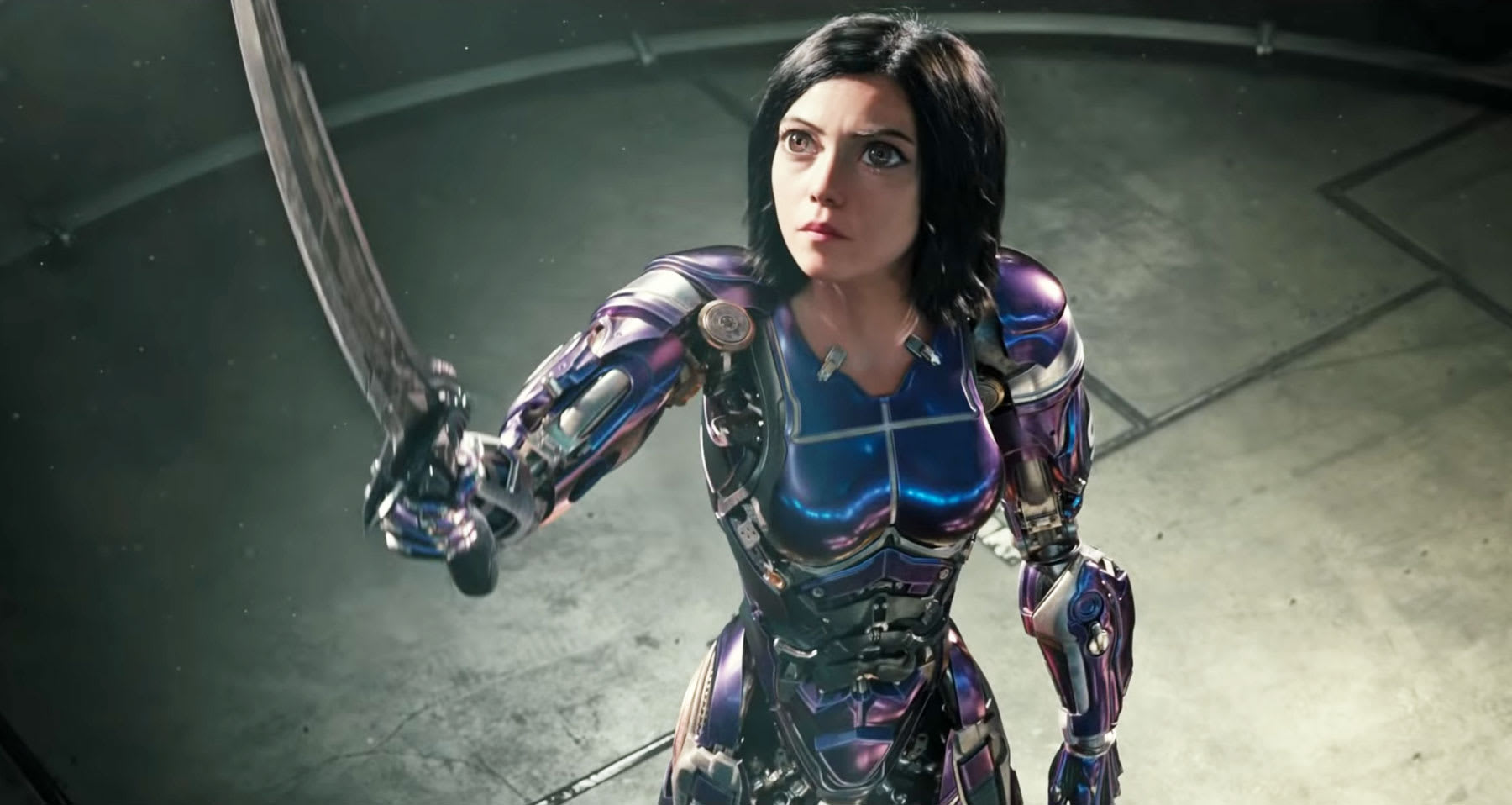
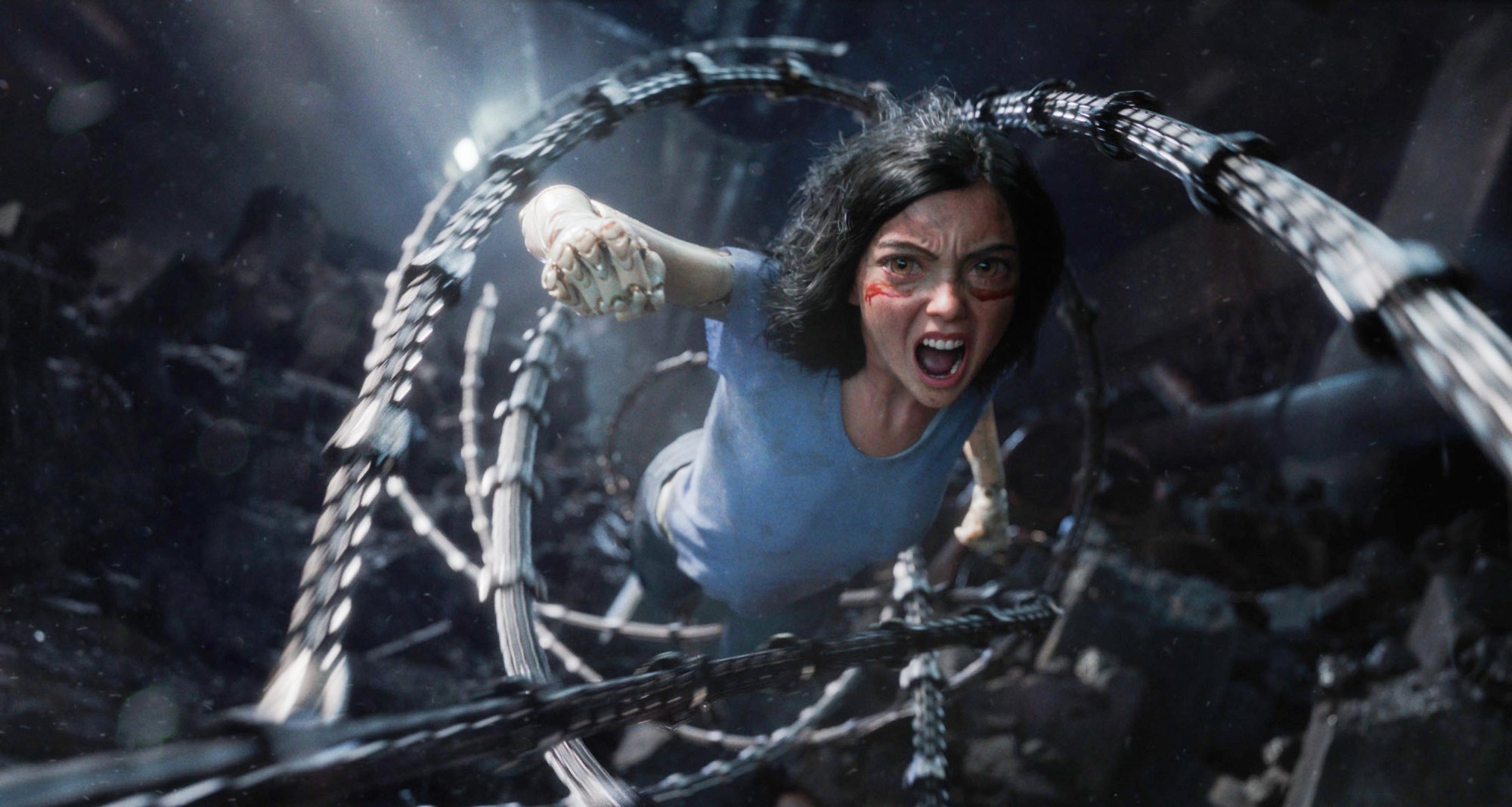
From design to personality, I fell in love with Alita the moment I first saw her in the promotional trailers months back. I knew she’d be your typical brave girl fighting against the system character, but I wasn’t expecting her to be the feisty rascal kind—a delightful surprise. Brazen and bold, the girl is drawn to danger like a moth to a lamp. It’s always all or nothing with her, and Alita’s rebellious free-spirited nature makes her a refreshing heroine to cheer for—even if her recklessness tosses her down the rabbit hole more than a few times.

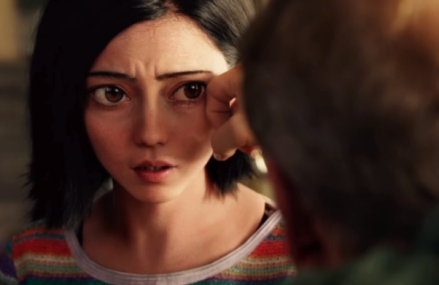
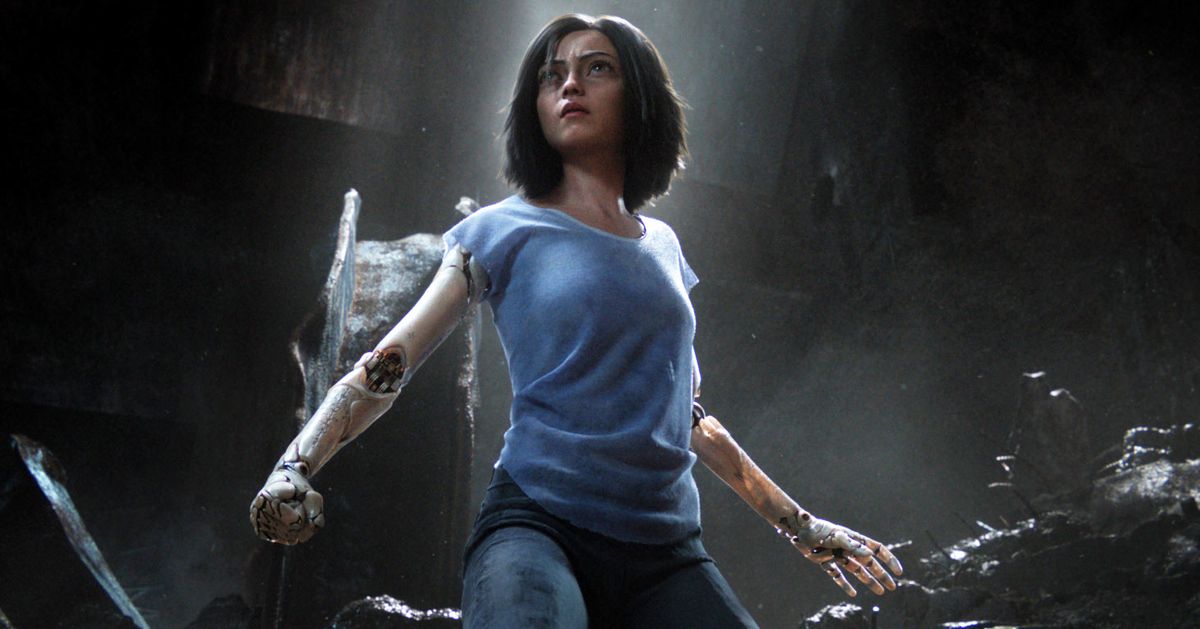
Did I mention that Rosa Salazar is freakin’ OUTSTANDING as the titular role? Cause she’s absolutely phenomenal, able to communicate to the audience that she struggles with fighting this world’s injustice, but is always eager to learn something new. Salazar’s gradual transformation from fluffy, chocolate-loving teenager to hardcore warrior is impressive to behold. Every second Salazar is on screen feels genuine. Through this loss of innocence, she doesn’t let the emotions hold back (even during the tender moments). If she induces a tear in your eye as you watch, I’m not sorry. She’s that awesome.

alita tear.PNG

The rest of the cast deserves a round of applause too, especially Christoph Waltz’s portrayal of Dr. Ido for making him this benevolent yet fascinating foster figure. What a dad. (And bless his aide, Gerhad, whose mere presence provides enough support for Alita.) The same glowing things could be said about Keean Johnson’s semi-dreamy Hugo, the junk dealer.

As for the villains, Mahershala Ali’s acting is perfect for the intimidating “king” of Iron City, Vector, but his character’s status(es) needed stronger clarification, as I didn’t even realize what his roles were until halfway into the film. Same for Jennifer Connelly’s Dr. Chiren, a somewhat frustrating character given her circumstantial duality.

And NO, the large CG-altered eyes don’t detract from the narrative one bit. After five minutes, they just became part of her charm, and I didn’t even realize it afterwards.

Image result for alita battle angel trailer

Motorball & The World Below

Between the numerous sci-fi action sequences and the stunningly brutal sport of Motorball, Alita is a visual feast. Whether fighting in back-alley slums, the dark sewers below, or on the exhilarating race track surrounded by stadium lights and roaring cheers, there’s never a dull moment in this film. And Motorball though, WOW, one of the franchise’s biggest spectacles is brought to life through stellar visual effects and cyborg goodness to make any sci-fi junkie drool just watching.

Alita also does something really neat with visual lighting. The film begins in the rustic, sunlit scrapyard, which transitions to an even brighter, cheerier atmosphere when Alita meets Hugo. But when rain begins to fall, the dark and dreary cityscape—lit only by holographic street signs and neon lights—emphasizes the literal night journey Alita embarks on. Once she uncovers the truth, light returns as she confronts Vector and his pawn Grewishka to finally deliver justice.

Related image

From the intricate and gorgeous detailing of Alita’s cybernetic body to the remarkably thrilling fights, the attention to detail in crafting this postwar cyberpunk world is on a level of its own. If this isn’t a faithful adaptation of the manga, I cannot even begin to imagine what greatness Yukito Kishiro’s original story contains.

No great sci-fi movie is complete without an equally epic score, to which Tom Holkenborg overwhelmingly pulls through. Between the strong symphonic opening in “Discovery” and “Motorball” busting through the gates with its powerful rhythmic tribal drumming, the harmonic balance between strings and dubstep is just right. For the credits, Dua Lipa’s “Swan Song” also ties in well as a piece addressing social injustice and change. Thank god for Apple Music, because I’ll be listening to this soundtrack for weeks to come.

But Will it be Enough?

With so many moments where you just want to pump your fists in the air and cheer, Alita does everything it needs to do to be a great movie. Gripping, emotional, heartfelt even, but will it be enough? Will this be the last we hear of Alita and company on U.S. theater screens, or will Rodriguez and Cameron’s efforts be enough to finally end the trend of live-action anime adaptations being one-off movies?

Either way, I support everything this film tried to accomplish and then some—heck, I went to the theaters twice, and totally would’ve gone a third if my schedule wasn’t so busy as is. Beyond the issues of faithful source reconstruction or the present lack of a thorough conclusion, all I wanted from Alita: Battle Angel was an entertaining film that holds on its own—and boy does Alita stand proud and tall.

Related image


I do not stand by in the presence of evil. — Alita


Afterword

Oh man, such a GOOD MOVIE my friends!! Job well done to the cast and crew for sure, as this is already a good contender for my favorite non-anime film of the year. Whether in theaters or on your home screen in the near future, I hope you got (or eventually get) a chance to watch it, cause Alita‘s not one to miss. They did this one right, holy shit.

I don’t really ever review live action films, but for Alita’s charm, I’ll make an exception. 2019’s Alita: Battle Angel is certified “Cake” here at the cafe, and should we ever see a sequel, there’s a solid chance I’d bump this one up to a “Caffe Mocha,” without a doubt! Guys, let me know your thoughts about this kickass LA-anime-done-right down in the comments, be it your praises or your criticisms, and until next time, this has been

– Takuto, your host

Cacophony in Paradise: RahXephon & Accepting the World | Review

A brief spoiler-free review of the 26-episode winter 2002 anime “RahXephon,” animated by Bones, and both created and directed by Yutaka Izubuchi. 

megumi.PNG


Prophecy & Lore: Angel Mu Attack 

His life was ordinary. Or at least, it was supposed to be. 

Three years ago, Japan was invaded by the Mu, beings from another dimension that look exactly like humans except for the fact they possess blue blood. Now, in 2015, Tokyo comes under attack by terrorist aircraft that are quickly driven back by a flying humanoid weapon called a Dolem. Amidst the disaster, 17-year-old Ayato Kamina spots Reika Mishima, a beloved classmate of his.

While trying to escape from the terrorist attack above, Ayato escapes to an underground subway but is cornered by government officials in black. Out of the blue, a short-haired woman named Haruka comes to his rescue, informing Ayato that she was sent to retrieve him by the organization TERRA. Still skeptical of the stranger, however, he flees from Haruka onto a train where he oddly encounters Reika once more. But unbeknownst to him, this train isn’t headed to safety. Ayato arrives in a bizarre, holy domain where a tremendous egg sits in the middle. Reika’s mysterious singing in Ayato’s presence causes the egg to tremble and a giant robot—the RahXephon—is hatched.

Image result for rahxephon temple

Suddenly, Ayato’s mother appears atop the Dolem that had stopped the TERRA Invasion. When a cut to her skin reveals a shocking drop of blue blood, Ayato flees “Tokyo Jupiter” aboard the RahXephon with Haruka, bewildered and betrayed.

What unfolds next is a story of grand proportions. Prophetic lore and Aztec legend weave together in a larger-than-life tale about what it means to understand others. As the future of mankind rests on the shoulders of one unsteady pilot burdened with a heavy fate, a young boy must decide whether the love for himself and others outshines the dark realities of the world.

Image result for anime

Classic in its Own Way

Obvious point out to get behind: There are many, MANY comparisons that can be drawn between RahXephon and its “spiritual prequel,” the grossly influential 1990s Neon Genesis Evangelion. I mean, clearly, one was inspired by the other. As such, I’ll try my best to appreciate RahXephon for its own merits. It may be more obscure, but there are reasons why the fans that have seen it regard it as a classic.

Starting with my criticisms, RahXephon‘s plot definitely rushes to the finish line come the last couple episodes. There’s also a seemingly misplaced (yet ridiculously crucial) backstory episode early on when the viewer still has yet to distinguish the adult characters, and much of the underlying prophetic forces require immense focus—and even then, reading in between the lines, so to speak.

But my biggest issues don’t accurately reflect the plot’s numerous strengths: RahXephon centers itself around the concepts of time, music, intrigue, mystery, and romance. Its powerful character dynamics, deep introspective forces, rich philosophical views, character and mecha designs, and influences by Mesoamerican culture and Japanese folklore carefully intermix to create a profound, satisfying story with little to no plot holes by the end. All pieces of the puzzle connect towards a final answer which works out so well. Eventually, everything connects. 

terra.PNG

The Struggle to be Human 

Very few anime dare to feature such a dense network of complex human relationships between characters, let alone do it this well. Each week, the TERRA crew encounter a new Dolem that must be met with a different fighting strategy, meaning that everyone on deck is constantly interacting with another.

As a result, not all talk is about work. Unnecessary rumors spread. Drama starts. Realistically, co-workers get frustrated, confused, angry, and jealous at one another, and these attitudes manifest in cut-off communication, the “silent treatment,” lackluster performance, or total inability to come to work one day. To make matters even more devastatingly real, each of the characters struggles to be human in their own ways, which is often reflected through thoughtful monologues or, worse, actions that harm another.

Self-care is such an important element of RahXephon. The series especially convinces us how difficult it can be to maintain connections with others through its most important plot line: the unusual relationship between Ayato Kamina and Haruka Shitow. And oh boy is it a messy one. Although Haruka appears to be some badass adult stranger to Ayato at first, we come to realize that their bond runs much deeper than even he was led to believe.

Image result for cartoon

Ayato constantly struggles with expressing what he wants. His inner conflict to understand his own desires often clashes with the many “professional” relationships he must maintain as the RahXephon’s pilot—female relationships to be specific. As such, his complexity becomes the leading force in this very much character-driven story about being useful to others. It sounds simple enough, but it’s much harder to live up to others’ expectations than we give the act credit for.

There are forces out there much bigger than ourselves—than our own petty problems—that we must respect. As Ayato comes to grip with the situation fate has bestowed upon him, it takes every ounce of ownership and bravery the human spirit can muster to accept such a weighty destiny. Though he pisses a lot of people off (sometimes even the viewer), I was always on his side. He’s an admirable lad, albeit a bit blind to his own heart at times, and I quite enjoyed his depth and perseverance.

mishima.PNG

Transcending Technique: A Mecha to Last Decades

While the anime was created in 2002, studio Bones at this point had yet to experiment with the early 2000s 3D CG that popularized this period of anime. That said, it is probably one of the last mecha shows to utilize computer animation without creating fully 3D CG mechas. And it shows, because for the most part, RahXephon‘s animation holds up incredibly well.

Specifically, the characters are animated with such solid consistency that every character close-up is worthy of being key art in itself. Because the RahXephon is just as strangely mystical as the Mu are divine, the fight scenes and combat abilities are always captivating to watch. If RahXephon’s animation was designed as a callback to the earlier mecha anime of the 70s, I’d believe it.

However stunning the animation may be, the show’s color palette is on the duller side. The island backgrounds feel washed out, and it sometimes causes nothing in particular to stand out. This leads to many of the conversational moments (which are quite abundant) to occasionally feel stagnant and uninteresting. Aside from the RahXephon’s brilliant cobalt and gold, pale grays and blues dominate much of the landscape. On the RahXephon, though—man, what a beast, so unique and cool-looking. The spectral wing motif hails as one of the series’ greatest icons, and now I get why!

Related image

Add a Little Jazz: Ambiance & Expression

Ichiko Hashimoto’s soundtrack is simultaneously exactly and nothing like anything you’ve ever heard. Specializing in jazz, vocals, and the piano, Hashimoto provides RahXephon with introspective trance music fit for the story’s ambiance. She uses a large amount of harmonic dissonance to create cacophonous tracks fitting for those more disturbing moments in the series, which also ties in to the theme of music. Lots of electric guitar, too.

Almost intrinsically, her orchestral works (like the final episode’s “Before You Know”) stir the heart and the mind, while her more abstract brass and percussive pieces add layers to the complexity on screen. She even dabbles into epic Richard Wagner operas for classical inspiration, which is awesome.

The series has its own intensely iconic battle preparation themes, one of my favorites being “The Chariot.” And when TERRA members are just taking a lunch break at work, that’s where the jazz music (like “Their Daily Lives) lifts the atmosphere. Of course, for all those emotional and moody moments, Hashimoto’s got a “rainy day” solo piano track for that, too (“Solitudes” and “A Few Memories”). Altogether, it’s an expressive OST that feels so very 90s that it’s impossible not to call unique. In case you’re curious, my favorite track is “Adolescent” from OST 2 for its calming strings air of catharsis.

Image result for quon rah xephone

I’d also like to extend my biggest hugs to English dub director Matt Greenfield and his fantastic crew from ADV for their incredible work on this series. Ever since Eva, I’ve never been disappointed by his style—the guy certainly knows how to direct a good dub.

Bonus shoutout to Chris Patton for his take on the lead, Ayato Kamino. Patton’s been praised for how natural his teenage boy voice is—plus, I mean, he’s just really freakin’ good at acting—but man, Ayato is easily my favorite role of his! It’s a shame that more older English dubs don’t sound this stellar.

Related image

To Weather the Storm 

From beginning to end, RahXephon is a storm of emotions. Some of the characters get their happy ending; others do not. Some characters are also significantly more frustrating than others. But it’s the complexity of their relationships and inner turmoil that make this great cast so realistically flawed. It may provide more psychological headache than heart-pounding action, but considering its themes of connection and isolation, I wouldn’t have had it any other way.

RahXephon boasts a daunting cast size, and although the focus becomes strained as we bounce from one perspective to the other, the series never gives up in its pursuit to weave these stunningly complex lives together to form a multifaceted, absolutely compelling narrative—just how a series of these proportions should be.

Related image

In a world where everything is about to change, what point is there in trying to continue? I don’t know, and yet that is what each and every one of us survivors must do—that much is clear. In spite of everything, the human animal must fight to live on. — Jin Kunigi


Afterword

There are so many things going on in RahXephon it’s NUTS, but I’m so glad to have finally watched this series—and for the 2019 V-Day special no less! I may review the movie if I find something in it especially worth talking about, but otherwise, that’ll conclude everything I’ve got for now. Man, what a fantastic find, an artifact absolutely worthy of any psychological anime fan’s catalog, or perhaps any mecha fan’s collection. Speaking of collection, as per the tradition, I allow myself to splurge on the series’ physical release as a token of completion. Not only was this one fun to hunt for, but I settled on what will likely be the BIGGEST collector’s edition box set I’ll own. Plus it was CHEAP. Stay tuned for details.

If it didn’t already need to be said, RahXephon is officially on the “Caffe Mocha” menu, a rating reserved for only THE best of shows. That said, it’s certainly not for everyone. If you don’t like psychological or mecha anime, look elsewhere (it is weird, but easier to digest than Evangelion, hahaha). Also, it’s a slower burn, so don’t be expecting climactic end-of-the-world fights every episode. Otherwise, I encourage you to check it out for sure!

Rahxephon key art

If you have seen RahXephon, now’s your chance to boast your knowledge and passion (or criticisms) for this classic series down in the comments. I’d love to here your thoughts on either the show or this review, so if you could impart your feedback, I’d greatly appreciate it. I had an all-around wonderful experience unearthing RahXephon, and I’m excited to see what next year’s marathon will offer. ‘Till next time my friends, thanks for reading!

– Takuto, your host