Tumbling Over TRIGUN: Exploding Frontierism and the Wilder West


“All of life’s journeys come with meetings, partings, and reunions.”

– Meryl Stryfe


Upon finishing Trigun (1998), Trigun: Badlands Rumble (2010), and Trigun Stampede (2023) for the first time this past February, I surprised myself when I hopped over to the keyboard and realized I had nothing to say. The words simply wouldn’t come. It’s not like I was blown away from witnessing a masterpiece. If anything, my experience felt mostly lukewarm, save for the tingle of relief that came from having cleared out another series in my watch stack. 

So, rather than force myself (and any readers) through a more traditional review or reflection post, I figured I’d tug a bit on the unique setting elements that stood out to me either for their sheer creativity or potential historical allusions. Note that this is NOT a formal analysis, nor am I suggesting any authorial intent. Instead, I aim to connect Trigun with a separate history that precedes its creation, that which is bottled within my incredibly limited understanding of the U.S. Wild West, its motifs, and a few themes. Unfortunately for Stampede fans, this means I’ll mainly be sticking to the classic series. Mild spoiler warnings for the entire Trigun animated franchise!

Ready? Steady? Let’s roll!!
No-Man’s Land, an Ever-Expanding Frontier

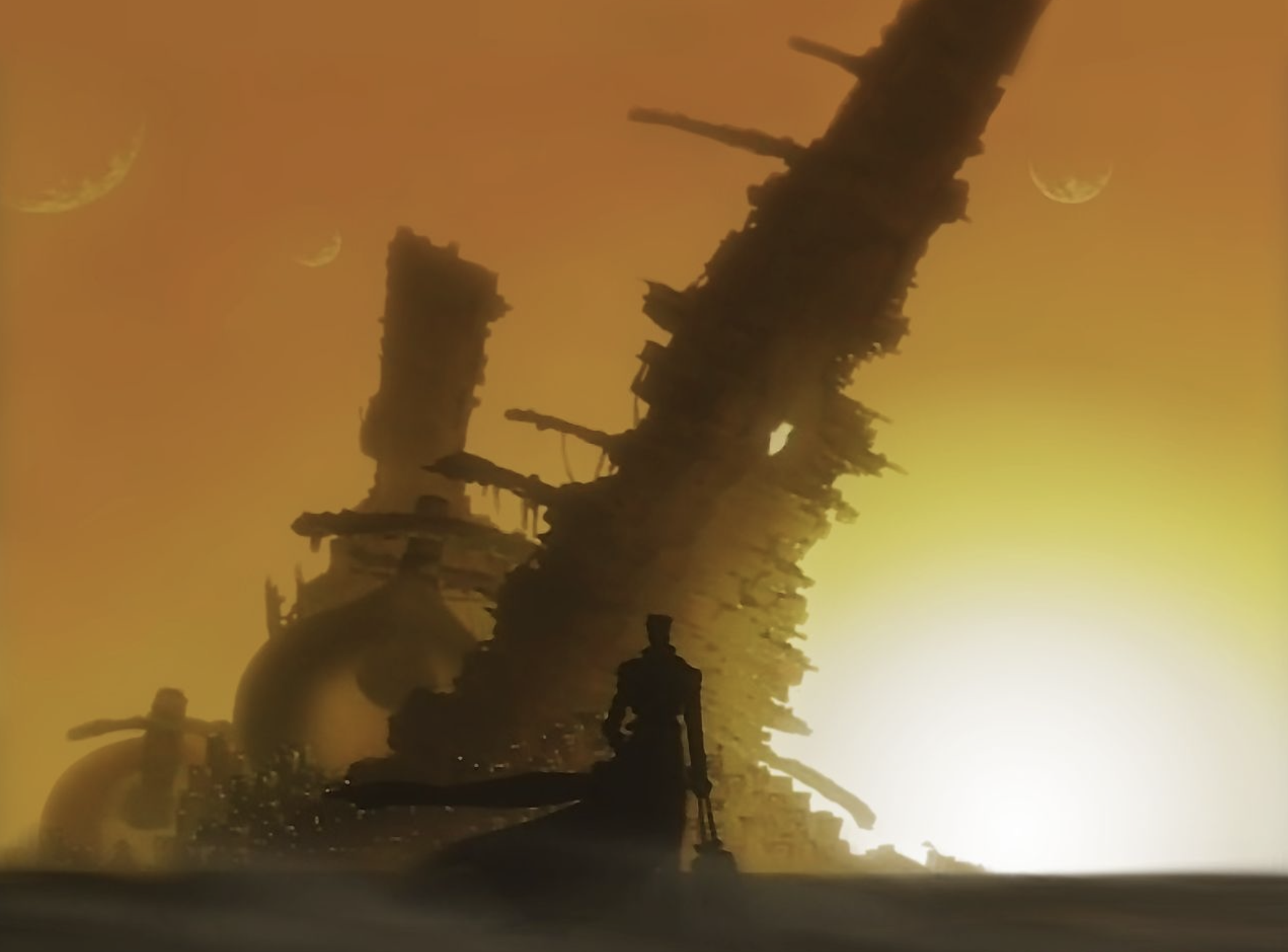
When it comes to Trigun, the biggest draw for me isn’t its flashy characters or high-octane entertainment value. Rather, it’s the world that this sci-fi Western is set within. Some call the desert planet Vash and crew roam “Gunsmoke,” while others refer to it by the equally loving moniker “No-Man’s Land.” (There’s literally a Reddit thread dedicated to fans disputing the planet’s name, I’m not joking.) 

However you stack the deck, this barren wasteland offers few sympathies towards the unwary. Although water is as precious as gold out in the dusty field, one can count on the occasional small-town saloon to have its shelves stocked with the goods. The liquor is cold, the women are tough, and everyone owns a gun. By the way, these towns or “Plants” apparently formed out of the husks of massive spaceships that crash-landed on the red planet long ago. This is the world of Trigun

. . . And call me crazy, but doesn’t it kind of sound like America’s own Wild West?

Historians peg the start of this period being 1800 with Frederick Jackson Turner’s Frontier Thesis declaring the frontier “closed” in 1890. When we think of cowboy Westerns, our minds are pulling on Hollywood portrayals of the peak of this period, around 1865. Given the relatively large span of time, one can interpret the frontier as an idea, a metaphor of process that is not only physical but also political, even psychological. Famously, Turner coined America’s Frontier as “the outer edge of the wave—the meeting point between savagery and civilization.” As adventurers, armies, and settlers pushed toward the Pacific, exploration, struggle, confrontation, and compromise each came to describe this psychological and social expansion. Hence, the frontiersman proved his Americanness by taming this savage Western landscape. Sadly, it was humanity that became (and technically already was) a part of this landscape. 


“We are searching for a place where we can live our lives in peaceful days. No wars, no stealing; a place that isn’t run by fear; a place where people can live, and actually trust other human beings.”

– Vash the Stampede


Whether cattle-driving cowboys and pioneers or refugees and migrant families from faraway lands, settlers of the frontier have traversed its rough terrain for centuries. Understandably, travel and setting play crucial roles in Western-inspired stories just like Trigun. More common than not is it to encounter characters in frontier stories moving from one plot to another in the search of a place to call home. (This is arguably the entire plot of Trigun Stampede . . .) Some ventures involve transcontinental travel or a plight from interplanetary worlds; other movements occur in intimate spaces as private as the bedroom or even the human mind. We see this mirrored in the way Vash strips down when he’s alone in his various busted motel rooms. The outlaw’s bright personality grows markedly dismal when he pensively reminisces on his travels, his fears, and his past. Across both anime adaptations, he manages to mask the truth of his identity beneath obnoxious smiles and booze, but it is traveling the frontier with Meryl and friends that slowly starts to wear down his bravado. 

The Transcontinental Railroad Sandsteamer

As a child, I used to be a train-kid. Trains occupied such a huge part of my life, so much so that I thought I’d grow up to be a train conductor one day. Oh, if younger me were to find out that passenger cars would become obsolete by the time he became a teenager, he’d probably have lost his faith in humanity much sooner. Thankfully, traveling by train is the best way to cross Trigun‘s seamless deserts, and Stampede made sure not to abandon faith either—even if the redesigns look more like clothes irons than locomotives! 

Wait a sec. Sandsteamer. Steam irons. Maybe Stampede is onto something after all. 

By connecting the already existing eastern U.S. rail networks to the west coast, the Transcontinental Railroad became the first continuous railroad line across the country. It was constructed between 1863 and 1869, which according to our earlier history lesson matches right up with the height of the Wild West era. No wonder so many Westerns featured precarious showdowns on the roofs of zooming train cars. Trigun pays homage to this combat motif in two drastically different episodic plots depending on the series. The thrilling two-parter arc in the classic version gave us a particularly in-depth look at the sand steamer’s inner schematics, and I’m eternally thankful for it. 

Wherever the journey goes, motion accompanies the landscape. Whether traveling by boot, cruising via sandsteamer, or hitching a ride on the back of Meryl’s bird/ostrich thing (or sports utility vehicle in the remake), the travel motif connects us to themes of personal growth, reflections of identity, and the cultivation of the agricultural frontier (for not everyone takes on the desert with pistol in hand). 

The Big Electrical Boom

Despite the analogies I’ve made to frontiers and railroads, Trigun isn’t technically a Western; it’s a science-fiction series, one that sometimes toys with elements of cyberpunk through its action-packed set pieces and leather-bound character designs. So, the third connection I make here might seem like I’m reaching (because I am, I always am), but hear me out!

Trigun‘s representations of electrical power “Plants” echo the advent of electricity and the West’s increasing dependence on it for survival.

In studying the fate of the Wild West, three major factors contributed to its end: barbed wire fencing, privatized land, and the railroad. Now, electricity wasn’t commercially available in the U.S. until the LATE 1800s, and western settlers wouldn’t get a taste of it until well into the 1900s, some places as late as the 1950s. (Shocking!) However, what seemed a pleasant commodity at the start eventually turned into a necessity in rural areas. During the Great Depression of the 1930s, communities banded together to bring electricity to America’s farmland. With electricity, farmers could produce greater quantities of food and other resources. 

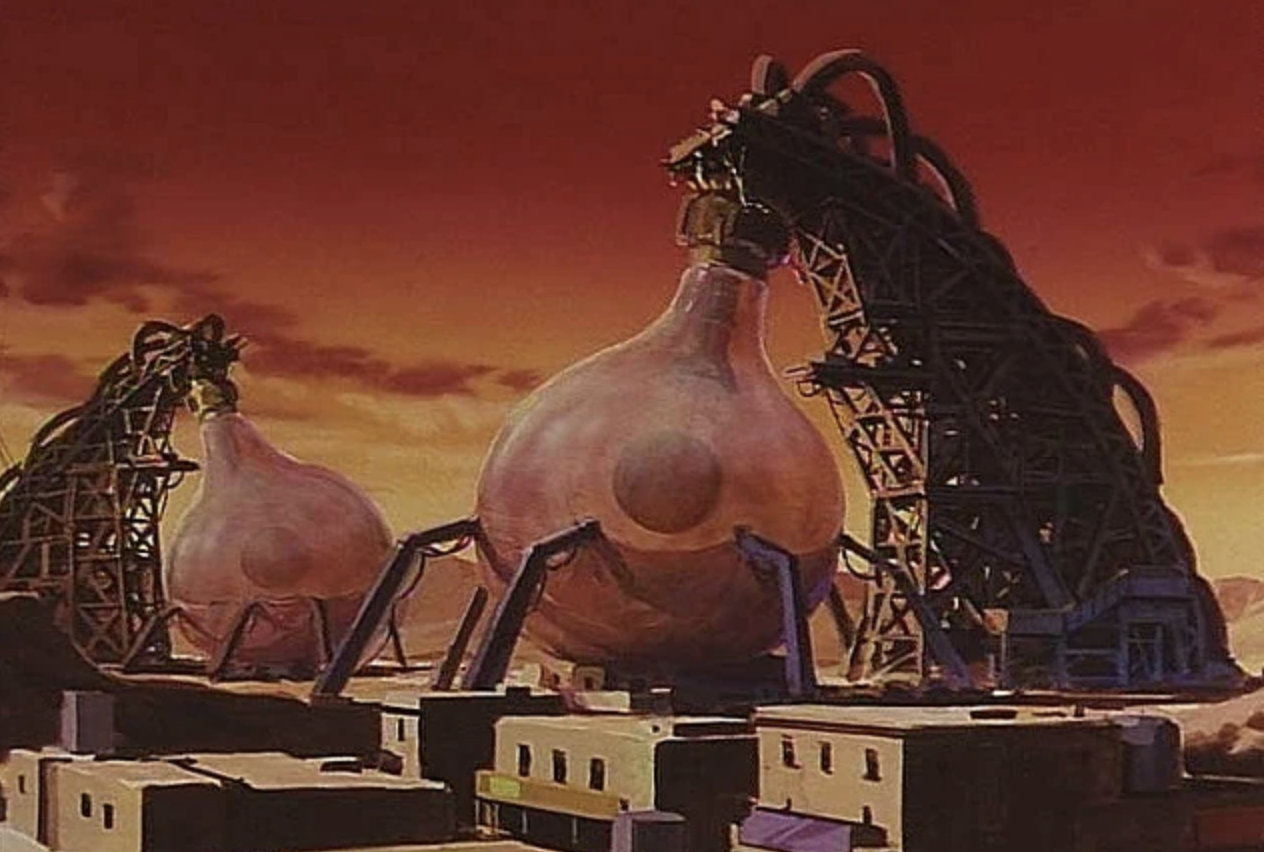
Taken together, I find it most intriguing how the Plants or spaceship remnants that form the heart of each dinky town scattered across No-Man’s Land (AKA Gunsmoke) resemble giant freakin’ lightbulbs. These Plants can generate energy and food/water-based on environmental conditions, which makes them ideal as colonizing vessels. (Remember that point about “taming the land” from earlier?) Not only that, but most residents that Vash and co. run into are doubly sure to cite half of their worries lie with the inevitability that their Plant is DYING and that not a soul knows how to fix them. Except Vash, of course. Family secret and all that, y’know? 

Like the dawn of electrical power and the final days of the Wild West, when faced with barren land, humanity had to turn to manufacturing artificial energy to eke out a living. This is the part where I add that my favorite moment in the entire Trigun anime franchise is when a comedically large lightbulb goes rolling down a hill and lands securely in the back of an equally large tank Lupin the Third style. Badlands Rumble, you are a gift to God’s green earth. 

Ballad Repetition and Saloon-Style Swing

If you’ve ever watched an old Western, you’d find that, like Trigun, ballads and bars just go hand-in-hand with one another. Across each iteration of this story, Vash, Meryl, Wolfwood, and crew frequent a lot of bars. Like, a Cowboy Bebop number of bars. In fact, the 1998 series opens the first episode inside of one. This, too, would’ve been common for real outlaws both then and now, but I didn’t need to tell you that. Stamped on the cover of my Trigun Funimation DVD set is the iconic yellow subtitle “The Ballad of Vash the Stampede,” a lasting reminder that the series is just that, a ballad: a recount of this pseudo-mythical heroic figure and the dramatic past that immortalized him. (Or permanently labeled him as an outlaw in every town and territory on this side of July City, take your pick.)

The point is, the ballad is the story of an adventure, of a hero, his tragic gifts, and his triumphant deeds. And like any song, it garners strength through repetition. If any story is going to get remade again and again, it’s one in a similar disposition to Trigun where having an evolving audience opens itself up to new variations on the same theme. Even as a standalone ’90s anime, the series uses its episodic escapades to drive the notorious character of the “Humanoid Typhoon” into the viewer’s skull time and time again until the outlaw FINALLY meets his fated showdown against ruthless rival Millions Knives. If Trigun is remembered for anything, it’s without a doubt for being the ballad of one irritating pacifist with blond hair, round shades, and a crimson coat. 

As an aside, music is as equally important as giant lightbulbs and steam trains for creating a setting reminiscent of vintage Westerns. Composer and guitarist Tsuneo Imahori brings jazz, folk, electronic, and orchestral genres into the 1998 and film OSTs that I can only call “electrified Western.” One moment the folk-style swing guitar is jamming’ out with the drums, the next moment it’s a storm of freestyle heavy metal. Or steady, sexy tango with bongos. Or smooth sax with jazz-style piano, saloon-style piano, ballad-style piano—look, if you can play it on a keyboard, Trigun has it. Stampede even dusts off its version of a “pipe organ.” Different composer (nothing but respect to my guy Tatsuya Katou), but still.

Whether ballad or blues, Western landscapes and their depiction entail a degree of imagination to create a complete vision of some kind. This is why I position the classic series over the remake; the classic carries charm in all that it does while the remake tries so hard to be “cool” that it feels like any sci-fi CG series with overly wrought apocalyptic tones and a lack of love for its crew. Still, there is motion in each landscape, and how that kinetic energy is directed will convey the magnitude—and the struggle—of the trying journey the frontier vehemently demands from us. And Trigun kicks that frontierism up a notch in every way. It’s not just the Wild West being re-envisioned—it is one wilder yet.


“I meditate diligently every morning. The subject is Life and Love. I quit after three seconds.”

– Vash the Stampede

Afterword: A 25-Year Retrospective Ramble

I’ll finish by addressing my lateness on two accounts.

The first is that this post comes over two months after my announcement that I’d be marathoning Trigun for my blog’s annual Valentine’s Day Special. I don’t really have any excuses aside from that I finished and didn’t really have too much to say on Trigun at the time . . . Now we’re here 2,000+ words later . . . However, this tardiness does not compare to the second offense: my being 25 years late to watching this much beloved sci-fi anime. Granted, it was released before I was born, but I’ve had Funimation’s Anime Classics DVD set collecting dust on my shelf for several years. I’m not sure why I waited so long to start Trigun, but in a way, I’m glad I watched it when I did. Any past iteration of myself would’ve found it annoyingly quirky. Now, after the release of its hotly anticipated remake series, I get to say it’s annoyingly quirky YET better than the original story it was based on. (Sorry, but when one has gung-ho gunslinger Milly Thompson and the other doesn’t, the decision is obvious!)

Trigun was a unique experience for me because it failed astonishingly at making me care about the epic sci-fi plot and the MC redemption arc it was working towards and said, “Hey, check out these lamp cities instead! We have trains, too!” Damn. Looking back, the whole marathon feels like a dream. Glad I dreamt it, but I’m happier to be awake. 

Ok, I think I’m done with the ballad of Vash the Stampede and its lovely calamities for a bit. Someone take it away from me so we can queue up a different tune. 

‘Til next time! 

– Takuto

YenPress’ First Audiobook Lives Up to the Hype || Sword Art Online Vol. 1: Aincrad Review

A brief spoiler-free review of the “Sword Art Online Volume 1: Aincrad” audiobook, narrated by Bryce Papenbrook, written by Reki Kawahara, recorded by Hachette Audio, and released by YenAudio in August 2021. A review copy was provided to me by YenPress following its release.


Revisiting Kawahara’s Famed World of Swords

Ah, Sword Art Online, one of my favorite titles in anime that always seems to get dumped on. Thankfully, the most recent anime adaptation for Alicization (wow, it’s been so long since I got to say that word online!) was able to “redeem” reception for the series overall, despite its own issues. But, as much as I prefer the newer content for SAO than the old stuff, today’s review is about returning to Aincrad—and in its shiny, new audiobook form, no less.

Before getting to the actual experience of SAO in oratory form, I wanted to spend a minute reflecting on this first volume. Unless you’re just now embarking on this franchise for the first time, it’s likely that you haven’t read this first volume in years. Trust me, I had to dust off the cobwebs of my own NerveGear as I jumped back into Kawahara’s famed world of swords. And you know what, I didn’t find it nearly as cringeworthy as my memory served.

As a refresher, Aincrad is the impossibly large, floating castle of the VRMMORPG (impressed that I still remember this ridiculous acronym) Sword Art Online in which nearly 10,000 players are trapped, including Kirito, Asuna, and their allies. Each of the death tower’s 100 floors contains unique terrain—medieval cities, forests, caves, lakes, deserts, mountains, etc.—in addition to a sprawling labyrinth called the floor dungeon. Defeating each floor’s dungeon boss is the only way to unlock the stairway to the floor above, thus progressing the game. It’s already an enticing premise, as each floor typically brings with it new in-game items, quests, places to explore, and above all, a momentous step closer toward the game’s completion. And best (or worst) of all, author Kawahara clearly loves this game world as much as its notorious creator, Kayaba Akihito.

One of my favorite aspects of this novel is the way Kawahara describes the experience of the game world itself. The opening of chic menu windows via “swiping through the air,” the calculative measuring of recovery and reaction times in perilous battles, and even the “shattering of precious polygons” upon the loss of a character’s life are all repeated incidents which Kawahara intently focuses on. The time Kawahara spends fleshing out Kirito’s thought processes as he explores the relationship between the castle and its coding is rarely overdone. If anything, his language can be truly beautiful and inspiring, and his romanticization of Aincrad as both a prison and a palace for gamers immediately appeals as this first volume’s most popular motif. Much to their initial chagrin, Kirito and Asuna slowly start to warm up to the virtual world’s vast beauty, and so does the reader. Aincrad is a colorful fantasy setting, but Kawahara’s inclusion of stylish sci-fi interfaces and comprehendible coding make SAO a fascinating blend of both genres. Additionally, his lyrical prose is amplified by the audiobook format.

Now, as a story, the biggest (and often most criticized) issue with the novel is its pacing. Because the plot begins on day one and caps off at over 2 years of being trapped in the game, many parts of Kirito’s narrative are obviously cut, reordered, or diminished. For example, since we are already acquainted with Lizbeth the blacksmith, Silica the beast tamer, Sachi the guild mate from other parts of the franchise, we find that their omission in this novel really cuts down on the female representation, specifically. I didn’t realize how male-centered this novel was until Bryce Papenbrook (Kirito’s English VA and the audiobook’s narrator) started reading for Asuna’s part. It’s not bad to be missing those characters per se, but I think the masculine gaze is still a valid area for critique.

Still, I would say that the content of this novel holds up even now in 2021. Aside from a couple jarring time jumps and the overt masculine focus of the novel (Kirito, Klein, Agil, Kuradeel, Heathcliff, and others vs. Asuna), the story manages to maintain a compelling hold on what matters most to Kirito in SAO: Asuna. I often find myself comparing the young gamer couple to popular Shakespearean lovers, as Kirito and Asuna’s struggles in SAO are truly accented by the fact that they charge into the darkness together. The honeymoon glow is undeniably one of the cutest parts in the entire series, and as someone who strongly dislikes Yui, I’m glad that I can once again enjoy their love without the annoying fairy AI child that the franchise endorses.

The First “Anime” Audiobook

Let’s get right to the technical aspects of this audiobook. The review copy I was provided by YenPress (thank you!) had a code for Google Play Books, which I’d actually never used before. After downloading the app, it was as simple as redeeming the code and hitting the play button. Google Play Books divides the novel’s audio files by chapter, and you can even bookmark certain areas. Also, the app has a buffer that automatically reloads the previous second or two when you pause it for a while. As someone who frequently had to “put the book down” to attend to other activities, this was extremely helpful.

Now let’s talk about the most interesting part: the audio narration. Bryce Papenbrook, who plays Kirito in the show’s English dub, has a naturally raspier voice. This presents a few obvious challenges when it comes to portraying more soulful or smooth-toned voices. As such, I placed my earbuds aware of my skepticism. As it turns out, however, Papenbrook is still a pro, and there was truly little for me to worry about even as early as 10 minutes in. He manages to have a secure hold on SAO’s overall tone and all its characters far better than most actors would for their projects. I could especially sense Papenbrook’s care in his lines where Kirito experienced loss of any kind. Instead of it coming across as edgy and cringe like the first anime does at times, Papenbrook’s Kirito in the audiobook has a remarkably deep sense of fear and anxiety, which is more than fitting given this first novel’s overwhelming sense of isolation and loss.

Not only has Papenbrook improved in voicing Kirito’s nuanced sarcasm and wit, but also he surprised me in his ability to portray the entire cast with stunning depth. How he was able to match Klein’s enthusiastic, wannabe hero just as well as the actual English VA’s performance was amazing. The same could be said for Agil’s deep suave, Heathcliff’s principled disconnection, and Kuradeel’s wheedling insanity—Papenbrook goes beyond simply changing his vocal register and gives all these characters defining vocal quips, variations in breath, and unique tones. Flipping between these characters must’ve been exhausting. But hey, I suppose that’s why they hired a voice-over artist for the job—and one who knows and loves the franchise enough to put care into delivering the whole story, even in its most questionable moments.

Also, can we talk about Bryce’s Asuna?? Like, how did he make her appear in my mind just as the original text and Cherami Leigh’s performance does? Given Asuna’s importance as Kirito’s other half, I figured that hearing Kirito’s own voice for both of them would’ve been the novel’s biggest turnoff. I think I was able to enjoy his performance so much because he does more than “try to sound like a girl” when voicing Asuna. Asuna’s personality is defined by her dual presence—the tough and cold “Asuna the Flash” and the warm, vulnerable Asuna that invites Kirito to her apartment—and Papenbrook’s acting for both is starkly different. He retains Asuna’s character by portraying these traits first, then putting the higher vocal pitch behind it, and the result is that she blends seamlessly into the narrative rather than obnoxiously standing out.

A New Outlet for Anime AND Bookish Fans

What is gained through the SAO audiobook—widened accessibility, “new” content, and a closer relationship to Papenbrook as an actor/fan of the franchise—comes, of course, at costs in the visual department. For one, we lose all of abec’s fantastic artwork that accompanies the light novel. His early stuff isn’t necessarily impressive, but I couldn’t imagine the series without his artwork for GGO and Underworld later down. That said, Kawahara’s “Afterword” is preserved in the audiobook, which was a pleasant surprise.

I think the biggest concern facing the SAO audiobook is the sheer number of female characters to come. (Literally, Volume 2 introduces FOUR new female side characters.) Papenbrook might’ve been able to handle Asuna well, as she is somewhat tomboyish in her own actions, but I wonder if he would also portray Lisbeth with the same natural nasal that her English VA has, or if he’ll attempt to go falsetto voicing Yui. OR, it could be a possibility that the torch will be passed onto another VA from the dub to read Volume 2. After all, Cherami Leigh is credited along with Bryce for the second volume’s listing. (It’d be cool if this became a sort of full-cast project once it gets going!) I suppose we’ll find out what they do when Volume 2 releases on October 18.

Seriously though, I continue to respect what Bryce Papenbrook does with the black swordsman throughout their run together, and I’m genuinely curious (assuming that Yen goes this far into dubbing) as to how he might play Eugeo, Kirito’s friend, foil, and one of the franchise’s most beloved characters.

For now though, I would definitely say that the audiobook is worth listening to, especially if you have a friend who is convinced they want to get into the series but they don’t care for anime. As for if I personally would want more SAO audiobooks in the future—absolutely, bring it Yen! On an entirely separate note, I’m particularly excited for The Miracles of the Namiya General Store and how that story will be read. I’m entirely optimistic about this whole project of inviting VAs to read our favorite light novels, and if Yen is willing to send me review copies in the future—Well, let’s say that I’m all ears for more.


Afterword

Special thanks again to YenPress and YenAudio for sending me an audiobook review copy of Sword Art Online Volume 1: Aincrad. (I love the project so much, and I apologize that this review came a month past the audiobook’s release!) To my readers, what do you think of the idea of light novel audiobooks? Also, would you consider revisiting the original Aincrad story in this new format or are you content with the books and/or the anime? Let me know down in the comments! Thank you so much for reading, and till next time!

– Takuto
These audiobooks based on Yen Press content will be available wherever downloadable audiobooks are sold, across platforms including Apple Books, Audible, Audiobooks.com, Downpour, Google Books, Libro.fm, Kobo, and more. This volume retails for $25.98 USD ($19.99 or less in some shops) and is approximately 7.5 hours in length.

STUDIO PONOC’s Modest Heroes (& Tomorrow’s Leaves) || Summer Film Spotlight #8

CELEBRATING STUDIO PONOC 🌱

Hey guys! Welcome to the eighth Summer Film Spotlight! Today we are taking a look at STUDIO PONOC’s 2018 film Modest Heroes, which was released by GKIDS. The film is actually comprised of three short films—“Kanini & Kanino,” “Life Ain’t Gonna Lose,” “ and “Invisible”—each of which are about 15 minutes in length and focus on the different heroes we may encounter in our daily lives.

I hope you’ll continue to join us on this summer journey through film. See you next Saturday with another Summer Anime Film Spotlight!

Interested in more anime, manga, or K-pop content? Subscribe to stick around 🙏

Thanks for watching~!

– Takuto

Children of the Sea 🐋 || Summer Film Spotlight #4

MYSTERIES OF THE SEA 🐠🐋🐠

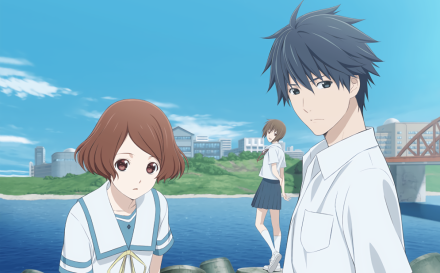
Hey guys! Welcome to the fourth Summer Film Spotlight! Today we are celebrating GKIDS’s beautiful dubbed Blu-ray release of Ayumu Watanabe’s Children of the Sea. This 2019 film adaptation of Daisuke Igarashi’s famed manga explores the fascinating relationship between nature and the human mind. Contemplated is the relativity of existence, and how we’re not so different from the stars shining above us—or the creatures lurking deep below the ocean’s depths.

I hope you’ll continue to join us on this summer journey through film. See you next Saturday with another Summer Anime Film Spotlight!

Interested in more anime, manga, or K-pop content? Subscribe to stick around 🙏

Thanks for watching~!

– Takuto

Tokyo Godfathers || Summer Film Spotlight #2

IT’S CHRISTMAS IN JULY ✨🎄✨

Hey guys! Welcome to the second Summer Film Spotlight! Today we are celebrating GKIDS’s beautiful dubbed Blu-ray release of Satoshi Kon’s Tokyo Godfathers. Although it is neither Christmas nor July, I thought it’d be fun to kick off the summer with beloved anime movies that fans have been loving for years, and Tokyo Godfathers is just that kind of film!

I hope you’ll continue to join us on this summer journey through film. See you next Saturday with another Summer Anime Film Spotlight!

Don’t forget to read the original blog post ➡️ Finding a Place to Belong: Tokyo Godfathers & the Gift of Kindness | OWLS “Miracles”

Interested in more anime, manga, or K-pop content? Subscribe to stick around 🙏

Thanks for watching~! –

Takuto

Fate/stay night: Heaven’s Feel I. Presage Flower || Summer Film Spotlight #1

SUMMER AT THE MOVIES BEGINS! ☺️

Hey guys! Today begins a series of weekly videos that will highlight an anime film I recently watched! First up is Ufotable’s Fate/stay night: Heaven’s Feel – I. Presage Flower, released by Aniplex of America. I love me some Fate, always, and it’s about time I figured out if all the hype surrounding these movies is worth it. (Spoiler alert, it is.) 🌸

I’ve been wanting to start a project like this for months now, and I finally have the time to sit down and talk about my favorite anime movies. I hope you’ll join me on this journey through film! Oh, and regular posting should resume again soon now that I’ve graduated from uni (more on that in an update forthcoming). See you next Saturday with another summer anime film spotlight!

Interested in more anime, manga, or K-pop content? Subscribe to stick around 🙏

It’s good to be back. Thanks for watching~!

– Takuto

BLACKPINK: Light Up The Sky – An Intimate Look at the World’s #1 K-Pop Girl Group || Review

A brief, spoiler-free review of the 2020 documentary film, “BLACKPINK: Light Up The Sky,” produced by Netflix, and directed by Caroline Suh.


The story of the #1 charting K-pop girl group finally gets told, and the whole world is watching.

Hey guys!

BLACKPINK IS IN OUR AREA for today’s video!! We’re gonna talk about YG Entertainment and Netflix’s latest K-pop documentary film, “BLACKPINK: Light Up The Sky,” which was just released on Wednesday, October 14th! No spoilers, so feel free to watch before or after viewing! (Also, there’s lots of fan rambling in this one, just thought I’d let you know 😉)

I LOVE THESE GIRLS WITH ALL MY HEART, and I hope these sentiments reach you as well! As much as I wanted to write out a review for this one, it just felt more natural to film a video instead. So, here it is, and I sincerely appreciate all those supporting my YT channel.


When you’re working in a group, everyone has their place and a role. And when everyone settles into their roles, that’s how synergy is born. That realization changed my outlook. When everyone is where they need to be, big things can happen.”

Jisoo


I’ve actually known BLACKPINK longer than I have BTS, so this film was extra special for me to watch. While it needn’t be said, this is a certified “Cafe Mocha” film here at the cafe, and one that you should totally check out if you’re a fellow BLINK, OR if you’re wanting to get into BLACKPINK and the K-pop scene and maybe don’t know where to start. Trust me, you’ve found a great place. To those who have seen it, you’ll definitely have to let me know what your favorite part of the film was in the comments!! 🖤💖

I’ll try to come back soon with a formal update explaining what’s going on with the blog, and where we should go from here. But for now, enjoy the video, and I’ll see you soon. ‘Till next time~!

– Takuto

Sakurada Reset: Supernatural Mysteries and Missed Opportunities || Review

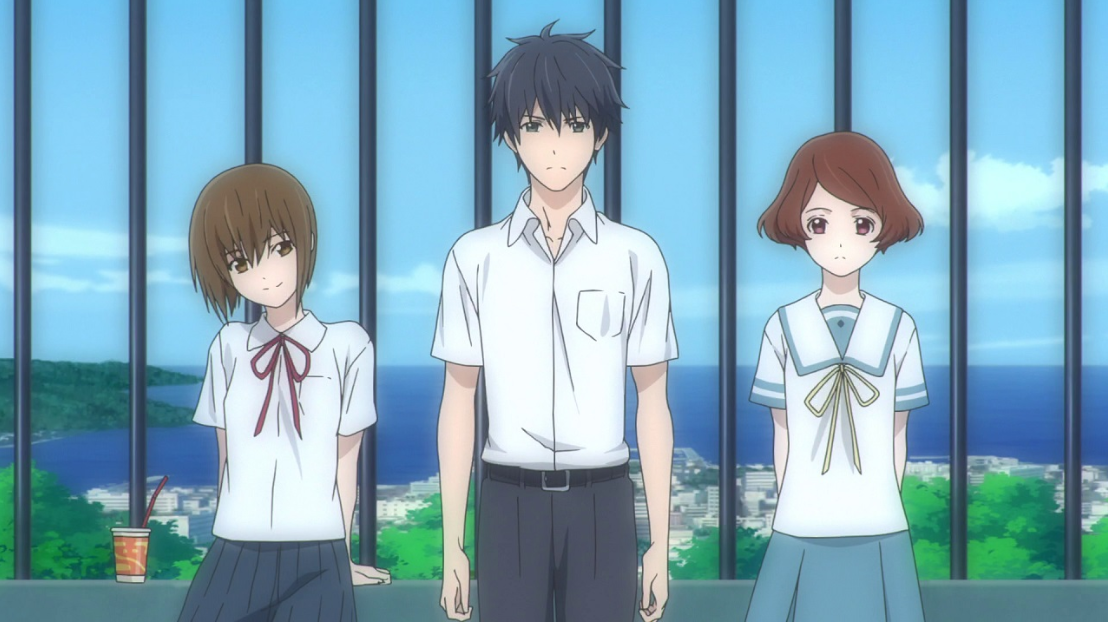
A brief spoiler-free review of the 24-episode Spring 2017 anime “Sakurada Reset” (also translated as “Sagrada Reset”), animated by David Production, directed by Shinya Kawatsura, and based on the light novel by Yutaka Kouno.

Haruki can reset time but forget she ever did. Meanwhile, Kei remembers everything.


A Town of Supernatural Gifts

Sakurada isn’t your average seaside town. Unknown to anyone else, its inhabitants are born with strange psychic powers. Upon being summoned to the school rooftop one day, Kei Asai meets Misora Haruki, a quiet apathetic girl with the power to reset time. Her gift comes with certain limits, however: she can only go back up to three days, and she can’t use it within 24 hours of the last reset. To make matters more complicated, she doesn’t ever remember using her power when she resets time!

This is where Kei comes in. His ability to remember everything and anything allows him to recall changed timelines and Haruki’s resets. Together, they wield their unique powers with their Service Club friends to aid the problems of others. As the club starts taking on increasingly difficult and crucial missions for the mysterious Administration Bureau—an organization which manages all the abilities in Sakurada for the sake of justice—Kei finds that the machinations of eerie organization go far beyond simple acts of service.

I love time travel stories. I know many people dislike the trope, but it never ceases to entertain me. When paired with a plot like Sakurada Reset‘s—saving others, government conspiracies, romance drama, etc.—you basically get a knock-off Steins;Gate (which is one of my faves). The only problem is that, aside from the last couple episodes, the series is really, really boring. Given that I find everything else about the series to be incredibly interesting, I’m chalking up Sakurada‘s slow and lackluster nature to the direction. At least our time traveling heroes are somewhat inspiring, right? Right???!

sakurada characters

Apathy is Contagious

Sorry to be the bearer of bad news, but Kei is one bland dude. Despite possessing one of the coolest abilities in the series, photographic memory, the gift does very little to make him likable. Like, he’s not rude or disrespectful, but he’s not exactly exciting to be around, either. I suppose he’s a SAFE option as a lead, but I’d rather my time travelers have a screw or two loose (like they tend to do) or have one overwhelmingly eccentric trait than be completely nonchalant about everything.

And sadly, Kei’s partner in crime isn’t much more interesting than him. In fact, Haruki’s hallmark is her absolute BLANDNESS, which allows Kei to tell her whatever he wants and she’ll do it. While I appreciate the sense of mutual trust that slowly starts to develop between them, I did notice that this kind of just left Haruki to be another tool for Kei to use (and not in the fascinating way that Code Geass‘ C.C. is to Lelouch). I’ll say that she’s reliable as a heroine, but not much else.

The rest of the cast ranges from similarly bland (man, apathy sure is contagious!) to unnecessarily complex. One example of bland is Kei’s best friend, Tomoki, whose abilities as a telepath makes him little more than the series’ top CHAD. Another is Seika, a girl who can communicate with cats, but is a weirdo and hard to converse with. On the flip side, Eri Oka, a punkish girl introduced later on who can implant memories, did nothing but make me want to pULL MY HAIR OUT, she’s so annoying. Same with Murase, a girl with an amazing power that basically makes her invincible, but boy is she a grade-A B*TCH to deal with sometimes. I could go on with describing my frustrations. Point is, they’re all good kids (kinda), just needlessly stubborn.

sakurada ocean

Calm and Quiet Seaside Energy

As Kei and friends continue to explore the city, I did slowly start to fall in love with Sakurada. Many sights became familiar, almost nostalgic, and I do think that the seaside setting does wonderful things for the story. Having the plot unfold in a smaller community than, say, Tokyo, allows characters to conveniently run into each other on the streets (which happens quite often) without seeming far-fetched. Plus, they have the ocean, and the sea is always a magical place for me.

If I had to describe the art and animation, I’d say what I have been about basically everything else—it’s safe. Not below average by any means, but decently pleasant, if not stiff and stale. (It sure doesn’t help that the MC’s script is boring as hell.) David Production took zero risk in making the powers in Sakurada look cool or exciting, which is SUCH a missed opportunity given how intriguing espers can be. Bummer. At least the music was good.

I couldn’t find credits for any other well-known work, but Rayons’ orchestral soundtrack compliments the pace of Sakurada Reset very well. The way some of the sad piano pieces transition to some of the series’ more casual, slice-of-life moments almost feels more like it’s music for a visual novel than an animated series. (There’s one particular piano/vocal track that really tugged at my heart.) This becomes more apparent when you start to realize that, for some reason, the music plays at a consistent volume THE ENTIRE TIME. No one “heartbreaking” moment felt more dramatic than the next, and I strongly believe that’s because the sound direction here—like the rest of the series—is so friggin’ lame. Again, good OST, just missed opportunities. WEAVER’s work on the second OP was BANGERS though!!

sakurada op

A Series of Missed Opportunities

For a supernatural school drama anime with mystery and time travel at every turn in the road, Sakurada Reset comes together as a strikingly unremarkable package. Its direction is steady (and sometimes quite artistic), but otherwise too slow to convince me to get excited about anything. Despite possessing unique super powers, the characters’ personalities are either disappointingly ordinary or straight-up noisome. And that’s too bad, really, because nothing about the series is terribly bad. It’s just average, and probably forgettable give or take a month or two.

If you came from a show like In Search of the Lost Future (wow, now THAT takes me back) and were hoping for something a bit more, Sakurada Reset will serve you well. It explores living with regrets, human longevity, and trust much better than other time travel romances do. However, if you came expecting a masterpiece like Steins;Gate, prepare to be disappointed—you won’t gain much from these long 24 episodes.

sakurada tree


We’re connected by our abilities. Since we have abilities, the two of us were able to stay together all the time, automatically, as a matter of course. Kei Asai


Afterword

In continuing to tackle my never-ending backlog, I was happy to be able to cross this one off the list. It sure was mediocre, but not something I regret watching. For all those curious, I consider Sakurada Reset a “Coffee” rating, and only recommend it if you’re longing for a particular kind of feeling, something transient and fleeting but, also, not wholly unenjoyable. If you have taken the one-way train to Sakurada by chance, be sure to let me know your thoughts about the series in the comments! Thanks for reading, and ’till next time!

– Takuto

Den-noh Coil: The 2000s Sci-Fi Anime You Never Watched (But Should) || Review

A brief spoiler-free review of the original 26-episode Spring 2007 anime “Den-noh Coil” (also translated as “Dennou Coil”), animated by Madhouse, created and directed by Mitsuo Iso.


Nostalgia, Child’s Play, & the Internet

In the near future, people have integrated augmented reality their daily lives through the use of specialized cyber glasses. A virtual world of “E-spaces” overlays Daikoku city’s electronic infrastructure. Viruses hide in plain sight, yet only glasses wearers can see these virtual hazards. Children in particular find immense joy in tracking down old abandoned E-spaces and using them for their own game. Hacking spaces, switching servers, discovering damaged domains—it’s like the coolest game of geocaching you could ever play! Some have even taken interest in hunting for metabugs, small gems which can be converted into currency or special items in the digital world.

This brings us to Yuuko “Yasako” Okonogi and her family, who have just moved to Daikoku City despite rumors of some people mysteriously disappearing. While searching for her cyberdog Densuke, Yasako encounters Fumie Hashimoto, a playful classmate and member of “Coil.” Comprised of other community youngsters, the small unofficial detective agency helps glasses wearers solve various cyber troubles. The girls’ meeting also brings Yasako’s snappy grandmother back into her life, who just so happens to run a shop that sells illegal tools which interact with the virtual world AND is the bright mind behind Coil.

Like any program, however, there are many bugs in the system, dubbed “illegals.” Some are lost, aimlessly wandering the digital landscape to eternity. Other illegals exist to cause mayhem, and some are harmless yet like to follow humans around, much like a household pet would. Another girl, Yuuko “Isako” Amasawa, is also investigating these corrupt spaces, but her abrasive hacking style (and attitude) deters her from making friends. The kids in Coil are determined to discover the truth behind the mysterious viruses and disappearances, but little do they know what corruption lurks on the dark side of the web.

yasako and fumie

Virus Attacks & Friendly-Fire Hacks

For the entirety of the series, Yasako serves as our blank canvas as Fumie guides us through the ins and outs of the virtual world. The two girls become best friends, and Fumie’s intelligent yet loud personality meshes well with Yasako’s soft naivete. Navigating through scary virus attacks and friendly-fire hacks from their fellow classmates, the go quite well together as a pair.

But, if there’s one giant brick wall stopping them from having fun in this digital space, it’s going to be Yuuko Amasawa. To avoid confusing the two Yuuko transfer students, the kids call her Isako. And boy is Isako one tough nut to crack. She’s standoffish, rude, and totally not interested in making friends; rather, her eyes are set solely on collecting metabugs for her own personal mission.

To complicate matters, the incredibly obnoxious and bratty Daichi Sawaguchi (along with his self-named “Hackers Club” goons) are also trying to snatch up metabugs, drawing out much of the conflict in the series’ first half. As things get weirder and weirder on the digital side, these hidden secrets tell of disastrous things happening in Daikoku City. Maybe, just maybe, the forces undermining the kids’ efforts will allow them to start seeing eye-to-eye.

isako hackers club

Given that practically the entire cast of this one is made of children, I’m SO glad that the English dub from Maiden Japan cast all the young boys with female dub actresses. (It just helps avoid the cringe of hearing a 30-year-old man voicing a ten-year-old.) I’ve never heard a dub where the children—to this extent—act and sound so much like children should. These kids are FUNny and are a hoot to watch! (And I LOVE Specs Granny!!)

Whether chasing down urban legends, stalking haunted hotspots, or connecting dreams and memories across time and digital spaces, these kids go on quite the coming-of-age journey. Together, they prove that the Internet can be a fantastic place for self-discovery—but also a potentially hazardous landscape without practicing proper safety.

dennou coil kids

Integrating CG with the Digital World

Although the show has a quiet, lukewarm start to it, the talents at Madhouse breathe astonishing life into Den-noh Coil. Mitsuo Iso not only directed AND created the entire story—he also drew many of the key frames himself! His style is jerky yet detailed, full of motion and expression. There’s some really well-animated character work done here, and it’s all in the details. Whether fidgeting children, readjusting glasses, or making silly faces, the animation fully encapsulates the behaviors and mannerisms of goofy 6th graders.

Despite coming from an era of anime where the use of CGI was almost purely experimental, the 3D CG works remarkably well here since Den-noh Coil‘s world is deeply intertwined with the digital space of the Internet. Muted, drab, washed-out Tokyo landscapes provide a unique, small-town community atmosphere to the series. Much of the AR special effects work is done with CG, giving us a nice distinction between the bleak watercolor skies of the real world and the quirky (yet dangerous) E-spaces that the kids are so fond of exploring.

I also found the entire soundtrack of the show to add a unique quality to Den-noh Coil. The series is accompanied by soft acoustic guitar and the quiet cascade of digital sound effects whenever the kids are dueling in back alleyways. Tsuneyoshi Saito’s OST, as with most of his other works (most notably Fafner), showcases the strengths of orchestral music. If we’re not getting weaving wind ensembles, we may hear the solemn beat of tribal drumming, or even the tender, evocative enchantment of the piano. It’s classic, and this kind of music will always win me over.

searchie

Connection, Disconnection, & Loss

Den-noh Coil takes a bit to get going, but enjoy its comedy/slice-of-life beginning. Trust me. These early-middle standalone episodes explore youth, life, and living side-by-side with this digital world, and are by far some of the strongest in the series. (The beard episode was especially great.) I’d argue that the episodic direction in the middle is far stronger than the main overarching story. Then again, I just find that the episodic style suits the series’ world and setting better.

About two-thirds of the way in, this sci-fi adventure kicks up the mystery with a starkly different plot set in motion. The character drama in the middle is also strong and even stronger at the end, which ties in well with the creepier subjects of the series’ finale. It’s a striking tone switch, but it really makes for an exciting finale.

yasako laser

These days, no one talks about Den-noh Coil (which is partially why I was drawn to it in the first places). I think that’s sad, because it’s more relevant now than it ever was in 2007 when it first came out, and I can’t help but think how highly people would praise the series if it was put out today. Certainly, it’s one creative piece of sci-fi.

Den-noh Coil tackles themes of connection, disconnection, loss, extinction, living within boundaries, and learning to push beyond certain limits. It explores what can go wrong in a world that lives side-by-side with technology, a world that can be hacked AND hack you just the same. Some stories are silly and eccentric; others are thought-provoking and startlingly philosophical. If you’re wanting an anime that explores transience in the digital age and you’re tired of being directed to Ghost in the Shell or Serial Experiments Lain, go give Den-noh Coil some love. It’s TOO overlooked and under-appreciated, and I guarantee it’s the early 2000s sci-fi anime you never watched—but absolutely should.

yasako and isako


What is real? Does being able to touch things make them real? If something can’t be touched, does that mean it isn’t real? What things are really, truly here? What things are actually here for sure?  — Yuuko “Yasako” Okonogi


Afterword

I had to sit on my rating for Den-noh Coil for a while. On one hand, it’s slow, a bit drab, and unnecessarily confusing with all its technobabble nonsense. On the other, however, it’s surprisingly dynamic and full of interesting ideas. And you know what, it’s for these reasons that I welcome Den-noh Coil as a certified “Cafe Mocha” title. THIS right here is what we call an anime gem, and you should seriously consider adding it to your watch list if you love sci-fi or augmented reality in the slightest! Had I watched it as a child, I couldn’t even begin to imagine the boundless fun I would’ve had with it! Are you one of the rare few who have seen Den-noh Coil? Please let me know, as I’m looking for fellow Coil kids to love this show with! Thanks for reading, ’till next time!

– Takuto

The Start of a Long Journey: Yona of the Dawn Manga Volumes 1-3 || First Impressions

First impressions and loose thoughts on volumes 1-3 of Mizuho Kusanagi’s manga series “Yona of the Dawn,” initially published in 2016 by VIZ Media. Spoilers will be present.


A Terrible, Terrible Birthday

I’m no stranger to the beautiful and cruel world of Yona of the Dawn. I followed the anime when it first aired many years ago. Loved it. Since then, I decided to pick up the first NINE volumes of the manga to hopefully quench my thirst for a sequel we’ll probably never get. Wellll, you know how I do these things—the manga sat on my shelf for a good couple years, untouched, and the dust started to collect.

Until now! My rekindled love for manga has motivated me to tackle my shelves before buying new titles, which naturally placed volume one of this long-awaited read in my hands. And guys, what can I say that hasn’t been said already? Yona is a wonderful shoujo fantasy series with a compelling cast of characters living in an interesting Asian-inspired world. BANG. What more could you want?

But in case you know nothing about Yona, the shoujo manga follows the titular Princess Yona, whose bright red hair makes her the crown jewel of the Kohka Kingdom. After her doting father, the king, is murdered in cold blood by her childhood friend and lover, Su-won, Yona flees for her life with her faithful guard Hak. Now, Yona sets out on a journey to reclaim her country with hak, which includes tracking down the four dragon warriors of ancient lore.

Out on the Run

Right off the bat, I think the most striking thing about Yona’s world is the choice to use Korean-inspired names instead of the typical Japanese names. In fact, the series draws more inspiration from Korean culture than it does Japanese, making it an intriguing blend of both cultures. The series carries with it a heavy traditional feel, but also contains a surprising amount of fun and comedic moments despite the tragic start.

Following their flee, Hak seeks out his home village of Fuuga to avoid further pursuit from Su-won’s soldiers. The village’s chief (and Hak’s foster grandfather), Mundeok, is an admirable figure who I’m sure could’ve taken in Yona and raised her very well—but that wouldn’t be much of a story then, would it?

No, instead, Yona puts her foot down and decides to leave the village herself, demanding Hak continue to stay at her side. (The audacity, I know!!) Shortly after, Yona and Hak confront their pursers, and we get the powerful scene where Yona slashes her own hair—which she is adored for—to free herself from Kang Tae-Jun’s captivity. If that’s not symbolic of a woman choosing strength and independence over frailty and vanity, I’m not sure what is. The passing of Yona’s cut lock to Su-won leads him to believing that Yona has truly perished, which deeply hits him, interestingly enough. Like, Su-won isn’t a good guy, but, is he truly bad . . . ?

She with the Crimson Hair

Volume 3 is where we finally start to get a glimpse of the overall plot Yona is about to take up. Now that we’ve become acquainted with Yona’s rare fiery side as well as Hak’s reliability and loyalty on and off the battlefield, we are introduced to Ik-su, a lackadaisical priest who fled the capital when the regime changed years ago, and Yun, a haughty young pretty boy whose talents in cooking, fashion, and herbal remedies will prove incredibly useful on their journey going forward.

Ik-su tells Yona (and the reader) a great deal about the world, the legend of the dragon warriors, and Yona’s role in all of it. He prophesizes the assembly of the four dragon warriors, and how their coming together will awaken the monarch and resurrect the red dragon of dawn. The spirit of the dragons is passed down through four individual bloodlines, each of which still bear fealty to their beloved crimson dragon even to this day.

After a sad parting, we leave behind Ik-su, and Yun joins us in traveling to the White Dragon Village. There, in the land of the wind, we meet the first dragon warrior, a beautiful young man named Gija who possesses the “arm of a dragon,” scales and all. Although Gija bumps heads with Hak, the pain in Gija’s arm makes him realize that joining Yona is his life’s calling—and the destiny that has been passed down his family for generations. Another bittersweet parting between Gija and his grandmother sets us on the long quest to finding the other dragon warriors.

A Fantastic Historical Fiction Drama

Mizuho Kusanagi’s art style is the stuff of legends. Almost flawlessly, she recreates an era in time that dates back to the Three Kingdoms period of Korea. Mind you, it’s all historical fiction, so none of the setting is real, but Kusanagi reimagines this period from architecture and fashion style to customs traditional of this period. It’s such, SUCH, a gorgeous manga.

All of Kusanagi’s characters are beautiful (as one might expect in a shoujo manga), but also brazen and fierce. There’s a fire in Yona’s eyes that is unmatched; in Hak’s, a gaze of strength and familiarity; and in Su-won, a dark, melancholic sadness. Each cover piece alone is a work of art, as the coloring is so pretty and vibrant, much like Yona’s captivating red hair.

So, will I be reading more Yona of the Dawn in the future? Well, duh—I already bought the first nine volumes, or did you already forget? Haha! Seriously though, if I didn’t already have them, I would’ve placed an order immediately following the second volume. Yona has a lot of promise, which comes as little surprise given how highly talked about this series is. I’m excited to embark on this long journey with Yona, and I do hope you’ll be tagging along for the ride.


If it were a person . . . if this were a battlefield . . . I’d need my arrow to fly true. Drawing your bow means taking a life—or letting someone take yours.Yona


Afterword

I could talk on end for how much I love Hak, how much I love Yun, and how endearing of a protagonist I find Yona to be growing into. But, I’ll save that for future manga write-ups. After all, this is only the first three volumes, and there are well over 20 volumes available in English! I do hope you’ll continue with my reading of Yona of the Dawn. What are your thoughts on this highly beloved series? Let me know down in the comments! ‘Till next time!

– Takuto

CLICK HERE TO READ MY THOUGHTS ON VOLUMES 4-6