Hyouka: Fifty Lazy, Dull, Grey Shades of Curiosity (FEAT. Sherlock Houtarou)

A spoiler-free review of the spring 2012 anime “Hyouka,” produced by Kyoto Animation, based on the “Koten-bu Series” novels by Honobu Yonezawa.

Do you read the newspaper anymore? You know, that compilation of local and global updates printed on cheap, ink-rich, pulpy paper that would arrive every Sunday morning (delivery date varying on location)? Yeah, me neither. Between bright news channels on TV and the instant convenience of the Internet, I have no right reason to order such a monochrome, drab publication (unless you do it for the ink odor, to which I reckon you meet with a psychiatrist ASAP).

But despite my preferences, there are still those who cling to this plain method, which is completely fine, by all means. My only question: Who would want to pay for boring when digital brilliance is free with the click of a button?
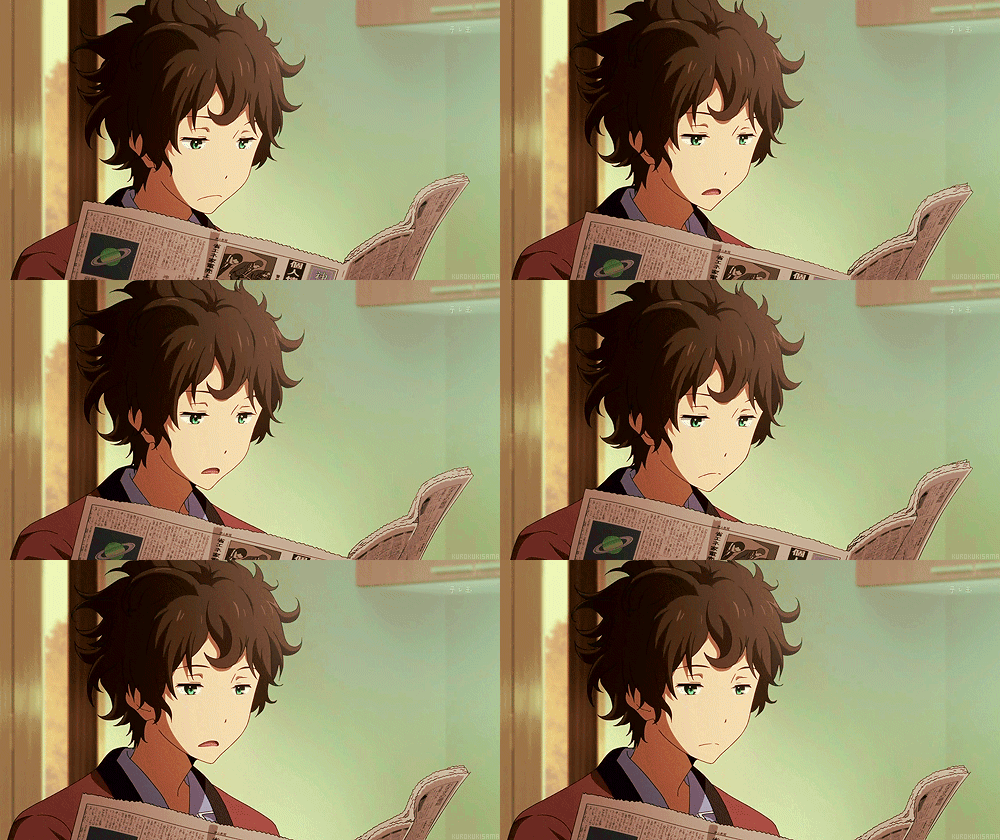
This bum. Nice Hair.

This bum. Nice Hair.

Enter Oreki Houtarou, our mundane, dispassionate, high-school culprit who would indeed prefer this simple format. Why? A newspaper is neither flashy nor motivational. Additionally, it comes to you rather than you going to it, which though might not sound like a good enough excuse for us, works fantastically in Houtarou’s favor.

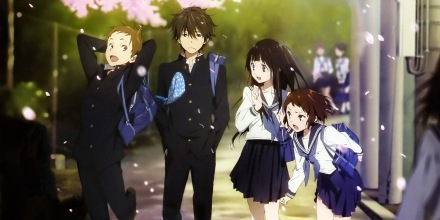
To save his elder sister’s club from disbandment/comply with orders, Houtarou reluctantly joins the Classic Literature Club. There, he reunites with his lively buddy, Fukube Satoshi, and adversary/manga addict, Ibara Mayaka, a couple too energetic for him to be around. That’s not all lurking in the clubroom, however. Violet-eyed Chitanda Eru, a proper, lovely girl, transforms into the quintessential curiosity bomb when something interesting and mysterious catches her eye, or rather, tongue (“Curiosity killed the cat,” or “Cat got your tongue,” anyone?). Anyway, the story follows the Classics Club and their investigations surrounding their beloved Kamiyama High, for the more they unravel mysteries, the more they get tangled up with each other’s personal lives.

And that’s all these kids do. Solve mysteries for the mere sake of solving mysteries – all while satisfying Chitanda’s raging curiosity, of course! The development of the setting and characters comes from each of these case arcs that divide the series. That’s where problems can arise, you see. With the way the anime is set, beginning strongly and upholding that entertainment through the middle, the end pulls the characters out of the thrilling school festival setting to further polish the two relationships. What that creates is a most lackluster ending – as if we ended on just another episode – which is a real shame considering that the suspense from the two previous potent mystery arcs was driving up to this ‘finale.’

Ah, friendship ~

Despite my need to rearrange the story arcs, Hyouka’s characters are at least one-of-a-kind. As you know, Houtarou is and was my site’s mascot prior to my watching this anime, and you might be glad to hear that he’s sticking around! “If I don’t have to do it, I won’t. If I have to do it, I’ll make it quick.” Bent on avoiding a “rose-colored high school life,” that is his faithful motto. But he gradually breaks away from this eternal LAZINESS the more he quells Chitanda’s curiosity. The consequent result of his efforts – He develops a driving curiosity for himself!

“I’m not stupid. I’m just too lazy to show how smart I am.”

This is how I look when people ask to see my notes.

SAME

Houtarou is also incredibly relatable (my bedhead twin). I found his nonchalant way of dealing with the day-to-day schemes of his rather gray life not only amusing but realistic. Besides his dull “oohs” and “ahs,” provided by the charming actor Yuuichi Nakamura, he also has very little to say. Most of Houtarou’s ‘dialogue’ is composed of complex thoughts in that brown bushy head of his (indicated by the tugging of his bangs), while what he actually spouts is concise and to the point.
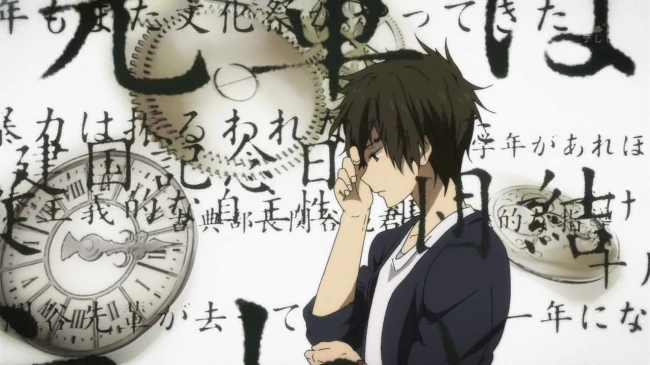
If Chitanda’s energy combats Houtarou’s laziness, then Satoshi’s spunk grinds with Mayaka’s bluntness. Claiming to be a “database” that can store info but not make conclusions, Fuku-chan supports Oreki regardless of his high expectations for him. All the while, Mayaka tries desperately to win Fuku-chan’s heart and Chi-chan fires questions in Oreki’s direction. Ladies and gents, here you have the musings of the Classics Club!

Calling the animation simply “beautiful” would be the easy way out. The cinematography here makes other KyoAni works look elementary. The dull world around Houtarou is coated in pale browns and yellows to reflect his boring view. In contrast, when he becomes shocked or surprised, lighting plays a key effect, as everything sparkles and brightens the eyes! When it comes to the mystery aspects of the show, each time a new case is introduced, the run-down of the information carries its own unique and quirky animated sequence. It’s as if Shaft and KyoAni birthed a gorgeous, brilliant, and eccentric child!

Kids actually utilizing their public libraries – and it’s cool!

I want to bring up the OST not because it’s necessarily the greatest thing ever, but because it fits the mystery atmosphere so perfectly! For the majority of the tracks, irritated strings, peculiar xylophones, and romantic choirs/pianos/harps pave the way for intense thinking and detective work. Sleuthy, eerie, dramatic, or flat out rambunctious, the music remains an engaging feature of Hyouka. The exciting inclusion of classical music, be it the reoccurring Beethoven, Bach, or Faure adds a, and imagine this, “classy” feel to the whole shebang. I simply can’t get enough of “Sicilienne” and Bach’s “Cello Suite!” *Cue reading letter from Oreki’s sis*

Before we leave the OST department, I’d like to highlight “Yasashisa no Riyuu” by ChouCho, the first opening. This song just oozes with good feels and astonishing visuals, so it was naturally a shame to lose it after the first half! Similarly, the first ending “Mikansei Stride” by Saori Kodama was also a pleasant touch.

tumblr_m4qozdj3ue1r6ksv2o1_r1_500

Hyouka’s best feature was its ability to juggle the genres of mystery, drama, romance, and slice-of-life, and do it phenomenally! To parody, it was like “Fifty lazy, dull, Grey Shades” of freakin’ curiosity. Seriously, if I was having the crappiest day ever and was wanting to be cheered up, or if I wanted something fairly heavy to dip my emotions into, then this is one of the bests. Even if the mysteries are lacking towards the end, there are plenty of other great qualities the story has to offer. So why don’t you throw down that dusty newspaper of yours and hop online with Hyouka!? It’s not like you were reading it, anyway.

“People who are confident in themselves never talk about expectations. “Expectation” is a word rooted in giving up. It leaves you with no other choice. It makes it obvious that you’re powerless.” – philosophy of Fukube Satoshi

+ One-of-a-kind characters (especially Oreki, Fukube, and Irisu) with different viewpoints and philosophies on expectation. Great vocal performances for characters

+ Mystery arc “Why Didn’t She Ask EBA”

+ Sensational cinematography of Oreki’s drab world and its contrast, captivating art and animation

– “Just another episode” ending; no satisfying conclusion

I can’t believe I finally got to watch Hyouka! Uf, and what a splendor it was. For the café, Hyouka is a solid 8/10 with a superior caffe mocha rating! It’s a real bummer that, at this point, there is no English localization of the anime (WHY HASN’T ANYONE PICKED THIS UP). While I encourage you to watch it if you have a hankering-for-a-tinkering with some mystery drama, the only way to find it is through fansubs, meaning not-so-legal streaming. Only watch it if that kinda thing doesn’t bother you. To those who have, what did you think of Hyouka? “Watashi KININARIMASU!” *Oreki: . . . shit.* Thanks for reading, keep an eye out for thieves hangin’ around your club room, huehuehue, and until next time, this has been

– Takuto, your host
Nagi-Asu: Proving that Life is Simply Better Down Where It’s Wetter

A spoiler-free review of the 2013-2014 anime “Nagi no Asukara” or “Nagi-Asu: A Lull in the Sea,” produced by P.A. Works.

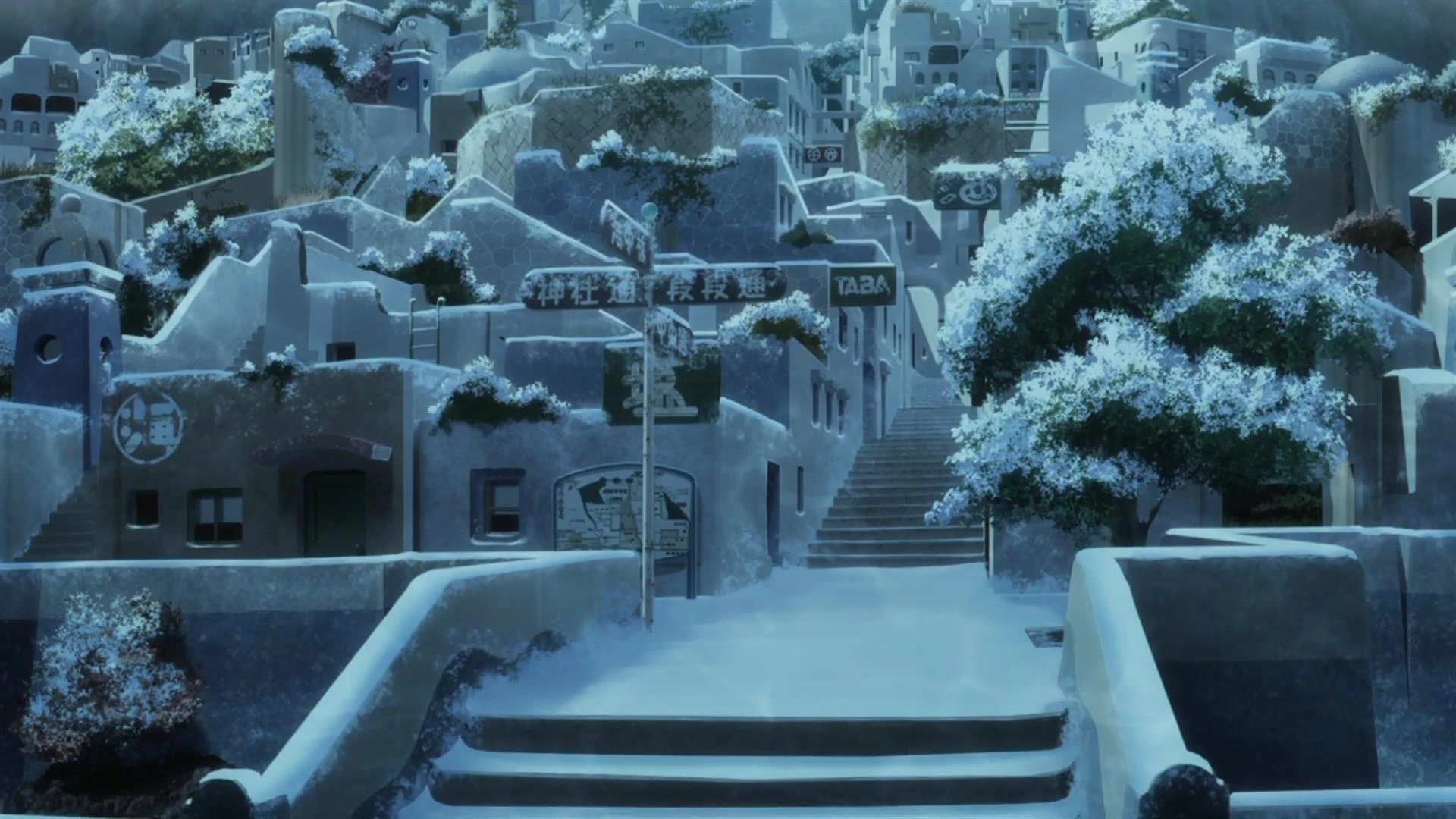
I will sacrifice all of my worldly possessions if I could live in Shioshishio for a year. In fact, Umigami, just take my soul. I’ll even be the Ojoshi-sama if it means visiting this dreamlike underwater village. Please, give me Ena ~

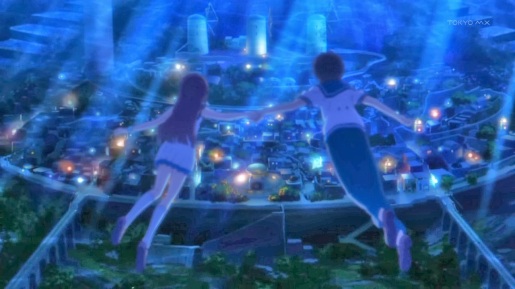
Shioshishio, the enchanting undersea village

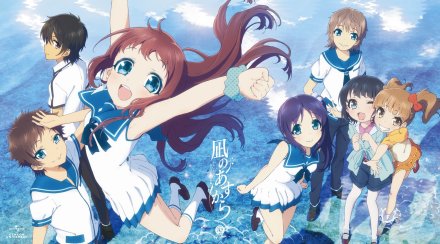
Since the dawn of humanity, civilization had lived on the ocean floor. As curiosity tugged at their legs (or fins), however, several humans migrated to the land, which caused a huge splintering in lifestyles. Upon their undersea school closing, Hikari, Manaka, Chisaki, and Kaname – four 14-year-old middle school kiddos – are forced to eke out education on land and adapt to the unfamiliar environment. They aren’t alone in terms of emotional struggle, though. Three surface kids – Tsumugu, Miyuna, and Sayu – must also confront their feelings before the whole lot grows older, and the rift between the sea and the land, old and young, tears the two parties apart.

It should become clear right off the bat that we’re dealing with seven individuals, which means in terms of coupling someone will be left out. As dramatic as that sounds, Nagi-Asu manages to keep a level head, never allowing said drama to grow out of hand nor become overbearing. That’s not to say that the show is lighthearted, though! Uh, no, it’s got just the right amount of spice, but in that way, has its own way of plucking your heart strings, and thankfully it doesn’t ever snap them. The anime incorporates themes of love by using slice-of-life tactics, and it overwhelmingly succeeds on this front.

See, love – it’s easy as Hikari loves Manaka, but Manaka falls in love with Tsumugu, though Chisaki might have a crush on Hikari, but Kaname is already in love with Chisaki, and . . .

Oh the water physics – don’t try to wrap your head around it. Just admire its subtle beauty and convenience . . . writing on paper, running around, boiling food on the ocean floor . . . What is this, SpongeBob!?

tumblr_mxsgh10THD1sax5fho4_500

But moreover, once the drama wave sinks back into the ocean, we are left with a story about innocent crab children crawling out of their shells to deliver their unrequited love to one another. Because the characters are so unexperienced with the notion, and have even grown up together in the local village, it’s vital to pay attention to each of their reactions to the sudden emotional turns taken in the series. Thankfully, the animation directors have a very keen eye for these delicate matters, and display facial expressions with such passion! Props to the VAs, too, for putting up equally impressive vocal performances, especially Hanae Natsuki’s youthful role as Hikari and Kana Hanazawa’s adorable Manaka!

Let’s talk about those characters now. I’ll admit, they’re a great, well-developed bunch, but the only one whom particularly snatched my attention was the main character himself, Hikari Sakishima. Born ‘n raised in the deep blue, he harbors a distinct hate towards the land people. Specifically speaking, he loathes the silent but strong Tsumugu for him loving his little Manaka – or rather, Manaka sneaking a peak at this dark-tanned land dweller. Underneath his layers of stubbornness, Hikari prematurely believed that he and Manaka were an assumed pairing. Manaka has other plans. Throughout the series, Hikari struggles with his passive relationship with his other friend, Chisaki, and we witness him grow from a boy to a man (kinda sorta, not physically at least :3)!

I have much to say about the art and animation, but it’d do you justice to simply marvel at the “environmental porn” surrounding the sea village itself and its sister harbor above. The animators always use the color blue. In fact, it’s in every frame of the series. Sharply contrasting the magnificent hue is orange, blue’s complementary color. Whether it be the rust on the boats moored at the dock or the land school’s uniforms, orange manages to cancel out blue’s magic. Not only is it smart cinematography, but the most effective. Nagi-Asu is truly is the prettiest anime series I have ever seen!

There’s only one word to describe this OST: Heart. It has a lot of heart. While lively guitar strums out the cheerful opening tone, fitting for the youthful boasts of Hikari, a bittersweet piano slides in to caress the emotional moments featured in the series. “Cry for the Moon,” “Tears of the Sea,” “Prayer,” “Solitude,” and “The Ofunehiki Song” are the best examples of this mood. I could listen to this soundtrack for hours on end, but then only feel depressed that I spent so much time out of the water’s embrace 🙂

To add to the praise, I must admit that both of Ray’s openings, “lull ~Soshite Bokura wa~” and “ebb and flow” are so incredibly fitting for the undersea atmosphere! They make me want to swim around in cool, clear waters with all of my friends. But we can’t forget “Aqua Terrarium” by Nagi Yanagi, the first ending, which depicts the cold, deep blue ocean floor with a frozen Manaka.

It would be a crime to not watch Nagi-Asu. The art is divine and animation of this quality is rare to come by! Always, the story kept me intrigued, and the romance between the characters tied the package all together! But I can’t help but regret the switch to the above ground in the second half, especially when they had so much going for them down where it was wetter. So much life; carefree days of youth. The surface is a bitter cold. Adults struggle to make a living, and kids don’t have as near wide of smiles as the Shioshishio squad. Growing up and realizing your feelings, whether they are for others or nature, was a deeply felt theme in the anime. However much I disliked the change, the two halves of the series were the twin tides that brought the message in the bottle to the salty shore; truthfully, both were needed.

“Having feelings for someone just brings sorrow to someone else. Someone always gets sacrificed and suffers. If this is what it means to fall in love . . . then falling in love is terrible.” – Hikari Sakishima

+ Story felt fresh; romance and drama were never too overbearing, but enough to convey true feelings of love

+ Characters were very well-developed and entertaining, notably Hikari and maybe Chisaki

+ Themes of old vs. young, love of people vs. nature were demonstrated with a content satisfaction

+ UNDER THE FREAKIN’ SEA, absolutely stellar art and consistent superior animation quality

+ A rich OST full of heart, appropriate instruments to enhance the mood

– Switch from underwater to above land was somewhat disappointing

– A few interfering elements to the story were ‘too’ supernatural

I have returned to anime reviews! Do you prefer this new format over the previous one? It’s a work in progress, but I’m trying to find a style I’m completely satisfied with. Did you have similar thoughts about this under-the-sea fantasy drama/rom-com? Different? For the café menu, Nagi-Asu receives a solid 9/10, and I strongly recommend you watch this show on Crunchyroll – and it’s free of all things, so no excuses! If you enjoyed the review, feel free to caress that like button like a red-bellied sea slug, as that’ll let me know if you like my content! Ah, how grand it feels to be back to these reviews ~ Until next time everyone, this has been

– Takuto, your host

ALDNOAH.ZERO Episodes 1-6 English Dub Thoughts

Konnichiwa, minna, today I’m here with a totally unscripted (script?) post regarding Aniplex of America’s [ridiculously overpriced] first volume of the sci-fi mecha drama anime about space wars, ALDNOAH.ZERO. Their first volume contains episodes 1-6 on DVD with an all-new English dub. Before we have a look at the cast, you can read my season one and two reviews for more background on the series by clicking on them and/or go watch the show yourself for free over on Crunchyroll!

You have no idea how long I’ve been waiting for a U.S. release of this show . . .

Art book available in the Limited Edition release.

Our main man Inaho Kaizuka is voiced by Max Mittelman. He’s fairly new to voice acting if I am correct, but he brings a fresh breath to the nearly-silent protagonist. Natsuki Hanae did a fine job, don’t get me wrong! But Mittelman uses a little more expression when he speaks, and that means all the world considering that Inaho acts like a pre-recorded message. So far so good!

The passionate drama bomb Slaine Troyard is voiced by Zach Aguilar, another newbie, I think. His intense breathing and airy voice try to compensate for Kensho Ono’s higher pitched, younger sound, but it’s still not as good as the Japanese dub. The acting was great, his voice was just too low. I should add that by episode 6, his voice really grew on me, and I just hope that in the second set he finally feels comfortable with his role.

Erika Harlacher does a fine job at capturing Princess Asseylum Vers Allusia‘s allure. Sometimes it sounds as if she’s holding back too much air, but I don’t know if that was an acting issue or the sound setup. Solid nevertheless.

Since those are the main three characters, I’ll just list the minors with a brief reaction:

Christina Vee as Rayet Areash – OMG it’s Homura Akemi *heavy breathing*

Erica Mendez as Inko Amifumi – She didn’t sound like Ryuko, but most definitely a rising star in voice acting

Bryce Papenbrook as Calm Craftman – Man, Papenbrook can pull off the best young “fiery” guy-friend voice ever, awesome!

Christine Marie Cabanos as Nina Klein – “Right or left or right or left or . . .” not too shabby, high voice matches character

Bobby Thong as Okisuke Mikuni – Gets sucked up in the first 5 minutes, good I guess

Erica Lindbeck as Yuki Kaizuka – She does a great older sister, like damn 😉

Matt Mercer as Lt. Marito – The last time I heard Mattew was actually in person at a con, so hehehe makes a good alcoholic

Ethan Murray as Soma Yagarai – Yep, he sounds like a doctor to me

Julie Ann Taylor as Darzana Magbaredge – She’s ironically missing that low edge like in the Japanese, but still a nice performance

Trina Loo as Kaoru Mizusaki – Not much to say here other than she’s Magbaredge’s b*tch

Sandy Fox as Eddelrittuo*gasps, shreeks* come here you tiny little cute puffy servant you, wait, you didn’t read that

Lex Lang as Count Cruhteo – Wow, we need this guy more often! So majestic, so bold

Kirk Thornton as Count Saazbaum – Another powerful voice, one of my favorites to listen to!

Todd Haberkorn as Trillram – YESSS WE NEED MORE SASSY HABERKORN

Patrick Seitz as Vlad – This and Trillram were probably the best rolls cast, that rich gurgly low voice is what more actors should strive for

Kyle McCarley as Kisaki Matsuribi – Very similar to Inaho’s boring dialect, only not as memorable

Lucien Dodge as Yutaro Tsumugi – I honestly didn’t realize how much of a pervert this character was until I watched this English dub *glasses gleam*

Alan Lee as Shigo Kakei – I mean, he’s a background character, what can you expect

Carrie Keranen as Countess Femieanne – It was racking my brain as I watched the whole episode, but then it dawned on me. ALL HAIL LADY SATSUKI! She’s also Mami Tomoe, which I didn’t realize. Fabulous acting!

Geoffrey Chalmers as Rayregalia Vers Rayvers – He nailed the old king voice for sure, well done

Below is the English Dub Trailer Aniplex posted a while back. See it for yourself!

And here is their cheesy little yet humerous English Cast Promotional video announcing their presence at the 2015 Anime Expo. Dorky as it was, it made me realize something: There are actually two heroes of the story; two different eyes to watch the show through. Remembering this makes me want to rewrite my reviews, or revisit the franchise in a future post because I enjoy it so much. 😀

As you can see, I am really pleased with how the English dub was executed! Besides Slaine’s slightly low voice, everyone else was pretty well cast. Now I have to wait until October for the second set to be released . . .  that’s an awful long wait 😦 I hope they decide to dub the second season, despite it’s disappointment, as I’d love to watch it all over again! I do think that the set is worth picking up for hardcore fans of the series, despite the DVD being $30 for only six episodes. It was so much fun watching an episode each night before I went to sleep . . and now it’s over. Thanks for reading this rather different post! Did you enjoy a step away from reviews? How do you think the A.Z English dub fares compared to the Japanese? Personally, I thought it was much better/easier to watch in English. Channel your thoughts to the comments below, and until next time, this has been

– Takuto, your host
Triumph! Sound the Euphonium!

A review of the 2015 spring anime “Sound! Euphonium”

I’ve been joined at the hip with music since a young age, and, having been a first-chair orchestra member for seven years and counting, I have not only the right but the responsibility to announce that this series exemplifies the hearts and minds of every concert band and orchestra member to T. Putting KyoAni’s ideal cuteness aside, Sound! Euphonium accurately depicts how rigorous classroom music can be when kids become critical of themselves.

Talented euphonium player  Kumiko Oumae enters Kitauji High School’s brass band club during her first year (‘Euph’: a “good sounding” small tenor-pitched tuba, sometimes referred to as a baritone). There, she encounters her old classmate Reina, and memories of a previous junior high incident flood back, causing Kumiko to be hesitant. As Kumiko remains strong buddies with other girls, though, Reina slowly opens up and the two become very close friends. Looming in the darkness is the national contest, which their meticulous new teacher, Taki-sensei, proposes to have the students decide for themselves whether or not they should pursue the gold.

Much like in real life, hours of practicing, enduring hardships, insanely challenging musical passages, kids who have talent that start to waver, competition among new and old recruits, wanting to drop out to focus on education and countless other issues bring a shining realism to the table – a characteristic that I haven’t sampled for a while now. From start to finish, the show knows exactly where it wants to go, and as much as I want to say it was the practical setting to thank, it’s because of the characters that this drive was so truthful.

Euphonium‘s cast does not rely on one or two characters, but rather the entire ensemble. Kumiko herself is strong-willed, though sometimes acts a little empty-headed, and her budding romance with the silent yet brilliant Reina is certainly our sweetest relationship. But there are several other duos that bring the issues listed earlier to light. The vigilant Asuka and occasionally sheepish Haruka tackle youth leadership with unsurety. The lackadaisical yet easy-going Nakagawa manages to keep Kumiko on her toes in terms of skill. Sub characters like the hot-headed Yuuko and gentle Kaori pose a nagging trouble to the professional Reina when they all duke it out for the trumpet solo. Seeing as how I play a string instrument, I was dying to hear more dilemmas from the only string player in the band: On the oversized contrabass everyone, Midori “Sapphire-chan” Kawashima! Too bad she only existed to cheer on the other girls 😦

I was overly pleased with what the anime had in terms of cast, as nearly each member of the band, major and minor, received standout character designs and individual thoughts and scenes. Having Taki-sensei  as a rather disoriented teacher also made situations more ambiguous. For instance, he’d ask “Are you having trouble with that?” Then instead of following up, Taki would declare, “Please have that ready by next week.” There were just certain aspects to his character that made me want to cuss, but then he would return on scene with a heartwarming smile and encouraging speech, kinda how a real director would.

If I had to pick something about the plot that seemed off, it would be the sudden love interest and misplaced drama. In the first few episodes, we clearly see that things between Reina and Kumiko are really awkward. After climbing a mountain trail path in a certain middle episode, however, POOF! The two become super intense friends – for some, too close for comfort. It’s not really yuri, but you could ship the two by just looking at the poster art now.

The non-music drama stems from a miniscule love triangle between Kumiko, an energetic girl pal Hazuki and Tsukamoto, Kumiko’s childhood friend. Seeing how Tsukamoto only cares for Kumiko, who feels indifferent, Hazuki becomes a forced trope just to milk some sort of depressing drama out of the whole shebang, not that the show already played perfectly fine without it. But like the sudden love, it’s all only one episode, so it can easily be overlooked.

I KID YOU NOT when I claim that Kyoto Animation performs their finest job I’ve ever seen from them in terms of animation!! All of the shining brass instrumets, the natural movement of people breathing during practice, the beautiful people themselves, and that side-of-the-river bridge where Kumiko always goes to chat and play the euphonium – it’s all so soooo gorgeous; a true crime not to watch the opening at least once to get a glimpse of BREATHTAKING EVERYTHING!!

The OST is also remarkable! Orchestra tagged along with a piano for melody hits up feels from slice of life to cliff sunsets to tension in the classroom . “Flow of Destiny,” the simplest variation of the main theme can be elegantly heard throughout the series. Real classical music is also pulled into the soundtrack for during performances and practices. Especially noted is Reina’s ditty of the “From the New World Symphony’s 2nd Movement,” which everyone stopped to listen to. 🙂

Hitting off each note is the exciting opening “DREAM SOLISTER” by TRUE! I love the inclusion of the brass instruments – it makes the song coherent to a show about a brass club, ya know? The ending “Tutti” by the Kitauji Quartet is also tons of foot-tappin’ fun!

In terms of character interaction, the featuring of the entire class as a whole and as individuals, stunning animation, topnotch voice acting, realistic musical presentation and content, Sound! Euphonium did several things right and executes everything with near perfection! The ending is also standing ovation-worthy for including the uncut concert performance rather than just cutting that out to view the results. Concert band and orchestra kids were given the best representation in anime – for most, more than what we could ever ask for. 5/5 stars, a triumphant “Caffé Mocha!” Congrats, Kitauji High School Band – You most definitely deserve the Gold in my eyes!!

+ Relatable and realistic anime for high school band and orchestra classes (or at least some); best representation anime has given us students

+ Themes of hard work VS raw talent are executed quite well

+ Absolutely breathtaking visuals, instruments look excellent, actual music is awesome, too

+ Story knows exactly where it’s headed, and delivers with a triumphant, satisfying end

– Sudden romantic relationship drama unnecessarily threw plot off course, though only for an episode

Thank you for reading my review over the wonderful Sound! Euphonium! It was definitely one of the most fun and fulfilling shows to follow this past spring. Did you have similar thoughts on this show? Were you as impacted as I was? Leave your comments below so that we can chat! Now while the inspiration is hot, I’m gonna go work hard myself and practice my cello! Haha, until next time, this has been

– Takuto, your host

From the New World Review

I always used to think that sci-fi was robots, high-tech cities, and people in black suits shooting guns at other people in black suits. Flying cars, neon lights, and stainless steel, right? Well I’m not all wrong, but I’m certainly not right, as here is Shinsekai Yori (From the New World), a psychological mystery drama that uses themes from the supernatural and the occult to create – yep, you got it – a science fiction anime. Prepare to abandon all sense of worldliness and jump into your traditional Japanese village, where, for some reason, something doesn’t feel quite right . . .

Unknown apocalyptic events have passed which destroyed most of the world. Taking place 1,000 years in the future, we are met with a small Japanese village of humans that have supernatural, psychic Power. Two Committees maintain peace and judgment: Ethics and Education. On the surface, they are the ones maintaining this masterful, humble utopia, but these Committees actually regulate information and manipulate reality in the village. Whether it’s by “banishing” troublesome individuals or even subverting one’s own memories, they will risk any and everything to maintain order.

There’s always this dangerous aura that spurs from the setting, making each and every day in class risky. Adventures outside of the village barrier, which no one is allowed to leave, are hazardous, yes, but exhilarating and unknowing. As far as you know, everything outside the gates is desolate and menacing. Rules upon rules established by the Ethics and Education Committees allow for “thinking in the box only,” and actions that go against these authoritative groups warrant unimaginable punishment. Thus, the theme proven most effective to preserving protection in the village is to use FEAR as a means to influence and control the youth. Well done, From the New World.

Our actual story centers around Saki and her four friends: Satoru, Shun, Mamoru and Maria. We witness the development of their Powers in school (some more than others) and the truths of the real world outside the village. From child to teen to young adult – innocence to rebellion to experienced –  we follow five youths that will inspire the drive for hopeful future of change.

What’s obviously the best part of this anime is the particular care that went into telling a great story. It seems that at all times, we are shown only what we need to be seen for the time being, much like a novel, filling holes and uncovering twists at the end of each chapter. Speaking of, the show was based on “Shinsekai Yori,” a Japanese novel by Yusuke Kishi. That’s right, not a light novel, not manga, a “book” book. That explains why the anime feels like something all teachers would make their kids read. It requires that kind of technical thinking.

But it’s not all smooth sailing – no – because like books, each “chapter” of the characters’ lives begins so painfully slow. Told from Saki as the narrator flashing back on the events, the time skips include life at ages 12, 14, 26, and 36. The pace only picks up towards the end of each arc when they decide to info dump us, a reoccurring problem.

Another issue I had with the show was actually the Powers. To what is their extent?? Levitation (of body and objects including giant rocks), pyrokinesis, the ability to reassemble glass, drawing with the mind, creating reflective surfaces out of nothing – seriously! What can they not do? I understand that each person has some sort of practice unique to them, but still, with all things considered, I feel that they could at least be living in a city with their powers rather than some weird collection of occult shanties (no offense). Also, they cannot kill another human due to the “Death of Shame,” a genetic trait which causes them to die instantaneously if they use their powers to kill another . . . umm, I guess it’s conventional, but that’s it.

The characters are developed well enough to identify definite progression since episode one, especially Saki and Satoru, but that development comes with discovering the events that led up to present-day. Well, that and the Monster Rats, humanoid mutant rats that live in colonies and obey the psychic people like gods.

In fact, the most interesting character in the entire series is a Monster Rat known as Squealer, a helper of Saki and Satoru in their early days outside the barrier. I literally can’t say anything due to spoiler’s sake, but do keep an eye on this creepy fellow – he performs some very very commendable acts as a main character . . . some wicked, Machiavellian acts we’ve all seen sometime before . . .

I found the animation by A1-Pictures to be gorgeous: soft sunrises, intense sunsets, luscious forests, and beautiful character designs. While it contributed to the atmosphere of the show marvelously, including the vast difference between the village and “Tokyo,” it’s not 100% satisfaction.

Apparently there was a change in staff when it came to design work and animation around earlier/mid episodes that fluctuated between two totally unlike styles – neither of which were bad, just noticeably different. Another weak point was the Monster Rat Colony fight scenes. The boulders are so CG and glaringly horrendous that I just laughed the whole time!

Sound-wise, hair-raising tracks boost the suspense and inevitable horror. In contrast, subtle adventurous songs for exploring helped establish various moods. A standing ovation, however, goes to “Ienikaeru (Going Home),” which is actually composed by Dvorak and coincidently, from the 2nd Movement (Largo) of the “From the New World” Symphony. Being a classical nut, this tune as the evening “children, return home” theme that plays over speakers in the village completely through me off. One of my all time favorite classical works, on the verge of tears when this played at the end 😥

Oh yeah, Yuki Kaji’s freaking awesome as always, performing the role of Satoru with such strong conviction and youthful stress. Always great to listen to him!

One of the biggest reasons I love From the New World is because it reminds me sooo much of No.6, another one of my first anime that I hold to heart. Soundtrack, dystopia, youth, romance, suspense, thriller, science fiction – it’s got it all, too, but this anime did what No.6 didn’t, and that was deliver with a fulfilling ending. I never, ever got closure from watching that anime a couple of years back, no matter how much I searched for “anime like No.6.” I can finally rest easy.

Despite being just a science fiction story, this anime feels more scary real than anything else I’ve encountered in a long while, and that could be because of its realistic characters and their actions. Its analysis of the human condition through a dark, manipulative plotline adds so much depth and curiosity that you’ll be guessing until that last episode, but no more than that. Why? Because by the end of the show, From the New World does not get very far at all, but it paves the way to a more hopeful future instead, and after all of the wrong, disturbing, and twisted carnage that I bore witness to, I could not ask for more than that.

“We have to change our way of thinking if we really want to change the future.” – Watanabe Saki

+ Mastered storytelling, made gripping and curious until the very end

+ Incorporation of “Going Home” really made the mood shine

+ Thriller tone so realistic like nothing I’ve seen in a long time; fresh, clean slate after viewing

+ Satisfying ending that delivers justice to the show

– Brief animation issues

– Info dumping in the beginning/middle of each new arc made for rugged understanding

Wow, this anime was so hard to talk about! It’s such a beautiful story that you should defiantly check it out. It’s not for everyone, but for those seeking something completely different than the norm and/or are wanting a clean slate by the end, you can watch the whole thing on Crunchyroll for FREE! Thanks so much for reading my emotional report over From the New World, and in fact, thanks world for the joyous experience! Beware the Trickster Cat, and until next time, this has been

– Takuto, your host
ALDNOAH.ZERO 2nd Season

One of the most controversial anime to come out these past couple of seasons finally comes to a close. But who comes out on top? Slaine fans get “Slained” and you Inaho dogs, just sit there and don’t smile. Nah, I’m just kidding! Caution: Spoilers for both seasons are present!

Picking up from the first half’s suspenseful ending, silent protagonist Inaho undergoes a surgery that connects some sort of calculating machine into his shot eye. No. He’s not dead, but the thing’s pretty cool. The Deucalion suits up for battle, and while the Terrans celebrate their temporary “victory” / prepare for any Martian activity, the Martians step up their game.

As Slaine, the Terran-born Vers soldier accompanies Count Saazbaum, who seeks revenge on Earth, an “accident” occurs and Saazbaum is killed. In an attempt to restore the Vers Empire and reclaim the blue planet, Slaine ascends to Count status and primitively the throne with a new gal who literally came out of NOWHERE, wheel-chair-bound, lavender-haired Princess Lemrina.

Rather than stand by twiddling their thumbs, the Terrans take the fight to the Martians, and an all-out space war rages! But the fate of the two races ultimately resides in Princess Asseylum Vers Allusia, whose preserved body in Martian Custody slowly reawakens . . . a bullet to the brain and she didn’t die either. Damn.

I’ll admit – I really enjoyed the first season, especially the end. Sure the plot and characters went downhill after the first 6 or so episodes, but it kept me thrilled to see what would happen next.

Season two is a bit different, however. First the pros. The show starts stronger than ever before with the inclusion of Asseylum’s sister Lemrina was probably one of the series’ best moves. While my favorite moments in the first season were obviously the glamorous, high-energy robot battles, season two’s were the drama talks among the Martian hierarchy. The manipulative Lemrina is an essential part of Slaine’s motive for justice, for she can change her appearance to mirror Seylum’s, masking any idea that Seylum had died. In turn, she is a thorn in his side, desiring his affection and secretly wishing that she could replace her comatose sister for good. Though these additions couldn’t save the series in the end, the spicy and dramatic relationships really turned up the emotional dial for this sequel – I only wish I could’ve see more of Lemrina.

Now the cons. The plot is an obvious wreck. Poor pacing, bad balance of characters, and a much different (lesser) tone than the first half resulted in a LACKLUSTER ENDING. Seriously, after two seasons of killer alien robots and explosive combat and emotions – no one died. Not even any of Inaho’s friends took the fall. I’m not saying that death is a good thing in anime; it’s simply that ALDNOAH.ZERO went through a lot of trouble and no one bit the bullet.

Overall, season two values a softer and more emotional approach to a very different story. While the franchise still retains its innumerable plot holes, lacks proper character attention, and frankly sh*ts on its own design, A.Z is still passes as a decent tragedy.

Characters, what’s to say? The sequel drops any supporting Terrans, so you can all forget about Inaho’s friends. Well, maybe besides Inko and his sis. That Marito guy doesn’t even get any follow up to his problems, whatever they were. Just poor balance of characters.

More of the Martian counts are introduced as distinct personalities, which ties back to one of the greater things this sinking ship of a show offered. Their intense qualms regarding loyalty to the almighty dick Slaine made for more interesting views.

Inaho is still pretty meh. He still swoops in to take out the Counts, calibrating all of their weaknesses and eliminating them in the last second. His eye causes him suffering, but he endures the pain for the computer’s benefits. One part of the show really startled me, and that was the smooth transition from Inaho to the eye “talking” to Seylum. Supposedly, the eye grew a consciousness of its own or something cause it carried out Inaho’s last words to the Princess. Just goes to confirm Inaho is nearly no different than a robot, cause I hardly noticed the shift in dialogue – and they even stated it.

It felt really weird when Asseylum woke up from her coma, as if Lemrina’s whole world came crashing down on her – and it kinda did. Too bad Asseylum wasn’t as near as complex as Lemrina, for she remained the same old boring, dutiful Princess. However, she grew some balls in the end and surprised everyone. When that happened, A.Z woke up from its nightmare and ended things right then and there.

Slaine was by far the most developed, but that wasn’t necessarily a good thing. He went from being an obedient servant of the Vers monarchy to a stubborn, stuck up b*tch. I guess it proves once again the power is greed trope. I can distinctly recall him saying that he had pretty much started down the road to hell, and that there was no turning back. His decisions make absolutely no sense; he does retarded stuff, and in the end gets blamed for everything that happened. Humanity will remember that the whole war was because of him. Like . . . wut?

A-1 Pictures’ animation didn’t drop in quality whatsoever. It’s still pretty solid, so if you’re one for the Kataphrakt CGI fights, then you’ll be satisfied. Characters are colored in lighter tints to contrast the black nothingness of space. I love the characters and their expressions! Also, the Martian Kataphrakts are freakin’ cool, even if their design makes little to no sense.

The OP “&Z” by SawanoHiroyuki[nZk]:mizuki mirrors the softer appeal the anime presents while the ED “GENESIS” by Eir Aoi, to me, captures the downfall of Slaine and the ultimate tragedy of the show. Beautiful.

Hiroyuki Sawano continues to impress with touching, somber piano solos and full orchestra tracks. Though the small OST is repeated over and over again to where you can predict what song will play next, the tracks are still great, supporting the mood admirably. His attempt to milk what he could out of A.Z wasn’t in vain; there are several touching moments centered around Slaine, Asseylum, Inaho and Lemrina that were particularly beautiful despite their relevance to the plot.

If you watched ALDNOAH.ZERO’s first season, then go ahead if you haven’t already and finish this thing off. To others, I would avoid this franchise in general for its inconsistent plot, poor distribution of character development, and at times nonsensical scheming. The show is not bad, it’s just messy, and I would only watch it if you are searching for high-energy, well-animated, robot space combat or political drama, though do realize that that part eventually goes down the drain. I’m glad ALDNOAH.ZERO is over. It’s just a shame that the writers couldn’t learn from their mistakes – the show had A LOT of potential.

I guess that’s it. THE ANIME DOESN’T END HORRIBLY WHATSOEVER. If you watched A.Z, please leave a comment below with any of your thoughts. I’m a bit lost when it comes to this show. If you had similar musings, hit the like button for more anime reviews. Until next time, this has been

– Takuto, your host

Yona of the Dawn Review

Late into the simulcast season I decided to pick this one up and boy did I make the right decision! Today, let’s dive into the soft and beautiful world of “Akatsuki no Yona: The Girl Standing in The Blush of Dawn.”

Sheltered yet joyful Princess Yona was having a great day. Her birthday was right around the corner, and the love of her life, the charming Soo-won, was visiting the Kohka Kingdom. Before she could tell her gentle father the king of her unrequited love, however, she witnesses the man she loves sinking a knife into the king’s chest – her father was assassinated. Confused, upset, and torn apart by the dreadful betrayal, the red-haired Princess Yona flees the palace with her loyal servant Hak.

On her journey to renew the kingdom by befriending the four dragons, AKA beautiful boys, she realizes that while the late king prohibited violence, there were many who were suffering during this time. Yona finds the determination to protect her people, taking up the sword and bow with unwavering spirit.

Here’s the interesting bit though: While the cunning Soo-won brutally killed Yona’s father, he did so to protect the kingdom. Sure he is labeled as the “antagonist,” but his motives might be more pure than we think, as he pops in and out of the story curing the problems of villagers and rekindling the kingdom’s faith . . .

Yona of the Dawn follows a simple premise. Find the four dragons, stop the new king, and save the world. Fans of Avatar: The Last Airbender or Tales of Symphonia might enjoy Yona for its traditional journey setting, though it’s not as near as grand.

Other than its somewhat boring and overused plot, another beef I have with this show was the unsatisfactory ending. If a season two is confirmed, then I immediately withdraw this complaint. Otherwise, it’s ultimately a prologue for something magnificent. “As the heroes, now all assembled, stand by the cliff’s edge with weapons in hand, the king’s army appears on the horizon” – kind of ending. Seriously, the last dragon boy is introduced in the final episode . . . there better be a sequel.

Princess Yona is a beautifully dynamic character. She starts off as the typical fragile, pampered princess but gradually develops into a fierce and brave fighter – one to be feared! I thought Yona would be plain at first, but heck no – she’s on FIRE! Such a great independent girl woman.

Her smartass companion Hak is a badass, too. Swingin’ his glaive around, knocking down enemies left and right, he also harbors a very intimate side with Yona . . . it’s almost as if he can’t hold it back . . . but that’s more to follow up with in the hopeful second season.

Young “protector” of the clumsy oracle is Yun, one of the more invest-worthy characters in the series. Standing as a child who grew up during the late King II’s weak reign, Yun was hit the hardest during these poor times. Flash forward to the present and the acclaimed “bishonen” speaks with sass and a quick-temper. His growth continues as he crosses paths with royalty in the form of the Princess, whom he despises at first, but grows to love more than anyone else. :3

The charming dragon boys + Hak and Yun remind me so much of the Host Club from Ouran High School Host Club. Their conversations with each other are quirky and comical, yet they also have fantastic solo moments and tragic stories. Though these lovable dudes don’t live up to Ouran’s standards, they’re still pretty fun to watch! Heads up that the jokes are pretty stale. Just saying.

The art is pretty decent. Combat scenes are done smoothly and character designs are ornate. Specifically speaking, the animation used for Yona’s flowing red hair contrasts brilliantly with the background. Add that with her angry violet eyes and you literally have the dawn striking your heart.

The OST supports the theme of the anime immensely. The first opening and main theme “Akatsuki no Yona” by Ryo Kunihiko is SOOOOO TRADITIONAL AND GORGEOUS. Second OP, “Akatsuki no Hana” by Cyntia is a bit spunkier, complimenting the action and twists driving the show. To calm down is “Akatsuki” by Akiko Shikata (one of my fav artists), reflects the oriental atmosphere. Great songs!

Yona of the Dawn starts off a bit slow, but grows into an adventurous drama about a girl reclaiming her torn-apart kingdom. The varying characters help to lighten the mood, but sometimes their constant antics ruin serious moments. It’s a give-and-take gimmick, but otherwise, they make you chuckle. 😀

Yona of the Dawn offers enjoyable characters and a heartwarming story. I only wish the adventure would continue, and I have a strong feeling it will. This anime is a hidden pleasure, giving you all kinds of feels and wrapping up everything nicely; no noticeable plot holes besides a necessary continuation of this goddamn beauty! Shojo or reverse harem fans, go Yona of the Dawn. It takes a bit to get its motor started, but after that it’s pure satisfaction. Even if you don’t care for the more shojo bits, there are plenty of great sword fights and a very original second half in store!

“I am the proud princess of Kouka Kingdom, so I should not complain but do something about it myself.” – Yona

This review was a bit shorter than my usual ones, but there’s not much else to say! I can’t wait for a home video release by FUNimation. Thanks for reading and slice that like button to pieces if you liked my review (LOL)! Until next time, this has been

– Takuto, your host

In Search of the Lost Future Review

Also known by its French name, À la recherche du futur perdu, I’m a fan of every word in this anime title. This show is an adaptation of the original Japanese adult visual novel developed by Trumple, and unfortunately does not include the spicier eroge scenes. Yeah I know – that’s horrible! But let’s continue reading, shall we?

Public school Uchihama Academy is growing too large in student population to support itself and thus requires a new building to be built. In honor of its last standing year, a General Club Festival will be held in the old building. As the many excited clubs begin to prepare for their festival, rumored sightings of ghosts spread quickly, and the student executive committee asks the astronomy club to return order amongst the student body. While cleaning out their club room’s second floor, dedicated member Sou Akiyama discovers something that would change his future forever – or rather, someone – as lying unconscious before him is a naked/wet girl named Yui Furukawa, and guys, she ain’t on the roster.

Besides that promising episode one, the first half of the anime is spent on trivial filler, such as skipping class “for fun,” going on dates at the bowling alley and of course, working hard for the astronomy club’s participation in the festival.

But all of that is helpless character development. If the show really wanted to build quick attachments to characters before sh*t got real, then the writers shouldn’t have opened up with the same old stereotypical hogwash. Those first five episodes are sheer boredom and ultimately pointless to the plot. I was gonna drop this series . . .

Until the last few came, then I was semi-glad I didn’t pitch this show along with TRINITY SEVEN. Time travel, artificial intelligence, quantum turing and wait, Schrödinger’s Cat? From like episode 7 and on, a dash of Steins;Gate tries to patch up this lackluster fail of a plot, only to fall short with another two episodes of filler.

Because of the second half, I have more love for the characters. At first, only Nagisa Hanamiya proved worthy of time mainly because you could tell the short yet sassy third-year was hiding something. She kept watchful eye of a mysterious black glowing box, too . . .

Then I connected with the wise Airi Hasekura: Sou’s close friend, club president, aikido learner, and future scientist. She is easily appealing compared to the rest of the cast, especially when we learn of the “lost future” of the female lead, Kaori Sasaki, some schmo we were supposed fall in love with.

Speaking of leads, the main characters, Sou, Kaori and Yui, the transfer, are all bland characters. They perform their cutout task and then yeah, that’s it. At least the supporting characters had depth and a sense of fondness.

Oh gawd, the animation by Feel is so attractive – at freeze frame, that is. The moment characters are put into motion, be it walking around the room or running, things just look choppy. In some scenes, characters even lack their original detail – it’s as if the animators had to warm up each day when working on scenes, some being breathtaking while the majority standing as unfinished.

The soundtrack tries to patch up empty space, only having one worthy dramatic track, and thus only assists the show. There’s nothing new going on here, but hey – it isn’t bad by any means.

“Le jour” (“The Day”), the opening sung by Satomi Satō harbors a thrilling sense of mysteriousness and tragedy. It sounds like rejuvenation yet at the same time sings of loss. While “Le jour” is an absolutely beautiful song, its visuals appear to still be in the works as the show progresses. In episode one, the opening is just full of cheap still frames, but by episode 12, includes smooth and powerful visuals of the characters and stars. Yeah. Well at least it got better over the series, right? o_o

The ending song is “Ashita Mata Aeru yo ne” (“We’ll Meet Again Tomorrow, Right?”) sung by Kaori Sasaki (Hatsumi Takada) and Yui Furukawa (Akane Tomonaga). Yet another lovely song that I’ll probably end up downloading – somehow 😉

In Search of the Lost Future follows in time travel’s conundrum and questions as to whether going back over, and over, and over again is worth the hardship and patience. In all artistic and presentation sense, I’m positively sure that the franchise has one of the best visual novels ever made. However as an anime, the adaptation is quite lacking in all departments. Emotionally, the show has a pleasant ending, but it’s not worth all of the headache and disappointment to meet those tears of joy. “We pass by much today, and someday will change our fate.”

Thanks for reading and be sure to hit that like button (you can follow for more reviews, too!) if you enjoyed my thoughts over the 2014 Fall season’s In Search of the Lost Future. I may return to revise this review if FUNimation proceeds to dub this anime, but until next time, this has been

– Takuto, your host
Oreimo 2 (season two) Review

Of course I had to continue with Oreimo 2 because the first season was so eccentric! If you haven’t already, check out my anime review of Oreimo (season one) for a better reinstating of the plot. Also, watch the first season before you read this, as a spoiler or two might be present in this review.

Following Kirino’s departure to America in season one (OVAs), the sequel picks back up on the average life of Kyousuke Kousaka. When the older brother demands his sister’s return, even traveling all the way to America himself to do so, things between the two begin to break apart again. After all of the work in season one Kirino still seems just as tsundere as ever. Drama rears its ugly head, however, when Kuroneko, Ayase, Kirino and the rest reveal their mixed feelings for our bumbling brother. The story goes from otaku culture in society to relationships with siblings and others.

This second season crushes the majority of the characters by turning them on their own heads. Specifically speaking, the hot-headed and sophisticated Ayase is no longer that. Do you recall the moments when she detested Kyousuke, eroge, and everything else that he was involved in? How about the episodes of time where she would yell at Kyousuke and even Kirino just to try to cleanse Kirino of her hobbies? That signature kick that she would deal upon him when he was against Ayase – well, that’s still here, but anyway, the series suddenly turns her into an active yandere without even a second thought. She was one of the few serious characters, now diminished to a lover and a dreamer. A shame.

Kirino remains true to her tsundere influenced setup. In fact, she still gets mad at Kyousuke, yells at him, and then kicks his door. I love Kirino as a character; even in this second season, she realizes the bad things she does and tries to take care of it, though this usually fails and then gets cleared up by Kyousuke. She’s just a teenage girl – she makes mistakes but grows through them. The only difference in her mood is that towards the end, she somewhat realizes her love and dependence on Kyousuke. It’s weird and strays away from the original plot, but touching nonetheless. After watching the strange ending, I now understand Kirino and Kyousuke as characters much more than before.

If you liked Kuroneko, Saori, and Manami, you’ll be pleased to know that they have improved. Kuroneko gets her own little arc with Kyousuke, but I found it less right than him and Kirino. Kuroneko and Kyousuke didn’t go well together; I couldn’t feel the connection between them like I did with his sister, and I know it’s “wrong” to say that. Saori receives a nice embellishment with her sister and her past, which many people skip by, but I found those episodes to be more enjoyable than the entire Kuroneko arc – and that’s saying something!

Enough about characters. The soundtrack is pretty much the same quirky OSTs as last season. Some new tracks are added to the romantic moments, though. The opening, which I can’t even remember, is just another J-pop song. Yeah it’s fine, but nothing I can recall.

Animation has improved. And saying that the quality before was fine, this was even more enjoyable. I like the concept art of Kirino and the other girls’ characters. They are soft, yet gorgeous and just overall well presented.

Oreimo 2 is a very good anime; it just fails to deliver as a sequel to an amazing first season. This season drops most of the otaku acts and focuses on forced cliché relationships. I guess if you love drama, then here you go, but I watch this particular anime for the struggles of otaku life and comedy – Oreimo is not a serious show, so why should it start being so now? For people who followed the first season, feel free to watch the sequel, just know that it’ll break your views of the interesting characters we encouraged for the previous twelve lovely episodes.

And with that, I conclude my overall thoughts Oreimo – My Little Sister Can’t Be This Cute! Currently, though I do not own a copy of the series, you can watch it for free over at Crunchyroll, but you can also slide on over to my place because “The only one I sexually harass is you!” – Kyousuke

Hehe, if you found this review at all helpful or interesting, go ahead and slap dat like button. You know you want to. 😉

– Takuto, your host

selector infected WIXOSS Review

Black*Rock Shooter + Yu-Gi-Oh + Puella Magi Madoka Magica. That’s all I’m gonna say.

A popular teen card game called WIXOSS carries a dark secret. LRIG cards (girl backwards – honestly took me a while) are rumored cards that contain the live consciousness of girls, and those females who obtain an LRIG are known as Selectors. When drawn into battle, Selectors face off against each other in another land, aggressively trying to win enough victories to have their wishes invoked by their LRIG. When Ruko Kominato gets infected by “Tama,” a cute yet battle-driven LRIG, she is tossed into the dark and twisted lies of the Selectors’ game. She’s good at first, but what happens when you lose . . .

Do not be dismayed by the fact that the show is based on a card game. I feel that that was the turnoff that makes this show less well-liked or popular. The rules to the game occur in a simple pattern that needs no explanation, so you can sit back and relax, that is to say, on the edge of your seat >.< Instead of trying to grasp the workings of the game, just watch the show – the game is just a way to convey the dark plot (not gonna spoil), making the kids think it’s just a harmless teen card battle. That aside, the plot of selector infected WIXOSS is somewhat to understand, gripping, and tragic. Heads up on Hitoe, though, as she makes the whole thing confusing by the end.

Pick a color of the basic rainbow and that’s how many characters there are. Literally, each character has that one attribute that makes them so generic. Sure, they all have their quirks that make me feel bad for them, and it sure sucks to be them, but I feel it was done better in other anime (see top). Ruko, however, acts as a white sheet of paper, being drawn on by the other characters until it’s hard to make out who she is. At the beginning, she has one mindset, but by the end, boy, she rounded out very nicely! The only other character I thoroughly enjoyed was Akira. I LOVE CRAZY characters! They are unpredictably creepy and enforce amazing plot twists. Akira was no exception to my standards.

The animation, done by J.C.Staff (A Certain Scientific Railgun and many others) was, well, bland. I know the atmosphere that they were going for was dreary like a rainy day, but did it need to be like that all the time? The only interesting scenes were when battles went down. I love the darkness that swells around the girls in the mysterious world.

Sound-wise was also kinda dim. The OST had no stunning tracks whatsoever, but the mood was never lost. The opening, “killy killy JOKER” by Kanon Wakeshima is amazing though! I play the cello, so I definitely know quality tone when I hear it, and man, I heard it. Give it a listen; it is the essence of the show. Also noteworthy is the ending, “REALIZE – Yume no Matsu Basho” by Cyua. Really amazing OP and ED this time around.

So with so-so animation, soundtrack, and characters, is the anime worth watching? Actually, yes. Pacing is well thought out, so getting bored doesn’t happen often. If you want to see what happens when dreams turn corrupt or want a thought-provoking battle of emotions and desires, then this is the show. It’s sorrowful, tragic, and sweet. The thing is, this core idea is not new. Watch Puella Magi Madoka Magica and you’ll see the many similarities the shows have (PMMM is much better). Finally, the ending is like really really  awesome for a first season. A real game changer. I had a decent good time watching it. “Tama, GROWWW!!”

I hope this review sparked any interest in watching selector infected WIXOSS. You can watch the full series over at FUNimation.com. If you enjoyed this review, give it a like! I’d appreciate it :3 Until next time, this has been

– Takuto, your host