Sword Art Online II (Phantom Bullet) Review

It’s funny that I do this review before the prequel, but it’s been a while since I’ve seen the first season and I didn’t want to half-ass a review. Enjoy ~

It’s been one year since Kirito escaped the deadly game that is Sword Art Online. Meanwhile, ALfheim Online has gained much popularity, for it serves as a peaceful outlet for Kirito and his friends to escape from real world troubles.

Evil doesn’t die so easily, though. Roaming around another famous VRMMORPG by the name of “Gun Gale Online” (GGO) is “Death Gun,” a cloaked man rumored to kill individuals in real life through the game’s avatars. Kirito once again risks life and limb through virtual means to apprehend the mysterious assassin, but he’s not alone – the best sniper in the game, Sinon, with her highly destructive PGM Ultima Ratio Hecate II, proves worthy of battle herself in this world of guns. As the world tournament Bullet of Bullets commences, Sinon, Kirito, saber in hand, and Death Gun enter the arena among many other foes, guns locked and loaded.

After the events of last series, SAO had a little repairing to do, and GGO was the best tool to do so. This arc in the light novel series by Reki Kawahara made up for the lack of action and strength in the first season’s Fairy Dance arc. Phantom Bullet reminds us of the quality characters and themes that the SAO series was famous for; a powerful sequel that matches the strong will and survival feel of the first arc, Aincrad. Sword Art Online II is engaging and thrillingly eerie through to the end of the arc.

Kirito logs into GGO as a . . . girl? Yep, and it’s just great. His particular model possesses long dark hair, and his breastplate, well, yeah, adds emphasis. While he continues his unwavering badass style, he crumbles when he finds out that Death Gun must be a member of the “Laughing Coffin” guild, a player-killing group from SAO. The vibe from the first season returns as Kirito realizes that he could actually die in this harsh, cold, foreign world. He starts to recall haunting memories of the PK-ing he committed himself when fending off the Laughing Coffin members. This new revelation builds on past his one dimensional superb fighting skills.

Asada Shino is weak, quiet, and had shot someone when she was very young, and that terrifies her. She can’t even hold a weapon without trembling and then vomiting. But in GGO – a virtual world, she’s not actually killing anyone, so she masks her fears through Sinon, the cerulean-haired, lime-armored heroine. In the gun world, she’s stronger, faster – better. She doesn’t have to worry anymore, because Sinon protects her and fights for her. Sinon puts a new spin on “the will to fight” that makes her my favorite character. When she meets Kirito, she thinks they are both girls, and acts in a friendly manner, but quickly goes tsundere when she finds out the truth.

Kirito and Sinon balance each other out very well – I couldn’t have asked for better pairing besides maybe Asuna, who supports Kirigaya Kazuto on the other side of the amusphere. Sinon does, however, fall to Kirito’s irresistible charm when she becomes weak, but hey, that’s just her real-world self breaking through, not a whole new and sudden change.

I would tell anyone to watch SAO for the character costume designs alone because holy sh*t this is where it’s at! Match these colorfully crafty armor and weapon designs with fluid visuals pumped with action and A-1 Pictures really has something going on! As mentioned previously, there are many more battle scenes in this sequel, and quality never dipped once. The landscape of GGO is give a desolate color palette to that of a ruined desert city. Graphically and artistically, the anime does take me to the mature and virtual world of GGO.

Yuki Kajiura adds to this unique universe by providing an adventurous soundtrack. There’s not really much to say, as it is still just as amazing as the first season’s. She did, however, take the “Survive the Swordland” track, the epic main theme, put it on flute, and up the tempo to add a new sense of glory to the Kirito and Sinon action. Nice 🙂

While the opening “Ignite” by Eir Aoi was befitting for a show with this quality of animation, the true delight is in the lovely ending, “Startear” by Luna Haruna. It features Asada Shino young and old along with her avatar, Sinon, providing a reminiscent feel of childhood and maturation.

Sword Art Online II is a strong follow up to its first season, as it contains much action, brilliant music along with fluid animation, and reminds us of the themes the very first arc held. I recommend all of the SAO series to young viewers because of its genuine romance and characters. While more mature viewers might get bored of the concept , I still recommend this season for its high quality animation and soundtrack. This second series definitely lives up to the hype, so I’d get aboard the SAO train before it’s long gone.

You can watch all of the anime for free at Crunchyroll! Sword Art Online II continues to cross the bridge between the virtual and real worlds, proving to us that they might not be as different as people think. “The virtual world is just a different form of reality.” – Asada Shino
It has been tons of fun following this thrilling adventure! Till next time ~

– Takuto, your host
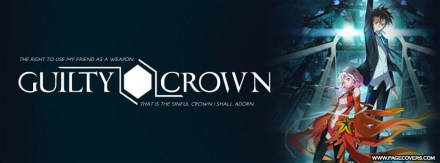
Guilty Crown Review

If I ever were to become a writer, should I ration out all of my “good” ideas for other works or use them on one? Well that depends, really. Am I writing to cover my point only; for no sequels whatsoever, am I trying to make my work the next big series, or am I trying to get famous for the sake of being such? The anime Guilty Crown attempts all three ideas and, let me say, puts all of its eggs in one, crushed basket.

Ever since “Lost Christmas,” an apocalyptic virus pandemic that swept through Japan in 2029, Japan has been under the influence of a government organization called GHQ that is set out on curing the virus while managing public safety. Shu Ouma, your average normal high school teen who is bound by “fake” friendships, is thrown into a rebellious group by the cold name of Funeral Parlor when he gets infected with a stolen Void Genome. Given the “King’s Power,” a biological weapon that allows him to draw out voids, which are physical manifestations of one’s heart or soul, distraught Shu is forced to fight on the front lines against the twisted government and their ultimate plan to resurrect the “Eve” of the apocalypse virus.

When I summarize the plot for my reviews, I do so with the intent of leaving out any spoilers that might ruin one’s experience, like ya do. But in this anime’s case, I left out A LOT. For spoiler’s sake? No. Simply because there is way too much going on in Guilty Crown. I know this anime was wanting to be the next “end of the world” type that covers every single detail to the finale, and that’s fine, but some of these ideas don’t even flow well together. The show’s story steals something precious from every solid robot/action anime prior to its own existence, so why would I not want to watch it? It’s too choppy; fails to explain itself and its motives by just throwing in ridiculous action scenes, one-liners, or ways to put the main character through hell.

While many people disagree with the many, many characters, I think that they are one of this show’s few saving graces. I found Shu Ouma to be a very relatable character (I love his hair). He lacks confidence and so he regrets his mistakes too much – but that’s what makes him such an ideal protagonist. He is, in his friend Hare’s words, “The Kind King.” You can especially witness his behavioral changes a little more than halfway through the series. There is the most powerful and memorable event in the anime (I cried, and I don’t ever cry for anime).

Gai Tsutsugami is the other male lead. He acts without feelings to his followers yet when he does express the slightest emotions, they are meaningful and inspiring. Leadership is one of the story’s main themes, and Gai presses that issue to the point where you’d follow him to the end, too. Though corrupt, he truly is a good leader.

I was actually a bit disappointed in the show’s female lead, Inori Yuzuriha. I can’t mention a whole lot about her for spoiler’s sake, but she is pretty static as a character. I mean, she’s a famous Japanese pop singer, a dangerous fugitive of Funeral Parlor, and more. She plays the role she is given, but you’d wish she did a little more in the first half of the show. However, she does have brilliant costume designs if that counts for anything!

As I mentioned earlier, the animation by Production I.G is stunning. Everything from the vivid voids, the sharp, geometric architecture, and detailed characters are brilliantly done up. There are many unique character outfits, so that is also a plus. The animation quality remains strong to the end.

The openings, “My Dearest” written by Supercell, performed by Koeda and “The Everlasting Guilty Crown” by Egoist, a unique band from the show featuring the voice of Inori, show rapid flashing images with upbeat tempos. The sweet first ending, “Departures – Anata ni Okuru Ai no Uta,” is also performed by Egoist. A shout out to “Euterpe,” the best insert song I have ever heard and have even memorized the lyrics to J which is also performed by Egoist.

Hiroyuki Sawano brings to the show epic techno soundtracks that add to the wonderfully choreographed battles. He provides suspense and drama in softer times, too. “Bios Delta,” the main theme of the show, is just mindblowing – a perfect interpretation of Shu Ouma’s struggle! Give all of the songs I listed a listen – you won’t regret it!

Now back to the top, Guilty Crown is a huge, disastrous train wreck, but at that, one hell of a ride. In a similar way to Sword Art Online, I feel that younger viewers would see past the bi-polar character motives and glaring plot errors to just focus on the action and character relationships – well, that and the awesome music! At its time in 2011, the anime tried to be the next big thing, and sadly because of that goal, it was just visually epic; failed to deliver a consistent story to the end. If you enjoy a decent crack at science fiction and the apocalypse, amazing action and intricately romantic scenes, then hey, give it a go. Otherwise I think you can skip this one; it’s just a messy conglomeration of past sci-fi anime. I liked it way more than I should have, though, and its impact on me couldn’t be replaced by any other anime!!

I admit I LOVED GC, and presently, FUNimation’s limited edition copy of Guilty Crown occupies a neat section of my shelf, waiting to be downloaded and heard by the world as the song of the apocalypse. “The right to use my friend as a weapon – that is the sinful crown I shall adorn.” What a great caption for Shu.

And with that I hope you all have a less complicated day! I say “Hi and welcome to Takuto’s Anime Café” for all new followers and viewers. You’re awesome 😉 Hit that like button if you enjoyed this review and until next time, this has been

– Takuto, your host

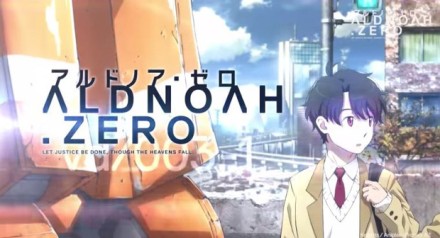
ALDNOAH.ZERO Review

Fellow Café members, let me just start with what this experience was – a coincidence. Ever heard of one? Yes, I thought so. I’ve seen the masterpieces that are Puella Magi Madoka Magica and Fate/Zero prior to this series, and little did I know that this one was written by the same guy. Gen Urobuchi, for the better, you got me again!

Humankind began migrating to Mars when an ancient alien hypergate was discovered on the moon in 1972. Using the Aldnoah technology they had additionally discovered, the VERS Empire was formed. Soon after, the VERS Empire declared war on Earth. This war caused the destruction of the Moon and the gate, creating a belt of debris around Earth and disabling any known connections. Presently in 2014, the princess of VERS travels to Earth only to be attacked and “killed” during a peace mission. The people of VERS are now furious and stand determined to take Earth this time around as both races are thrown back into war.

Isn’t that a cool concept? Aldnoah.Zero dives into the aspect of human separation, and how it is not Terrans versus Martians so much as it’s humans on Earth and those on Mars against each other. They all want each other’s’ blood even though it is actually the same type. Add this dark theme and giant robot, or “kataprakt,” fights and you have yourself a show that is interesting and worth one’s time.

Speaking of, one flaw that I would like to point out is the fact that the Martian’s could have easily squashed any human resistance with their super powered Aldnoah kataprakts, but what would be the good in that, right? Like seriously, one of the enemy robots can create a dimensional barrier that absorbs all forms of energy, allowing it to walk through buildings without any struggle. WHY DID THEY NOT MAKE MORE OF THESE?? This forced the opening fight to require Inaho’s smarts, as he literally couldn’t go rushing in at the enemy. Perhaps if a fight on this scale of strategy was at the end, then maybe the final boss wouldn’t have been such a snooze.

Our true story centers on the triangle between the Terran Inaho (Orange), Princess Asseylum Vers Allusia, and the Terran Slaine (Bat). Inaho is quiet, resourceful, and a calm, quick thinker. This makes me love him yet dislike him at the same time, for although he rarely says stupid stuff, he follows the bland archetype hero.

On another note, Asseylum receives asylum by Inaho and co. upon her arrival (Hehe, puns). She is a dutiful young lady who, for housing the mysterious power of the Aldnoah, one would think she would have some kind of combat skills, but it’s whatever. In that aspect, she reminds me of Princess Lenessia from Log Horizon. They both act in amateurish ways, thinking that a simple meeting would solve planetary war.

Slaine is the crux of emotional occurrence in ALDNOAH.ZERO. Throughout the entirety of the series, the Terran-born boy struggles between supporting the Terrans and/or the Martians. He doesn’t fully support the Martians, but simply Asseylum. When I think of it this way, it clears a lot of the mud that crowds Slaine’s decisions.

In Slaine’s regard, the end of the first half of the series is probably one of the most suspenseful and unexpected twists I have ever seen. Because I don’t want to spoil too much it will remain your unknowing secret. I can understand complex emotions, but wow, I was not expecting that. For those who have seen the end of the series, how shall we encrypt that last line? I guess we’ll just have to wait for season two in 2015. It’s going to be a long wait. . .

The animation quality for this show is phenomenal! Not only that, but the soundtrack by Hiroyuki Sawano contains epic, pumped up techno action pieces that engage me into combat. It fits the high-tech battlefield mood perfectly. The show is filled with awesome robot combat and explosive maneuvers that left me swerving in my seat to dodge flying metal fists or energy blades of death! It is interesting to note that the studio that animated ALDNOAH.ZERO also did the infamous Sword Art Online, a series which had a second season running at the same time. A-1Pictures must have been very busy, as the animation quality for both series is top-notch – definitely some of my favorite animation.

With Urobuchi comes Kajiura, as Kalafina performs the series’ amazing opening “heavenly blue.” Jesus, I love this music so much! Kajiura pulls out all of the stops in this new opening: the techno groove is hot and upbeat. The show’s ending theme, “I Say Cry” by aLIEz (also by Hiroyuki Sawano), also deserves an honorable mention. Both of these are a must-listen.

I fully recommend ALDNOAH.ZERO to fans of Urobuchi’s works and for people that are looking for something with sci-fi action-packed fights with great background music, and a well-paced plot to where you want more after every damn episode. So isn’t that everyone? Well, yes and no. The last few “bosses” are lack luster and require Inaho to just hack and slash; no real strategy is required. Because of such a loss, the crafty interest in both Inaho and the Martain generals drop tremendously. Nevertheless, I will be awaiting the second half for this great adventure of revenge, tragedy and hope. “Let Justice Be Done Through The Heavens Fall.”

At the moment, you can watch all of ALDNOAH.ZERO on Crunchyroll.  I really hope the show receives localization and a dub, because yeah, I thought it was worth watching again. Leave a comment below and thanks for reading! Till next time this has been

– Takuto, your host

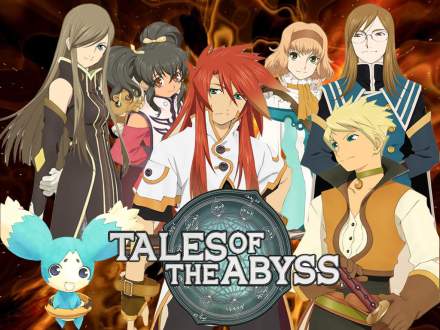
Tales of the Abyss: The Animation Review

After watching Tales of Symphonia I just had to check out more from the Tales series. Sadly, Tales of the Abyss was more of a letdown for me. So if I didn’t care for it then why write a review? Plot ideas can be tricky to come up with, I’ll admit, but when a story has too many ideas it ends up as a convoluted train wreck. The main story of Abyss derails itself so often that I found myself sleeping during the show, only waking myself up to see the character back stories. With that said, I want to inform you of the really cool aspects of this show, the occasionally crumbling plot aside.

Set in the common medieval atmosphere the Tales series likes to enforce, Auldrant is a world run by the Score, a prophecy written many years ago. Luke fon Fabre, the spoiled yet confined heir of the kingdom of Kimlasca, spends his afternoon in sword training with Master Van until a mysterious woman by the name of Tear Grants shows with the intent of taking Van’s life. Suddenly, Luke and Tear are warped across the world to the opposing empire of Malkuth. Now that Luke has the freedom he has dreamed of for so long, he begins to realize why he was restricted from the world, who he really is, and what his hidden powers are. All the while there is a band of look-alikes that are trying to kill the heroes, a not-so-holy church that wants Luke, a sea of miasma that threatens to destroy the planet, and an oncoming war between the two kingdoms.

These plot ideas sound kinda cool, no? But when all of them are thrown together it doesn’t benefit the anime.  Speaking of adaptations, Tales of the Abyss the Animation is actually based on an RPG, but an anime was released later on. You can ask anyone, but Tales of the Abyss is by far the closest recreation of a Tales RPG in anime format. Most of the scenes are translated exactly like they appear in the game, not taking away from the Abyss vibe.

I do not remember all of the characters from this series, and that is really a bummer because they all link together in one way or another.  Tear, a Seventh Fonist for the Order of Lorelei is a character I enjoyed because of her straight forwardness and her knack of guiding Luke in the right direction. She remains a strong and reserved character through the duration of the story. Though she acts coldly to Luke on occasion, she is quite respectful and well-mannered to everyone else. A second character whom I enjoyed was Jade Curtiss, the necromancer of fonic artes and a Malkuth army colonel. He is a generally happy character, but he doesn’t reveal his preferences or personality, making him seem complex to the other characters. With his dark background, one couldn’t tell if Jade was acting for the greater good or if he had something planned up his sleeve. The only problem with Jade was that some of his later happenings were predictable, but it is also like this in the game, so whateves. I love the way the Japanese always pronounced him as “Jeido Kaatisu” – I still call him that today!

Other than those couple characters, I found the rest of the cast to be decent, but nothing spectacular. Most of the best scenes were not when something epic was happening, but when all of the characters were just conversing with one another. The interactions were golden, especially any of them with Jade or Tear. The anime had also included many notable flashback scenes in just the right places to help flush out characters. A character death in particular made me bawl for hours; it was the way in which he made it sound that did me in. With as big a cast as this one, it felt as if some characters (clones or noblemen) were placed in just to balance another, and that is not how it should be! But it is an RPG, so some of those characters are necessary. Other than that, character motives made sense and dialogue was pretty interesting.

The OST for Abyss stands as . . . suitable, actually. Listening then and now, the concert band songs are beautiful and express grandeur. They keep to a fantasy adventure theme that sounds as if the pieces came straight out of the game, which they might have. Some tracks like Tear’s song that she sings and “Peaceful Times” are especially easy to remember. Most of the characters have a fitting theme that is a perfect reflection of their personality. The opening theme “Karma” by BUMP OF CHICKEN is the same opening the game uses, so fans of the game can appreciate that. Personally, I rock out to that song! All-in-all, the soundtrack is decent classical dance as it appropriately captures the moments from traumatizing to engaging.

Tales of the Abyss was animated by Sunrise Inc. in 2008, and they did a great job of adapting the art from the game into an anime. Again, I have not played the game, but if you view some concept art you will notice the breathtaking similarities. One of the highlights for this show was the artwork for the landscapes. Characters might just be conversing or walking into town and the background animation is just splendid! Adding in that and the year it was done up makes Tales of the Abyss one of the best animated adaptations for the Tales series.

While I may have been bored or confused at times, that does not mean that the entirety of the show was uninteresting. There were many entertaining scenes that make up for the tedious ones. The anime is definitely an adventure, but whether it is one I would traverse, I would have to say no. Show-wise I was amused, but it was not a driving force by any means; it is not one where you would drop whatever you were doing just to watch it.

I was not changed or moved in any way by this anime. It was good, yes, but no more than that. Other than a few characters and plot points, I can’t recall much from this anime other than it was a mess. While this show did not push me to do anything in particular like high-ranking anime should, this show was my first “okay” anime, for everything up until then was no letdown. If you enjoy somewhat heart-filling adventures with action and great music, are investing yourself in the vast Tales series, or are looking for new ideas to use in writing, gaming, or whatever, then this show is for you. Otherwise, spend your time with something more beneficial and organized.

Though I didn’t pick up a copy, you can purchase all four parts by Bandai Entertainment (sub only) on Rightstuf.com. I’m sorry if I sound like I hate this anime – maybe I just can’t appreciate all that it has to offer. Hopefully you will have better luck with this one! Until my next review, I’ll pass on Tales of the Abyss with a push of my sketchy Jade glasses and a wave of fonon arte magic as I steal an apple from the Malkuth marketplace, because, you know, “why do I have to pay for it?”

Thanks for reading!

– Takuto, your host

Tales of Symphonia: The Animation Review

In the summer of 2012, I happened to be browsing for cool J-pop music and ran into Starry Heavens by Day After Tomorrow – Tale of Symphonia’s game opening. After brief research over the game, I noticed that this game had an animation for it as well. This made me curious. I watched all of the episodes on YouTube until I reached the unfinished United World Arc. When the last two episodes were later released, I couldn’t help but smile and share this to a couple others.

The two worlds of Sylvarant and Tethe’alla share a mana link between each other, which is unknowing to the population of the world. When one world gets mana poured into it, the other is drained. To restore her world with beauty and life, Colette Brunel, the chosen, who has the job of reawakening seals to become an Angel, must set out on a journey of World Restoration. Along with the protagonist Lloyd Irving, their intelligent friend Genis Sage and his older sister/their teacher Raine Sage, Colette and Co. begin to realize that their world is actually more twisted than it seems. Interesting characters who also tag along include a clumsy ninja, a lifeless girl with crazy strength, a former baron and now fighter, a mercenary who stays quite and a bumbling ladies-man – all of which who have their own tragic and memorable back stories.

The story itself is best told through the view point of Lloyd Irving, whom struggles with school but makes up for in sword skills. Why this person? Not only is Lloyd the main protagonist, but he is also unintelligent, meaning that when the plot needs to be explained, the series just uses Lloyd to vent out the news to the viewer. When Lloyd figures something out or learns something new, so do you. I find this concept of two worlds, one of which is always in decline, to be exciting. It adds for two distinctive ways to see the world. Is it loving and beautiful, or is it actually cruel and dry? This theme can be applied to parts of the our world today, which makes it more relatable and powerful. All in all, it is a fairly solid idea that can lead to many open opposing stories and character view points.

The only thing that drags down the plot is the fact that it’s an animation based on a game, which means that there are many terms that are randomly thrown in there because they were in the game. Because the series fails to link some of these devices, there can be many WTF moments at times.

I can recall the main casts’ names and their stories – even a couple years later. Namco Tales Studio did a phenomenal job on the character designs and motives. What was nice was that I couldn’t brand characters by a stereotype, as they were all really intricately done. Sheena Fujibayashi, for instance, was the clumsy ninja whom I mentioned earlier. While she appeared as an assassin out to get the Chosen who also had love quarrels, she bore a really strong and sorrowful weight from her village.

Zelos Wilder was by far the most unpredictable character out there. Not only is he half comical and half murderous, he also works for several opposing forces in the Symphonia world. Whenever he betrayed a group I got really mad and started to hate him, but then he always came back and I admired him once again.

All of the older characters, Yuan, Kratos and a few of the generals also had intriguing pasts. One of my favorite parts of this anime was seeing the past of the main antagonist, _______, for he ended up being much more than the rumored hero of the Kharlan War. Long live the Four Seraphim!

One downside to this selection was actually the main character Lloyd. I found him to be caring yet annoying at the same time. He was that only exception to the sterotype list, and that is that he is the hero. He wants everyone to live in peace and harmony and blah blah blah – it gets annoying really fast! If you can get past some of Irving’s dramatically heart-filled speeches, then you will find this cast to be one of the best you’ve ever seen.

I’ll immediately start with the show’s second opening, “Canary in the Sky” by Nana Mizuki. Holy Hima it is amazing! Its effective use of a violin and a guitar take my breath away. The song fits and represents the Symphonia series perfectly. Whether this anime is interesting to you or not, go ahead and give it a listen – you will not be disappointed. As for the rest of the OST, the only stand out moment was at the end of OVA nine. TO THIS DATE, I have only encountered few plot turners who threw me for a loop like this one. The song “Ta ga tame no sekai” sung by Shikata Akiko is one of my top few favorite ending themes, as it transcends the series to a whole new level of epic. Her voice is haunting and calming at the same time and when she is accompanied by the upbeat drums and a full on choir who sing with her, I could just die right then and there. I also love the series’s last ending 🙂 . So tropical!

The animation was done by Ufotable, who is good at what they do and this is no exception. Action scenes and attacks were splendidly animated and the way the technology appears in the series is just cool. You can really tell the difference in quality when you compare the first arc done in 2007 compared to the last episode in 2012. One thing I did notice is that on occasion, the faces would look funny, as in the eyes just didn’t line up correctly. On that note – where are their noses!? In some scenes they have no nose, which is very distracting. However, I think the game is like that too at times

I distinctly remember sleeping through the first four episodes of the series. The Sylvarant Arc was so slow I almost dropped the series as a whole. It was only because of its music and characters, however, that led me onward. When you watch it, just know that it gets a hell of a lot better when you hit the second arc, Tethe’alla. For the rest of the series, I was thoroughly enjoyed. All of Symphonia’s epic chorus songs make me wanna wave around a sword, too!

I always doubt this series when I compare it to others. But then I realize – this show was actually really good! It has enough plot twists to keep one interested and it provides excellent sad stories to pass the time (if you can say that sad stories are “excellent” :P). The relationships the characters share are priceless and respectful to witness as well. I did love this series, a lot. If I’ve inspired you at all to go for this series, do keep in mind that it is based off of a game, so some of its conclusions will seem a little far-fetched.

This show is not available for purchase in the states, but the sorrow of Mithos, the goodness of Lloyd and the faith of Colette rest in a seed of remembrance at the bottom of my heart.

Thanks for reading!

– Takuto, your host