The Flame Expands: Fire Force Manga Volumes 4-6

Loose thoughts on volumes 4-6 of Atsushi Ohkubo’s manga series “Fire Force,” initially published in 2016 by Kodansha Comics. Spoilers will be present. 

CLICK HERE TO READ MY THOUGHTS ON VOLUMES 1-3


A Bug in the System

Continuing where the third volume left off, volume four reveals the presence of a traitor in the Tokyo Fire Force. We also find that the secrets to spontaneous human combustion don’t lie in a fault with the Sun God, but rather are caused by man himself. Specifically, followers of the “Evangelist” are trying to track down people who are blessed by the Sun God by injecting random men, women, and children with a strange insect born from the ashes of Infernals.

Although we don’t know much, these wanted individuals supposedly possess an “Adolla Burst,” or “pure, undefiled flame,” and a great aptitude to wield their pyrokinetic abilities. Shinra just so happens to have one of these Adolla Bursts.

Enter Rekka Hoshimiya, the Company 1 traitor and a devout follower of the Evangelist. I distinctly remember disliking this part of the anime most, as it also happens to center around Tamaki and her allegiance to this terrible man. While nice character growth for her (what with the shattering of her greatest role model and her overcoming this sad reveal), Shinra’s fierce encounter with Rekka is unfortunately bogged down by more awkward fanservice pandering.

In a couple of action stunts, Shinra is thrown off balance and rolls into an abused Tamaki’s chest while she is propped sitting against a pillar of the abandoned factory setting. I get that Ohkubo likes this kind of thing in his manga and that he finds it funny, but I just think it’s awkward—and in a bad way. For one, it ruins the tension built up in this serious fight. Secondly, of all the places to land, OF COURSE Shinra has to fall into her bosom—and more than one time!

But the best part of this little setback is how it ironically propels the story forward immensely. Suddenly we know a lot more about SHC, as well as a taste of what the true enemy looks like—and it ain’t pretty.

In Good Company

I really like volume five. The book opens with the history of Company 8’s formation told from Hinawa’s sharp perspective, as well as the backstories of Hinawa, Obi, and Maki’s relation to one another. Hinawa was a diligent soldier in the Imperial Army; Maki was a general’s daughter but also worked hard as a rookie soldier; and Obi was an honest-to-goodness firefighter (and he still is, really).

This backstory serves to flesh out Hinawa’s rigid character, answering why he’s so punctual towards his company but also compassionate towards victims of SHC. His story is a sad one, but is brought into great care thanks to Obi. On that note . . .

God I admire Obi so much. What a great guy. Finding out that the reason he was kicked out of the job was because he decided to release the soul of an Infernal (despite shitty orders from the Fire Force) was totally a thing he’d do. And the fact that Hinawa was the one who pulled the trigger just SENDS me. These two really do have each other’s back.

Volume five’s second half shifts gears to the next big development: the attack on Asakusa. We meet the annoying, foul-mouthed lolita twins of Company 7, Hikaga and Hinata, as well as the stubborn dude simultaneously protecting and destroying this region of Tokyo: Benimaru Shinmon. 

A tough nut to crack, Benimaru is the exact kind of guy I CANNOT STAND in shounen anime. EXCEPT, for some reason I like him a lot. Maybe it’s because of Ohkubo’s character design, or because I remember his dub voice from the anime, but everytime Benimaru flexes his gifted pyrokinetic skills, I just gawk at the pages for hours. His signature final move, Nichirin (“The Sun Wheel”), adds a super neat oriental flavor to the different types of fire power in this series.

The world also starts to open up a lot in this volume. Like with Hibana’s Company 5, we see how Company 7 handles the Infernal cases, and it’s shockingly touching. Honoring the spirit an unsuspecting person who goes Infernal, Company 7—with their savior Benimaru at the front—parades Asakusa with cheers and destruction, celebrating their life and death in the process by lighting up the town and rebuilding from the ashes. I like the Company 7 way of things.

The Flowers of Edo

If volume five provided the build up to this invasion of Asakusa, the sixth volume adds the climax. The White Hoods have set a trap for Company 8, and it would seem that Benimaru’s poor leadership has caused his own Company 7 to fall for it as well. As citizens start mistaking one another for various crimes, a citywide spell of doppelganger sets in on Asakusa. We find that one especially potent servant of the Evangelist, Yona, has the power to reshape the human face, and boy are its effects nasty.

Even though there’s this new typed of horned Infernal revealed—which is appropriately called a Demon—the White Hoods themselves really shine as the action set piece on this one. The archer with the gorgeous yet deadly crescent-shaped bow made of flames makes HER reappearance from Rekka’s shocking death in volume four. As villains, the character designs for the White Hoods seem just as well thought out as the MCs themselves, and it’s always nice to have a badass-looking villain cloaked in white. We know very little of Arrow’s personality, but the motivation is clear: to return mankind to the inferno. 

Growing from his learned failures, Benimaru pulls off a fantastic victory thanks to Shinra’s backup. Lieutenant Konro shows more pathos than I’d have imagined a guy like him would, and it’s because of Konro’s backstory reveal that Benimaru comes across as a tired man looking for atonement. This duo nicely parallels Hinawa’s dedication to Obi from the previous volume. Perhaps the two companies aren’t so different after all.

Most interesting of all was Shinra’s strange tingling sensation in his foot when he heard Konro’s shout. Does the Adolla Link allow him to sense the passionate flames of others? I’m sure we’ll find out soon. What I did like about Shinra from this volume was his cooperation with Arthur in the White Hoods fight, but also how he literally leapt into action before he could even think when Konro screamed his name. (The acceleration shots were bursting with an energy I could feel!!)

I was reminded of Deku from My Hero Academia, and how the one thing that drew All Might to Izuku was how his legs moved before he thought about the dangers ahead. Given Shinra’s aspirations to be a hero (and the importance of his feet!), I wouldn’t be surprised if this is how they were tying it all together.

Last but certainly not least was the final page reveal: the man who was working with the Joker has made his way into Company 8 as their chief scientist. I think I got actual chills from that scene! Also, does this creep really serve Shinra’s now-evil brother Sho??? I’m not sure where this is going, but I have a feeling that Shinra and the rest of Company 8 are gonna have to really watch themselves around this eerie dude.

After all, it is always darkest beneath the lamp.


The spirit of Company 8 hasn’t changed since the day it was formed! To the dying, we give our prayers and respect . . . and to the living, we give release from the flames. We value human life . . . that’s what we’re about. —- Akitaru Obi


Afterword

Is anyone else reading Fire Force? Well, I hope you either are or weren’t planning to because I just spoiled a huge part of this developing story! Did you like this type of post where I sat down and just freely wrote about the manga I’ve been reading? I’d love to hear your thoughts—both on the series and on the post—in the comments. If a couple of you enjoyed it, I’d be happy to do reflections like this for future Fire Force volumes as well as other series I’m reading, just let me know! The story only continues to expand, and I’m eager to explore past what I’ve seen in the anime. ‘Till next time!

– Takuto

CLICK HERE TO READ MY THOUGHTS ON VOLUMES 7-9

Fire Force MANGA Vol. 1-3 || First Impressions

First impressions for volumes 1-3 of Atsushi Ohkubo’s manga series “Fire Force,” initially published in 2016 by Kodansha Comics.


Heroes, Devils, and the Inferno

Shinra Kusakabe’s enlistment in the Tokyo Fire Force was by no means an accident. After losing his mom and brother to a household fire, Shinra sets his sights on becoming a hero of the flames so others do not have to go through what he did. It’s a noble goal for sure, but not one without its difficulties. For one, he’s got a creepy little smile that appears whenever things get too intense, which often sends mixed signals to the people he saves. Additionally, his unique pyrokinetic ability shoots fire straight from his feet, leaving behind a literal wicked streak wherever he goes, the so-called “devil’s footprints.”

The Fire Force isn’t just responsible for squelching household fires, though. To fight the inferno in this elite force also means releasing the souls of those who ignite from spontaneous human combustion, a rare dysfunction that can cause an ordinary person to burst into flames on the spot. It can be hard to purge someone who was perfectly fine and healthy just a moment ago, but better to put out the flames quickly than to draw out their suffering. Thankfully, the special force is equipped with many other talented pyrokinetics who also use their powers for good.

The concept of spontaneous human combustion certainly brings with it its pathos, which the Fire Force respects with a humble prayer, “látom,” and a swift, efficient termination of the victim. However, it is certainly odd that the Sun God would punish his own subjects with the flame. As Shinra and his Company 8 comrades start investigating the other companies and their research, they quickly find that while fire brings light, it can also cast terrifying shadows.

Explosive From the Start

While the world and story of Fire Force is full of potential, it’s the quirky characters that make the series shine. From the same mind that created the equally wacky Soul Eater (which I thought was mediocre at best), I honestly love everyone I’ve met in these first three volumes. Shinra’s got this natural charisma to him, a chiseled edge that I find more captivating compared to other shounen protagonists. At the same time, he’s a little doughy boy whose just trying to do his best, and I like him for that.

His friendly fire rival and bunk-mate Arthur Boyle is a delusional dunce who’s convinced he’s a knight. Arthur’s antics get a little annoying at times (HOW DOES A MAN NOT KNOW WHICH HAND TO HOLD HIS SWORD IN I–), but like Shinra, he’s a lovable idiot, even if stupid to the core.

The rest of Company 8 is shaping up to be an entertaining and endearing bunch. Obi commands the squad with overwhelming authority and love for his crew, despite not possessing any fire abilities himself. (Perhaps that makes him even more commendable.) I’m sure we’ll find out more about him as the series goes on. His second in command, the sharp-eyed Lieutenant Hinawa, seems to share a past with Obi. The same goes for Maki, a talented second generation pyrokinetic who can manipulate the flames into cute little fire sputters, but could also squat Shinra and Arthur with her strength. I hope we learn more about Company 8 as the series goes on.

Lastly for noteworthy characters, the first three volumes conclude the Princess Hibana arc. A leading research force into human combustion, Hibana rules over her subjects with a much colder hand than Obi does. Ohkubo has this tendency to give characters certain speech quirks that get annoying fast, and Hibana’s use of the word “gravel” to describe every single human she comes across gets old quick. However, Hibana’s encounter with Shinra changes her perspective a little, and as she joins Company 8’s goal of uncovering the secrets of human combustion, Hibana becomes a beautiful ally worth having.

Saved by the Flame

My only big gripe with the series so far is the strange fanservice timing. I know it was an apparent problem for those watching the anime, but the manga has it too. Most of these unfortunate scenes revolve around a Company 1 cat girl named Tamaki, whom which Shinra or Arthur constantly stumble into through weird action stunts. For example, Shinra goes to raise his hand for a greeting, but “accidentally” slips it IN HER BRA. Like, WHAT?? I don’t get the appeal, but thankfully it doesn’t happen too often.

Where this quirky fanservice has be annoyed, I can at least admire Ohkubo’s iconic character art style. Again, maybe it’s just a matter of subject, but I am enjoying this series TEN times more than I did Soul Eater. With their shimmering blue reflective tape and puffy coat, the signature Fire Force uniforms are what first caught my eye. This design choice has me absolutely LIVING, and I can’t wait to cosplay it someday soon!

Fun, intense, and fast-paced, Fire Force depicts the great wonder of the flame with artistic fury and creativity. The world is crafted with immense intrigue, and I’m dying to know what secrets the top dogs in Company 1 are holding. Given Shinra’s fiery spirit and determination, I bet it won’t be too long before we find out.


It doesn’t matter who you are–it doesn’t matter if you broke the law. If someone’s in trouble, we go to help. The Fire Force isn’t like the military. Isn’t that what heroes do? — Shinra Kusakabe


Afterword

So, where do I stand on Fire Force after three volumes? Guys, it’s great. Tons of fun. My only concern is whether to continue reading the manga or to just watch the anime. I had impulsively bought the first NINE volumes in a sale a while back (I know, you’d think I’d learn . . .) but I did this because I didn’t think we’d get a second season. Well, now it’s a thing, and from what I understand, the anime does a pretty good job at staying faithful to the source. If anyone who has dabbled in both has any recommendations, I’d love to hear them. For now, though, I’ll read what I have, and who knows, maybe I’ll find the answer for myself! Thanks for reading, and until next time!

– Takuto

Click here to read my thoughts on volumes 4-6!

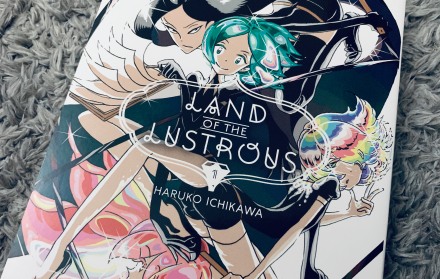
A Second Chance to Shine: Land of the Lustrous MANGA || “First” Impressions

First impressions for volume one of Haruko Ichikawa’s manga series “Land of the Lustrous,” published in 2017 by Kodansha Comics.


So, I Was Wrong . . .

This is a bit of a weird post, but hear me out. The story goes like this: I’m sitting here ready to sell the first five volumes of Land of the Lustrous that I own because I wasn’t going to continue reading it. Ever since the anime enchanted me back in late 2017, I have been eager to find out what happens in the story beyond the adaptation. Everyone online is always hyping up the manga each time a new volume is released, and I wanted to join in on the fun. (This all began when the manga started being released in English, of course.)

But as soon as I flipped open the cover, I didn’t understand any of it. The characters all looked the same, the art style was visually attractive but hard to follow. None of it made sense to me. I couldn’t even get past the first chapter. So, I put the book(s) back on my shelf, thinking I just wasn’t in the right head space for reading manga.

Months pass. I distinctly recall trying out that first volume again, but didn’t get beyond the opening act. A year goes by, and this series is still sitting there looking pretty. Before I know it, 2020 is here. At some point I tried again—couldn’t do it. What was I not understanding? Was the writing beyond what I could contemplate? Why was everyone raving about this series each time a new volume was released when I couldn’t even get past the first fifty pages?

“A Perfect Adaptation”

Just the other day, Jack of Under the Scope over on YouTube put out this video titled “Land Of The Lustrous: A PERFECT Adaptation.” Now, I know Jack to be a pretty smart and reasonable guy. But this was a pretty big claim, even for him. So I watched it, eager to hear what he had to say—and what I, apparently, was not picking up.

Through his tight-knit, formal analysis comparing the anime and the manga, I walked away having entirely different thoughts about Land of the Lustrous than I held going in. I was reminded of all the wonderful things the anime series did, and why I wanted to pick up the manga in the first place. Really, my kudos go out to Jack and his editor.

I’m only writing this post now because, as you can imagine by the title, I finally completed volume one of the series—and all in a single sitting, no less! Thanks to watching Jack break down how Haruko Ichikawa constructed the manga (even if it was only his interpretation), I was able to understand so many new things about this book I had neglected for the past couple years.

For one, the panel composition is brilliant. (And no, I’m not just saying that because Jack did.) I get why it’s intelligent compositing; the word bubbles naturally guide the reader through the page, following the action, emotions, and anticipation built up before flipping to the next one. Some of Phos’s dialogue actually had me grinning, whereas many of the comments made by Cinnabar and Diamond made my heart ache with sympathy.

And the fights between the Lunarians and the Gems are unbelievably gorgeous and fluid, nightmarish and dreamlike. Ichikawa’s mastered a strong eye and steady hand for crafting all kinds of tectures: glossy hair and glassy eyes, brittle arms and blowing fields, viscous liquids and vile substances. I seen now that Land of the Lustrous is a tactile experience as it is a narrative one. Much of this is accomplished by the stark use of flat black vs. round white shapes to catch the reader’s eye, but it’s also the Gems themselves that carry the weight of this unique story.

It Was Always This Good

As graceful as the action and writing may be, a common criticism of the manga series is that it’s hard to tell characters apart. But, as YouTube friend Simply Gee pointed out, perhaps that’s part of the point. Phos lives in a world where their individuality is a stunningly hard thing to achieve, despite there only being 27 other Gems to compete against for Kongo-sensei’s attention. They all have the same body shape, wear the same clothes, and live in the same construct. Thus, it’d only be natural for characters to gradually become more defined—physically and emotionally for themselves AND the viewer—as the story progresses. Everyone will have their chance to shine eventually.

I realize this post was less of a “first” impressions and more of a commentary on the series as a whole, but the bottom line I’m getting at here is that Land of the Lustrous is very intelligently designed—and that shouldn’t stop anyone from trying to enjoy it. Heck, still I don’t know a thing about mineral hardness and Moh’s scale, but I love Dia’s caring personality and Jade’s stern, no-nonsense attitude nonetheless.

Elegant, unique, and bizarrely stylish, Land of the Lustrous is about searching for purpose in life. However, as one might expect, the book reads very different than the adaptation. In this instance, it took me needing a little push to understand why the manga is so beloved by others. But I believe learning what makes a work of art “good” will always be worth it. After all, I’d certainly rather be in the club that enjoys reading Land of the Lustrous than not—because it’s very good. Then again, I suppose it always has been.


What if you tried making a big change in yourself? Maybe try something you never do would help? — Diamond


Afterword

I can’t recall if I’ve ever written a manga first impressions before, given that I don’t read much manga. If this is the first, however, I’d love to hear what you thought, as well as whether you’d be interested in more of these! I’m definitely keeping Land of the Lustrous on my shelves, and will continue reading until at least until I’ve read those five volumes I bought a while back. After that, well, I suppose we’ll see! I imagine the series only gets better, though. Thanks for reading, and until next time!

– Takuto