

Yamada’s First Time (B Gata H Kei) Review

“B Gata” meaning “Type: B” and “H Kei” meaning “Style: H.” Make of that how you will.

Everyone has sexual tendencies, but is it natural for a virgin teen girl to want to bang 100 guys her first year in high school? Well, Yamada is 15 years old, and this is her goal. She’s beautiful, popular, athletic, smart, and even musically talented – so why the sudden urge? We quickly discover that she has no sexual experience whatsoever when she corners a boy in the library and flashes him. But hey, as the saying goes, “The journey of a hundred miles starts with a single step.”

Like so many, I judged this show just hearing the title. After actually watching it, however, I was in love by episode one. This plot is definitely a hit-or-miss for some, considering its mature themes, but the show goes beyond that. While Yamada’s First Time lacks the actual sex, it teaches a valuable lesson about rushing into things, and how you might want to rethink things through before you do something regrettable. This anime is a one-of-a-kind gem that shines best when it strays from its goal.

Yamada is an interesting character, that’s for sure. She’s slutty, perverted to the max and simply a disaster. But despite her intriguing plot involvement, she is a really enjoyable character. Yamada can be the “go get em’” girl all she wants, but deep down she is only a teenager – she’s still growing and learning. Her lust to lose her V-card results in her chasing down the most unremarkable boy in her class, Kosuda, and she begins to realize that she might have feelings for him.

Kosuda (“cherry boy”) is doomed to her by the first episode – that innocent boy in the library, but he sure doesn’t think that! Kosuda is bland, boring and honestly looks like a background character. He represents the average boy in many ways, but stands out because he gets so freakin’ nervous about most everything related to Yamada. In that, he’s quite hilarious to watch.

While it’s fun following these two chase after each other, you realize that by the end of this short anime, Kosuda is all Yamada’s gonna get. The anime loves teasing its viewers with X-rated hot stuff, but then quickly pulls up its pants before anything unfolds. After watching so many ridiculous scenes with the two, you really want them to have sex – you do and you know it!

Accompanying the lead couple is Yamada’s enduring girlfriend Takeshita who advises her through her journey, Yamada’s Eros Deity, the brash and sexual embodiment of her darkest desires that promotes her banging boys, Kosuda’s quiet childhood friend Miyano who crushes on him the entire series, the perfectionist transfer student and rival of Yamada, Kanejo, and so many more. What can I say? Yamada’s First Time has an ensemble cast that manages to entertain and keep you laughing.

There’s not much to say regarding the animation. It lacks much detail in background scenery, but it gets the job done. You can tell the animators put extra work into making Kanejo and Yamada appear cuter than the others, as it shows when the two face off in various activities.

The OST is spicy and dramatic, fitting the tone and adding to the overall flavor of the series! Argumentative scenes are well supported while the softer romantic scenes strike the heart. I especially enjoyed the opening and ending, “Oshiete A to Z” and “Hadashi no Princess,” both by Yukari Tamura. The opening is just so catchy and tons of fun! J It reminded me of other S.A.V.E. titles like Strike Witches or Negima!?.

Yamada’s First Time is by no means a full-blown hentai, but rather a more playful ecchi. The show teases its viewers and services the fans. It’s a guilty pleasure that I enjoyed probably way more than I should have >.< Because of its mature content, the anime is not for everyone. But my god do I recommend it – absolutely. Yamada’s First Time is a precious and lovable anime. “Sometimes you just have to take the leap and build your wings on the way down.” – Kobi Yamada

While I don’t currently own a copy, Yamada’s First Time in FUNimation’s S.A.V.E format is on my Amazon.com cart! For less than $15.00, it’s a must buy! Also, Brittney Karbowski’s role as Yamada is really good ~

Thanks for reading as always and be sure to check out other reviews for more recommendations. If you had similar thoughts or were inspired to watch this anime, then go ahead and hit that like button or drop a comment below! I welcome all new customers (followers) to the anime café and until next time, this has been

– Takuto, your host
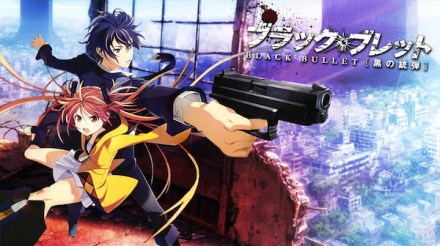


Black Bullet Review

The apocalypse cannot be summed up in thirteen episodes, especially when half of those episodes are pointless loli fights.

In the near future, humans have been defeated by the giant viral insects called the Gastrea. Shortly after, mankind created Varanium, a weakening metal that is immune to the virus and wards off the Gastrea effects. Black Varanium walls were erected around the Tokyo area to keep the insects out, but the real toll has already been taken in the form of the “Cursed Children.” Due to Gastrea infecting the mothers, Cursed Children were born as red-eyed girls with superhuman powers.

Satomi Rentarou lost his family to the Gastrea in an earlier war, and because of his hatred for them ended up joining Tendo Civil Security as a Promoter, one of the many organizations fighting against the Gastrea. Teamed up with his loli partner, Aihara Enju, the two receive requests from Tokyo’s leader, Seitenshi-sama, that involve protecting her from harm’s way, managing public safety and of course, killing off the Gastrea with their black bullets.

I expected this series to be an action rom-com, similar to Aria the Scarlet Ammo, and I got that impression, that is, from the first half of the series only. The first half follows Rentarou and Enju beating up all who oppose Seitenshi-sama. There are comedic scenes, decent character development and yeah – just pretty laid back.

But around episode eight or so, the government gets involved, and we all know what happens then. Our little fights become all-out war and by then the show isn’t even interesting anymore.

And for a show about the Gastrea, they never show up in the city after the first episode, so I don’t really know what genre to classify this series as. Replacing the Seitenshi-sama bits with in-town Gastrea fights would have at least kept the consistency of the overarching plot.

At least the anime does a decent job at defining the discrimination between ordinary citizens and that of the red-eyed Cursed Children. I got really emotional when any of them died, but maybe because they are only little lolis. Still sad stuff though!

The only characters worth mentioning are Enju, Rentarou and his boss, Kisara Tendo. Enju constantly asks to marry Rentarou, but we never really find out why – or at least it’s not memorable. Other than that flaw she’s pretty cute, innocent, and a kick-ass fighter!

Rentarou’s only redeeming quality is the fact that his voice actor is Yuki Kaji (Shu Ouma, Eren Jaeger). He does such a phenomenal job at capturing the youth male in an expressive and active manner. Towards the end, I only watched the series for Kaji’s amazing acting.

Kisara is . . . hmm, Rin Tohsaka? Pretty much, only that Tohsaka’s a billion times cooler. They belong to involved families, aid the protagonist, act somewhat, and I say this lightly, tsundere, and they both look the freakin’ same.

But I still liked Kisara. She and Rentarou actually push the romantic level in this series to a point where I was satisfied, and not overdone. Her end, though, makes me question her bi-polar-ness. “I am evil.” What the hell?

The reason I started this series was for its animation by Kinema Citrus Co. I love the bright colors and matching pallets on the characters. Eyes, hair, clothing, boobs – just everything was nicely done. The only problem was the cheap CGI animation in the Gastrea. They seriously look like dumb indistinguishable blobs.

As far as sound goes, the OST is pretty vivid. A variety of different styles were used to caption the different moments. Techno, choral, orchestral and even Western-inspired tracks were present. Emotional death scenes are well supported by the soundtrack. I can’t really complain.

Now the opening –I love the J-pop band fripSide after hearing them perform the openings for A Certain Scientific Railgun and its sequel, but their new song (the opening) certainly raises the bar. “Black Bullet” (original, I know) amplifies itself with rushing choir chants similar to Attack on Titan’s second opening, and it’s such a catchy beat. CHECK IT OUT!

The ending, “Tokohana” by Nagi Yanagi, also deserves a shout out for its haunting glow. It subtly captions the cries of the Cursed Children. I bow to you, Nagi Yanagi.

At its end, Black Bullet finishes with an epic fight, yet ultimately resolves nothing. I guess the Cursed Children get it good, but Kisara only gets a start to her story. Along the way, the show answers no questions, adds new ones, and just fails to explain anything. Had the last ten minutes specifically been taken out then I could have made an enjoyable experience out of the whole thing, but sadly, no.

I guess Black Bullet falls into the trend of “good animation, unexplained plot,” similar to TRINITY SEVEN that I recently finished. If the anime just answered its own problems before adding new ones – antagonist Kagatane, I’m talking to you – then again, I would have had a lot of fun with this series. And because of its lack in explanation, I can’t really recommend this anime. Perhaps if you enjoy loli combat, colorful animation and fripSide, then go ahead. Black Bullet had something going, but shot too many holes in itself by the end. “The scariest thing about killing people is getting used to it” – Satomi Rentarou

If you had similar or even favorable thoughts on Black Bullet, feel free to leave a comment below! I want to know if it was just me who was unsatisfied. Thanks for reading, have a good one, and until next time, this has been

– Takuto, your host

Psycho-Pass Review

I haven’t watched a lot of “good” sci-fi anime, for instance, Ghost in the Shell. Because of that I can’t really preach in this department. I have, however, seen a couple of works by Gen Urobuchi, so I kinda expected your average themes to be turned on their heads in the dark and thrilling anime that is Psycho-Pass. But does it live up to the reputation?

Set in the near future, law and order are maintained through the Ministry of Welfare Public Safety Bureau. Behind the scenes, however, is the all-knowing Sibyl System, a complex system that can quantify any person’s state of mind or personal tendencies. Once this number, one’s “Psycho-Pass,” becomes cloudy in hue and their “Crime Coefficient” reaches too high in count, you’re pretty much screwed.

As such, simply thinking about crime is enough to earn you a lifetime behind bars or even death.

Justice is served through the Dominator, a destructive weapon connected directly to the Sibyl System’s judgment that can either stun or instantly blow someone to smithereens if fired. Though, if Sibyl deems one’s Psycho-Pass clear or low in number, then the Dominator will enter safety mode and ceasefire.

Two divisions exist between maintaining this peace: Investigators, who are tasked with unraveling civil cases and Enforcers, contained criminals who chase down the target(s) in the Investigator’s stead so that the Investigators’ Crime Coefficient remains a healthy number.

Akane Tsunemori is a newbie to the PSB. She lives a simple and idealistic life granted to her by the Sibyl System, yet slowly begins to question its judgment throughout her career as an Investigator. Even though she can be naïve at times, Akane never comes across as weak, as she quickly adapts to the new, shady lifestyle as a detective.

Many people ignored Akane, dismissing her because she was boring and dull – realize that this was Urobuchi’s goal! In the beginning, she is meant to represent your average, clean citizen. But like anyone would, she changes as she discovers the secrets behind Sibyl. I was drawn to her scenes and found Akane to be a very great lead character.

And yeah, her eyebrows are jacked up and her haircut is styled kinda funny, but people this is anime – at least she has a few stand-out characteristics instead of being some indistinguishable moe chick.

The male lead is hunting dog Shinya Kougami, a rough young man who was once a talented Investigator, but because he got too invested into a case regarding the series’ main villain, his Psycho-Pass became cloudy. As a result he was demoted to Enforcer status.

Akane and Kougami share a unique and respectful relationship, for the two get close enough to understand each other, yet never get romantic or lovey-dovey either. In the second half or rather last few episodes, Kougami splits off from the crew in an act of challenge against Sibyl to hunt down the antagonist, Shougo Makishima. Because of that, along with her recently acquired knowledge of the truth behind the Sibyl System, Akane must step up her game as a leader. I am quite fond of both Akane and Kougami’s balancing act.

The rest of the PSB’s Unit 1 include Ginoza, the statistical Investigator who follows the Ministry of Welfare Chief’s commands, usually no matter how messed up; Masaoka, a worn-down Enforcer who receives gracious amounts of screen time despite his roll; Yayoi, an ex-musician who only gets an episode to herself then is tossed to the side; Shion, an analyst for the PSB who is presumably a lesbian; and finally Kagari, a rebellious joker who lacks any kind of characterization besides one scene with Akane, in which we find out that he was taken in at age five.

Yep. You heard me. He could barely read and write before being written up as a criminal. Messed up sh*t, this system is.

All in all, the cast is well supported, giving off a vibe similar to that of Black Butler’s characters. My only problem with them is their lack of background information, though it’s not really necessary to fully enjoy the show.

The animation by Production I.G does a great job at drawing the line between the cleanliness of this utopian society and its corruption behind the scene. Action scenes are well choreographed and quite entertaining. The concept art for the Dominator is deadly yet sophisticated, too!

Thing is, as a whole the animation tone is quite drab. Neutral colors are used so often that no other emotions pop out. I suppose it does its job, but it could have shown more color (for example, all people have the same pasty white skin).

On the other hand, the OST enhances drama, suspense, and all of the action. The OST includes everything from dubstep and techno for fights, blues for laid back moments at HQ, and thoughtful, curious beats for mystery. Hats off to “Kansatsugan.”  Excellent stuff.

The show’s first opening, “abnormalize” by Ling Tosite Sigure, depicts rapidly flashing visuals reminiscent of Guilty Crown’s opening. While this first opening captures the law and order side of Psycho-Pass . . .

The second opening, “Out of Control” by Nothing’s Carved in Stone, questions that same justice, and instead focuses more on chasing down the enemy.

These are very fitting openings, as they accurately symbolize both halves of the show.

Half one establishes the laws and rules of society, what is wrong and what is supposed to be right. Build up is met through confusing mystery cases that try to establish mood, setting and characterization.

The latter half dives into the burning question behind Psycho-Passwhat is justice, and what is humanity willing to risk for a utopian world, if even achievable? Makishima, the mastermind of all evil, seems to be able to bypass Sibyl’s judgment by containing his emotions, even though he commits multiple crimes and murders. Is it really that simple to undermine the great and mighty Sibyl?

Psycho-Pass is a show that, although implies a very cool setting, never manages to reach the heart of things. It encompasses a powerful system of understanding and is even a likely future for humanity, that is, if we just go along with society’s ways. I just wish there was more depth to this anime – in all categories.

Nevertheless, Psycho-Pass is an outstanding and notable piece of science fiction. It does contain a fair share of gore, however, so it’s not for everyone. Otherwise, I recommend this series to those willing to challenge the boundaries of the human mind and psyche. It’s thrilling to the end and I enjoyed every bit of it!

Part One and Part Two of Psycho-Pass, with a nice dub by FUNimation, await the order from the Sibyl System as to whether I should blow up my own brain after watching this series to protect its true identity . . . “Your Crime Coefficient is above 165; Destroy Decomposer enabled. Carefully aim and destroy the target.” – Dominator

Whew! I had a lot to say about this anime. Thanks for reading and hit that like button if you, well, liked this review! Follow for more reviews and until next time, this has been

– Takuto, your host

selector spread WIXOSS Review

I should be able to watch a season one and if I didn’t care for it – or was satisfied with what I saw – no big deal. I can drop the series, yet still retain a complete story given from the first season. Sequels are follow-ups designed to add more character depth, continuation of new plot (if any), answer lingering questions, and build upon/improve the first season if need be.

I usually find myself disliking sequels, however. They either make or break my impressions of the first season even though they should be just as good, right?

Season one, featuring the dark fantasy card game, selector infected WIXOSS, leaves off on a very large cliff hanger. As such, its second season presents more of a continuation rather than a whole new idea. I had to continue selector, whether I liked it or not. So while ‘sequel’ might not be the correct term for this season, selector spread WIXOSS is nonetheless twisted, thrilling, and overall successful. Though keep reading to find out why.

selector spread WIXOSS picks back up on Ruko, a distressed WIXOSS player who had recently lost her LRIG, Tama, to the wicked Iona in their last fight. Things are also different now, as Iona has become Ruko’s LRIG, and Tama has supposedly been swept away to the “White Room.” Without one of her closest friends, all seems lost for Ruko. She quits battling for a while and even ignores Iona. That is until she and her other friends begin to unravel the darkness surrounding the selector games by visiting the creator and author of the WIXOSS book series – a series that has already foreshadowed the fate of the girls.

Already the premise of this season is ten times more intense than the last. Ruko must cope with her worst enemy, which requires forgiveness on a whole new level. Their current relationship forces the two to come out of their shells, providing the much needed depth missing from the first season. It’s a good kind of weird feeling ~

And their meeting with the author of the accompanying novel is like chatting with that of a god! It was just such a clever and well-thought out solution to the girls’ issues. But although helpful, there were still many questions surrounding their minds at the time.

There is also a shift in character leads. Akira (my fav from last season), Tama, Iona and Mayu (hinted at the first season) all receive major development and backstory. Akira on a psychological level whiles the others on a more emotional level. The supporting characters also hop aboard the improvement train; Chiyori and her LRIG, Hitoe’s current LRIG and friend Yuzuki, and Ulith become crucial contributors to the plot. Even Ruko rounded out nicely – and I was satisfied with her already! Character development was well executed in this second season.

For the main part, the animation (J.C. Staff) remained just as boring and dull as it was in the first season, the only exception being the furious battle scenes and Mayu’s “White Room.” The shady atmosphere and bright magic attacks contrast brilliantly on the battlefield. Mayu’s world encompasses light pastel patterns followed by glimmering shapes and stained glass works on the vast walls. I Love the concept design for this room, and when Mayu seems particularly angry, she shifts the room around to her pleasure. Quite cool indeed.

OST-wise, it’s the same dubstep and techno groove the first season sported. There are a few more dramatic tracks for the new developments, but otherwise it remains decent at best. I say decent because while the battle scenes are awesome, daily life or casual scenes are very empty and unfulfilling. The new opening, “world’s end, girl’s rondo” by Kanon Wakeshima, rivals that of the first in terms of powerful string melodies, upbeat tempo, and sauciness. I love them both sooo very much! The songs represent the world the selector series paints, and the new ending, “Undo –Ashita e no Kioku-“ (Undo –A Memory For Tomorrow) by Cyua also follows that trend.

At first, selector infected WIXOSS is too easily compared to Puella Magi Madoka Magica, for they both support the same twisted and dark themes behind the magical girl genre. But after selector spread WIXOSS, I can officially say that the series continues to step away from Madoka’s shadow to create a purpose and end for itself. I recommend all of the selector series to anyone! The card game part of the series is also further explored in this sequel, so never fear that aspect. WIXOSS is different, and deserves so, so much more. “We cry OPEN!!” – opening lyrics

Thanks for reading and I hope you enjoyed my thoughts over selector spread WIXOSS! FUNimation Entertainment will be releasing an English dub on blu-ray and DVD later this year, and I definitely plan to pick up both seasons. Check out my selector infected WIXOSS review if you haven’t done so already! Have a great one and until next time, this has been

– Takuto, your host

In Search of the Lost Future Review

Also known by its French name, À la recherche du futur perdu, I’m a fan of every word in this anime title. This show is an adaptation of the original Japanese adult visual novel developed by Trumple, and unfortunately does not include the spicier eroge scenes. Yeah I know – that’s horrible! But let’s continue reading, shall we?

Public school Uchihama Academy is growing too large in student population to support itself and thus requires a new building to be built. In honor of its last standing year, a General Club Festival will be held in the old building. As the many excited clubs begin to prepare for their festival, rumored sightings of ghosts spread quickly, and the student executive committee asks the astronomy club to return order amongst the student body. While cleaning out their club room’s second floor, dedicated member Sou Akiyama discovers something that would change his future forever – or rather, someone – as lying unconscious before him is a naked/wet girl named Yui Furukawa, and guys, she ain’t on the roster.

Besides that promising episode one, the first half of the anime is spent on trivial filler, such as skipping class “for fun,” going on dates at the bowling alley and of course, working hard for the astronomy club’s participation in the festival.

But all of that is helpless character development. If the show really wanted to build quick attachments to characters before sh*t got real, then the writers shouldn’t have opened up with the same old stereotypical hogwash. Those first five episodes are sheer boredom and ultimately pointless to the plot. I was gonna drop this series . . .

Until the last few came, then I was semi-glad I didn’t pitch this show along with TRINITY SEVEN. Time travel, artificial intelligence, quantum turing and wait, Schrödinger’s Cat? From like episode 7 and on, a dash of Steins;Gate tries to patch up this lackluster fail of a plot, only to fall short with another two episodes of filler.

Because of the second half, I have more love for the characters. At first, only Nagisa Hanamiya proved worthy of time mainly because you could tell the short yet sassy third-year was hiding something. She kept watchful eye of a mysterious black glowing box, too . . .

Then I connected with the wise Airi Hasekura: Sou’s close friend, club president, aikido learner, and future scientist. She is easily appealing compared to the rest of the cast, especially when we learn of the “lost future” of the female lead, Kaori Sasaki, some schmo we were supposed fall in love with.

Speaking of leads, the main characters, Sou, Kaori and Yui, the transfer, are all bland characters. They perform their cutout task and then yeah, that’s it. At least the supporting characters had depth and a sense of fondness.

Oh gawd, the animation by Feel is so attractive – at freeze frame, that is. The moment characters are put into motion, be it walking around the room or running, things just look choppy. In some scenes, characters even lack their original detail – it’s as if the animators had to warm up each day when working on scenes, some being breathtaking while the majority standing as unfinished.

The soundtrack tries to patch up empty space, only having one worthy dramatic track, and thus only assists the show. There’s nothing new going on here, but hey – it isn’t bad by any means.

“Le jour” (“The Day”), the opening sung by Satomi Satō harbors a thrilling sense of mysteriousness and tragedy. It sounds like rejuvenation yet at the same time sings of loss. While “Le jour” is an absolutely beautiful song, its visuals appear to still be in the works as the show progresses. In episode one, the opening is just full of cheap still frames, but by episode 12, includes smooth and powerful visuals of the characters and stars. Yeah. Well at least it got better over the series, right? o_o

The ending song is “Ashita Mata Aeru yo ne” (“We’ll Meet Again Tomorrow, Right?”) sung by Kaori Sasaki (Hatsumi Takada) and Yui Furukawa (Akane Tomonaga). Yet another lovely song that I’ll probably end up downloading – somehow 😉

In Search of the Lost Future follows in time travel’s conundrum and questions as to whether going back over, and over, and over again is worth the hardship and patience. In all artistic and presentation sense, I’m positively sure that the franchise has one of the best visual novels ever made. However as an anime, the adaptation is quite lacking in all departments. Emotionally, the show has a pleasant ending, but it’s not worth all of the headache and disappointment to meet those tears of joy. “We pass by much today, and someday will change our fate.”

Thanks for reading and be sure to hit that like button (you can follow for more reviews, too!) if you enjoyed my thoughts over the 2014 Fall season’s In Search of the Lost Future. I may return to revise this review if FUNimation proceeds to dub this anime, but until next time, this has been

– Takuto, your host
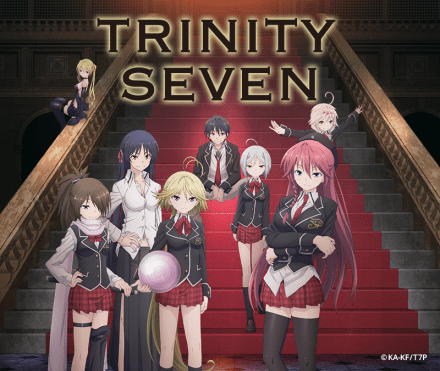
TRINITY SEVEN Review

Harem anime rely on three concepts to succeed, regardless of how stupid the plot might be:

1. A decently likable lead that undergoes some sort of personal growth throughout the show
2. An even more enjoyable and interactive ensemble cast that is attracted to said lead for some odd reason
3. Humorous dialogue and decent amounts of fan service

. . . Or so I thought.

TRINITY SEVEN demonstrates what happens when an anime relies too much on its harem, sidelining any plot explanation, and ultimately pays a heavy price for such unbalanced writing.

Arata Kasuga’s world literally comes crashing down on him when an apocalyptic event known as a “Breakdown Phenomenon” destroys the whole world and throws his cousin Hijiri Kasuga into a different one. Unable to get Hijiri back nor stop the catastrophe, Arata finds himself enrolling in a magic school, Royal Biblia Academy, that houses the great “Trinity Seven,” seven girls who have mastered their own “Thema” and are ace magicians. From here, Arata plans to “learn the magic” of these powerful ladies and control his “demon lord candidate” abilities in order to bring back his beloved cousin, Hijiri.

What caused this untimely “Breakdown Phenomenon?” What did the caster gain from this tragedy? How does one learn the complex system of magic?

These are just a few of the many reasonable questions that get little to no answer. Crucial explanation is tossed out for exploding clothes, bouncing boobies and nude scenes of Arata and the girls. I enjoy my fair share of fan service as much as the next guy, but TRINITY SEVEN has way way too much of it! I grew really tired of it :/

Unnecessarily convoluted plot aside, the show might score a win with its characters.

The lead boy Arata Kasuga appears to be your typical pervert, but he’s surprisingly different. He’s honest about his attractions, never stuttering while apologizing a thousand times; we’ve all seen it, don’t lie, it gets really old. “Thank you for the feast” is one of his quotes to witnessing nudity. Kasuga was a fresh harem lead, and I enjoyed the fact that he doesn’t use the Trinity Seven, but instead fights even stronger alongside them. Plus, his voice actor is Yoshitsugu Matsuoka (Kirito-kun) – you can’t get much better than him!

While a couple of the Trinity Seven are cutout characters, the ones that I found myself drawn to were Lilith Asami, Levi Kazama, and Akio Fudou.

First off, Lilith-sensei is one of the teachers at Royal Biblia Academy, and as such is Arata’s #1 tease. She wields a magical rail rifle weapon and knows how to fire it quite well. I love the concept art of her character, red-braided hair with blue eyes and a monocle on occasion, as well as her hate/love relationship with Arata. The two get along well, and by the end, hold respectful positions with each other. Also, Arata loves her giant jugs – the best out of the Trinity Seven 😉

Levi and Akio act more like supports for Lilith and Mira Yamana (the cute yet stern tsundere leader) respectively, and as such are mainly “power houses.” They both have their own motives, yet go along with Arata’s teasing. Truly a hidden comical duo!

Another one of the show’s better features was the animation by Seven Arcs. While intricate CGI architecture made up the school and its majestic hallways, characters had matching and rich color designs, be it in uniforms, hair color or eyes. The ecchi hot scenes are also a beauty; graceful curves and shining skin really do go a long way :3

OST-wise, the soundtrack contains lovely violin melodies for both combat and relaxation. Sometimes rap-like chanting is sung to help fill the space. It’s unique and adds its own touch to this anime.

The opening “Seven Doors” by ZAQ is freakin’ amazingballz! By using chromatic scales to create a haunting undertone, and mixing that with a sweet, reminiscing melody, you get a super cool song! Check it out – it is a must! BTW, I love Hijiri’s cute face when the verse starts ~

Now back to the rant. TRINITY SEVEN is nothing but boobs, attempted serious magic, exploding clothes, then more boobs. It’s awesome for a while and really could have been so much more, but by episode 6 or so I was utterly lost and just done. To be honest, I can’t believe I stuck it out, but then again, I’m a completionist, so yeah. “Connect to blah blah – Execute Thema!” Or whatever the hell it is.

Thanks for reading! Remember that these are my own thoughts, so feel free to drop a comment with your own. Until next time, this has been

– Takuto, your host

Sword Art Online II (Mother’s Rosary) Review

The Mother’s Rosary (Rosario) side story arc encompasses the last few episodes of the series Sword Art Online II, and is the most touching bit from this franchise that I’ve seen thus far. Stick around ~

A popular figure by the name of Zekken, who wields the “11-hit Original Sword Skill” that is even faster than Kirito’s skills, challenges anyone in ALO to a fight. Asuna proves worthy of challenge and, after one hell of a match, is recruited by the “Absolute Sword” to fight alongside the “Sleeping Knights.” The guild is composed of terminally ill kids who wish to leave their mark in the world by defeating Aincrad’s newest floor boss themselves. Konno Yuuki, AKA Zekken, however refuses to tell Asuna anymore than that, as time is running out for our little purple knight. All the while, Asuna’s mom grows tired of her daughter wasting valuable time in a stupid video game.

I never truly appreciated Asuna like the majority of people do – even in Aincrad I thought she was a mediocre tsundere at best. Now, with the gorgeously smooth opening fight of Asuna VS Zekken, I have a growing appreciation. But wait, it gets better! She also endures a cold relationship with her mother, both sides knowing that she must eventually sacrifice her “childish” gaming in order to improve her grades and tests for the years of coming school work. Her mother forces adulthood unto Asuna that makes her more relatable and explains her actions more reasonably. Asuna’s struggle might not be a fresh concept, but witnessing the relatability of these real-life dilemmas, in one of my favorite anime nonetheless, forces me to reinterpret Sword Art Online‘s Asuna – and for the better.

While the rest of the supporting Sleeping Knight members are kinda pushed to the side, Konno Yuuki receives much development. Because it’s necessary for a full review, SPOILER ALERT: Konno severely suffers from acquired immune deficiency syndrome, or AIDS, which ultimately disables her from any physical activity. The AmuSphere and Medicuboid technology allow her to escape into the fantasy world, and the inevitable fate made out for her – death. We all see it coming, and when it does, let the waterworks begin:'(

I was so happy when I saw the recognition given to “the most powerful swordsman,” for once, a title not for Kirito. The inspiring amount of respect players of the Alfheim world gave her was incredible; truly, a legend died that day, not a little girl. Zekken will forever be missed, both online and in reality. “There are things you can only share with someone by fighting. For instance, how serious you are.” – Konno Yuuki

The amount of love and servitude that Asuna had given Konno was unbelievably generous. For her last few weeks, Asuna worked with Kirito and his mechatronics knowledge to bring Yuuki to school and her own house one last time, similar to his experiment with their digital daughter, Yui. I also have to mention the respect that Kirito had, backing down to support Asuna and her fight with the Sleeping Knights. What a gentle boy :3

And the opening – it’s the same great song with new visuals! It’s subtle but made all the difference. I’m loving the sharp violet resonance and pretty scenery of Alfheim 😀 The opening and these past two side stories have really changed my opinion of ALO altogether.

Although depressing, this last arc provides the much needed embellishment of Asuna’s character and introduced a small but very rememberable character. SAO impresses me the more I watch it, so I hope to see more wonderful content full of enchanting music, charming characters and high quality animation.

Sword Art Online II is tons of thrilling fun and concludes with a strong, heartwarming finish. I give this series a thumbs up and fully recommend it to fans of the first. If you haven’t seen either seasons, then you’re missing out! Well, at least for this season. Thanks so much for reading and until next time, this has been

– Takuto, your host
Sword Art Online II (Caliber) Review

Following the much dragged-out Phantom Bullet arc is the Caliber side story arc. This will be my brief thoughts about these few high-spirited episodes.

Kirito and Leafa discovered the legendary Holy Sword Excalibur a year ago, but could not acquire it due to guardians blocking the path. Well recently, towards the dawn of New Year’s Eve, Suguha discovers that the “Caliber” quest has been unlocked to the public. Kirito immediately bands with his friends Asuna, Klein, Lisbeth, Silica, Sinon, and his sister’s avatar Leafa to conquer the castle Thrymheim in Jotunheimir and claim the most powerful weapon in ALO before the year is up!

The whole GGO experience lacked the traditional SAO feeling of ‘playing’ in a game, considering the high stakes. Now, Sword Art Online II brings back the basic concepts of gameplay to add a very crafty and cool mechanical undertone. Many people do not like ALfheim Online, and for obvious reasons I can understand why, but this arc doesn’t dig up those brash emotions and opinions for the Fairy Dance arc; this here, fellow cafe-goers, is traditional RPG, and with its playful references to game terminology envisioned in unique, colorful and appealing animation. This change of pace is absolutely necessary to Kawahara’s planned plot progression and character development, whether we like it or not. Besides, it’s just the characters doin’ what they do best and love!

It’s always wonderful to see the older characters, but I have to spotlight Sinon and Asuna in particular. Upon entering this new fantasy world, Sinon dons the Cait Sith cat attire, complete with cute little ears, and becomes flying fan service! She’s not all fluff, though, as she uses a magic bow to target enemies from far away. This subtle yet crucial decision is very befitting for her sniper-like character.

And Asuna, dayum! She is given the front lines for parts of the fight against King Thrym, pulling out hidden rapier for combat, and might I say that Asuna battles with the swift furiousness of a true KOB commander once again; however, it’s not quite enough to make up for her time served as “Titania.”

So if ALO is a Norse-based world, then why the hell Excalibur of English legend?! The World Tree design in SAO is by far favorite, and the consistent “-heim” worlds add to the Norse feel, but I don’t know why they chose Excalibur; is there no other legendary weapon from Norse Mythology?

*spoilers ahead* Now this side story was pretty mediocre, so what made me change my view was the way Sinon let it end, or rather, didn’t let it end. Thrymheim begins to collapse, and ultimately Kirito is forced to leave the heavy Excalibur behind. Sinon, disagrees, and whips out her bow, calculates distance, takes aim and fires a retrieval arrow at the holy sword, hoisting it back up by a magical rope then giving it Kirito as a token of remembrance in her honor. This on-the-spot action was just so freakin cool, as it made the whole arc worth it. Seriously, Sinon is waifu material :3

Last thing to mention was the new opening, “courage” by Tomatsu Haruka, Yuuki Asuna’s voice actress. It is matched in its fast beat with crisp, brightly colored visuals of Alfheim and the characters. It’s a really respite-filled and cheery song, so give it a listen!

Thanks for reading! Check out my Sword Art Online II (Phantom Bullet) Review for more thoughts on SAO’s fun and adventurous sequel. You can watch the entire anime for free at Crunchyroll. Till next time,

– Takuto, your host

Sword Art Online II (Phantom Bullet) Review

It’s funny that I do this review before the prequel, but it’s been a while since I’ve seen the first season and I didn’t want to half-ass a review. Enjoy ~

It’s been one year since Kirito escaped the deadly game that is Sword Art Online. Meanwhile, ALfheim Online has gained much popularity, for it serves as a peaceful outlet for Kirito and his friends to escape from real world troubles.

Evil doesn’t die so easily, though. Roaming around another famous VRMMORPG by the name of “Gun Gale Online” (GGO) is “Death Gun,” a cloaked man rumored to kill individuals in real life through the game’s avatars. Kirito once again risks life and limb through virtual means to apprehend the mysterious assassin, but he’s not alone – the best sniper in the game, Sinon, with her highly destructive PGM Ultima Ratio Hecate II, proves worthy of battle herself in this world of guns. As the world tournament Bullet of Bullets commences, Sinon, Kirito, saber in hand, and Death Gun enter the arena among many other foes, guns locked and loaded.

After the events of last series, SAO had a little repairing to do, and GGO was the best tool to do so. This arc in the light novel series by Reki Kawahara made up for the lack of action and strength in the first season’s Fairy Dance arc. Phantom Bullet reminds us of the quality characters and themes that the SAO series was famous for; a powerful sequel that matches the strong will and survival feel of the first arc, Aincrad. Sword Art Online II is engaging and thrillingly eerie through to the end of the arc.

Kirito logs into GGO as a . . . girl? Yep, and it’s just great. His particular model possesses long dark hair, and his breastplate, well, yeah, adds emphasis. While he continues his unwavering badass style, he crumbles when he finds out that Death Gun must be a member of the “Laughing Coffin” guild, a player-killing group from SAO. The vibe from the first season returns as Kirito realizes that he could actually die in this harsh, cold, foreign world. He starts to recall haunting memories of the PK-ing he committed himself when fending off the Laughing Coffin members. This new revelation builds on past his one dimensional superb fighting skills.

Asada Shino is weak, quiet, and had shot someone when she was very young, and that terrifies her. She can’t even hold a weapon without trembling and then vomiting. But in GGO – a virtual world, she’s not actually killing anyone, so she masks her fears through Sinon, the cerulean-haired, lime-armored heroine. In the gun world, she’s stronger, faster – better. She doesn’t have to worry anymore, because Sinon protects her and fights for her. Sinon puts a new spin on “the will to fight” that makes her my favorite character. When she meets Kirito, she thinks they are both girls, and acts in a friendly manner, but quickly goes tsundere when she finds out the truth.

Kirito and Sinon balance each other out very well – I couldn’t have asked for better pairing besides maybe Asuna, who supports Kirigaya Kazuto on the other side of the amusphere. Sinon does, however, fall to Kirito’s irresistible charm when she becomes weak, but hey, that’s just her real-world self breaking through, not a whole new and sudden change.

I would tell anyone to watch SAO for the character costume designs alone because holy sh*t this is where it’s at! Match these colorfully crafty armor and weapon designs with fluid visuals pumped with action and A-1 Pictures really has something going on! As mentioned previously, there are many more battle scenes in this sequel, and quality never dipped once. The landscape of GGO is give a desolate color palette to that of a ruined desert city. Graphically and artistically, the anime does take me to the mature and virtual world of GGO.

Yuki Kajiura adds to this unique universe by providing an adventurous soundtrack. There’s not really much to say, as it is still just as amazing as the first season’s. She did, however, take the “Survive the Swordland” track, the epic main theme, put it on flute, and up the tempo to add a new sense of glory to the Kirito and Sinon action. Nice 🙂

While the opening “Ignite” by Eir Aoi was befitting for a show with this quality of animation, the true delight is in the lovely ending, “Startear” by Luna Haruna. It features Asada Shino young and old along with her avatar, Sinon, providing a reminiscent feel of childhood and maturation.

Sword Art Online II is a strong follow up to its first season, as it contains much action, brilliant music along with fluid animation, and reminds us of the themes the very first arc held. I recommend all of the SAO series to young viewers because of its genuine romance and characters. While more mature viewers might get bored of the concept , I still recommend this season for its high quality animation and soundtrack. This second series definitely lives up to the hype, so I’d get aboard the SAO train before it’s long gone.

You can watch all of the anime for free at Crunchyroll! Sword Art Online II continues to cross the bridge between the virtual and real worlds, proving to us that they might not be as different as people think. “The virtual world is just a different form of reality.” – Asada Shino
It has been tons of fun following this thrilling adventure! Till next time ~

– Takuto, your host

WataMote: No Matter How I Look at It, It’s You Guys’ Fault I’m Not Popular! Review

A really touchy subject that I have is friendship. I don’t really hang out with people nor talk about anime a whole lot in public. The friends that I have at school stay at school, and that’s the way it’s been for a long time. I study, do my work, laugh a lot, then head home to catch the simulcasts! So looking back at my freshman year, was I excited to start? Waiting for new things? Not really, but this new freshman girl, Tomoko, expects her whole world to change when she starts high school – and for the greater good!

Kuroki Tomoko is a boring girl; she googled it. The kid spends hours, even nights, watching anime, playing otome games and browsing the web. In middle school, her best friend, Yu-chan, and herself were “really cool,” and now entering high school, she intends to keep that middle school rep. She expects her new school life to be like it is in her anime: eating on the roof, sitting by the window, casually flirting with boys . . . Instead, she’s an unnoticeable, hobbling disaster that can’t even say goodbye to her own teacher! Unsocial, flat-chested, bags so large under her eyes it’s a wonder she can even hold her head as high as she does! But she’s determined to achieve flawless, and that’s all that matters, right?

I could spend this entire review saying how relatable Tomoko is, but I’ll leave those sunrises for you. Kuroki is a fragile, shaggy black-haired little girl, her main feature being her bulbous, emerald and sleep-deprived sagging eyes. Though a failure, Tomoko always tries to do what all of the popular kids in anime do. She merely wants to fit in with her peers by trying new things and improving her social status. With that said, her perseverance is unmatched by any other character out there! She never gives up, telling herself constantly that “there’s still plenty of time left to change!” And that’s why I love this cute mess :3

Kuroki isn’t that perfect, however, as she never follows follows up on her training to become recognized by the world. Coming so close in her many new experiences, she either turns back running and crying or fails so miserably that it just becomes sad to watch her and this show. If she truly wanted to become popular, she would’ve stayed in each game just a little longer to see what’s beyond the credits, so to speak.

The other characters, Tomoko’s realistic mom and dad, her easily-angered brother Tomoki, and her transformed old friend Yu-chan are great when supporting Kuroki throughout the show. They never bring her down (except for Yu-chan being a hottie) or ruin the anime. Her family and friend are good contrast to her abstract way of thinking. Later we are introduced to the student council president, who hides in the back calmly and gracefully giving Tomoko the attention she wants; a pure role model to follow.

Visually, I am reminded of Negima!? when I watch this anime. The show features a unique geometric lighting that highlights what is important or what you as a viewer should be following. The anime even grayscale individuals, Kuroki included, to show depression or if they are unimportant. Tomoko herself gets many intense and brightly colored scenes that capture her anger or stress, which are just hilarious. As for the graphics, it’s hit or miss, really. I was fond of them.

Okay, I don’t like screamo music. At all. But this opening, “No Matter  How I Look at It, It’s You Guys’ Fault I’m Not Popular!” by Konomi Suzuki and Kiba of Akiba is hardcore punk . . . and I find myself drawn to it and its powerfully flashy scenes. It is an exaggerated yet symbolic song of struggle – ideal for this anime.

The rest of the OST is filled with what feels like old-timey film or game music, just updated. Many of the tracks are foolish piano melodies or outlandish tunes, while some are clearly made from a soundboard of sorts. It’s hard to describe, yet I don’t really need to since it’s nothing outstanding.

I feel a male audience is best suited for this anime, for my sister only took pity upon Kuroki Tomoko, realizing that she herself wasn’t that much of a loser and saw right through the comedy. Boys would sympathize, then move on to attempt to enjoy the hilarity behind the small details of the show.

WataMote was hilarious and tons of fun at first, but it doesn’t really resolve itself. By the end Tomoko is still an unsocial loner; however, the student council president does catch her eye. Perhaps if it had like 2-3 more episodes or an OVA for resolution so that I could forgive Kuroki for her mistakes, because it certainly doesn’t need a sequel to drag things out. I enjoyed this anime’s fresh/complex comedy, but not its tragedy. WataMote was great; it just wasn’t done quite yet.

Presently, a copy of the anime by Sentai Filmworks with a fabulously dubbed Tomoko by Monica Rial sits on my shelf waiting for a text from its best friend or a “hey” from a super hot boy – “Screw you guys.” – Kuroki Tomoki

This was a great way to spend parts of my winter vacation. I hope you are all doing well, too! A “hello” to my new followers and those already following! You’re all choosing the right cafe to relax at 😉 Hit the like or follow button for more material and until next time, this has been

– Takuto, your host