
In March 2026, CRITERION invited anime director Shinichiro Watanabe to select his top film picks from their signature closet. I don’t follow CRITERION closely, but the occasional celeb or artist spotlight will show up on my YouTube feed and spark my curiosity. With charming stoicism and carefully measured breath, Watanabe pointed out his favorite films left and right. His contagious enthusiasm caught onto me, and I couldn’t help but be left wondering: What are my own gaps in Watanabe’s filmography, assuming “filmography” is the word I’m permitted to use for anime films and series?
Unsurprisingly, there’s a world of Watanabe out there I’ve yet to explore. While the thought met me at a chance moment where I’d just finished Carole & Tuesday (2019), several iconic titles have escaped me: Macross Plus (1994), Samurai Champloo (2004), Kids on the Slope (2012), Space Dandy (2014), and 2025’s Lazarus to name a few.
Samurai Champloo stood out––”Ain’t that the edgy, Edo hip-hop series? And Crunchyroll, despite their resistance to keep any anime in print these days, recently opted to release a new limited edition BD for this of all things?” The series’ reputation precedes itself; it’s a cult classic, I know. Maybe it was time I stepped back in time, not only to early 2000s culture, but also to the 250 years of Edo peace and tranquility.
Because in Edo-era Japan, the roads were totally safe from vengeful exiles, villainous highwaymen, and kick-flipping vagabonds, right?
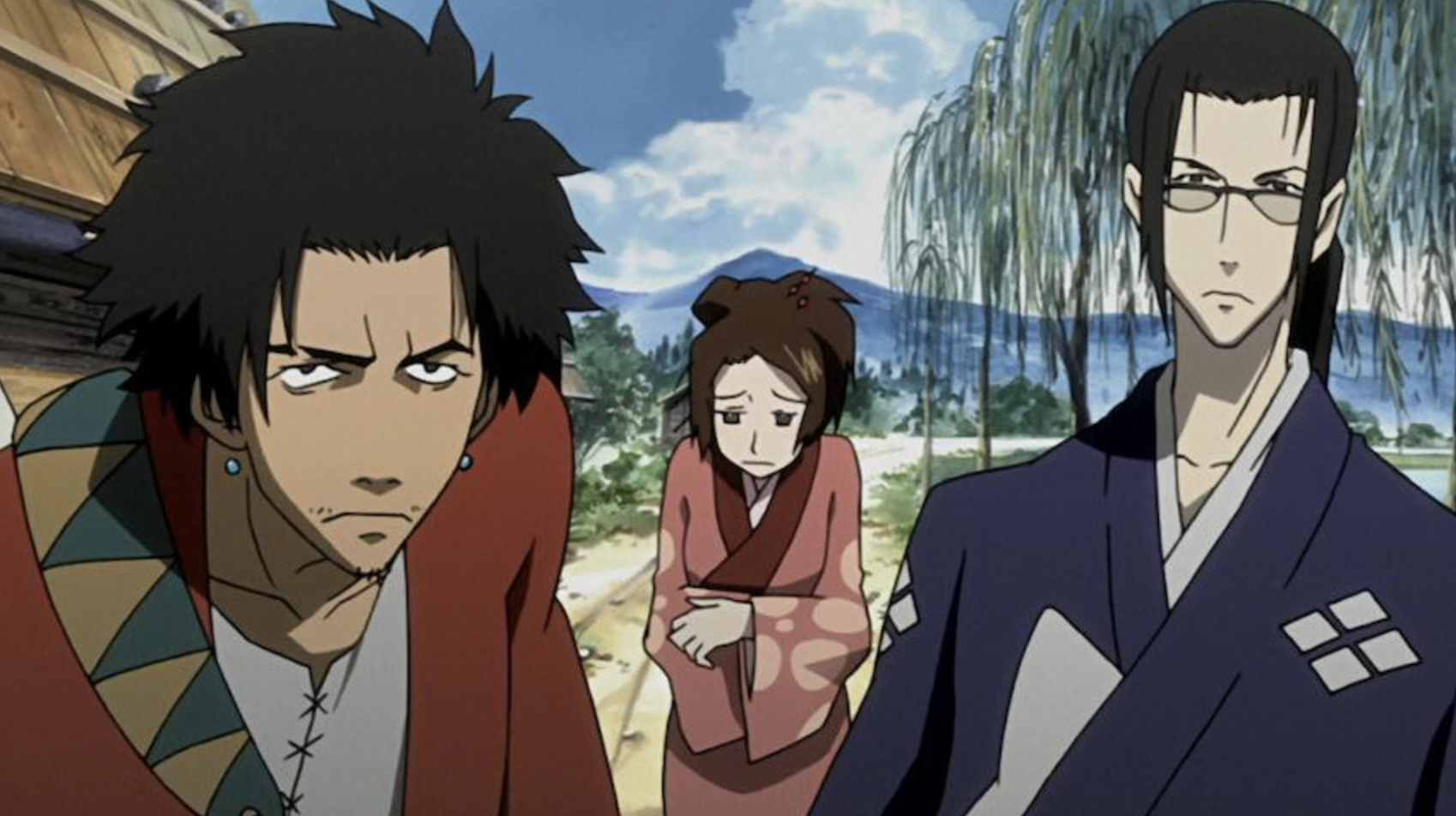
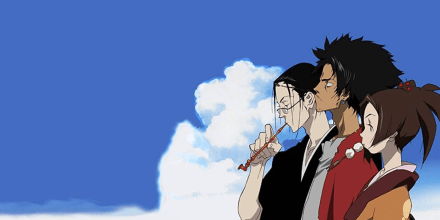
The unique vibe and clash of colorful personalities propelled me through my watch of Samurai Champloo. There’s a singular mission set upon vagabond scum Mugen, ronin Jin, and former-waitress Fuu: To find the samurai who smells of sunflowers. An elusive man from Fuu’s past, the cheery girl clings to the hope that the “sunflower samurai” will hold the answers to her family’s collapse. Unfortunately for the vagrant trio, tracing the scent of sunflowers means traversing the entire country to its opposite end. With no end of wandering warriors who wish to relive the free-for-all frenzy of the bygone Warring States Period, the 26-episode journey inevitably chronicles too many unpleasant incidences of starvation, kidnapping, and battling to the death. When lives aren’t on the line, the series enjoys rich, episodic character dramas between members of the trio and the countless others they pass who are similarly seeking safe passage and respite. (The Episode 11 story of Jin rescuing the woman sold into a brothel was just, ah *chef’s kiss.*)
Samurai Champloo serves up style with its one-of-a-kind blend of hip-hop and street-punk amidst the traditional Japan backdrop. In fact, I learned from a Reddit thread that “Champloo” comes from champurū, “a stir fry dish from Okinawa meaning mix of different things. It refers to Mugen’s Ryuukyuu origins and how the shows is about two samurais of completely different styles – hence a Samurai Champloo.” This duality is reflected in character designs, interactive dialogue (the English dub in particular ROCKS this), one-off episode subplots, and the original music score. (I immediately downloaded MINMI’s 2004 Imagine album for those vibey insert songs and ending tracks.) Tonally, it’s silly, serious, or this fascinating fix of both that builds to some amazing deadpan reactions.
Of course, I’m not the first remark these praises, but I was fascinated with how accessible the series ended up being. My preconception of this anime was that it was gate-kept by needing a knowledge of both historical Japan AND an appreciation for hip-hop and the communities that cultivated the genre. Sure, the 10 years since I’ve been familiar with the title Samurai Champloo have served me well on both of these fronts, but trust me when I say that this Watanabe title is just as “accessible” as Cowboy Bebop is. Well, for the most part.
Reviews of Samurai Champloo unavoidably draw their comparisons to Watanabe’s directorship and his Bebop, so let’s get that out of the way now. You’ll likely have better odds of recommending Bebop to someone than Champloo because the former’s galactic sci-fi voyage is more has become more universal as a setting compared to Champloo‘s niche dedication to stir-frying together Edo Japan and American hip-hop––and ALL of the gestural idiosyncrasies these vastly different genres communicate. Bebop also has Ed, and Fuu’s fun, but she’s no Ed.
That said, there’s an aimless quality that looms over both series, and of the different Watanbe works I have watched, it’s most notable with these two. Around the turn of the century, it became a sort of stylistic trend (perhaps inspired by pillars like Bebop and Champloo) to sort of just “follow” eccentric characters around. Unsuspecting encounters and fated duels alike can yield the kind of raw, punchy, and impactful blade combat that you really can’t find anymore these days. Likewise, episodes can start and end with as little as a character lying down on a straw mat. Various story vignettes may allude to other creative works or historical nods, but they may prove as inconsequential as a shoulder shrug. That’s why I mentioned style earlier. It’s so important that the series offers an unmatched aesthetic; otherwise, you’re just watching Mugen dine-n’-dash or Fuu get hopelessly gagged and tied up again, and again, and again.
That’s probably where I’d like to end this post: it’s startlingly easy to cozy up to Samurai Champloo‘s main trio. All of them start off as unapproachable, dangerous, or foolish. But by the end, I hesitated to play the final episode 26 because, just like Bebop, the trio is almost certainly buying time before the end, their end. That feeling of drifting through purgatory is dovetailed with the fates of men who eventually must pay up for past crimes, or to atone for begotten sins. Bebop does this masterfully with Spike Spiegal’s windy retreat from and destined showdown with Vicious, a name which carries with it the ruthless dread that awaits all those who turn from the syndicate. Fortunately for our friends in Champloo, fate smiles a bit more kindly to those who can repay bad karma with good and honest deeds. At the end, Mugen and Jin wonder what the point was behind guiding Fuu all the way to Nagasaki. As they escape with their lives and part ways in a field of green grass, the answer therein lies with the question. Perhaps it was because they dedicated themselves to protecting someone for once that kept them ever so slightly meandering on the path of good.
And that is good for both the characters and the viewer, because as much trouble as they invite for themselves, I would’ve been too sad to face the future where Mugen’s nonchalant negligence of basic human decency and Jin’s indomitable resistance to speak his mind wouldn’t get to cross once more with Fuu’s obnoxious, glowing optimism.
Afterword
This is the closest to a typical review that I’ve done on this blog in literal years. For the momentum to come from Samurai Champloo of all titles is attest to its enduring qualities. We’re lucky that the series is still largely in print, so I’ll be hunting down the Blu-ray to add to my collection. Until then, Samurai Champloo is “Caffé Mocha” certified, a rating that means absolutely nothing if you’re unfamiliar with how I used to do things here! Hah! The equivalent is 5 stars, a rating reserved for the best anime has to offer and those too mood-boosting to ignore. There’s a randomly placed baseball episode in the second half that breaks up the finale’s pacing, but that’s about my only complaint.
I realize I didn’t talk much about the acting nor language preference, but I did watch the series in English. I felt it a reasonable choice given all the stylistic and cultural blending, and I stand by this decision. The dub gave me another reason to pedestal Steve Blum for his snarky Mugen, and Kari Walgren delivers the ever-hopeful, head-empty Fuu with an adorable likeness. It’s as solid as Bang Zoom! English dub productions come.
If you remember Samurai Champloo, tell me: What was your experience like with the series? What aspects did you enjoy, and what kind of anime fan might you recommend it to? If you haven’t watched it yet, let this be your decennial reminder to check it out before it turns 25 in 2029! Thanks for reading!
– Takuto
 Takuto's Anime Cafe