Yūki Hayashi: Music to Motivate the Soul | OWLS “Melody”

Chances are that if you were linked here from another blogger pal, you might be new to this place. To those first-timers, “Hi, I’m Takuto, and welcome to my anime cafe!” As part of the OWLS blog tour’s fourth monthly topic for 2018, “Melody,” I wanted to showcase a single composer rather than a specific series or genre. He writes with the strength of a series’s characters in mind, empowering them to go beyond and rise to meet any occasion. His name is Yūki Hayashi, and he’s probably my favorite composer in the realm of modern anime.

Music is a form of healing and self-expression. For this month’s topic, we will be exploring some of our favorite musical pieces (anime/drama OSTs, movie soundtracks, music genres, etc.) and how that music has provided us enjoyment and, perhaps, how it has impacted our lives.

I love music! Even in these OWLS posts, I make it a must to at least cover any particular tracks of a given show that stood out to me most. As such, it is my greatest pleasure to finally dedicate an entire post to a man who has unknowingly helped transform my life into something I am proud of living. Thanks Lyn (and Shokamoka) for the very simple yet exciting prompt! In this post I’ll be covering the many soundtracks composed by Hayashi, but none of these highlights will contain spoilers, so enjoy! Click each song title to listen!

tsukishima.PNG


A Bit of Background

Perhaps [the series remains constantly engaging] because of musician Yūki Hayashi’s own experience as a rhythmic gymnast; the man already knows how to match tempo and tune with fancy footwork. Hayashi is a rising favorite of mine, as he knows how toImage result for yuki hayashi perfectly time moments that should be epic with music that is absolutely epic . . . There’s a raw love for classical strings, piano, and a bit of drums for movement in Hayashi’s internationally-infused music, and that’s why I’ll always look forward to his perfect, inspiring scores.

— Musings from my review of Welcome to the Ballroom

Inspiration to Lift Us Off Our Feet

Welcome to the Ballroom

We were all that awkward kid once, aimlessly going about our days with no aspirations or anything to make us stand out. Tatara Fujita was the same way, until the world of dance appeared right at his doorstep. Through dance, the young boy learned what it was like to stand up straight for the first time. Slowly, he accumulated a few rivals, but everyone knows a rival is just a competitor waiting to become a friend. With slicked back hair, perfect posture, and a beautiful partner at his side, Tatara earned confidence in himself by means of hard work, dedication, and the willingness to try something new. But dance would be nothing without song, which is what we’re talking about today.

Since I’ve already gone on length with my favorite tracks from this series in my review, I’ll just re-reminisce on a few of the bests. “Lesson Fuukei – Hajimete no Step 2” shows us how much sheer willpower it takes to start dancing. “Ballroom Shakou Dance” reflects on the progress made, and the long but exciting road ahead. “Ganbaritai Kimochi” lifts our spirits into the air screaming “YEAH, this is MY moment to shine!” As Tatara starts to see his own style of dance bloom, he’s gifted with the “Tatara Waltz,” a sweet melody just for him. Lastly, “Rise & Fall” reflects on inspiring triumph and crushing defeat, a fitting end to the series. These tracks carry so much heart—as does the rest of the OST—and I still listen to them now when I need a boost back into that positive mindset!

Motivation to Push Us Forward

DIVE!!, Haikyuu!!

Now that we’re standing tall, Hayashi’s ready to keep us going strong with these back-to-back sports!! series. One of DIVE!!‘s saving graces was its soundtrack, specifically this song which, in typical Hayashi fashion, takes a minute to get going, but soon can’t be contained because of its sheer motivational outburst! Music like this encourages Tomoki Sakai and fellow MDC divers to reach a place that only they can see.

And while at this view from the summit, Haikyuu!! bounces onto the scene full of youth and energy in tracks like “Chemical Change,” “Senior Proficiency,” and practically the rest of the OST. Taking a quieter but just as inspirational approach, “Goal” and “Evolution” appeal to emotions under the surface level. Then there’s “Powerhouse Schools,” “Kageyama vs Tsukishima,” “Into the Fray,” and “Let the Games Begin!!” to pump you up for the intimidating challenges that lie ahead. But we can’t forget that life has its setbacks, which is why “Frustration” resonates so well with me. While there is one more epic violin track I can’t find, the saddest yet most beautiful song, “Adults,” reminds me that kids (like myself) grow up fast, and that life is too short to not have fun or experience friendship. This track makes me want to cry because I can’t go back to simpler times, but it also makes me smile at how far I’ve come.

Heartache to Make Us Grow

Kiznaiver, Death Parade

Kiznaiver may be a show about understanding what friendship means, but along the way the characters sure do feel a great deal of pain. Loneliness and the difficulties of connecting with others plague its main cast (just as how they can affect us, too), and yet, there is beauty in sorrow. “Toumei Na Omoi,” my favorite track from the series begins with a cold harp soliloquy, but gradually opens up for a tender, heartwarming chorus.

This next heartbreaker needs no introduction. Death Parade welcomes the macabre by relishing in the woes of humanity. Visually, the Quindecim is quite appealing. But beyond the fancy visage lies a broken cast and a graveyard of puppets. Heralded as one of the “Most Emotional OSTs,” please feel free to lose yourself in the beautiful darkness of “Moonlit Night” and its breathtaking piano intro.

Strength to Go Beyond

My Hero Academia

Can I just place the entire soundtrack here? Honestly, every tune in this hit-shounen series is an absolute BOP. From the splendid, upbeat cheerfulness of “Symbol of Peace” and “I am here!!,” both All Might themes, to the workout motivation provided by “HERO A (Training to be the best!),” Izuku’s story never stops inspiring both the other characters and the us, the viewers! None of that playful rap or pep-band nonsense compares to “PLUS ULTRA,” however, as this single track contains enough power to move mountains—no wait, planets—the very heavens! All Might’s charisma ascends through this incredible music, much as how his strength is passed down to Izuku.

Did you think I’d forget “My Hero Academia” or the *in*famous “You Say Run“? HAH! Glory to all the UA heroes for pushing us to go beyond—and PLUUUS UUULTRA!!!

Ambition to Fulfill Our Dreams

Robotics;Notes

But none are more inspiring than that which I’ve saved for last. BEHOLD, the “Main Theme” of this most-underrated anime. The tale of a girl who musters the strength to turn a borrowed dream into her own reality, Akiho Sinomiya spends countless years chasing after her sister’s shadow. It’s a series about individuality and the passion to challenge impossible odds—even if friends, family, and society don’t agree with your ideals. Overflowing with ambition, motivation, bravery, and hope, Yūki Hayashi doesn’t dial back the heroism one bit. If anything, this is ingenuity in its rawest state. The roaring bass and cellos, the soaring violins, and the percussion section that just keeps giving—THIS is the spirit which motivates the soul!

Yūki Hayashi & The Resolve to Change

I love music. I listen to anime soundtracks often, and I pay attention to what exactly it is in the composition that moves me. As previously stated, Hayashi certainly has a way with notes. He weaves together strings, winds, brass, percussion, electric bass, and sometimes a dash of choir topped with remixing for truly epic scores. Even more interesting is that he’s almost always attached to works that feature characters struggling to grow—protagonists that grapple with finding their resolve to change themselves for the better. The road to such change is of course rife with hardship, competition, wins, losses, redemption, self-evaluation, and eventually a brief moment of pure intensity that shouts “LOOK AT ME!!!”

As people, we all desire attention, and to be our very best selves. Hayashi knows this path can also be messy, both physically and emotionally, and he clearly conveys these feelings through melodies and chords. He says, “This is what failure sounds like,” only to follow up with “And this song feels like victory, doesn’t it?”

Whether it’s a tall, tall wall looming in front of you,

the want yet inability to connect with others, 

the need to prove that your dreams are obtainable,

or perhaps the desire to change . . .

Know that the view from the summit is one that exists ONLY for you—so chase after it relentlessly. Try new things, make mistakes, meet new people, but never, never give up on your reasons for wanting to improve. Because maybe, in the process of overcoming your own impossible odds, you’ll inspire someone else to be a better human, much as how Yūki Hayashi inspired me through something as simple as a melody.

Image result for Anime


Do you have a favorite anime composer that just blows you away? What about specific fave OSTs that lift your spirits after a dull day? Do you listen to as many “motivational” YouTube playlists as I do? Haha, let me know about your music tastes or this post down in the comments! This concludes my April 14th entry in the OWLS “Melody” blog tour. Mel (Mel in Anime Land) went right before me and wrote about Shinhwa, one of her favorite K-pop groups, which you can read right here! Now, prepare for Marina (Anime B & B) with the music she enjoys listening to while writing this Monday, April 16th! Thanks for reading, and until next time, this has been

– Takuto, your host

Fate/Extra: Last Encore – A Horrifically Beautiful Nightmare | Review

A brief spoiler-free review of the 10-episode winter 2018 anime “Fate/Extra: Last Encore,” animated by Shaft, directed by Akiyuki Shinbou and Yukihiro Miyamoto, and based on Type-Moon game “Fate/Extra.”

Image result for fate extra last encore saber


The Dungeon Horror Genre Meets Fate

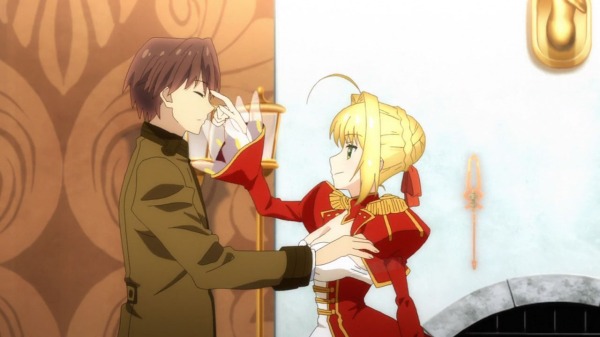
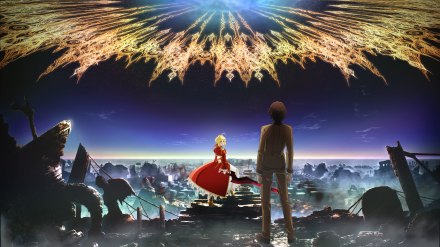
Hakuno Kishinami is a high school student—no, was a high school student? Doesn’t matter, because in a flash and flurry of visions pertaining to both the past and the future, Hakuno awakens in a strange virtual world styled much like a video game. He remembers neither his former life, nor how he got here, but before he even has time to comprehend his wacky situation, Hakuno is forced into a fight unlike one the world has ever seen: the Holy Grail War. Only this time around, supposedly over a hundred masters are competing for the coveted wish-granting chalice! Thankfully, a servant adorned in a maelstrom of crimson rose petals and shimmering gold manifests and comes to Hakuno’s aid. Her name is Saber, and together the two set out to conquer the seven enigmatic “floors” of this Grail War’s stage, as well as answer the burning question in Hakuno’s mind: “Who am I?”

hakuno and saber.jpg

I borrowed that last quote from the official synopsis because, within both the characters and the story itself, there’s a vague sense of emptiness surrounding the situation. As an alternate route for Fate/stay night set in an entirely different universe, countless questions about the world and its origins arise. Unfortunately, very few are answered, and as each episode progresses, it becomes harder and harder to care about Hakuno, the entities he encounters, or this chapter of Fate in general. This new Grail War also presents itself weakly, rarely calling back to the fact that Hakuno should be fighting other servants and masters along the way when, oddly enough, each floor seems abandoned, which brings me to my next point.

Image result for fate extra last encore rani

I like to call Last Encore a weird Dungeons & Dragons take on the Fate universe for its similar adventure style setup. On each floor that Hakuno, Saber, and eventually Rin climb to (or rather soar up to via magical elevator), the trio confronts 1) the floor’s master, 2) the floor master’s servant, and 3) a helpful ally (or tricky foe) who resides/is trapped on that floor. Each floor’s denizens offer a new lesson in character, survival, or how to live, and deciding who the party should ally themselves with or stay away from serves as decent entertainment.

Not-So-Familiar Faces

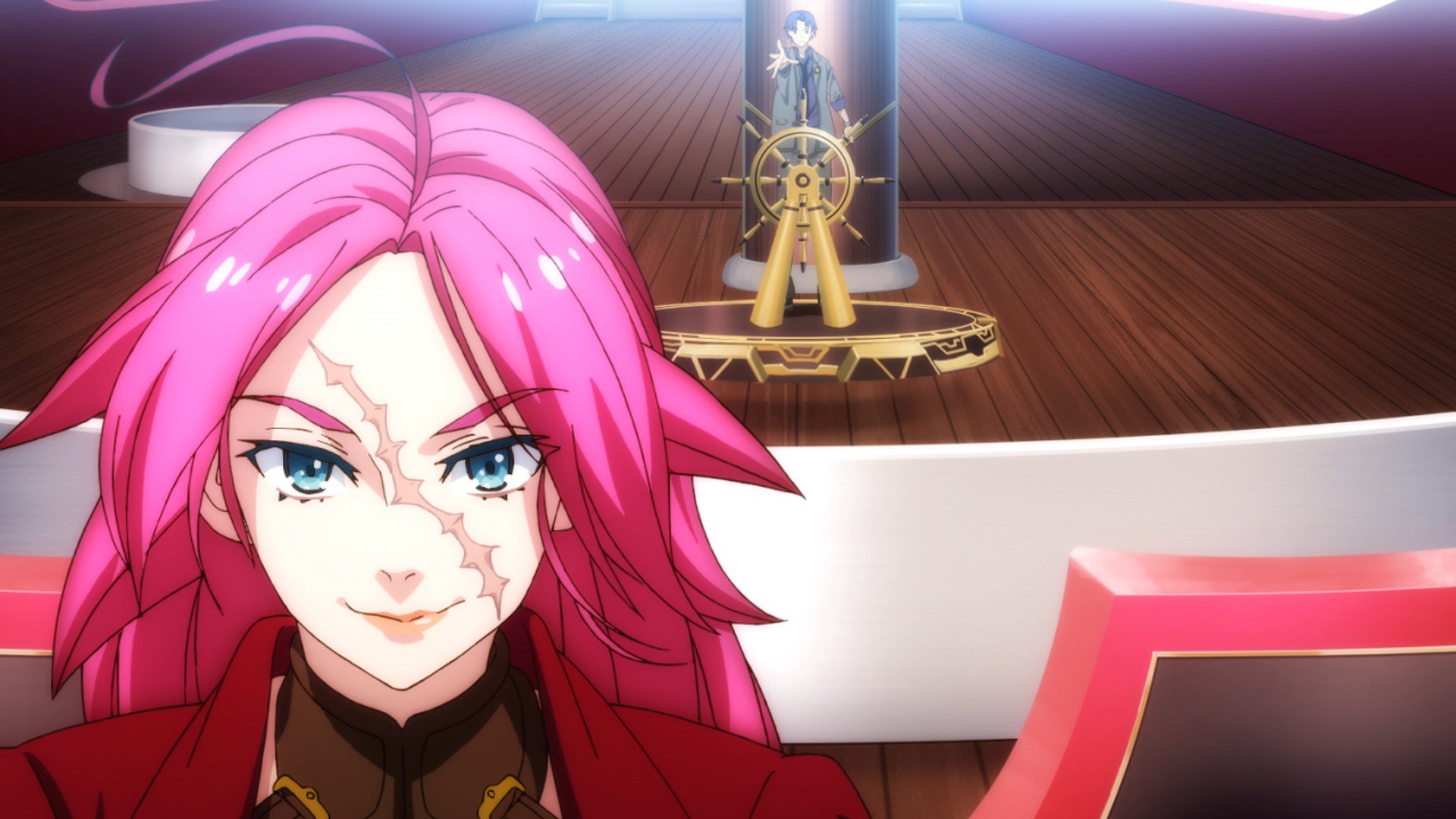
Last Encore‘s master and servant pairs reveal very little about themselves, which is a crying shame considering that you can typically count on Fate characters as ALWAYS being some of the most interesting crew you’ll ever run into. Heck, much of this historical fantasy cast—Robin Hood, Francis Drake, and a certain red Saber—receive better backstory and development in Fate/Grand Order, and that’s a FREAKIN’ MOBILE GAME.

Image result for fate extra last encore francis drake

With so many characters encountered in such a short 10-episode time, it can be hard to remember who is who and what they do when you know that at the end of the episode, Hakuno and Saber will prevail and ascend to the next floor. As such, the other masters and servants NEED to be interesting, and sadly, the opposite happens since there’s not enough time for me to invest care. Philosophical as they may be, the interactions between characters in Last Encore are hollow, save for maybe one charismatic lass . . .

No Guts, No Glory!

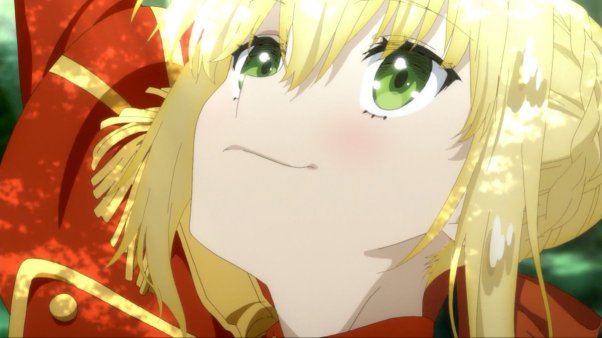
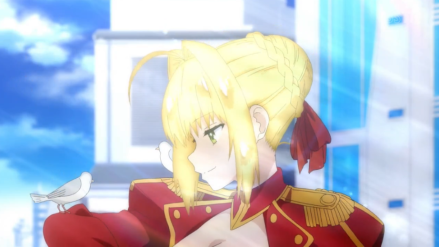
Never does our red-clad hero proclaim this famous idiom, but boy does it typify her personality. To keep this review spoiler-free, we’ll just ride by the servant moniker. That said, prepare the “Umu!” counter, cause here’s our Maestro’s beloved servant! Unlike the others in this series, Saber is characterized quite well. Even reoccurring favorites like Rin and the not-so-much-favorite Shinji fail to truly grasp the viewer’s attention like Saber does. Charming, wise, experienced, and loves to show off her vast wealth and skill accumulated from former days of glory, Saber practically steals the show any time she gets the chance. She’s unapologetically boastful and confident, and her ridiculous remarks make her fun to watch. Shaft may promote her allure through annoying underskirt shots (or straight-up nudity), but we know the real reason she captures our hearts is because of her valor and chivalry in battle, as well as her playful charisma on the side.

cheery saber.jpg

I will admit, Saber really doesn’t change much over the course of their journey, but that’s not why she’s there. She’s Hakuno’s guide, his partner, and through her ideological dialogue, she mentally keeps Hakuno thinking in the right mindset—and from succumbing to his darkest thoughts.

Fate in the Hands of Another Studio

Though the [very few and short] fight scenes look splendid, Shaft captures the individual essence of each floor’s quirks and qualities even better through unique landscapes, backgrounds, and art styles (including a floor designed to recreate Madoka Magica‘s eerie cuteness). Though the environment helps craft Extra‘s story, proving on multiple occasions to be more interesting than its characters, the alarming number of rough transitions between fantasy and reality, past and future causes immense confusion and boredom. The plot is already such a jumbled up mess, and to place Shaft at the head of this project is both genius and a horrifically beautiful nightmare. Arguably, with all the random floating objects and unnatural physics, it’s “too much Shaft” at times. At least that lighting is gorgeous.


This slideshow requires JavaScript.

SIDE NOTE: I appreciate the endeavor to animate more of this massive franchise, but between an OK Apocrypha and now an even worse Extra, I can’t help but think Fate should be left not only to quality animators like the masters over at Ufotable, but also to its core writers. Shinbou excels at bringing the strange to life, but this sci-fi/fantasy adventure RPG style isn’t his strongest suit. 

Lastly, Satoru Kosaki’s score left a brilliant ambiance where the dialogue often tangled itself up (probably helps that he’s no stranger to studio Shaft’s style, having done much of the Monogatari OST). Also, the OP “Bright Burning Shout” by Takanori Nishikawa has an uplifting shounen fight song vibe to it, while the ED “Tsuki to Hanataba” by Sayuri allowed the bittersweet moments in the series to shine.

For the Fans Who Wanted One Last Encore

Trailing the viewer along through the bizarre sounds like something Fate/Extra: Last Encore would be excellent at, but Hakuno’s narrative is simply boring. And while a degree of mystery helps keep the mind engaged and asking questions, come episode ten you’ll be disappointed by this series’s lack of a proper ending. As one would imagine, Hakuno and Saber eventually reach the top floor, but to what end? The story abruptly stops upon the elevator reaching floor seven, and though a 20-minute finale OVA awaits us this summer (oh my god), no one will care by then.

Ultimately, it’s all a real shame, as I was finally hoping to branch out of the same old Fate and see what all the hubbub of Extra was about without having to sit through the PSP game. Several elements like changing the character design, recruiting a different studio, and twisting the story to fit as an anime series, seemed right, but just fell apart by the end. Watch the beginning of this shoddy cyclical Fate adaptation and I’m afraid you’ve already seen the end. Perhaps this is my “roundabout” way of saying that you shouldn’t advertise yourself as the encore when those unfamiliar with the original haven’t even properly enjoyed the main show.

I should do what I am capable of. That is all anyone can do. — Saber

saber with birds


Afterword

It’s hard to write a review about a show that I really wanted to enjoy, especially something from Fate. Nevertheless, I must be honest with myself here. There were moments of true beauty, in which the shot composition, character animation, dialogue, music, and emotion all synced together spectacularly. But those moments only made up a small part of this already very short adventure. Such is why I award Fate/Extra: Last Encore the “Breads” rating, and recommendation to pass on it unless you have played the game and are wanting to enjoy a “similar” story in anime format—to which I say, enjoy, Praetor!

fate extra last encore.jpg

I’d love it if you could sway my mind on this title, so let me know what you thought about it or this review down in the comments! Thanks for reading, and until next time, this has been

– Takuto, your host

The Sweetest Kind of Rom-Com: “My Love Story!!” | Review

A brief spoiler-free review of the 24-episode spring 2015 anime “Ore Monogatari!!,” also known in English as “My Love Story!!,” animated by Madhouse, directed by Morio Asaka, and based on Kazune Kawahara’s manga of the same name. 

eating.PNG


A Bumbling, Tumbling, Pure-Hearted Gentleman

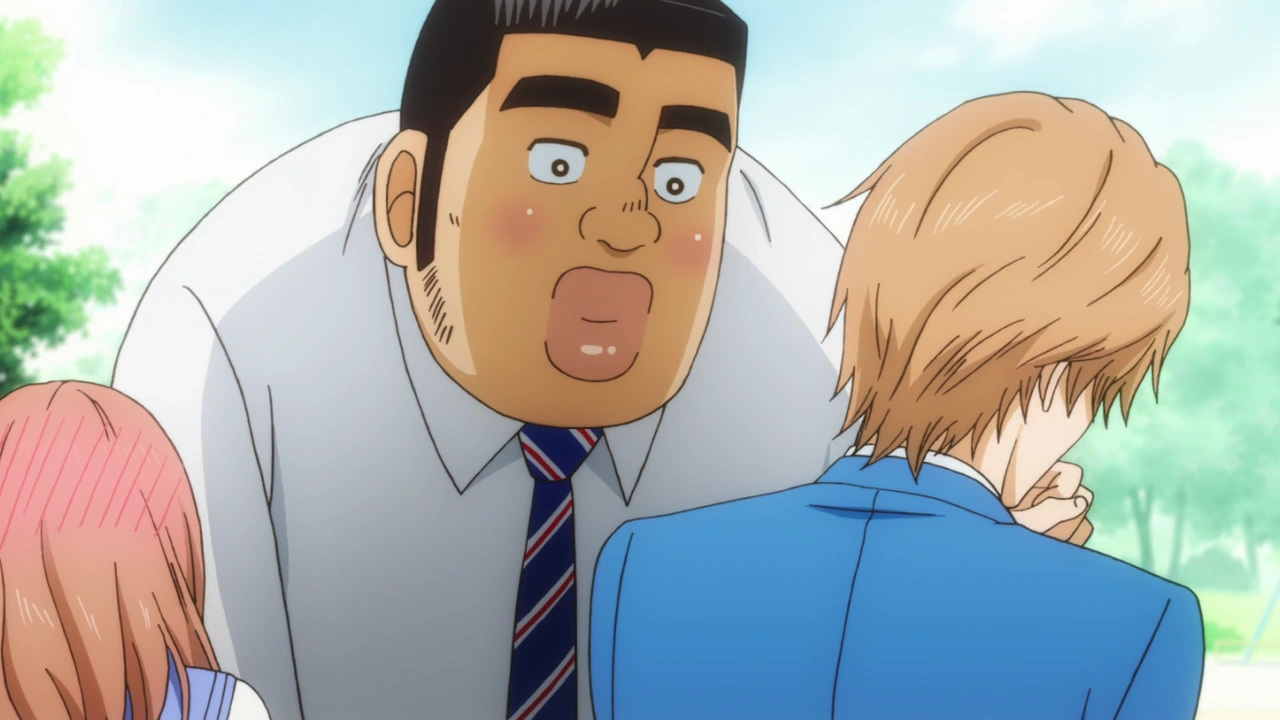
Takeo Gouda is a big guy. Though more akin to a bear (or perhaps a gorilla) than a human, I suppose simply calling him “big” wouldn’t do this mammoth of a man any justice. Takeo is an overwhelming, brutish force of masculinity, but underneath all that beefy muscle and thick skin lies a kind, respectful, and unwavering heart of gold. While he may unintentionally scare off all the girls he meets (often coming to their rescue only to go unaccredited for his good service, of course), he’s amassed quite the male following among his high school’s freshman class for his honorable sense of duty and righteousness. Did I mention Takeo was just a freshman? Oh, and did I mention that he is a pretty big guy?

Image result for my love story episode 1 takeo

Well, even if his nonexistent love life never takes off, at least Takeo’s got Sunakawa, his cool and handsome best friend. The two are as inseparable as brick and concrete (I’ll let you guess who is who), but maybe therein lies Takeo’s problem: Sunakawa’s irresistible yet subtle charm and dashing looks has unintentionally captured the heart of every young girl Takeo has ever loved! Suna politely turns them all down, however, and as much as that would aggravate any other guy’s best friend, things somehow always work out for the two.

One day, Takeo nobly saves one Miss Rinko Yamato from a groper on a train, ultimately throwing him head-over-heels for this sweet, kind-hearted baker! Though the two awkwardly meet several times afterwards, Takeo holds himself back, suspecting that “Miss Yamato” only has eyes for Suna. In a surprising turn of events, Rinko admits she feels love, but it’s not for Takeo’s best friend—as his good karma would have it, Rinko loves Takeo, and here begins their love story!!

Related image

Love Comes in All Shapes and Sizes

By episode three, I honestly thought the show could’ve ended. SPOILERS but not really, the two fall in love very quickly, and Takeo’s fear of never hooking up with a cute girl disappears come this early confession. Why is it called My Love Story!! then if we already know how the story goes? WELL, unlike most shoujo series out there that tantalize viewers with a painfully slow romance that ends with the main couple holding hands (if you’re even that lucky), My Love Story!! follows Takeo and Rinko throughout their relationship: celebrating holidays together, meeting the others’ family (Takeo’s parents, oh my god, when you see them it all makes sense), and most importantly, hooking up their fellow dudes and gal pals that are looking for a high school sweetheart. It’s not a test to see how long they stay together. Rather, it’s about how they can unite the hearts of others through their love.

Because Rinko isn’t the kind of girl to wait on her man, the story moves at a pleasant pace—don’t get me wrong, it’s still very, very slow compared to most couples out there, but it’s a slow-burning tenderness that feels so honest and true. The series is, for the most part, quite episodic, as new characters are brought on the screen only to be swiftly swept off their feet by these two match-makers and eventually (and gently) “tossed aside.” Any relationships that do return to the screen build nicely over the course of the series. Takeo and Rinko are #couplegoals, and there are probably very few shows out there that are sweeter than this rom-com.

Related image

Also, can we appreciate the unusual MC’s character design here and Rinko’s unwavering love for him? There is no joke—she legit values his looks. Bless these two.

“MISS YAMATOOOO!!!”

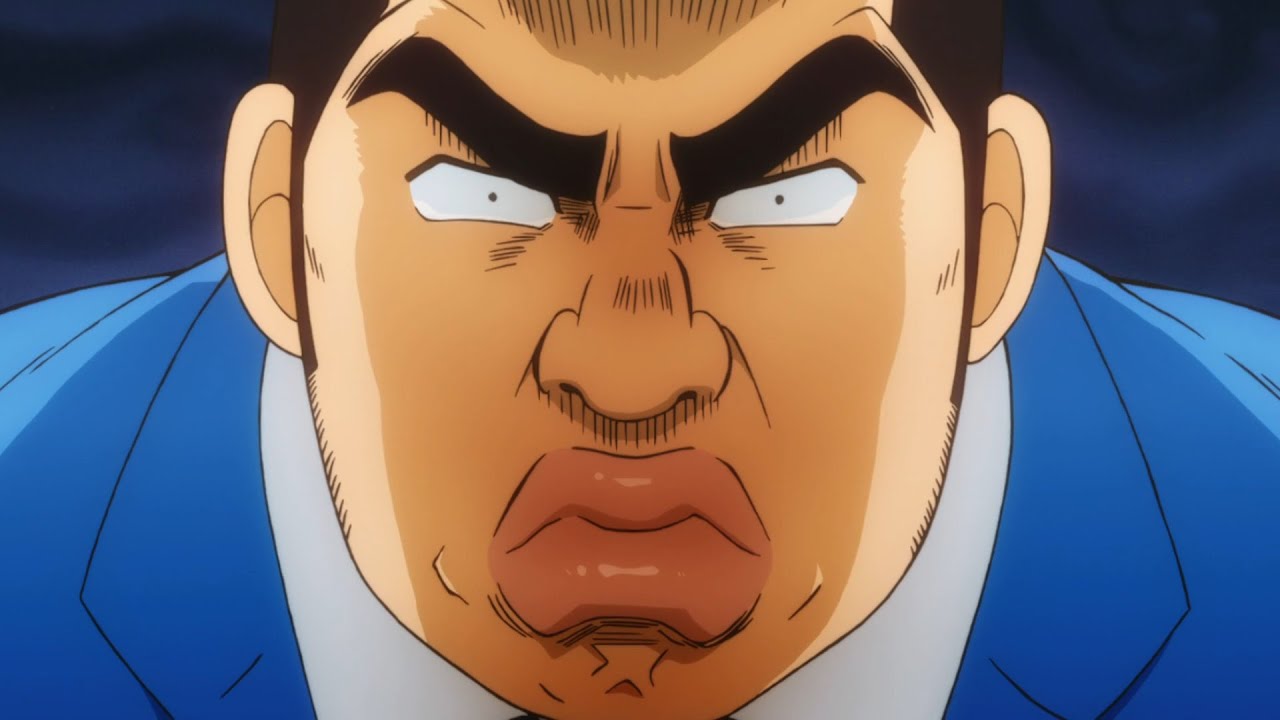
Takeo Gouda is truly A GOD AMONGST MEN. (This man’s lips, just wow.) He’s a big ol’ softie despite his ridiculously boarish stature, and he’s got the restraint of a freakin’ nun, no joke. Sometimes Often times that over-politeness causes Takeo to seem like an awkward lug, but it’s honestly so lovable and refreshing that I just can’t. In fact, the whole show feels like a huge refreshment from the annoying tropes of the shoujo genre, granted that I haven’t seen nearly enough to consider myself knowledgeable on the subject. Though Takeo’s personality is goofy, dutiful, and well mannered, the guy would be nothing without a voice. I DID watch My Love Story!! with Sentai’s English dub, and while they normally aren’t at the same quality as Funimation or Aniplex’s, this dub ROCKS. So much character in every comedic line, so much heart when things need to be cute, Andrew Love FINALLY plays a teenager where his macho voice is appropriate—you could say that I “Love” his burly performance!

Image result for my love story episode takeo and rinko

The very same goes to Miss Yamato, voiced by the ever-lovely Tia Ballard (I just can’t get enough of her voice)!! If Takeo is sweet, Rinko is even sweeter—and no, I’m not just talking about her mouth-watering dessert creations. She’s the rich chocolate chips to Takeo’s squishy dough, the perfectly layered icing on an impressively sized cake. This woman has no flaws, I tell ya! Just kidding: she has a less-than-delicate side that really wants to get together with her boyfriend (who’s totally not prepared) on a more intimate level. But honestly, isn’t that everyone? Friendship, the desire to connect with another, and letting go of repressed feelings are all major themes in this series, and where lovemaking is concerned, My Love Story!! is still one of the purest examples out there!

Image result for my love story anime

And I couldn’t forget about our normally-the-lead-but-now-just-a-bishie Sunakawa AKA Austin Tindle. How Sentai got a magnificent beast like Tindle, the world may never know, but all that matters is he’s here, and that he plays the unamused hot guy. If it weren’t for Takeo’s overwhelming presence, Suna would absolutely take the spot as best boy. He may look like he’s bored out of his mind and dosing off half the time, but Suna is kind, attentive, and always watching out for Takeo’s large sweaty back. Every single Suna moment left me like, “Bro . . .”, as he’s a really upstanding and intelligent guy despite characters like his  typically being cast as the “high-and-mighty jealous types” in this situation. Like the rest of this all-star cast, Suna is thankfully so much more than a stereotype, and I valued his brotherhood and cool-headedness. He’s easy to miss at times, but he’s always there for his friends.

It’s. So. Funny. 

LITERALLY ME in every episode. Madhouse brought to life one of the most adorable romance titles out there, yet there’s an added level of humor to Takeo’s build and [hilariously grotesque] facial expressions that made me bust a gut at least ten times per episode. Surprisingly, the slapstick comedy here won me over as one of the biggest reasons why everyone should watch this show. Between the bestial way in which Takeo reacts to everything and his demonstrations of, umm, affection to Suna, I was left with tears in my eyes it was all so funny. Again, this is where the English dub really shines!

Related image

A “Cake” Title in its Purest Form

My Love Story!! stole the simulcast spotlight back when it aired in 2015. Although its popularity has died down significantly (the manga picking up the anime’s slack, as it offers a continuation to what is ultimately but an adaptation), it’s still a pleasantly refreshing rom-com that cuts out all the shoujo drama BS. It’s light-hearted, cleansing, and even touching when it wants to be. Plus it’s really funny! I’ll admit that romance anime aren’t really my thing, so this series was PERFECT for a viewer who tries to avoid the unnecessarily serious stuff.

All this and more is why I recommend My Love Story!! to ALL anime fans. Should you enjoy watching it, you’ll come away feeling happy and bubbly inside, and perhaps even recall your first innocent love (or wistful bromance). We all have stories to share, and Takeo Gouda’s is one that’ll leave you laughing out loud one moment and clutching your warmed heart the next.

I helped a girl who turned out to be a nice girl. That gives me the strength to go on. — Takeo Gouda

Related image


Afterword

Kind of short review, as the show really is sweet and simple. If you watched My Love Story!! and enjoyed it, what part in particular made you like it? Was it the atypical character setup, the laughs, Rinko’s treats, Takeo’s boundless excitement, or just Suna being Suna? You ought to let me know! I WILL try to respond to your comments quicker, haha!

Image result for ore monogatari

If you couldn’t already tell, this series currently sits lovingly on my shelf as the ideal “Cake” title here at the cafe, and I do hope you give it a shot if you haven’t yet. Thank you so much for reading, and until next time, this has been

– Takuto, your host