Tales of Symphonia Orchestrates Racial Harmony By Overcoming Great Tragedy| OWLS “Colors”

Chances are that if you were linked here from another blogger pal, then you might be new. To those first-timers, “Hi, I’m Takuto, welcome to my anime cafe!” As part of the OWLS blog tour’s  fourth monthly topic, “Colors,” I decided hit up a show that originates from a GameCube JRPG—the one and only Tales of Symphonia which was, fun fact, the SECOND anime I had ever watched!! You know what that means—aww yeah, old-school Takuto wrote a dope review about it (here) years ago that is littered with grammatical errors but full of heart. It currently has zero comments and likes, so go mess that up for me, will ya? Be gentle 🙂

We are all part of one race, the human race. “Colors” refers to people of color in anime. For this month’s topic, we will be discussing how people of color or
characters of different “races” (could be a literal alien race) are represented in anime. Some topics we are considering is the dangers of stereotyping, bi-racial
characters, and the importance of racial inclusion.

I had the recent pleasure of finally finishing the Tales of Symphonia PS3 game recently, so I’m excited let the experience come full circle by revisiting one of the titles that got me into anime. Thanks Lyn for the prompt!

Image result


A brief discussion on the various races and factions that appear in the 2007-2012 11-episode OVA series “Tales of Symphonia: The Animation,” based off the GameCube game by the same name, created by Bandai-Namco, produced by Ufotable, directed by Haruo Sotozaki (“Tales of Zestiria”). SPOILER WARNING

When One World Flourishes, the Other Withers

Enter Sylvarant, a fantasy world of monsters yet very little magic. Why? The mana that flows through the realm has been draining out for a long time now, and it seems that the land will only grow drier (literally) with each passing day. Little to the peoples’ knowledge, a second world exists out there, one that mirrors their own home, and the reason it prospers and thrives is because the mana flow resembles that of an hourglass, Tethe’alla, this second world, residing on the bottom.

This is where the Chosen one comes to save the day! “Chosen” by the heavens, Colette Brunel of Sylvarant sets out on her quest of World Regeneration to flip the hourglass back in their favor. But her clumsiness and well-being worry her friends Lloyd Irving and Genis Sage. So the two, along with Genis’s older sister Raine (who happens to be their village’s teacher) and a mysterious mercenary named Kratos, embark on a journey, encountering new friends and more foes with their own philosophies that will forever shake the foundations of their precious world that they’ve studied for so long.
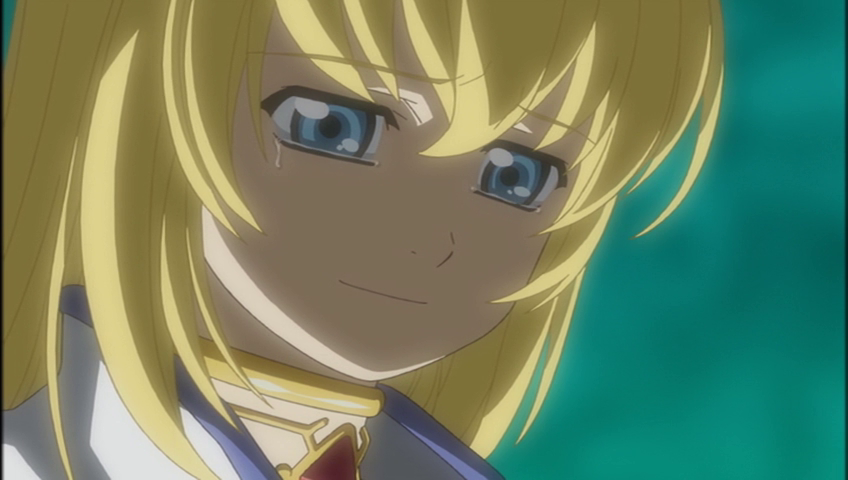
Image result for tales of symphonia anime screencaps

Just when our gang finally learns to love the world for what it is, things take one tragic turn after another, forcing our heroes to question the reason they fight, and whether their quest is one of nobility or selfishness. Remember, when one world flourishes, the other withers—people are bound to make great sacrifices.

Symphonia remains one of the top, if not THE #1 game in the incredible Tales franchise. Rife with gorgeous visuals, dramatic Celtic-inspired music, and heartbreaking characters, the animation holds on its own by establishing a fantasy adventure world (or two) where there’s always something to be lost for one of its characters. As the series progresses, we viewers, too, begin to question if a happy ending even exists for this broken cast of many ages and races. Symphonia tackles the harsh realities of acceptance and racism through its memorable characters.

Related image

Oppressed, Punished, and Exiled

In this vast fantasy world, several races and factions exist, most of which frequently bump heads with one another. Aside from the dwarves, who lead quieter pastimes as master craftsman, there exist elves. They live reclusive lives hidden in villages among the trees, like Heimdall, and choose to isolate themselves from society because half-elf breeding (the result of human x elf mating) is frowned upon. Largely stemming from human jealousy—for elves have much longer lifespans and can use magic, but humans possess neither—and disgust for one’s blood to be tainted by the others’ race, both humans and elves decided to hate the “perfect” half-elves all around, which leads us to Symphonia‘s most tragic bunch.

Related image

Half-elves cower at the tip of every whip cracked and at the shackles of every chain latched. Disdain from both humans and elves has caused these poor people to be punished for their mixed blood, and, if they are lucky, exiled from the land. Some literally fled to a floating isle called Exire to avoid their tragic fate. Those who could not escape detainment were hunted down, beaten, and even tortured. The main reason for their abuse, aside from their physical make-up, derives from the legend of the the great Kharlan War. In it, humans and elves fought over the two countries, Sylvarant and Tethe’alla, which left half-elves, near-omnipotent magic users with longevity in beautiful human bodies, to be caught in the crossfire.

If We Could Just Include Instead of Exclude . . . 

Lloyd Irving, the main character, was raised by a dwarven father, meaning that he has seen the abuse from a more objective standpoint than that of a human, elf, or half-elf. Out of rage for their treatment, the Desians, a treacherous organization of half-elves, had swept through Sylvarant, enslaving humans and sacrificing them to create enhancing magic crystals called Exspheres. What they are doing is wrong, and Lloyd knows it, clutching his own mother’s Exsphere from when she was still among the living.

Image result

With a burning desire to end all enslavement and restore the two worlds to one so that all can live in harmony together, Lloyd uses his own experience with the people he holds dear to guide his quest. When it is revealed early on that his best friend Genis and sister Raine are, in fact, half-elves, Lloyd doesn’t grief or retaliate harshly. There’s even a scene where Genis mourns because he knows that when Lloyd and all of his friends eventually pass away, he will be left behind alive but lonely. Instead, Lloyd sympathizes, and smiles because he is still able to enjoy their company in the present, looking beyond racial treatment and into the value of their personality.

Genis himself undergoes his own journey when he meets the great Mithos, suppposed Hero of the Kharlan War. In actuality, he manifests as a young half-elf boy just like Genis who only wished for a world where he and his sister Martel could live in peace. Viewing Mithos as a painful mirror of his very being, Genis seeks solace in this poor boy. Unlike Lloyd’s determination to seek symphonic harmony with all races, however, Mithos sought to convert everyone into one homogeneous kind, believing that if race didn’t exist, then neither would racism. The boy is right and his ideals are true, but the execution of his plans via brutal nature was naive and cruel. The heart was in the right place, but the mind wasn’t, and that’s why Mithos continues to suffer until his own sister rejects him.
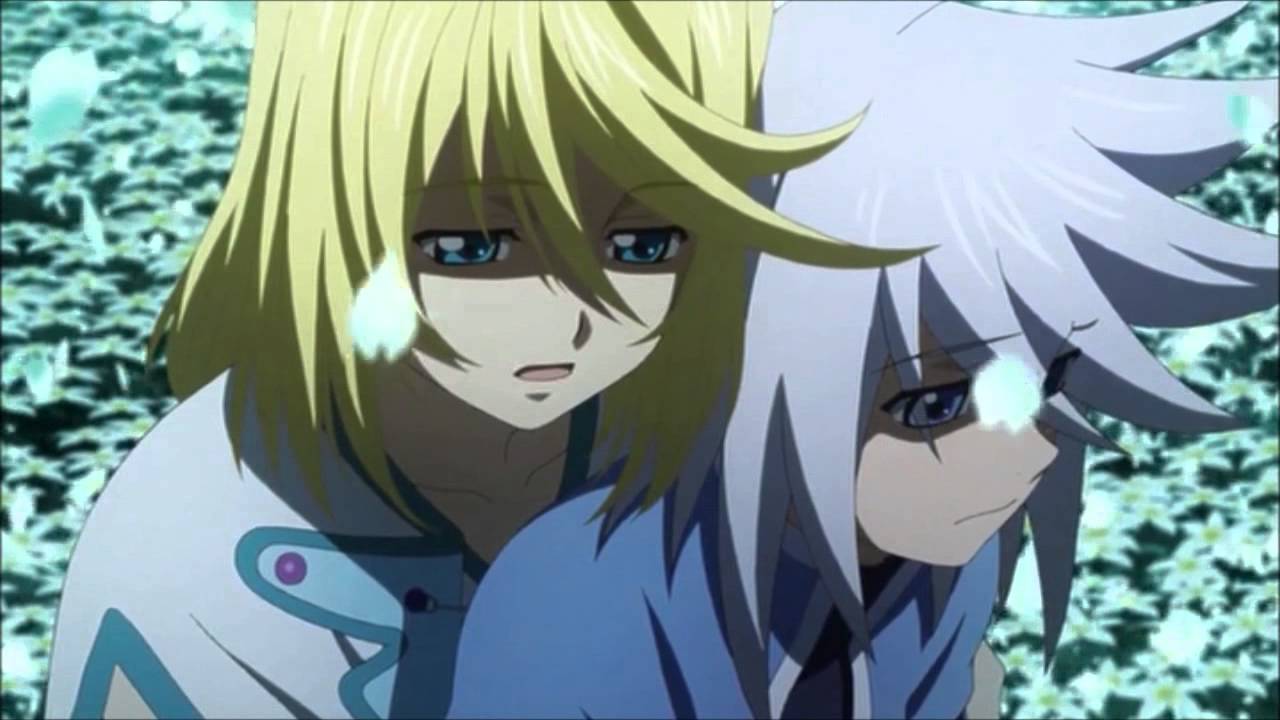
Image result for tales of symphonia anime mithos

We need more people like Lloyd and Genis—people who have had experiences with trauma on both sides, yet still manage to see the good in others regardless of their race or status. But there’s only one way to handle this matter carefully. Rather than force people to accept the beautiful array of colored people on this planet, shoving our own ideals down their ignorant throats, we need to integrate warm, positive spirits into communities that suffer from racial exclusion.  We must value the characters, not appearances, of all different peoples in order to end this childish thinking.

Dividing the world into two so that people could exist on separate planes was not the answer. Same goes for establishing one master race. The weight of Lloyd’s unwavering acceptance and determination to create a world for everyone is the greatest joy that can come from the series. It’s the hope that someday we can all overcome our own tragedies to play in one harmonic symphony together that makes “Tales of Symphonia” ring true to so many hearts. Life in this kind of new world begins not by looking at what which makes us different, but celebrating what we share in common, and that is beautiful. 

Image result for tales of symphonia anime lloyd and genis

“Dwarven Vow #1: Let’s all work together for the sake of a peaceful world.” – Lloyd Irving


Tales of Symphonia is a really neat show full of heartwarming themes and deep characters, so do check it out if this kind of fantasy is your thing! For those who have seen it, what do you think of the game or its anime adaptation? What about how it’s emotional bits are portrayed? I preferred the anime’s flow in this department, but hey, let me know your thoughts!

This concludes my April 22nd entry in the OWLS “Colors” blog tour. Please check out Stephanie Clarke’s (Anime Girls NYC) post over the darker colored villains from the currently popular Twin Star Exorcists! And now the magic will trickle down to Eren (sakuradaisuki) as she walks us through “Colors” in the dear-to-heart Sailor Moon on Monday, April 24th! Thank you so much for reading, and until next time, this has been

– Takuto, your host

Image result

United We Stand in Ghost S.A.C. 2nd GIG| Review

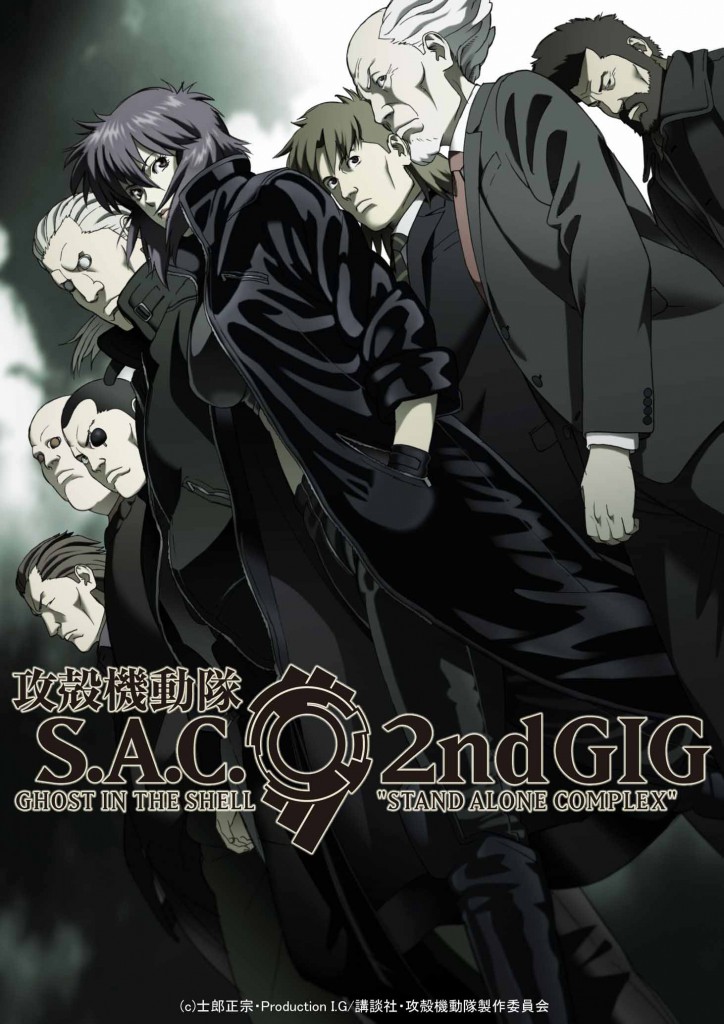
A brief spoiler-free review of the 26-episode winter 2004 anime “Ghost in the Shell: Stand Alone Complex 2nd GIG” and its recap 2006 film “Individual Eleven,” produced by Production I.G, directed by Kenji Kamiyama, based on the original manga by Masamune Shirow.

Cafe note: I reviewed the first season right here, so check that out prior to reading this. Many thanks, happy reading~!


Back to the Cybernetic City

With the Laughing Man’s agenda terminated by Motoko Kusanagi and the gang, Section 9 is no longer forced to operate in the shadows. Taking an interest in the way the brutal hunting force operates, Japan’s newly elected Prime Minister Kayabuki re-establishes Section 9 as her final attempt to fend off the latest rounds of cyber-terrorism, and find a party whom she could trust her life with. This new deadly collective, “The Individual Eleven,” has led a string of seemingly unrelated terrorist plots and assassinations across the nation.

Just as the Major and Chief Aramaki begin investigating into these gruesome cases, however, the Japanese government faces a forced confrontation by the alarming build-up of foreign refugees who were ousted from their homes during the Third World War, and are now seeking asylum in Japan. Section 9 attempts to juggle both crises, but their constant bumping heads with Kazundo Gouda of Cabinet Intelligence Service leads the Major to suspect he may be even more tangled up in the mess than the “enemy” is, and that perhaps both The Individual Eleven and the refugee crisis are just two parts of one titanic movement.

Image result

The Stand Alone Complex branch of the hit Ghost in the Shell franchise returns to the scene to reaffirm that everything, be it physically or digitally, is interconnected by the pushes and pulls of a techno-dystopian society.

Picking Up Where We Left Off

S.A.C. 2nd GIG wastes no time in welcoming us back to its inner universe. Unlike its predecessor, 2nd GIG features a clearer, more concisely written story. It achieves this by appropriately placing its “stand-alone” episodes within the timeline in less-congested areas of heavy plot action. Sticking to a story written in sequential order, 2nd GIG feels a lot easier to grasp, even if the characters themselves are more “complex” this second time around. I can see why fans acknowledge this series as the superior one not simply because the visuals are upgraded, but the linear way in which the story is told—even if the concept may not rival that of a wizard-class super hacker—seems more straightforward. Either that, or it just took me 26 episodes prior to get used to Kamiyama’s directing.

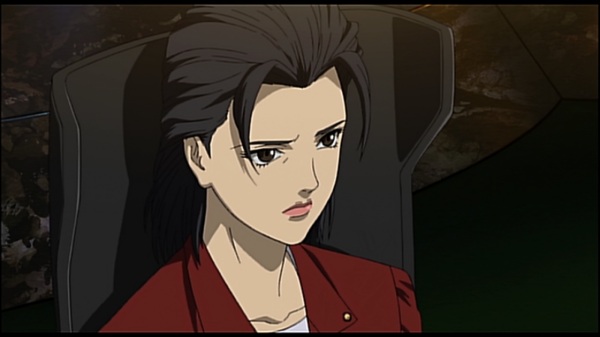
Image result for prime minister kayabuki

Critical characters to not only the series but the franchise as a whole are introduced quickly and efficiently, these namely being Kayabuki, Gouda, and Kuze, the eventual leader of the refugee camp and a mastermind in guerrilla warfare, both on the battlefield and in the net. Watching Kayabuki crumble before but endure the weight of those dirty politicians and back-alley deals emphasizes one trait that defined the Major as such a relatable character for so many: the strength of women, and the power, beauty, and grace that comes with enduring unfavorable outcomes and situations. Ghost in the Shell, like much of entertainment, explores the notion that life is one big power struggle; it’s as unavoidable as the rising moon or the flowing tides.

New, Twisted Faces

Speaking of power, Gouda is clearly not meant to be a likable dude. His *literally* twisted face should be an indicator of his reliability. He’s a competent and sophisticated man, using people and manipulating scenarios like he does with data. Though he’s got several tricks up his sleeves to be used against all of the pawns in the game, including the Major, his sheer level of skill and sneering wit make me MELT with a swelling love for his character. And John Snyder, his English VA absolutely knocked the role outta the park! We honestly need more intelligent rivals like him in anime; he’s a dick, but that’s what makes him so fascinating. Gouda is always one step ahead of the game, and stacking the deck is the only way to secure a trump card in this dirty world.

Image result

The Major’s foil finally manifests in the form of Hideo Kuze, an calm yet equally interesting antihero who holds a similar background. While I cannot mention too much without spoiling, I will say that he’s just as calculating as Motoko and Gouda, and perhaps more skillful and inspirational than both of them on a personal level. He’s quite interesting, so let his words sink in . . . everything he does is for the people . . .

Image result

Aside from the Major’s few moments, those members of Section 9 that did not previously have an episode for their own backstory (Pazu, Saito) receive one now EXCEPT for poor, poor Borma, the fat guy. While the Tachikoma’s return with more amusing exclamations and ideas, Togusa takes takes the back seat for this ride. One of these days we’ll get the backstory details and spotlight that they ALL deserve, but that time is sadly not now.

Improved Presentation Transcend S.A.C.

The two-ish year gap between each series really does reiterate the fact that Production I.G is the king of science fiction anime. Most of the characters receive new outfits and gear, all of which show off their differing personalities. The Major’s transformation from light gray and white to a dark gray and black skintight suit add contrast to the series’ new tone, a perfect match for some of the unsettling truths regarding the Major’s past. Her leather trench coat and obsidian visors complete the look. Besides the returning overly impressive architecture, it’s all the tiny details in character design that make 2nd GIG a fashion show for our models, both the sleek and the grungy alike.

Kanno returns to add that techno-blues/cop show soundtrack from the first season. Many of the tracks were even reused, so it’s not an entirely “new” OST. The epic action music in particular was done better this time. Where she doesn’t stand out in background music Kanno definitely makes up for with the new opening “Rise,” once again sung by the lovely Origa. “Rise” is the epitome of cyber punk trance dubstep, a song that hypes itself up with its intense beat, ascending chord progressions, and deep lyrics. Exhilarating stuff!

Since the characters remain largely underdeveloped in terms of background info, many just watch the show for its intriguing story, to which I point you toward the 3-hour (eek) recap film titled Individual Eleven that hones its focus solely on the core case from beginning to end. It is a recap, however, so all of your favorite one-off episodes are not present, and a lot of cool detours were cut, such as a fatal mission flaw by the Major that made my heart skip a beat. I give the same caution that I dished out last time, though—Individual Eleven features an entirely different English voice cast. While the wonderful Mary Elizabeth McGlynn, Crispin Freeman, and now John Snyder should never have been replaced as Motoko, Togusa, and Gouda, respectively, the new cast largely remains serviceable.

United We Stand – The Individual VS Society

Ghost in the Shell S.A.C. 2nd GIG continues as a more light-hearted cop-chase approach to the original 1995 film, and by this I mean that it is less about self-reflection and more geared towards the interactions people share with others. It’s also no laughing matter, either, presenting the sadness of war, and that in the near future warfare is still terrifying and tragic. 2nd GIG resumes its heavy, confusing political drama, but its new emphasis on securing a cyber body through the black market is neatly explored with greater depth, ironically “fleshing” out the world.

Image result

The sequel to the beloved Stand Alone Complex is a successful piece of science fiction and sociological analysis. It’s a series rooted in the effects of technology on people, be it the goods, bads, or really bads. Sharpening its linear storytelling and enhancing its setting and character designs, one really shouldn’t stop at the first season—continue to uncover the fate of Section 9 as the original story intended!

“The refugees have given me countless names. I joined forces with them with the intent to save them. But maybe the real reason I united with them was to keep the loneliness at bay.” – Kuze

Final Assessment:

+ Story told sequentially with with focused, linear direction

+ New character designs are more appealing; Major’s new look

+ Production I.G upped their game again!

+ Both Gouda and Kuze are excellent characters

+ Explores the pillars of social order through a cool story; the war on terror continues

– Section 9 members STILL don’t get the backstory treatment they deserve

– Recap film English dub remains pestering

Image result


GitS S.A.C. 2nd GIG also deserves its “Cake” title (4/5), a must-watch if you’ve already started the first! It does require a great amount of focus and minor understanding of corporate politics, though. Thankfully the action weighs well against the political banter. What did you think of the Individual Eleven story, and did the recap film aid in your understanding as it did mine? Let me know, and until next time, this has been

– Takuto, your host
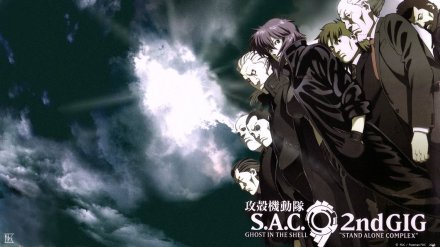
Image result

Still lookin’ fresh, Batou and Major